The Mini Electric Golf Cart Landscape in 2026
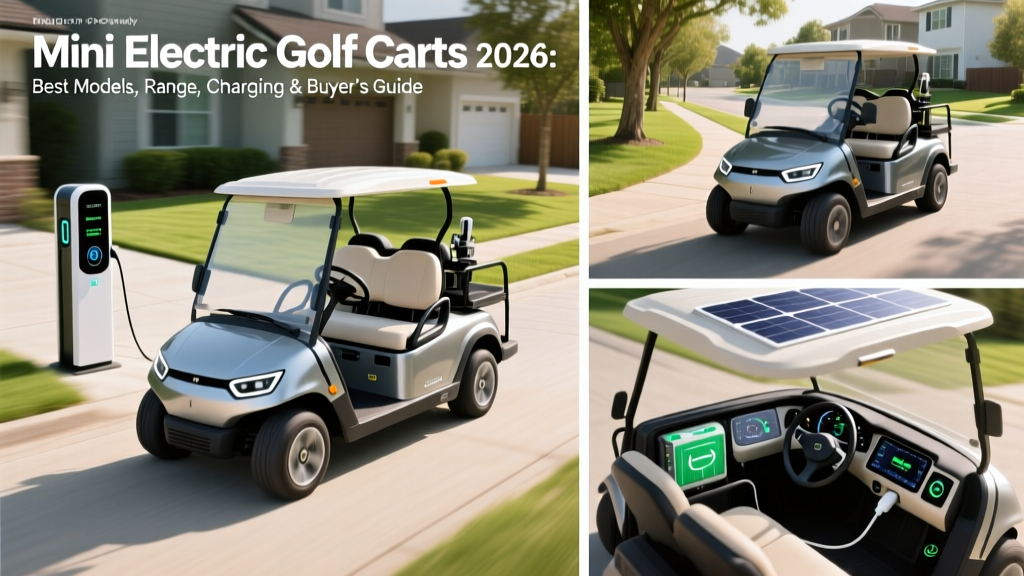
Mini electric golf carts have evolved far beyond the traditional club-course cruiser. Today's street-legal low-speed vehicles (LSVs) and personal transportation vehicles (PTVs) pack lithium battery packs, regenerative braking, and enough range to handle neighborhood commutes, resort campuses, and large properties. Whether you're eyeing a compact two-seater for gated-community errands or a lifted four-passenger model for rural acreage, the 2026 market offers more choice — and more confusion — than ever.
This guide profiles the top mini electric golf carts available now, with hard numbers on range, battery chemistry, charging speed, and pricing. We'll also address the question every buyer eventually asks: do any of these qualify for the federal EV tax credit?
Spec Comparison: Top Mini Electric Golf Carts
| Model | Battery (kWh) | Chemistry | EPA/Equiv. Range | Top Speed | Charge Time (0–100%) | Base MSRP |
|---|---|---|---|---|---|---|
| Club Car Onward 4 (Li-Ion) | 12.8 kWh | NMC Lithium | ~50 mi (est.) | 19 mph (LSV: 25 mph) | ~6–8 hrs (Level 1) | $14,900 |
| E-Z-GO Liberty (2026) | 14.4 kWh | NMC Lithium | ~55 mi (est.) | 19 mph (LSV: 25 mph) | ~5–7 hrs (Level 1) | $13,500 |
| Yamaha Drive2 PTV (Lithium) | 10.2 kWh | NMC Lithium | ~40 mi (est.) | 19 mph | ~5–6 hrs (Level 1) | $11,200 |
| EV Star (by GreenPower) | 17.0 kWh | LFP Lithium | ~60 mi (est.) | 25 mph (LSV) | ~7–9 hrs (Level 1) | $18,500 |
| Icon Electric Vehicles i40L | 10.5 kWh | LFP Lithium | ~45 mi (est.) | 25 mph (LSV) | ~6–8 hrs (Level 1) | $10,900 |
Note: Unlike highway-capable EVs, most golf carts are not EPA-rated for range or MPGe. Range figures above are manufacturer estimates based on standardized golf-course or flat-terrain testing cycles. Real-world results vary significantly with payload, terrain, and temperature.
Battery Chemistry: LFP vs. NMC in Golf Carts
The lithium battery pack is the single most expensive component in any mini electric golf cart, and the chemistry choice affects longevity, safety, and usable capacity.
| Factor | LFP (Lithium Iron Phosphate) | NMC (Nickel Manganese Cobalt) |
|---|---|---|
| Cycle Life | 3,000–5,000 cycles | 1,000–2,000 cycles |
| Energy Density | Lower (heavier pack for same kWh) | Higher (lighter, more compact) |
| Thermal Stability | Excellent — lower fire risk | Good — requires more BMS management |
| Cold Performance | Moderate range loss below 32°F | Better low-temp discharge |
| Cost Trend (2026) | Declining; increasingly standard in LSVs | Still common in premium golf carts |
For a golf cart that sits outside and cycles daily in a warm climate, LFP offers a compelling longevity advantage — you may never need a battery replacement over the vehicle's life. NMC packs are lighter and more compact, which matters in performance-oriented or weight-constrained builds.
Charging: What to Expect at Home
Mini electric golf carts do not support DC fast charging. There is no CCS, NACS, or CHAdeMO port on these vehicles. Every model charges via a standard 120V household outlet (Level 1 equivalent), and some higher-end LSVs offer optional 240V Level 2 capability.
| Charging Level | Power (kW) | Miles Added per Hour | Typical Use Case |
|---|---|---|---|
| Level 1 (120V standard) | 0.8–1.5 kW | ~5–10 mi/hr | Overnight charging (standard) |
| Level 2 (240V optional) | 2.0–3.3 kW | ~12–20 mi/hr | Faster turnaround (LSVs with option) |
| DC Fast Charge | N/A | N/A | Not available on golf carts |
Practical takeaway: If your daily driving is 15–20 miles and you plug in overnight, Level 1 is sufficient. For commercial fleets or multi-shift resort use, a 240V upgrade (typically $500–$1,200 for a dedicated circuit and charger) cuts downtime roughly in half.
Pricing, Tax Credits, and Total Cost
Here's where expectations need adjustment. Most buyers assume any electric vehicle qualifies for the IRS §30D federal tax credit. For mini electric golf carts, that is almost never the case.
- Vehicle must have 4 wheels and a GVWR under 14,000 lbs
- Must be primarily for use on public streets/roads (not off-road vehicles)
- Must have a battery capacity of at least 7 kWh
- MSRP must not exceed $55,000 (sedans) or $80,000 (SUVs/trucks/vans)
- Buyer AGI must not exceed $150K (single) / $300K (joint)
- Battery components and critical minerals must meet phased-in domestic sourcing thresholds
- Must be assembled in North America (final assembly requirement)
The problem for golf carts: Most mini electric golf carts are classified as off-road vehicles or neighborhood electric vehicles (NEVs) that do not meet the "primarily for use on public streets" requirement as interpreted by the IRS for §30D. Even street-legal LSVs (which are federally regulated under FMVSS 500 for speeds up to 25 mph) have not historically been approved for the credit. The battery capacity on most carts (10–17 kWh) technically clears the 7 kWh threshold, but final assembly and sourcing documentation is rarely structured to satisfy IRS requirements.
Bottom line: Do not budget for a $7,500 federal credit when purchasing a mini electric golf cart. Some states and municipalities offer separate rebates for LSVs or electric utility vehicles — check your state energy office or local utility for current programs.
Who Should Buy a Mini Electric Golf Cart?
Mini electric golf carts excel in specific use cases and fall short in others. Here's a practical decision framework:
- You live in a gated community, retirement village, or resort area with low-speed road access
- Your daily trips are under 20 miles round-trip on roads with speed limits ≤35 mph
- You need a compact vehicle for property maintenance, campus transport, or neighborhood errands
- You can charge overnight at home from a standard 120V outlet
- You want near-zero operating costs (~$0.02–$0.04 per mile in electricity vs. $0.12–$0.18/mi for gas carts)
- You need to travel on roads with speed limits above 35 mph
- You require more than 60 miles of range without multi-hour recharging
- You need climate-controlled cabin space, crash safety ratings, or airbags
- You want federal tax credit eligibility and highway registration
Pros and Cons at a Glance
- Extremely low operating cost: ~$0.03/mile electricity vs. $0.15/mile gas cart
- Near-silent operation — ideal for early-morning use in residential areas
- Minimal maintenance: no oil changes, spark plugs, fuel filters, or exhaust systems
- LFP-equipped models can last 3,000+ charge cycles before significant degradation
- Compact footprint fits in standard garages; some models fold or have removable roofs
- Regenerative braking extends range on hilly terrain
- No DC fast charging — multi-hour recharge is mandatory
- Real-world range often 20–35% below manufacturer claims under load or in cold
- Not eligible for federal §30D tax credit in most cases
- Limited to 25 mph maximum (LSV) — unsafe on faster roads
- No NHTSA crash-test ratings; minimal occupant protection vs. enclosed vehicles
- Battery replacement at end-of-life costs $2,500–$5,500 depending on pack size
Warranty and Battery Longevity
Battery warranty is the single most important factor in long-term golf cart ownership. Here's what the major brands offer as of 2026:
| Manufacturer | Battery Warranty | Vehicle Warranty | Estimated Replacement Cost |
|---|---|---|---|
| Club Car (Li-Ion) | 5 years / unlimited cycles | 3 years limited | $3,800–$4,500 |
| E-Z-GO (Liberty) | 5 years | 2 years limited | $3,500–$4,200 |
| Yamaha (Drive2 Lithium) | 4 years | 2 years limited | $3,000–$3,800 |
| Icon Electric (i40L LFP) | 5 years | 2 years limited | $2,500–$3,200 |
LFP packs in carts like the Icon i40L may never need replacement under normal use — a 3,000-cycle pack driven 15 miles daily would theoretically last over 16 years before hitting 80% state-of-health. NMC packs in premium carts may require replacement sooner if cycled heavily, but still outperform the old lead-acid standard (which required replacement every 3–5 years) by a wide margin.
Frequently Asked Questions
What is the real-world range of a mini electric golf cart?
Manufacturer claims typically run 40–60 miles on a full charge under ideal conditions (flat terrain, single occupant, moderate temperature). Real-world range with two passengers, mild hills, and temperatures in the 50–80°F range is typically 30–45 miles. In cold weather (below 40°F), expect an additional 15–25% range reduction due to increased battery internal resistance and any cabin heating load.
How fast do mini electric golf carts charge?
All current models charge via Level 1 (120V) at 0.8–1.5 kW, adding roughly 5–10 miles of range per hour. A full charge from empty takes 5–9 hours depending on battery size. Optional 240V Level 2 chargers (available on some LSV-class models) cut this to 3–5 hours. No mini electric golf cart supports DC fast charging.
Does a mini electric golf cart qualify for the federal EV tax credit?
Almost certainly not. The IRS §30D credit requires the vehicle to be primarily for use on public streets, meet final assembly and battery-sourcing requirements, and have proper manufacturer certification. Most golf carts and even street-legal LSVs have not been submitted for §30D qualification. Check the fueleconomy.gov tax credit database for any updates, and consult a tax professional before assuming eligibility.
Is an LFP or NMC battery better for a golf cart?
For most buyers, LFP is the better choice in 2026. It offers 2–3× the cycle life, superior thermal safety, and lower replacement cost. NMC provides higher energy density (lighter weight for the same range), which matters if your cart is weight-limited or you prioritize performance. If your cart will sit in a hot garage and cycle daily, LFP's thermal stability is a significant advantage.
Can I drive a mini electric golf cart on public roads?
It depends on your state and local regulations. Federally, LSVs (Low-Speed Vehicles) are legal on roads with speed limits up to 35 mph, but states can impose additional restrictions or allow them on roads up to 45 mph. You'll need a valid driver's license, registration, insurance, and the cart must have headlights, taillights, turn signals, mirrors, and a VIN. Non-LSV golf carts are restricted to private property or designated cart paths.
How does a mini electric golf cart compare to a gas cart?
Electric carts cost more upfront ($10,000–$18,000 vs. $7,000–$12,000 for gas equivalents) but dramatically less to operate and maintain. Over 5 years of typical use, an electric cart saves $1,500–$3,000 in fuel and maintenance. Electric carts are also quieter, produce no exhaust (important for enclosed storage), and deliver instant torque for hill climbing. Gas carts still win on range flexibility — a quick refuel takes minutes vs. hours of charging.
Sources: Manufacturer specification sheets from Club Car, E-Z-GO, and Yamaha Golf Cars; IRS §30D guidance at irs.gov; NHTSA FMVSS 500 LSV standards.