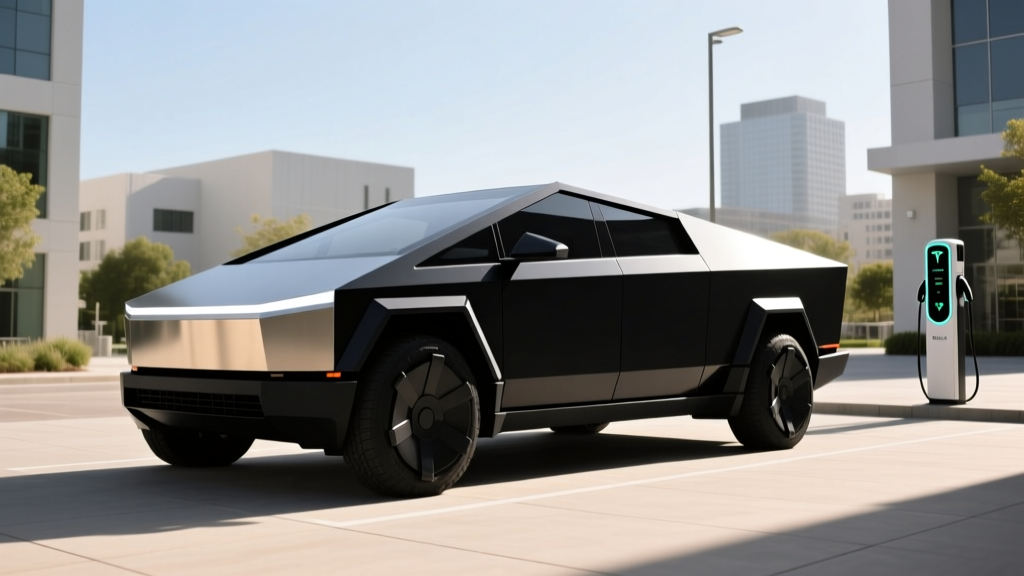
The Tesla Cybertruck Matte Black isn't a separate trim — it's a factory-applied stealth aesthetic package layered over Tesla's stainless-steel electric pickup. For 2026, the Matte Black option transforms the Cybertruck's mirror-finish exoskeleton into a dark, satin-black appearance using a durable PVD (Physical Vapor Deposition) coating, eliminating the fingerprint-prone shine while retaining the structural stainless-steel body. This review covers every spec that matters to buyers: real-world range, charging curves, tax-credit eligibility, and whether the Matte Black package is worth the premium over the standard Cybertruck.
2026 Cybertruck Matte Black: Core Specs at a Glance
| Specification | Value |
|---|---|
| EPA Estimated Range | 340 miles (AWD) |
| Battery Capacity (Usable) | ~123 kWh, NMC chemistry |
| Max DC Fast Charge Rate | 250 kW peak |
| 10–80% DC Fast Charge Time | ~28 minutes |
| Level 2 Home Charging | 11.5 kW (~37 miles/hr) |
| 0–60 mph | 3.9 seconds (AWD) |
| Horsepower | 600 hp (AWD dual-motor) |
| Drivetrain | Dual-motor AWD |
| MPGe (Combined) | 70 MPGe |
| Efficiency | 48 kWh/100 mi |
| Towing Capacity | 11,000 lbs (est.) |
| Base MSRP (AWD) | $79,990 |
| Matte Black Package Add-On | ~$3,000 (est.) |
| Battery & Drive Unit Warranty | 8 years / 120,000 miles |
Real-World Range: What the EPA Number Doesn't Tell You
The Cybertruck's angular stainless-steel body creates aerodynamic drag that hits efficiency hard at highway speeds. While city driving with frequent regenerative braking can push range close to the EPA sticker, sustained 70+ mph travel is where the 123 kWh NMC battery drains fastest. This matters if your commute is predominantly highway or if you road-trip frequently.
Tesla's heat pump helps mitigate cold-weather cabin-heating losses, but battery chemistry inherently slows in freezing temperatures. Preconditioning the battery before fast charging or departure helps recover some efficiency — always enable scheduled departure preconditioning in the Tesla app if you're charging at home overnight.
Charging Speed: DC Fast, Level 2, and the Charge Curve
| Charging Level | Power / Rate | Miles Added | Typical Use Case |
|---|---|---|---|
| Level 1 (120V) | ~1.4 kW | ~4 miles/hr | Emergency / trickle |
| Level 2 (240V, 48A) | 11.5 kW | ~37 miles/hr | Home overnight charging |
| DC Fast (Tesla Supercharger V3/V4) | 250 kW peak | ~200 miles in 15 min | Road trips |
The Cybertruck's 800V-class architecture enables peak charging at 250 kW on compatible Tesla Superchargers. However, peak rate is not sustained rate. The charge curve tapers significantly above 60% State of Charge (SoC). Expect the 10–80% session to take approximately 28 minutes, with the majority of that time spent in the 50–80% range where power drops to 100–150 kW.
For home charging, a 48-amp Level 2 wall connector on a 60-amp circuit delivers 11.5 kW, adding roughly 37 miles of range per hour. A full 10–100% charge takes about 12 hours — meaning overnight charging is practical for most daily driving needs. If your electrical panel supports a 100-amp circuit, Tesla's 80-amp Wall Connector can push up to 19.2 kW (~62 miles/hr), cutting full-charge time to roughly 8 hours.
Connector note: The 2026 Cybertruck uses the NACS (North American Charging Standard) connector natively. This gives it direct access to the entire Tesla Supercharger network (20,000+ stalls in North America) without adapters. For non-Tesla DC fast chargers that still use CCS1, Tesla sells a CCS adapter — though the network is rapidly converting to NACS.
Performance, Handling, and Drivetrain
The dual-motor AWD Cybertruck produces 600 horsepower and rockets from 0–60 mph in 3.9 seconds — quick for any vehicle, extraordinary for a 6,600-lb pickup. The tri-motor Cyberbeast variant (600 hp, 2.6-second 0–60) remains available for buyers who prioritize acceleration, but the AWD strikes the best range-to-performance balance.
Ride quality benefits from the adaptive air suspension, which adjusts ride height from 9 inches of ground clearance (standard) up to 16 inches for off-road use. The steer-by-wire system eliminates the mechanical connection between steering wheel and wheels, resulting in variable ratio steering that feels quick at low speeds but requires adjustment at highway speeds. Some drivers find it intuitive within a week; others never fully warm to the lack of traditional feedback.
Towing capacity is estimated at 11,000 lbs for the AWD model, though real-world towing at maximum capacity will cut range roughly in half. The 6.5-foot composite bed includes a powered tonneau cover and a built-in ramp, and the 120V/240V bed outlets enable job-site power delivery — a genuine work-truck feature, not a gimmick.
Interior, Cargo Space, and Technology
The Cybertruck seats five across two rows. Front legroom measures approximately 41.5 inches, with rear legroom around 38.2 inches — adequate for adults but tighter than a Ford F-150 Lightning's rear seat. The cabin uses a minimalist design dominated by an 18.5-inch center touchscreen that controls virtually every vehicle function, including glove box release, mirror adjustment, and windshield wiper speed.
Cargo volume behind the rear seats is roughly 34 cubic feet in the enclosed bed (with the tonneau cover closed). The front trunk (frunk) adds approximately 7 cubic feet of lockable storage. The powered vault-like tonneau cover can support up to 300 lbs of distributed weight, doubling as a platform for rooftop tents or gear.
Tech highlights include:
- Autopilot (standard): SAE Level 2 driver assistance with adaptive cruise control and lane-keeping. Requires active driver supervision — this is not self-driving.
- Full Self-Driving (Supervised) ($8,000 option): Enhanced Level 2 system with city-street navigation, traffic-light recognition, and automated lane changes. Still requires hands-on-wheel and eyes-on-road at all times.
- 15-speaker audio system with immersive sound.
- Bioweapon Defense Mode: HEPA cabin filtration with positive-pressure airflow.
- Sentry Mode with 360-degree camera recording and phone alerts.
- Powershare: 120V and 240V outlets in the bed and cabin, enabling vehicle-to-load (V2L) power delivery for tools, appliances, or emergency backup.
Matte Black Package: What You Get for the Premium
The Matte Black option replaces the Cybertruck's signature polished stainless-steel finish with a dark, satin-black PVD coating. This eliminates the mirror-like reflectivity that shows every smudge, fingerprint, and water spot — the most common complaint from early Cybertruck owners. The Matte Black finish is more forgiving in daily use, hides road grime better, and gives the truck a stealth-military aesthetic that many buyers originally expected from the concept.
Tesla applies the coating at the factory using a Physical Vapor Deposition process that bonds to the stainless steel at a molecular level. This is not a wrap or paint — it's a permanent surface treatment that won't peel or chip like conventional paint. However, scratch repair on Matte Black requires panel-level refinishing, which can be more expensive than touching up conventional automotive paint.
The package adds an estimated $3,000 to the vehicle MSRP. For buyers who planned to wrap their Cybertruck anyway (a $3,000–$5,000 aftermarket expense), the factory Matte Black is a cost-effective alternative with better durability and warranty coverage.
Pricing, Trim Levels, and Federal Tax Credit Eligibility
| Trim | Base MSRP | Matte Black Add-On | Total (Before Incentives) |
|---|---|---|---|
| AWD Dual-Motor | $79,990 | ~$3,000 | ~$82,990 |
| Cyberbeast (Tri-Motor) | $99,990 | ~$3,000 | ~$102,990 |
Federal tax credit (§30D) eligibility is complex and likely limited for the Cybertruck. Under current IRS rules, the §30D credit offers up to $7,500, but multiple caps apply:
- MSRP cap: Pickup trucks must have an MSRP at or below $80,000 to qualify. The AWD Cybertruck at $79,990 base MSRP barely clears this threshold — but adding the Matte Black package pushes the total above $80,000, potentially disqualifying it. The Cyberbeast at $99,990 is ineligible regardless.
- Buyer income cap: Modified adjusted gross income must not exceed $150,000 (single), $225,000 (head of household), or $300,000 (joint filers).
- Battery sourcing requirements: Critical minerals and battery components must meet escalating domestic-content thresholds. Tesla's battery supply chain has been evolving, and eligibility can change by production batch.
- Point-of-sale transfer: If eligible, the credit can be transferred to Tesla at purchase, reducing the out-of-pocket price by up to $7,500.
Check the official IRS §30D page and Tesla's own eligibility tool before ordering. Tax professionals can confirm whether your specific income and configuration qualify. Never assume credit eligibility based on marketing materials alone.
Efficiency, Ownership Costs, and Warranty
The AWD Cybertruck achieves an EPA-estimated 70 MPGe combined, which translates to approximately 48 kWh per 100 miles. This is less efficient than most EV sedans and crossovers — the truck's weight and aerodynamics demand more energy per mile. At the national average electricity rate of $0.17/kWh, charging costs roughly $8.16 per 100 miles, or about $0.08 per mile. For comparison, a gas-powered F-150 at 20 MPG combined costs approximately $0.17 per mile at $3.40/gallon.
Tesla's battery and drive unit warranty covers 8 years or 120,000 miles, whichever comes first, with a guaranteed minimum 70% battery capacity retention. The NMC chemistry in the Cybertruck's pack is proven across Tesla's fleet, though the large 123 kWh pack would be costly to replace out of warranty — expect $15,000–$25,000 for a full battery replacement based on current Tesla service pricing.
Insurance premiums for the Cybertruck run 20–40% higher than comparable gas pickups due to repair costs (stainless-steel bodywork, specialized glass, sensor recalibration). Get quotes before ordering.
Pros and Cons
Pros
- 340-mile EPA range is strong for a full-size pickup
- 250 kW DC fast charging on the Supercharger network
- 3.9-second 0–60 mph with dual-motor AWD
- 11,000-lb towing capacity with integrated brake controller
- Powershare V2L outlets for job-site and emergency power
- Matte Black PVD coating eliminates fingerprint/smudge complaints
- Air suspension with adjustable ride height (9–16 inches)
Cons
- Base MSRP near $80K; Matte Black package likely pushes over §30D tax credit cap
- Heavy (6,600+ lbs) — hurts efficiency and tire wear
- Steer-by-wire requires adjustment; not all drivers adapt
- Rear seat legroom tighter than F-150 Lightning or Rivian R1T
- Stainless-steel body repair is specialized and expensive
- Insurance premiums significantly higher than gas pickups
- MPGe of 70 is low — charging costs add up on road trips
Who Should Buy the Cybertruck Matte Black?
- You need a full-size electric pickup with 11,000-lb towing and V2L job-site power
- You want access to the Tesla Supercharger network for road trips
- You prefer a stealth, low-maintenance exterior over the standard mirror finish
- Your daily driving is under 250 miles and you can charge at home overnight
- Budget is under $70,000 — consider the Ford F-150 Lightning or Rivian R1S
- You need maximum rear-seat space for car seats or tall passengers
- You want a conventional steering feel (Rivian R1T uses a traditional rack)
- Tax credit eligibility is essential to your purchase math
Frequently Asked Questions
What is the real-world range of the Tesla Cybertruck Matte Black?
The EPA estimates 340 miles for the AWD model. Real-world range is typically 270–310 miles in mixed driving, dropping to 260–280 miles on the highway and 210–250 miles in freezing temperatures. Preconditioning and moderate speeds help maximize range.
How fast does the Cybertruck charge at home and on the road?
On a 48-amp Level 2 home charger, the Cybertruck gains approximately 37 miles of range per hour (11.5 kW). On a 250 kW Tesla Supercharger, the 10–80% session takes about 28 minutes, though the charge curve tapers significantly above 60% SoC.
Does the Cybertruck Matte Black qualify for the $7,500 federal EV tax credit?
It depends on your configuration and income. The AWD base MSRP of $79,990 falls under the $80,000 truck cap, but adding the Matte Black package likely pushes the total above the threshold, disqualifying it. Income caps and battery-sourcing rules also apply. Consult the IRS §30D guidelines and a tax professional before ordering.
Is the Cybertruck Matte Black worth buying over the Ford F-150 Lightning or Rivian R1T?
The Cybertruck wins on towing capacity (11,000 lbs vs. Lightning's 10,000 lbs) and Supercharger network access. The F-150 Lightning is more affordable, has a larger rear seat, and qualifies more easily for the tax credit. The Rivian R1T offers more refined on-road manners and a conventional steering system. Your choice depends on which trade-offs matter most for your use case.
How durable is the Matte Black PVD coating?
Physical Vapor Deposition bonds the coating at a molecular level to the stainless steel — it won't peel, fade, or chip like a vinyl wrap or conventional paint. However, deep scratches require panel-level refinishing, which is more specialized than standard auto body touch-up work.
Can the Cybertruck power my home or job-site tools?
Yes. The Powershare system provides 120V and 240V outlets in the bed and cabin. At 240V, it can deliver up to 9.6 kW of continuous power — enough to run most power tools, a refrigerator, or temporary home backup during an outage. Vehicle-to-home (V2H) integration for whole-house backup requires a compatible bidirectional charger, which Tesla has not yet fully enabled as of early 2026.