Quick Verdict: Should You Lease the Cybertruck in 2026?
Leasing the Tesla Cybertruck in 2026 has become the pragmatic path to owning Tesla's polarizing electric pickup. With monthly lease payments ranging from roughly $850 to $1,350 depending on trim and terms, a lease shields buyers from the Cybertruck's uncertain long-term depreciation while still capturing available federal incentives. Tesla Financial Services structures most Cybertruck leases at 36 months with 10,000 to 15,000 miles annually, and the lessor (Tesla) claims the §30D federal tax credit — passing it through as a capitalized cost reduction that lowers your monthly payment. This guide breaks down every number you need before signing.
Range, Battery & Efficiency: What the EPA Says vs. Reality
The 2026 Cybertruck lineup offers two battery configurations across three trims. The Dual Motor AWD (Long Range) carries an EPA-estimated 340 miles of range, while the tri-motor Cyberbeast is rated at 315 miles. Both use a ~123 kWh usable battery pack built on NMC (nickel manganese cobalt) chemistry, chosen for its higher energy density over LFP — critical in a heavy, angular truck pushing significant aerodynamic drag.
| Trim | EPA Range | Highway (70 mph) | Cold Weather (32°F) | Combined Real-World |
|---|---|---|---|---|
| Dual Motor AWD | 340 mi | ~265-285 mi | ~230-260 mi | ~270-300 mi |
| Cyberbeast (Tri-Motor) | 315 mi | ~245-265 mi | ~210-240 mi | ~250-280 mi |
The Cybertruck's stainless-steel exoskeleton and 6,800+ lb curb weight work against efficiency. At sustained highway speeds above 70 mph, expect a 20-25% reduction from EPA figures. In freezing temperatures, battery preconditioning and cabin heating can push losses to 30-35%. Plan road trips around 220-250 miles between charges for a comfortable buffer.
Efficiency lands at approximately 58-62 MPGe combined (roughly 55-59 kWh/100 mi), making the Cybertruck one of the least efficient EVs on the market per mile — a direct consequence of its mass and frontal area. For context, the EPA's fueleconomy.gov lists the Cybertruck's combined consumption well above lighter EVs like the Rivian R1T or Ford F-150 Lightning.
Charging Speed: DC Fast, Level 2 & Home Setup
The Cybertruck supports a peak DC fast-charge rate of 250 kW on Tesla's V3/V4 Superchargers using its native NACS connector. In practice, the charging curve is aggressive at low states of charge but tapers significantly above 60%.
| Charging Level | Max Power (kW) | Speed | Typical Use |
|---|---|---|---|
| Level 1 (120V) | ~1.4 kW | ~3-4 mi/hr | Emergency/top-up only |
| Level 2 (240V/48A) | 11.5 kW | ~30-34 mi/hr | Overnight home charging |
| Level 2 (240V/80A) | 19.2 kW | ~50-56 mi/hr | High-power Wall Connector |
| DC Fast (Supercharger V3) | 250 kW peak | 10-80% in ~28 min | Road trips |
| DC Fast (Supercharger V4) | 250 kW peak | 10-80% in ~28 min | Newer stations w/ CCS/NACS |
A critical ownership note: the Cybertruck's 800V-class architecture enables strong charge rates, but the massive 123 kWh pack means even at 250 kW peak, a full 10-80% session takes around 28 minutes — longer than smaller-battery EVs. The charge curve sustains near-peak rates from roughly 5% to 40% SoC, then tapers progressively. Above 80%, charging slows dramatically to protect cell longevity, adding 15+ minutes for the final 20%.
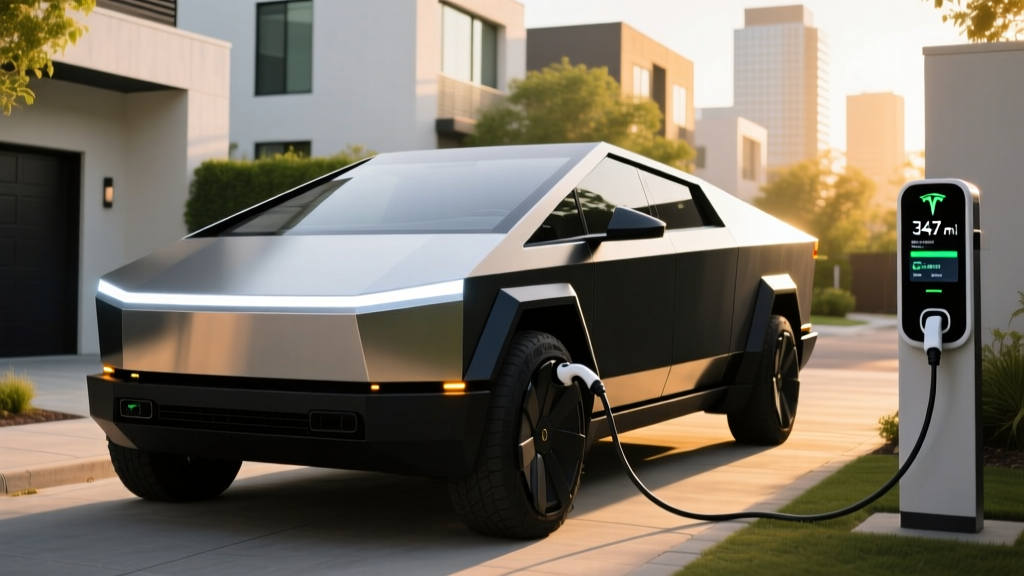
For home Level 2 charging, most lessees install a Tesla Wall Connector on a 60A circuit ($500-$700 equipment, $800-$2,000 electrician labor depending on panel proximity). At 48A/11.5 kW, a full overnight session adds roughly 240+ miles — sufficient for nearly all daily driving. Ensure your electrical panel has capacity; a 200A service is typically required.
Performance: 0-60, Horsepower & Drivetrain
The Cybertruck delivers supercar-rivaling acceleration despite its truck duties:
- Dual Motor AWD: 600 hp, 0-60 mph in 3.9 seconds
- Cyberbeast (Tri-Motor AWD): 845 hp, 0-60 mph in 2.6 seconds
Both trims feature adaptive air suspension with up to 16 inches of ground clearance, a 49-degree approach angle, and a stainless-steel unibody. Towing capacity is rated at 11,000 lbs (Dual Motor) and 11,000 lbs (Cyberbeast), though towing at max capacity will slash range by roughly 40-50%. The steer-by-wire system and rear-wheel steering give the 223.5-inch-long truck a surprisingly tight 37-foot turning circle.
2026 Cybertruck Lease Pricing & Federal Tax Credit Breakdown
Tesla's lease structure in 2026 typically runs 36 months with 10,000-15,000 miles per year. Monthly payments vary significantly by trim, down payment, and money factor.
| Trim | Base MSRP | Est. Monthly Lease (36 mo, $7,500 down) | §30D Credit Eligible? |
|---|---|---|---|
| Dual Motor AWD | $79,990 | ~$850-$950 | Yes — passed through as cap cost reduction* |
| Cyberbeast | $99,990 | ~$1,100-$1,350 | Yes — passed through as cap cost reduction* |
*§30D Federal Tax Credit — Lease Mechanics: When you lease a Cybertruck, the leasing entity (Tesla Financial Services) is the legal owner and claims the $7,500 federal clean vehicle credit. Tesla typically applies this as a capitalized cost reduction, effectively lowering the vehicle's lease basis and reducing your monthly payment by roughly $175-$210/month over 36 months. This structure bypasses the buyer income caps ($150K single / $300K joint) and MSRP caps ($80,000 for trucks) that apply to direct purchases — because the credit is claimed by the lessor under the commercial vehicle credit (§45W), not the consumer §30D credit. Confirm current pass-through terms with Tesla Financial before signing.
- MSRP at or below $80,000 (truck classification) — Dual Motor qualifies; Cyberbeast at $99,990 does NOT
- Modified adjusted gross income: ≤$150,000 (single), ≤$225,000 (head of household), ≤$300,000 (joint)
- Battery components ≥75% manufactured/assembled in North America (2026 threshold)
- Critical minerals ≥80% sourced from US or FTA-partner countries (2026 threshold)
- Vehicle assembled in North America (Cybertruck: Austin, TX — qualifies)
- Point-of-sale transfer available at time of purchase
Rules evolve annually. Verify current-year sourcing thresholds at IRS.gov and consult a tax professional.
Interior, Cargo & Standout Tech
The Cybertruck's cabin is minimalist and angular, dominated by an 18.5-inch front touchscreen and a 9.4-inch rear display. Seating fits six (three-across bench front and rear). Key dimensions:
- Bed length: 6 feet (72 inches), with a motorized retractable tonneau cover
- Cargo bed volume: ~67 cu ft (bed) + 15 cu ft (front trunk/frunk)
- Front legroom: 41.5 inches | Rear legroom: 38.2 inches
- Max payload: 2,500 lbs
- 120V/240V bed outlets: Up to 9.6 kW of vehicle-to-load (V2L) power
Standard tech includes Tesla's latest HW4 Autopilot hardware, Adaptive Cruise Control, and Autosteer. Full Self-Driving (Supervised) remains a $8,000 add-on or $99/month subscription — and is SAE Level 2, requiring constant driver attention. The Cybertruck also features Armor Glass (laminated ultra-hard glass), a bioweapon defense HEPA air filter, and an integrated air compressor in the bed.
Notable drawbacks: The steer-by-wire system has a learning curve and lacks traditional road feedback. Rear visibility is compromised by the bed design, making the backup camera essential. Panel gap consistency and early-build quality issues have improved through 2025-2026 production runs but still draw scrutiny. Insurance premiums run 25-40% higher than comparable trucks due to repair costs for the stainless-steel body.
Warranty Coverage
| Coverage | Term |
|---|---|
| Basic Vehicle Limited Warranty | 4 years / 50,000 miles |
| Battery & Drive Unit Warranty | 8 years / 120,000 miles (min 70% capacity retention) |
| Restraint System | 5 years / 60,000 miles |
| Rust-Through (Body) | 12 years / unlimited miles |
The 8-year/120,000-mile battery warranty guarantees at least 70% capacity retention. Tesla's NMC pack is liquid-cooled with an advanced thermal management system. For lessees on a 36-month cycle, the battery warranty will far outlast the lease term — a significant peace-of-mind factor.
Pros, Cons & Who Should Lease the Cybertruck
- Tri-motor Cyberbeast hits 0-60 in 2.6s — fastest production truck ever
- Stainless-steel exoskeleton is dent- and corrosion-resistant
- 11,000-lb towing + 9.6 kW V2L power for job-site or campsite use
- Lease structure bypasses §30D income/MSRP caps via lessor credit
- Air suspension adapts from 4" to 16" ground clearance
- Access to Tesla Supercharger network (17,000+ stalls in North America)
- Real-world highway range drops to 245-285 mi — below EPA sticker
- 55-59 kWh/100 mi efficiency is poor; high electricity cost per mile
- Insurance premiums 25-40% above F-150 Lightning / Rivian R1T
- Steer-by-wire lacks feedback; polarizing for traditional truck buyers
- Cyberbeast ($99,990) exceeds $80K §30D MSRP cap for purchase
- Bed is 6 ft — shorter than most full-size truck competitors (6.5-8 ft)
- You want a high-performance electric truck with Supercharger access and don't drive more than 12,000 miles/year
- You value the §30D lease loophole to capture the $7,500 credit regardless of income
- You need V2L power output for tools, camping, or backup power
- You need a longer bed (R1T: 4.5 ft but with Gear Tunnel; Lightning: 5.5 ft) or more traditional driving dynamics
- You want lower insurance costs and more proven long-term reliability data
- You drive 15,000+ miles annually and need better real-world efficiency
Frequently Asked Questions
What is the real-world range of the Tesla Cybertruck?
The Dual Motor AWD is EPA-rated at 340 miles, but real-world highway driving at 70 mph yields approximately 265-285 miles. In cold weather (below freezing), expect 230-260 miles. The Cyberbeast tri-motor drops to roughly 245-265 miles on the highway. Always plan charging stops with a 20% buffer.
How fast does the Cybertruck charge at home and on the road?
On a Tesla V3/V4 Supercharger, the Cybertruck peaks at 250 kW and charges from 10-80% in approximately 28 minutes. At home on a Level 2 Wall Connector (48A/11.5 kW), it adds roughly 30-34 miles per hour — a full overnight charge covers most daily needs. On a standard 120V outlet (Level 1), expect just 3-4 miles per hour.
How much does a 2026 Cybertruck lease cost after tax credits?
With the $7,500 federal credit applied as a capitalized cost reduction through Tesla Financial Services, expect roughly $850-$950/month for the Dual Motor AWD and $1,100-$1,350/month for the Cyberbeast on a 36-month lease with $7,500 due at signing. Exact figures depend on your credit tier, mileage allowance, and regional incentives.
Does the Cybertruck qualify for the $7,500 federal EV tax credit?
Yes, but the mechanism differs by purchase type. If you lease, Tesla (the lessor) claims the credit under §45W and passes savings through your monthly payment — no income or MSRP caps apply to you. If you purchase outright under §30D, only the Dual Motor AWD ($79,990) qualifies because the Cyberbeast ($99,990) exceeds the $80,000 truck MSRP cap. Buyer income caps and battery-sourcing rules also apply to purchases. Verify current rules at IRS.gov.
Is it worth leasing the Cybertruck vs. the Rivian R1T or F-150 Lightning?
The Cybertruck wins on raw performance (2.6s 0-60 in Cyberbeast), V2L capability (9.6 kW), and Supercharger network access. The Rivian R1T offers more refined driving dynamics, a quad-motor option, and better cargo innovation (Gear Tunnel). The F-150 Lightning provides a more traditional truck experience with a larger frunk and lower starting price. If you prioritize acceleration, tech, and charging infrastructure, the Cybertruck lease is compelling. If you need practicality and proven long-term data, cross-shop all three.
What are the biggest risks of leasing a Cybertruck?
Insurance costs are the biggest variable — expect premiums 25-40% above comparable trucks. End-of-lease disposition fees and excess wear/mileage charges can add up if you exceed your allowance. The steer-by-wire system and stainless body mean repairs go through Tesla-certified centers only, which can be limiting in rural areas. Finally, while Tesla's 8-year battery warranty covers the lease term, residual value uncertainty is precisely why leasing — rather than buying — is the lower-risk play in 2026.