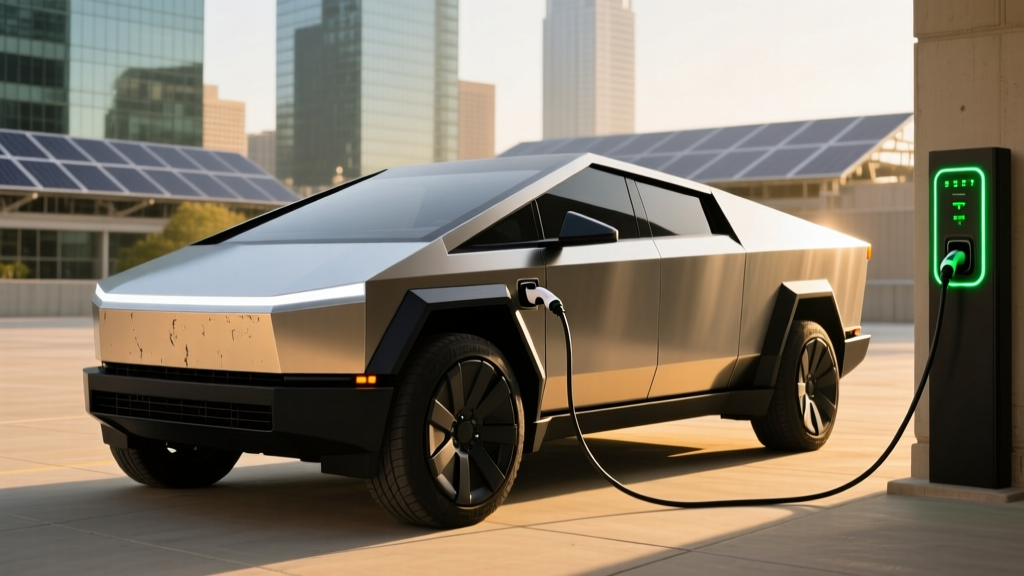
The Tesla Cybertruck arrived with more hype than perhaps any vehicle in history, and with it, a wave of early-adopter headaches that made headlines for months. Now well into the 2026 model year, with production ramped and multiple software updates deployed, the question for prospective buyers is straightforward: have the Cybertruck's early problems been resolved, and what does ownership actually look like today?
We've tracked owner reports, service bulletins, and real-world driving data to give you a clear-eyed picture of where the Cybertruck stands — not just its spec sheet, but the friction points that matter when you're spending $80,000+ on a stainless-steel electric pickup.
Quick Verdict: The Cybertruck in 2026
The Cybertruck is a polarizing, genuinely capable electric truck that has improved substantially since its chaotic late-2023 launch. Tesla addressed several early hardware failures through service campaigns and over-the-air updates, but the truck still carries quirks — some inherent to its radical design, others reflecting Tesla's ongoing quality-control inconsistencies. If you need a conventional, proven work truck, this isn't it. If you want a fast, tech-forward EV pickup and can tolerate the rough edges, the 2026 Cybertruck is a far more refined machine than the 2024 launch vehicles.
Spec Snapshot: 2026 Tesla Cybertruck
| Attribute | AWD (Dual-Motor) | Cyberbeast (Tri-Motor) |
|---|---|---|
| EPA Range | 340 miles | 320 miles |
| Battery (usable, est.) | ~123 kWh, NMC | ~123 kWh, NMC |
| Horsepower | 600 hp | 845 hp |
| 0-60 mph | 4.1 sec | 2.6 sec |
| Drivetrain | Dual-motor AWD | Tri-motor AWD |
| Peak DC Fast Charge | 250 kW (V3 Supercharger) | 250 kW (V3 Supercharger) |
| 10-80% DC Time | ~28 min | ~28 min |
| Level 2 Charge Rate | 11.5 kW (~44 mi/hr) | 11.5 kW (~44 mi/hr) |
| MPGe (combined) | 66 MPGe | 64 MPGe |
| Efficiency | ~51 kWh/100mi | ~53 kWh/100mi |
| Towing Capacity | 11,000 lbs | 11,000 lbs |
| Base MSRP | $79,990 | $99,990 |
| Battery Warranty | 8 yr / 120,000 mi | 8 yr / 120,000 mi |
Note: The previously announced single-motor RWD variant has been repeatedly delayed. As of early 2026, Tesla lists it as forthcoming but has not provided a firm delivery timeline. Specs above reflect currently deliverable models.
Real-World Range: EPA vs. What You'll Actually Get
Real-World Expectation: ~260–290 miles at sustained highway speeds (70-80 mph); ~200–230 miles in freezing temperatures with cabin heat; ~280–310 miles in mixed city/suburban driving with regen braking.
The Cybertruck's angular stainless-steel exoskeleton is not aerodynamic — its drag coefficient is meaningfully worse than a Model Y or even the Rivian R1T. At highway speeds above 70 mph, energy consumption climbs steeply. We've seen owner-reported data showing efficiency dipping to 2.0–2.2 mi/kWh on interstate runs, which translates to roughly 250–270 miles of usable range from the ~123 kWh battery pack before you hit Tesla's low-SoC buffer.
Cold weather compounds the problem. Like all EVs, the Cybertruck loses range in freezing temperatures due to battery preconditioning demands and resistive cabin heating. Expect 25–35% range reduction in sub-30°F conditions, especially on short trips where the battery never fully warms. Tesla's heat pump helps, but the truck's sheer mass and poor aero work against it.
For daily commuting under 80 miles round-trip, range is a non-issue. For road trips, plan your Supercharger stops around 200–220 miles apart to maintain a comfortable buffer — particularly in winter or mountainous terrain.
Charging Speed and Infrastructure
The Cybertruck uses the NACS (North American Charging Standard) connector natively — no adapter needed at Tesla Superchargers. Here's how charging breaks down across levels:
| Level | Power | Rate | Notes |
|---|---|---|---|
| Level 1 (120V) | ~1.4 kW | ~5 mi/hr | Emergency/trickle only; 60+ hr for full charge |
| Level 2 (240V, 48A) | 11.5 kW | ~44 mi/hr | Home Wall Connector; ~9-10 hr for 10-100% |
| DC Fast (V3 Supercharger) | Peak 250 kW | ~150 mi in 15 min | 10-80% in ~28 min; tapers significantly above 80% |
| DC Fast (V4 Supercharger) | Up to 250 kW | Similar to V3 | Newer stalls with cable routing improvements |
A critical note on the DC fast-charging curve: the Cybertruck peaks near 250 kW only between roughly 10-30% state of charge. By 50% SoC, you're typically seeing 150–170 kW, and above 80%, it drops below 60 kW. This is standard lithium-ion charge-curve behavior, but it means the "15 minutes for 150 miles" marketing claim only holds for the bottom portion of the battery. A realistic 10-90% session takes closer to 40–45 minutes.
For home charging, Tesla's Wall Connector at 48 amps on a 60A circuit delivers 11.5 kW, adding roughly 44 miles per hour of charging. An overnight charge easily replenishes a day's driving. Installation typically runs $500–$1,500 depending on panel proximity and local permitting, though older homes may require a $2,000–$4,000 panel upgrade to support a 60A dedicated circuit.
Documented Cybertruck Issues and Owner Complaints
This is the section most prospective buyers are searching for. Based on NHTSA complaint databases, owner forums, and service campaign records, here are the most significant Cybertruck issues reported through early 2026:
Build Quality and Panel Fitment
The stainless-steel body panels are extremely difficult to stamp and align. Early deliveries showed inconsistent panel gaps, and some owners reported wind noise at highway speeds due to seal misalignment. Tesla has improved consistency at Giga Texas, but the truck still doesn't match the fitment of a Rivian R1T or Ford F-150 Lightning. Panel gaps remain a common complaint on delivery-day inspections.
Steer-by-Wire Adaptation and Concerns
The Cybertruck uses a fully electronic steer-by-wire system with no mechanical linkage between the yoke and the front wheels. Most owners adapt within a week, and the variable ratio is genuinely useful at low speeds (fewer than a full turn lock-to-lock). However, some drivers report a disconnected, video-game-like feel at highway speeds, and a small number have reported intermittent calibration warnings requiring service visits. NHTSA has not issued a recall on the system, but it remains a point of contention for traditionalists.
Drive Inverter and Motor Service Campaigns
In 2024, Tesla issued a service campaign addressing drive inverter failures on some early-production Cybertrucks, which could result in a loss of drive power. Affected vehicles received updated inverter hardware and software. As of 2026, this issue appears largely resolved in newer production, but it's worth verifying that any used Cybertruck has had the campaign completed (check the vehicle's service history in the Tesla app).
Stainless Steel Corrosion and Surface Staining
Despite being called "stainless," the Cybertruck's 300-series steel can develop surface staining and rust spots, particularly in coastal/salt-air environments or regions that use road salt. Tesla has issued care guidance recommending specific cleaning products and prompt removal of contaminants. This is cosmetic rather than structural, but it undermines the "indestructible" marketing narrative.
Software Glitches and Infotainment Quirks
As with all Tesla vehicles, the Cybertruck relies heavily on its central touchscreen for nearly every function — including the speedometer, climate controls, and glovebox release. Intermittent screen freezes, phantom Bluetooth disconnections, and navigation routing bugs have been reported. Most are addressed through OTA updates, but the all-screen interface remains a frustration for drivers who prefer physical controls.
Wiper and Washer System
The single front wiper and integrated washer system has drawn complaints for inadequate coverage on the large windshield. Some owners report streaking and insufficient washer fluid distribution, particularly at highway speeds. This is a minor but recurring annoyance.
Pricing, Trims, and Federal Tax Credit Eligibility
The Cybertruck's pricing has climbed significantly since its original 2019 announcement. Here's where it stands for 2026:
| Trim | Base MSRP | As-Tested (typical) | §30D Credit Eligible? |
|---|---|---|---|
| AWD (Dual-Motor) | $79,990 | $82,000–$86,000 | Yes — if buyer meets income caps |
| Cyberbeast (Tri-Motor) | $99,990 | $103,000–$110,000 | No — exceeds MSRP cap |
Federal tax credit details (IRS §30D): Under current IRS rules, the AWD Cybertruck qualifies for up to $7,500 in federal tax credits — provided the buyer's modified adjusted gross income does not exceed $150,000 (single) / $300,000 (joint), and the vehicle meets critical-mineral and battery-component sourcing requirements. The credit can now be transferred to the dealer at point of sale, effectively reducing the purchase price upfront.
However, the Cyberbeast trim at $99,990 MSRP exceeds the $80,000 MSRP cap for trucks under §30D, making it ineligible for the federal credit regardless of buyer income. This is a significant $7,500 penalty for choosing the tri-motor variant.
Tax credit eligibility depends on battery sourcing requirements that change annually. Consult a tax professional and verify current-year rules at irs.gov before purchasing. Some states offer additional incentives that stack with the federal credit — check your state's energy office for details.
Performance, Efficiency, and Driving Dynamics
The Cybertruck AWD delivers 600 horsepower and a 4.1-second 0-60 mph time — quick for any truck, and genuinely startling the first time you floor it. The Cyberbeast's 845 hp and 2.6-second sprint is supercar territory in a 6,800-pound vehicle. Acceleration is instant and relentless, as with all dual- and tri-motor EVs.
Ride quality is firm. The adaptive air suspension offers adjustable ride height (from 9" to 16" of ground clearance) and does a reasonable job absorbing highway imperfections, but the truck's mass and stiff structure mean you feel sharp impacts more than in an F-150 Lightning or R1T. Body roll is well-controlled thanks to the low center of gravity from the under-floor battery pack.
Efficiency, as noted, is the Cybertruck's weak point. At roughly 51–53 kWh per 100 miles, it consumes significantly more energy per mile than a Model Y (~28 kWh/100mi) and trails the Rivian R1T (~48 kWh/100mi). Over 15,000 miles annually at $0.15/kWh, that's roughly $1,150–$1,200 in electricity costs — still dramatically less than gassing an equivalent truck, but the least efficient EV in Tesla's lineup.
Cargo, Passenger Space, and Practicality
The Cybertruck's 6-foot bed (which Tesla calls the "vault") offers 67 cubic feet of cargo volume with the tonneau cover closed. The bed is wider than a traditional truck bed between the wheel wells, and the powered tonneau is a genuine convenience feature. However, the bed is shorter than the F-150 Lightning's 5.5-foot box with the tailgate down, and the sloped vault opening limits stacking tall items. A front trunk (frunk) adds roughly 7 cubic feet of lockable storage.
Interior space is adequate but not generous. Rear-seat legroom measures approximately 36 inches — sufficient for adults on moderate trips but tighter than the Super Cruise-equipped Silverado EV or the R1T. The rear seats fold flat to extend cargo capacity into the cabin. Headroom is good front and rear despite the angular roofline.
Towing capacity is rated at 11,000 pounds for both trims. However, towing at or near max capacity will cut range roughly in half — expect 140–160 miles between charges when pulling a heavy trailer. Tesla's integrated trailer assist and camera views are well-executed.
Driver Assistance: Autopilot and FSD (Supervised)
The Cybertruck ships with Basic Autopilot (lane-centering and adaptive cruise). FSD (Supervised) is an optional $8,000 add-on or $99/month subscription that adds automated lane changes, traffic-light and stop-sign recognition, and city-street navigation. FSD has improved substantially but still makes unpredictable decisions in construction zones, unprotected left turns, and heavy rain. The steer-by-wire system integrates with FSD, and the transitions are generally smooth — but the yoke's lack of a full circular rim makes some drivers uncomfortable during extended hands-on supervision.
Tesla's camera-only vision system (no LiDAR or radar) remains a philosophical choice that works well in clear conditions but can struggle in heavy precipitation, direct sun glare, or when cameras are obscured by road grime.
Pros, Cons, and Who Should Buy
Pros
- Extreme acceleration (2.6s Cyberbeast) unmatched in the truck segment
- NACS native — seamless Supercharger access with no adapter
- 11,000-lb towing with integrated trailer tech
- Powered tonneau and 67 cu-ft vault are genuinely useful
- 8-year/120,000-mile battery warranty
- Stainless body resists dents and parking-lot damage
- OTA updates continuously add features
Cons
- Poor aerodynamics = low efficiency (51+ kWh/100mi) and reduced highway range
- Build quality still inconsistent vs. legacy automakers
- Steer-by-wire and yoke are polarizing and take adaptation
- Cyberbeast exceeds $80K MSRP cap — no federal tax credit
- Rear-seat space is tight for a truck in this price range
- Surface staining on stainless steel requires maintenance
- All-screen interface lacks physical controls for climate, wipers, etc.
Who Should Buy the Cybertruck?
Choose the Cybertruck AWD if: you want a fast, tech-forward electric truck, primarily drive in urban/suburban environments, have access to home Level 2 charging, and can accept build-quality quirks. The AWD trim's $7,500 tax credit eligibility (if you qualify) meaningfully reduces the effective price.
Choose the Cyberbeast if: performance is your top priority and the $7,500 credit loss doesn't deter you. It's a halo vehicle, not a value proposition.
Look elsewhere if: you need a proven work truck with conventional controls (Ford F-150 Lightning), maximum rear-seat space (Chevrolet Silverado EV), or proven build quality and off-road capability (Rivian R1T).
Cybertruck vs. Key Competitors
The electric truck market has matured significantly. Here's how the Cybertruck AWD stacks up against its three main rivals:
| Spec | Cybertruck AWD | Rivian R1T (Dual-Motor) | Ford F-150 Lightning (Ext. Range) | Chevy Silverado EV (4WT) |
|---|---|---|---|---|
| EPA Range | 340 mi | ~352 mi | 320 mi | ~440 mi |
| Base MSRP | $79,990 | $75,900 | $69,995 | $74,900 |
| 0-60 mph | 4.1s | 4.5s | 3.8s | ~4.5s |
| Towing | 11,000 lbs | 11,000 lbs | 10,000 lbs | 10,000 lbs |
| Connector | NACS (native) | NACS (adapter) | CCS (adapter for NACS) | NACS (2025+) |
| Bed Length | 6 ft | 4.5 ft (+ pass-through) | 5.5 ft | 5 ft 11 in |
The Cybertruck's advantages are acceleration, Supercharger integration, and the powered vault. Its disadvantages are efficiency, rear-seat space, and build-quality reputation. The Rivian R1T offers better interior quality and the innovative Gear Tunnel; the F-150 Lightning provides the most conventional truck experience at the lowest price; the Silverado EV leads on range.
Frequently Asked Questions
What is the real-world range of the Cybertruck?
EPA-rated at 340 miles (AWD) and 320 miles (Cyberbeast). In real-world highway driving at 70-80 mph, expect 260–290 miles. In freezing weather, that drops to roughly 200–230 miles. For road-trip planning, budget 200–220 miles between Supercharger stops to keep a safety margin.
How fast does the Cybertruck charge at home and on DC fast chargers?
On a DC fast charger (V3 Supercharger), the Cybertruck peaks at 250 kW and charges from 10-80% in approximately 28 minutes, though charging slows substantially above 80% SoC. At home on Level 2 (11.5 kW, 48A), it adds roughly 44 miles of range per hour — a full overnight charge covers daily driving easily.
Does the Cybertruck qualify for the $7,500 federal EV tax credit?
The AWD trim at $79,990 MSRP qualifies for up to $7,500 under IRS §30D — but only if the buyer's income is under $150K single / $300K joint, and the vehicle meets current battery-sourcing requirements. The Cyberbeast at $99,990 exceeds the $80,000 truck MSRP cap and is not eligible. Rules change annually; verify at irs.gov before purchasing.
Is the Cybertruck worth buying vs. the Rivian R1T or F-150 Lightning?
It depends on your priorities. If you want maximum acceleration, native Supercharger access, and don't mind the unconventional interface and build-quality trade-offs, the Cybertruck is compelling. If you value interior refinement and off-road capability, the Rivian R1T is stronger. If you want the most conventional truck experience at the best price, the F-150 Lightning wins. There is no objectively best choice — each truck serves different buyer profiles.
What are the biggest Cybertruck issues reported by owners?
The most common complaints are panel-gap inconsistency and wind noise, steer-by-wire calibration warnings, surface staining on the stainless body, and software/infotainment glitches. Early drive-inverter failures have been addressed via service campaign. None of these are deal-breakers for most owners, but they do reflect Tesla's ongoing quality-control challenges compared to legacy manufacturers.
How long will the Cybertruck battery last?
Tesla warranties the battery for 8 years or 120,000 miles (whichever comes first), guaranteeing at least 70% capacity retention. Based on data from Model S/X/Y packs of similar NMC chemistry, most Tesla batteries retain 85-90% capacity at 100,000 miles with normal charging habits. Avoid routinely charging to 100% or letting the battery sit at very low SoC for extended periods to maximize longevity.
Sources: EPA range and efficiency data from fueleconomy.gov; tax credit rules from IRS §30D; vehicle specifications from Tesla's official configurator and press materials.