A Cabin Built for Utility, Not Luxury Convention
The Tesla Cybertruck interior rejects the stitched-leather, wood-trim playbook that defines most premium trucks. Instead, Tesla leans into a minimalist, aerospace-grade aesthetic with a focus on durable materials, a massive central display, and a flat load floor. For buyers researching the Tesla Cybertruck interior before committing to a $80,000+ electric pickup, the real questions go beyond aesthetics: How much space do you actually get? What's the real-world range when you load the bed? And does the cabin tech justify the price?
This review covers the 2026 Cybertruck lineup — AWD (Dual Motor) and Cyberbeast — with exact EPA range figures, charging speeds, battery chemistry, cargo dimensions, and IRS §30D tax-credit eligibility. We'll also address where the interior succeeds, where it falls short, and how it stacks up against the Rivian R1T and Ford F-150 Lightning.
Core Specifications at a Glance
| Spec | AWD (Dual Motor) | Cyberbeast (Tri Motor) |
|---|---|---|
| EPA Range | 340 miles | 320 miles |
| Battery Capacity (usable) | ~123 kWh (NMC) | ~123 kWh (NMC) |
| Peak DC Fast Charge | 350 kW (peak) | 350 kW (peak) |
| 10–80% DC Charge Time | ~17 minutes | ~17 minutes |
| Level 2 Home Charge (48A) | ~11.5 kW / ~34 mi/hr | ~11.5 kW / ~34 mi/hr |
| 0–60 mph | 4.1 seconds | 2.6 seconds |
| Horsepower | 600 hp | 845 hp |
| Drivetrain | Dual Motor AWD | Tri Motor AWD |
| Efficiency (MPGe) | ~66 MPGe combined | ~63 MPGe combined |
| Towing Capacity | 11,000 lbs | 11,000 lbs |
| Base MSRP | $79,990 | $99,990 |
| Battery/Drive Unit Warranty | 8 years / 120,000 miles | 8 years / 120,000 miles |
Source: Tesla specifications, fueleconomy.gov. Figures reflect 2025–2026 model-year data. Range can be extended with the optional Range Extender battery pack (~470 mi on AWD).
Real-World Range: What the EPA Sticker Doesn't Tell You
EPA Estimate: 340 miles (AWD) / 320 miles (Cyberbeast)
Real-World Expectation: Expect ~270–300 miles on mixed highway driving at 70–75 mph. Cold-weather operation (below 32°F) can reduce range by 20–30%, bringing usable range to roughly 220–260 miles without preconditioning. Towing a 5,000-lb trailer cuts range roughly in half.
The Cybertruck's 123-kWh usable battery is one of the largest in any production EV, but the truck's angular stainless-steel exoskeleton creates significant aerodynamic drag (estimated Cd of ~0.39 — worse than the F-150 Lightning's ~0.35). This means highway efficiency suffers more than city efficiency, where regenerative braking recovers energy.
Tesla's heat pump helps mitigate cold-weather cabin energy draw, but the sheer battery mass (over 6,800 lbs curb weight for Cyberbeast) means the truck consumes more energy per mile than lighter EVs. Plan for roughly 48–52 kWh per 100 miles in mixed driving — that's the equivalent of ~63–66 MPGe, per EPA data.
Charging Speed: DC Fast Charge and Home Level 2
The Cybertruck supports an 800-volt architecture (shared with the Semi and next-gen Tesla vehicles), enabling peak DC fast-charge rates up to 350 kW at V4 Superchargers. However, peak rate is not sustained rate — the charge curve tapers significantly above 60% state of charge.
| Charging Level | Power (kW) | Speed (miles of range per hour) | Notes |
|---|---|---|---|
| Level 1 (120V / 12A) | ~1.4 kW | ~3–4 mi/hr | Emergency / trickle only |
| Level 2 (240V / 48A) | ~11.5 kW | ~34 mi/hr | Full charge in ~10–11 hours |
| DC Fast (V4 Supercharger) | Up to 350 kW (peak) | ~130+ mi in 10 min (peak) | 10–80% in ~17 min; tapers above 60% |
| DC Fast (CCS adapter, 250 kW) | Up to 250 kW | ~100 mi in 10 min (peak) | Third-party networks; slower taper |
Home charging reality: A full 0–100% Level 2 charge on a 48-amp circuit takes roughly 10–11 hours. Most owners will charge from 20% to 80% overnight (~7 hours), which is practical for daily commuting. Tesla's Mobile Connector and Wall Connector both support NACS natively. If you're charging on Electrify America or EVgo, you'll need Tesla's CCS adapter (included with newer deliveries, ~$175 replacement).
The Cybertruck's charge curve peaks early and tapers hard — you'll see 300+ kW briefly between 10–30% SoC, then it drops to ~200 kW by 50% and ~100 kW by 70%. This means the advertised "17 minutes to 80%" is achievable only with battery preconditioning (navigating to a Supercharger in the nav system triggers this automatically).
Interior Space, Cargo, and Passenger Dimensions
The Cybertruck seats five across two rows. Tesla prioritized a flat floor and wide cabin, but the angular roofline and steeply raked windshield create some trade-offs.
- Front headroom: ~41.0 inches
- Rear headroom: ~38.2 inches (limited by roof slope)
- Front legroom: ~42.1 inches
- Rear legroom: ~38.5 inches
- Bed length: 72 inches (6-foot bed, with tailgate closed)
- Bed volume: ~67 cu ft (bed); ~54 cu ft with tonneau cover sealed
- Frunk (front trunk): ~7.1 cu ft
- Total enclosed cargo (bed + frunk): ~74 cu ft
The powered stainless-steel tonneau cover (called the "sail pillar" design) is a standout — it retracts electrically and supports up to 300 lbs of distributed weight. However, the bed's triangular profile and narrow opening at the rear limit what you can load compared to a conventional 6.5-foot F-150 bed.
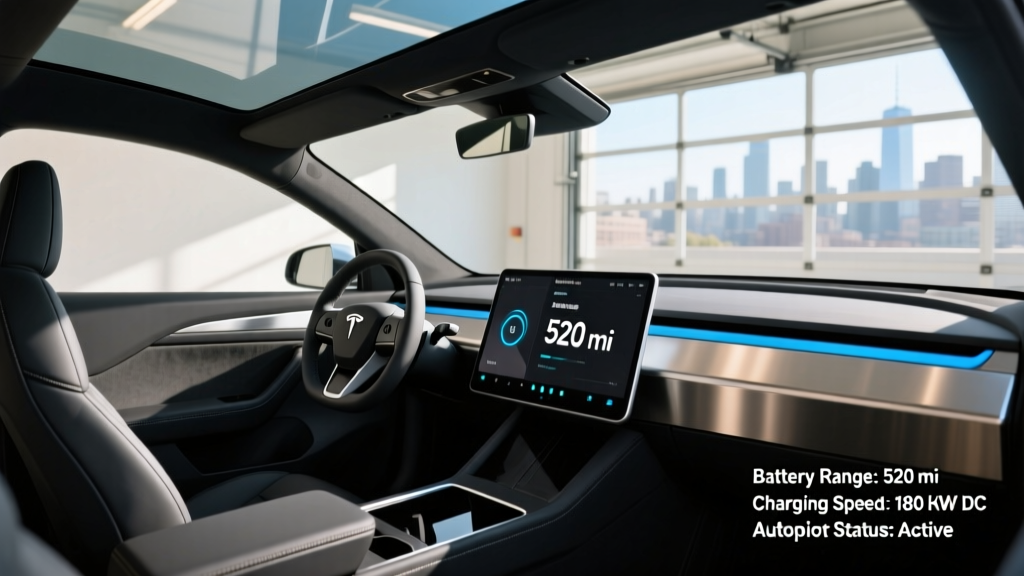
Inside the cabin, the 18.5-inch front touchscreen dominates the dashboard. Rear passengers get a 9.4-inch touchscreen mounted on the back of the center console — a first for a Tesla. There are no physical buttons for HVAC or media; everything routes through the front display or voice commands. The steering yoke (standard) takes adaptation: it offers no hand-over-hand rotation for low-speed maneuvers, and Tesla does not currently offer a round wheel option on 2026 models.
Tech, Driver Assistance, and Notable Drawbacks
The Cybertruck runs Tesla's latest infotainment software with integrated navigation, streaming (Spotify, YouTube, Netflix while parked), and a full-featured mobile app with climate preconditioning, Sentry Mode cameras, and remote bed/tailgate control.
Tesla Autopilot (standard) and Full Self-Driving Supervised (FSD, $8,000 option or $99/mo subscription) are SAE Level 2 systems. This means the driver must remain fully engaged — hands on the yoke, eyes on the road — at all times. FSD handles highway lane changes, stoplight recognition, and some city-street navigation, but it is not autonomous. Only Level 4 services like Waymo operate without a human driver.
Standout tech features:
- Steer-by-wire with rear-wheel steering (crab mode at low speeds, tighter turning radius than a Model S)
- 48-volt electrical architecture (industry first for a production truck — enables thinner wiring, more power to accessories)
- Bioweapon Defense Mode (HEPA cabin filtration)
- Powershare: 120V and 240V bed outlets (up to 11.5 kW export — enough to run power tools or back up a home circuit)
- Sentry Mode with 360-degree camera recording
Notable drawbacks:
- Yoke-only steering — no round wheel option; controversial for low-speed parking and off-road use
- Rear visibility is poor due to the sail-pillar design; Tesla relies on a digital rearview camera mirror
- No Apple CarPlay or Android Auto
- Stainless-steel body shows fingerprints immediately; Tesla sells a ceramic coating option (~$2,500)
- Insurance costs are significantly higher than average — expect $3,000–$4,500/year depending on state and driving record
Pricing, Trim Levels, and Federal Tax Credit Eligibility
| Trim | Base MSRP | As-Tested (typical options) | Federal §30D Credit Eligibility |
|---|---|---|---|
| AWD (Dual Motor) | $79,990 | $84,000–$88,000 | Not eligible (MSRP exceeds $80,000 truck cap) |
| Cyberbeast (Tri Motor) | $99,990 | $105,000–$112,000 | Not eligible (MSRP exceeds $80,000 truck cap) |
The Cybertruck does not qualify for the IRS §30D new clean vehicle credit. Under current federal rules, pickup trucks must have an MSRP at or below $80,000 to be eligible for the up-to-$7,500 credit. The AWD trim's base MSRP of $79,990 technically sits at the threshold, but mandatory destination charges and any option package push it over the cap. The Cyberbeast at $99,990 is well beyond the limit.
Additionally, §30D requires buyer income below $300,000 (joint filers) / $150,000 (single) and compliance with battery critical-mineral and component sourcing rules. Even if a base AWD Cybertruck could be ordered at exactly $79,990 with no options (rare in practice), buyers should verify current-year IRS §30D guidance and consult a tax professional before assuming eligibility.
Used Cybertruck credit: A pre-owned Cybertruck (model-year 2024 or later, purchased from a dealer for $25,000+ below its original MSRP — unlikely at current market rates) could theoretically qualify for the up-to-$4,000 used-EV credit (§25E), but market pricing makes this impractical in 2026.
Pros, Cons, and Who Should Buy
- Class-leading 11,000-lb towing capacity with integrated trailer brake controller
- 800V architecture enables fastest-in-class DC charging (350 kW peak)
- Steer-by-wire + rear-wheel steering gives a car-like turning radius
- Powershare 240V outlet enables job-site and emergency home backup use
- Stainless-steel body requires no paint — no chips, no clear-coat failure
- Massive 123-kWh battery delivers strong real-world range for a truck
- Does not qualify for the $7,500 federal EV tax credit (MSRP cap)
- Yoke-only steering is polarizing and impractical for some drivers
- High insurance premiums ($3,000–$4,500/yr) due to repair cost and theft risk
- Bed shape and tonneau limit cargo versatility vs. conventional pickups
- Poor rear visibility; heavy reliance on camera mirror
- No Apple CarPlay or Android Auto integration
Who the Cybertruck Suits Best
Ideal for: Tech-forward buyers who want a daily-driver EV truck with job-site capability (Powershare 240V), strong towing, and the fastest Supercharger access in the industry. The 340-mile range and 17-minute DC fast charge make road trips viable without extreme planning.
Not ideal for: Budget-conscious buyers (no tax credit, high insurance), traditional truck users who need a wide-open 6.5-foot bed with a flat load floor, or anyone unwilling to adapt to yoke-only steering and a screen-centric interface.
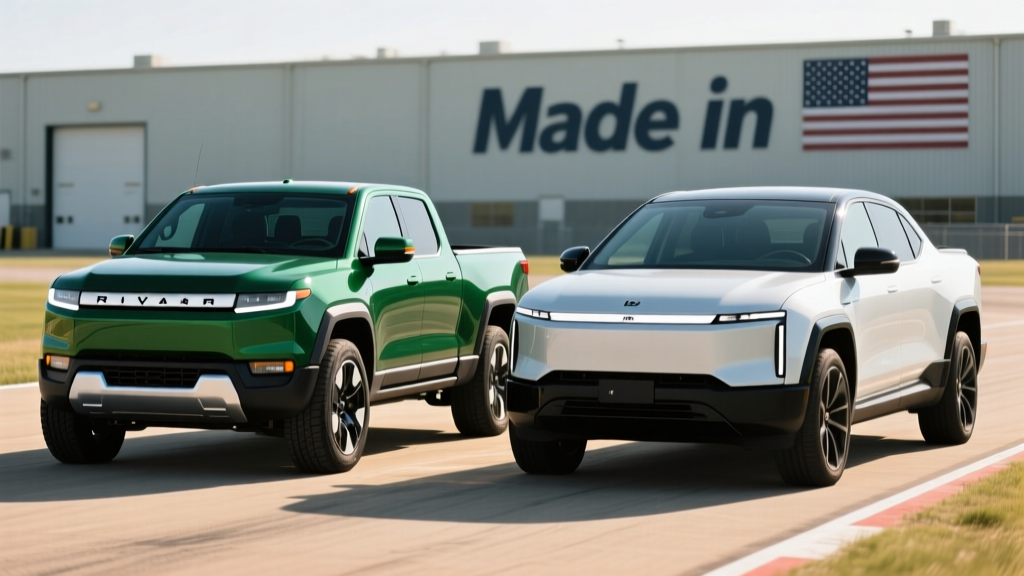
Key competitors: The Rivian R1T (Dual Motor, ~$75,000, ~352 mi range, qualifies for tax credit on eligible trims) offers a more conventional interior, a gear tunnel for cargo, and round steering wheel. The Ford F-150 Lightning (~$55,000–$96,000, ~240–320 mi range, tax-credit eligible on Lariat/XLT trims) provides a traditional truck experience with a massive frunk and Pro Power Onboard. Neither matches the Cybertruck's 350-kW charge rate, however.
Frequently Asked Questions
What is the real-world range of the Tesla Cybertruck?
The EPA rates the AWD Cybertruck at 340 miles and the Cyberbeast at 320 miles. In real-world highway driving at 70–75 mph, expect 270–300 miles. Cold weather (below freezing) can drop this to 220–260 miles. Towing cuts range roughly in half.
How fast does the Cybertruck charge at home and on the road?
On a 48-amp Level 2 home charger, the Cybertruck adds ~34 miles of range per hour (full charge in ~10–11 hours). At a V4 Supercharger, it peaks at 350 kW and charges from 10–80% in approximately 17 minutes with battery preconditioning. Third-party CCS networks cap at 250 kW with the adapter.
Does the Cybertruck qualify for the federal EV tax credit?
No. Under IRS §30D rules, trucks must have an MSRP at or below $80,000. The Cybertruck AWD starts at $79,990 but destination fees and any options push it over the cap. The Cyberbeast at $99,990 is far above the limit. Always verify current-year rules at irs.gov.
Is the Cybertruck interior practical for a family?
It seats five, and rear legroom (~38.5 inches) is adequate for adults on shorter trips. However, the yoke steering, screen-only controls, and limited rear visibility make it less family-friendly than a Rivian R1T or F-150 Lightning. The rear touchscreen for passengers is a nice touch for entertainment on road trips.
What battery chemistry does the Cybertruck use?
The Cybertruck uses an NMC (nickel-manganese-cobalt) lithium-ion battery pack with approximately 123 kWh of usable capacity. NMC offers higher energy density than LFP (lithium iron phosphate), which is necessary given the truck's size and range targets. Tesla recommends charging to 80% daily for NMC longevity, reserving 100% for road trips.
Is the Cybertruck worth buying over the Rivian R1T or F-150 Lightning?
If you prioritize the fastest DC charging, the highest towing capacity (11,000 lbs), and Tesla's Supercharger network, the Cybertruck is the strongest choice. If you want tax-credit eligibility, a more conventional interior, or a round steering wheel, the Rivian R1T or F-150 Lightning are more practical. Test-drive all three before deciding — the Cybertruck's yoke and screen-centric cabin are not for everyone.