If you have been searching for what the inside of a Tesla truck looks like, the answer is equal parts radical and practical. The Tesla Cybertruck ditches traditional gauges, door handles, and even a conventional glove box in favor of a minimalist stainless-steel cockpit dominated by a single massive touchscreen. But beyond the headline design, buyers need to know whether the cabin actually works for daily driving, road trips, towing, and family duty — and whether the numbers behind the truck justify its $79,990+ starting price.
This review covers the Cybertruck's interior layout, materials, cargo space, and technology in detail, then backs it up with the hard data every EV buyer needs: EPA range, battery chemistry, DC fast-charging speeds, real-world efficiency, federal tax credit eligibility, and how it stacks up against the Ford F-150 Lightning and Rivian R1T.
What Does the Inside of a Tesla Truck Look Like?
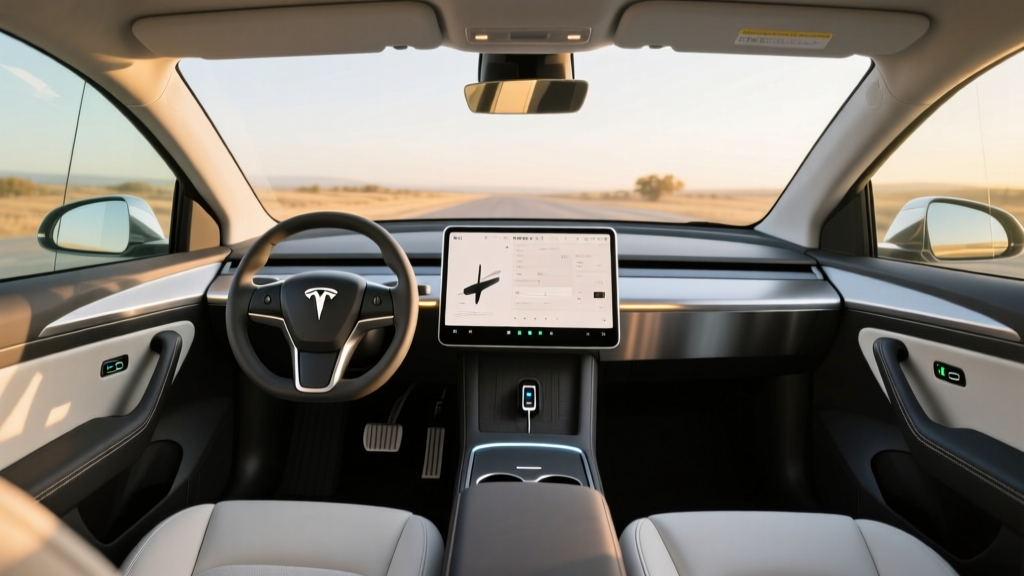
The Cybertruck interior is a study in extreme minimalism. There is no instrument cluster, no physical buttons on the dash, no traditional HVAC vents, and no visible door handles — doors open via electronic buttons on the door panel edges. Everything routes through a single 18.5-inch touchscreen that controls climate, media, navigation, vehicle settings, and even the windshield wipers.
The dashboard is wrapped in a dark microfiber-textile material with a geometric angular pattern that echoes the truck's exterior origami folds. Trim pieces use a cold-rolled stainless steel look that ties directly to the exoskeleton body. There is no wood, no chrome, and no leather — Tesla uses a vegan synthetic material called "Tesla Synthetic Material" on the seats, which are heavily bolstered and heated/ventilated in all rows.
The steering wheel is a flat-top, flat-bottom yoke-style design (a round wheel is available as a no-cost option on 2025–2026 models). Turn signals are buttons on the yoke rather than a traditional stalk, which remains the single most polarizing design choice in the cabin. A second 9.4-inch touchscreen sits behind the center console for rear-seat passengers, giving them independent climate and media control.
Front Row: Space, Visibility, and Ergonomics
Front legroom measures 41.5 inches, and headroom is generous at 41.1 inches thanks to the flat floor and high roofline. The seating position is upright and commanding — you sit on the truck rather than in it, with sightlines over the angular hood that take a few days to internalize. The massive windshield provides excellent forward visibility, though the thick A-pillars and angular rear window create notable blind spots that the camera-based mirror system partially compensates for.
The center console is a large, flat-top storage bin with a wireless charging pad on top and a deep cubby below. There is no traditional glove box — instead, a lockable storage compartment lives under the center armrest. Cupholders are hidden beneath a sliding panel. Two USB-C ports (up to 65W each) handle device charging in the front row.
Second Row: Passenger Comfort and Compromise
Rear legroom comes in at 38.5 inches, which is adequate for adults on shorter trips but tighter than a Ford F-150 Lightning's 43.6 inches. The rear bench seats three, but the center position is best suited for a child due to the transmission tunnel hump (which houses the 48V electrical system components). Headroom is 38.2 inches, and the sloping roofline makes taller passengers feel the squeeze.
Rear passengers get their own 9.4-inch touchscreen, two USB-C ports, and dedicated HVAC vents — a meaningful upgrade over the Model Y's rear setup. The seatbacks fold in a 60/40 split, and when folded flat, the load floor is nearly level with the bed, creating a pass-through for long cargo.
Cybertruck Range, Battery, and Efficiency
The AWD Cybertruck carries an EPA-estimated 340 miles of range on its dual-motor configuration. The tri-motor Cyberbeast drops to 320 miles EPA due to its higher performance tuning and weight.
Real-world note: Expect 270–300 miles on highway road trips at 70–75 mph. In cold weather (below 32°F), range can drop 20–30%, putting real-world winter highway range closer to 220–250 miles. Towing a 7,000-lb trailer cuts range roughly in half — plan for 140–170 miles between charges under load.
The Cybertruck uses an estimated ~123 kWh usable battery pack built on Tesla's 4680 structural cell architecture. Tesla has not officially published the exact usable kWh figure, but teardown analyses and EPA filing data place it in the 120–125 kWh range. The cells use a high-nickel NMC-type chemistry optimized for energy density and structural rigidity — the battery pack itself serves as a stressed member of the chassis, reducing overall vehicle weight.
Efficiency comes in at 70 MPGe combined for the AWD model, which translates to roughly 48 kWh per 100 miles — a typical figure for a 6,600+ lb electric pickup. The Cyberbeast's efficiency is slightly lower due to its tri-motor powertrain.
| Spec | AWD | Cyberbeast (Tri-Motor) |
|---|---|---|
| EPA Range | 340 miles | 320 miles |
| Battery (usable, est.) | ~123 kWh (4680 NMC) | ~123 kWh (4680 NMC) |
| Horsepower | 600 hp | 845 hp |
| 0–60 mph | 4.1 seconds | 2.6 seconds |
| Drivetrain | Dual-motor AWD | Tri-motor AWD |
| MPGe (combined) | 70 MPGe | 68 MPGe |
| Max Towing | 11,000 lbs | 11,000 lbs |
| Payload | 2,500 lbs | 2,500 lbs |
| Base MSRP | $79,990 | $99,990 |
Charging Speed: DC Fast Charging and Home Level 2
Charging speed is where the Cybertruck's 800V architecture and 4680 cells shine — but only at compatible chargers. Here is the full picture:
| Charging Level | Power / Rate | Speed |
|---|---|---|
| Level 1 (120V household) | ~1.4 kW | ~3 miles per hour |
| Level 2 (240V / 48A home) | 11.5 kW | ~26 miles per hour |
| Level 2 (240V / 80A Wall Connector) | 19.2 kW | ~44 miles per hour |
| DC Fast Charge (V4 Supercharger) | Peak 350 kW | 10–80% in ~15 minutes |
| DC Fast Charge (250 kW V3 Supercharger) | Peak 250 kW | 10–80% in ~22 minutes |
| DC Fast Charge (CCS adapter, non-Tesla) | Peak 150–200 kW | 10–80% in ~30–40 minutes |
Charging curve reality: The Cybertruck peaks at 350 kW only at Tesla V4 Superchargers and only when the battery is preconditioned (the truck does this automatically when you navigate to a Supercharger). Peak rate is sustained from roughly 10–30% state of charge, then tapers progressively. From 50–80%, expect average rates closer to 120–150 kW. This means the advertised 15-minute 10–80% time is achievable but requires ideal conditions: a V4 stall, warm battery, and low state of charge on arrival.
For home charging, the Tesla Wall Connector at 80 amps adds roughly 44 miles of range per hour — enough to fully replenish the pack in about 9 hours overnight. Most owners on a 48-amp circuit will see closer to 26 miles per hour, requiring 12–13 hours for a full charge. Given the Cybertruck's ~123 kWh pack, a 200-amp home electrical panel is strongly recommended; a panel upgrade to 200A or 400A may be necessary and typically costs $1,500–$4,000 from a licensed electrician.
Pricing, Tax Credits, and Total Cost
The Cybertruck's pricing has stabilized after the initial Foundation Series premiums. As of the 2026 model year:
| Trim | Base MSRP | Federal §30D Credit | Effective Price |
|---|---|---|---|
| AWD | $79,990 | Up to $7,500* | ~$72,490 |
| Cyberbeast | $99,990 | Up to $7,500* | ~$92,490 |
*Federal tax credit eligibility is not guaranteed. Under IRS §30D rules, the Cybertruck qualifies for the full $7,500 credit only if:
- MSRP cap: The truck must have an MSRP at or below $80,000 (trucks/vans/SUVs). The AWD at $79,990 clears this; the Cyberbeast at $99,990 does NOT qualify.
- Income cap: Buyer AGI must not exceed $150,000 (single), $225,000 (head of household), or $300,000 (joint).
- Battery sourcing: Critical minerals and battery components must meet escalating domestic-content thresholds per IRS qualifying vehicle list. Tesla has largely met these requirements for US-built vehicles, but always verify the specific VIN on the IRS portal before purchase.
- Point-of-sale transfer: The $7,500 credit can be applied at the dealership as a price reduction, effectively lowering your out-of-pocket cost.
This means the Cyberbeast — at $99,990 MSRP — exceeds the $80,000 truck MSRP cap and is ineligible for the federal credit. Only the AWD model qualifies, and only for buyers within the income limits. Consult a tax professional and check the IRS clean vehicle credit page for the latest qualifying vehicle list.
Interior Cargo, Storage, and Utility
The Cybertruck's angular design creates unique storage opportunities — and some compromises. Here are the hard dimensions:
Bed (the "Vault"): 6 feet long × 4 feet wide between the wheel wells, with a motorized retractable tonneau cover that Tesla claims can support 300 lbs of distributed weight. Total bed volume is approximately 67 cubic feet. The bed includes built-in 120V and 240V outlets (up to 11.5 kW of vehicle-to-load power), integrated LED lighting, and a lockable tailgate.
Frunk (front trunk): Approximately 7.1 cubic feet — enough for a couple of backpacks or charging cables. It is power-operated and lockable.
Interior cargo (behind second row): Limited to the rear seat area itself. With the 60/40 split seats folded, the pass-through to the bed creates a flat load floor suitable for long items like lumber or kayaks.
Sail pillars: The triangular spaces behind the rear doors are enclosed and lockable, providing additional hidden storage — a feature unique to the Cybertruck's geometry. These add roughly 5 cubic feet of secured storage.
Technology, Driver Assistance, and Safety
The Cybertruck runs Tesla's latest vehicle software on a custom AMD Ryzen-based processor with an RDNA 2 GPU — essentially the same silicon found in a PlayStation 5. The 18.5-inch front display runs at high resolution with minimal lag, and the interface is responsive even while running navigation, media, and climate simultaneously.
Driver Assistance — Autopilot and FSD (Supervised):
Tesla's Autopilot and Full Self-Driving (Supervised) are SAE Level 2 driver-assistance systems. They provide adaptive cruise control, lane centering, automatic lane changes, and traffic-light recognition — but the driver must remain fully engaged, hands on the yoke, eyes on the road at all times. This is NOT self-driving. Tesla's camera-only "Tesla Vision" system uses 8 cameras and a neural network for perception, with no lidar or radar.
The Cybertruck includes steer-by-wire steering — there is no mechanical connection between the yoke and the wheels. This enables a variable steering ratio that requires less than one full turn lock-to-lock, which is genuinely useful in parking lots and tight maneuvers but takes significant muscle-memory adjustment. The system has multiple redundancies, but it remains unfamiliar territory for most drivers.
Notable tech features:
- Bioweapon Defense Mode (HEPA cabin air filtration)
- Sentry Mode with 360° camera recording
- Dashcam with front, rear, and side cameras
- Over-the-air software updates adding features post-purchase
- Integrated 15-speaker audio system with immersive sound
- Vehicle-to-load (V2L) power: up to 11.5 kW from bed outlets, enough to power tools, a campsite, or partial home backup
No Apple CarPlay or Android Auto — Tesla's proprietary OS is the only interface. No traditional side mirrors (camera-based mirrors are standard, which some drivers find disorienting). No spare tire — Tesla provides a tire inflator kit. No NACS adapter needed at Superchargers (native NACS port), but CCS adapter required for non-Tesla DC fast chargers.
Warranty and Long-Term Ownership
Tesla provides the following warranty coverage for the Cybertruck:
- Basic Vehicle Limited Warranty: 4 years or 50,000 miles, whichever comes first
- Battery and Drive Unit Warranty: 8 years or 150,000 miles, whichever comes first, with minimum 70% battery capacity retention
- Rear Drive Unit (Cyberbeast): Same 8-year/150,000-mile coverage for all three motors
The 70% retention threshold is industry-standard, though some competitors (like Hyundai with the Ioniq 5) offer a 10-year/100,000-mile battery warranty. Tesla's 4680 cells are relatively new in mass production, so long-term degradation data is still accumulating. Early owner reports at 30,000+ miles suggest degradation in the 5–8% range, which is consistent with NMC chemistry expectations, but multi-year data is still limited.
The stainless steel exoskeleton eliminates paint (the truck ships in raw stainless or a satin wrap), which removes a common source of cosmetic complaints but introduces its own maintenance considerations — fingerprints, water spots, and the inability to touch up scratches with paint.
Cybertruck vs. F-150 Lightning vs. Rivian R1T
The Cybertruck competes directly with the Ford F-150 Lightning and Rivian R1T. Here is how they compare on the metrics that matter:
| Spec | Tesla Cybertruck AWD | Ford F-150 Lightning Extended Range | Rivian R1T Dual-Motor Max |
|---|---|---|---|
| EPA Range | 340 mi | 320 mi | 410 mi |
| Battery (usable) | ~123 kWh | 131 kWh | 149 kWh |
| Peak DC Charge | 350 kW | 150 kW | 220 kW |
| 10–80% DC Time | ~15 min | ~41 min | ~30 min |
| 0–60 mph | 4.1 sec | 3.8 sec | 3.5 sec |
| Horsepower | 600 hp | 580 hp | 665 hp |
| Max Towing | 11,000 lbs | 10,000 lbs | 11,000 lbs |
| Rear Legroom | 38.5 in | 43.6 in | 38.0 in |
| Base MSRP | $79,990 | $67,995 | $79,900 |
| Federal Credit | Up to $7,500 (AWD only) | Up to $7,500 | Up to $7,500 |
The F-150 Lightning wins on rear-seat space, lower starting price, and proven truck ergonomics. The Rivian R1T leads on range and adventure-oriented features (gear tunnel, quad-motor option). The Cybertruck counters with the fastest DC charging, steer-by-wire agility, and the most distinctive design — inside and out — in the segment.
Pros, Cons, and Who Should Buy
- Fastest DC charging in the pickup segment (350 kW peak)
- Steer-by-wire makes a 6,600-lb truck feel nimble in parking lots
- 11.5 kW vehicle-to-load power turns the truck into a mobile generator
- Stainless steel exoskeleton requires no paint maintenance
- Supercharger network access with native NACS — no adapter needed
- Massive 18.5-inch display with responsive, modern UI
- Rear seat is tighter than the F-150 Lightning; tall passengers will complain
- No Apple CarPlay / Android Auto — Tesla-only ecosystem
- Yoke steering and button turn signals require a steep learning curve
- Cyberbeast ($99,990) exceeds $80K MSRP cap — no federal tax credit
- Camera-based side mirrors frustrate some drivers in rain and at night
- No spare tire included; tire inflator kit only
- Cold-weather range loss of 20–30% is significant for a truck this size
Choose the Cybertruck if: You want the fastest-charging electric pickup, value Tesla's Supercharger network, need V2L power for job sites or camping, and are comfortable with a radical minimalist interior and steer-by-wire driving dynamics.
Look elsewhere if: You need maximum rear-seat space for adults (get the F-150 Lightning), want the longest range without towing compromises (get the Rivian R1T Max Pack), prefer traditional truck ergonomics, or rely on Apple CarPlay for your daily commute.
Frequently Asked Questions
What is the real-world range of the Tesla Cybertruck?
The EPA rates the AWD Cybertruck at 340 miles and the Cyberbeast at 320 miles. In real-world highway driving at 70–75 mph, expect 270–300 miles. Cold weather (below freezing) drops this to 220–250 miles. Towing cuts range roughly in half — plan charging stops accordingly.
How fast does the Cybertruck charge at home and on the road?
At a Tesla V4 Supercharger, the Cybertruck peaks at 350 kW and charges from 10–80% in approximately 15 minutes. On a home Level 2 charger at 80 amps (Tesla Wall Connector), it adds about 44 miles of range per hour, fully charging overnight in roughly 9 hours. A standard 48-amp home charger adds ~26 miles per hour.
Does the Cybertruck qualify for the $7,500 federal EV tax credit?
The AWD model at $79,990 MSRP qualifies for up to $7,500 under IRS §30D, provided the buyer's income is within limits ($300,000 joint / $150,000 single) and battery sourcing requirements are met. The Cyberbeast at $99,990 exceeds the $80,000 MSRP cap for trucks and does NOT qualify. Always verify on the IRS clean vehicle page before purchasing.
Is the Cybertruck worth buying over the F-150 Lightning or Rivian R1T?
The Cybertruck wins on charging speed and tech-forward design. The F-150 Lightning wins on price, rear-seat space, and conventional truck usability. The Rivian R1T wins on range and adventure features. Your choice depends on whether you prioritize fast charging and Tesla's ecosystem (Cybertruck), value and practicality (Lightning), or range and versatility (R1T).
What is the Cybertruck's battery chemistry and warranty?
The Cybertruck uses Tesla's 4680 structural cells with a high-nickel NMC-type chemistry, estimated at ~123 kWh usable. The battery and drive unit are warranted for 8 years or 150,000 miles with a minimum 70% capacity retention guarantee.
Does the Cybertruck interior have Apple CarPlay or Android Auto?
No. Tesla does not support Apple CarPlay or Android Auto in any of its vehicles. The Cybertruck uses Tesla's proprietary infotainment system exclusively, accessed through the 18.5-inch front touchscreen and 9.4-inch rear touchscreen.
How much cargo space does the Cybertruck have?
The bed ("Vault") offers approximately 67 cubic feet with a 6-foot length and 4-foot width between wheel wells. The frunk provides 7.1 cubic feet. The enclosed sail pillars behind the rear doors add roughly 5 cubic feet of hidden, lockable storage.
Sources: EPA Fuel Economy, IRS §30D Clean Vehicle Credit, Tesla official specifications. Always verify current pricing, credit eligibility, and specifications with the manufacturer and IRS before purchase.