Why Tesla Cybertruck Insurance Costs More Than You Expect
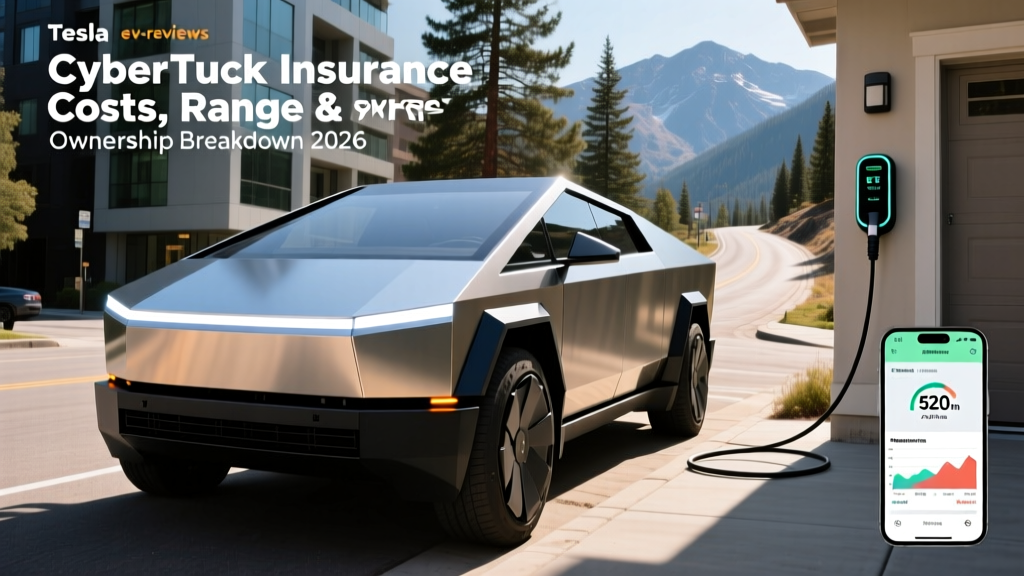
The Tesla Cybertruck is unlike anything else on the road — a stainless-steel exoskeleton, steer-by-wire steering, and a 48-volt electrical architecture that makes it a rolling engineering experiment. That uniqueness is also what makes Tesla Cybertruck insurance one of the most searched ownership questions in 2026. Insurers price risk based on repair frequency, parts cost, and collision data, and the Cybertruck's unconventional construction complicates all three.
Before you sign a delivery agreement, you need the full financial picture: not just the sticker price, but the insurance premium, the charging costs, the real-world range, and whether the federal tax credit actually applies to your situation. This profile covers every number that matters.
Tesla Cybertruck Specs at a Glance
| Attribute | AWD (Dual-Motor) | Cyberbeast (Tri-Motor) |
|---|---|---|
| EPA Range | 340 miles | 320 miles |
| Battery (usable, est.) | ~123 kWh, NMC | ~123 kWh, NMC |
| Horsepower | 600 hp | 845 hp |
| 0–60 mph | 3.9 sec | 2.6 sec |
| Max DC Fast Charge | 250 kW (NACS) | 250 kW (NACS) |
| 10–80% DC Time | ~30 min | ~30 min |
| Level 2 Home Charge | 11.5 kW (~37 mi/hr) | 11.5 kW (~37 mi/hr) |
| MPGe (combined) | 66 MPGe | 62 MPGe |
| kWh / 100 mi | 51 kWh | 54 kWh |
| Towing Capacity | 11,000 lbs | 11,000 lbs |
| Base MSRP | $79,990 | $99,990 |
| Drivetrain | Dual-motor AWD | Tri-motor AWD |
Real-World Range vs. EPA Estimates
EPA Sticker: 340 miles (AWD) / 320 miles (Cyberbeast)
Real-World Expectation: Plan for 260–290 miles on mixed highway driving at 70–75 mph. In cold weather (below 32°F), expect a 20–30% reduction, dropping effective range to roughly 220–250 miles for the AWD trim. The Cybertruck's massive frontal area and 6,800+ lb curb weight penalize highway efficiency far more than city driving, where regenerative braking recovers energy.
The Cybertruck's energy consumption — roughly 51–54 kWh per 100 miles — makes it one of the least efficient EVs on the market. For comparison, a Tesla Model Y Long Range consumes about 28 kWh per 100 miles. That gap matters both for range and charging cost: every mile in a Cybertruck costs nearly twice what it costs in a crossover.
Tesla's range-extender accessory (a bed-mounted battery pack) was announced to push range beyond 470 miles, but as of the 2026 model year, this add-on has faced repeated delays and limited availability. Do not factor it into your purchase decision unless Tesla confirms shipping inventory.
Charging Speed: DC Fast, Home, and the Curve Reality
| Charging Level | Power | Speed / Notes |
|---|---|---|
| Level 1 (120V) | ~1.4 kW | ~4–5 mi/hr — impractical for a 123 kWh pack |
| Level 2 (240V, 48A) | 11.5 kW | ~37 mi/hr — full charge in ~11 hours |
| DC Fast (Tesla Supercharger V3) | Peak 250 kW | 10–80% in ~30 min; tapers sharply above 80% |
| DC Fast (Supercharger V4) | Up to 250 kW* | *Cybertruck currently limited to 250 kW onboard |
The Cybertruck's 800-volt-class architecture theoretically supports faster charging, but Tesla has capped its peak DC rate at 250 kW. At a V3 Supercharger, you'll see peak rates near 250 kW only between roughly 15–40% state of charge. Above 60%, the curve tapers significantly — expect under 100 kW past 70% SoC. This is physics, not a defect: large NMC packs generate substantial heat during high-C-rate charging, and thermal management limits protect long-term battery health.
For home charging, a 48-amp Level 2 circuit (requiring a 60-amp breaker) delivers 11.5 kW. Given the ~123 kWh usable battery, a full charge from near-empty takes roughly 11 hours. Most owners charge overnight and never deplete below 20%, so practical top-up time is 6–8 hours. If your home has a 200-amp electrical panel with capacity, installation runs $500–$1,500 for a Tesla Wall Connector; older panels may require a $2,000–$4,000 service upgrade.
Insurance Costs: What Cybertruck Owners Actually Pay
Based on aggregated 2025–2026 quote data, Tesla Cybertruck insurance averages $3,800–$5,200 per year for a full-coverage policy, depending on trim, driver profile, and state. The Cyberbeast tri-motor variant typically costs 15–25% more to insure than the dual-motor AWD.
Several factors drive these premiums above comparable trucks:
- Stainless-steel exoskeleton repairs: Unlike stamped aluminum or steel panels, the Cybertruck's cold-rolled stainless skin cannot be easily bent back or spot-repaired. Dent or collision damage often requires full panel replacement at high cost.
- Steer-by-wire complexity: The 48V steer-by-wire system has no mechanical column. Any front-end collision involving the steering rack requires specialized calibration and parts that few body shops outside Tesla's network can handle.
- Glass: The windshield is a single, massive curved piece. Replacement costs exceed $2,000 in most markets.
- Weight and performance: At 6,800+ lbs with sub-4-second 0–60 times (AWD), the Cybertruck falls into a high-severity collision bracket for insurers.
Tesla Insurance, offered in select states, uses real-time driving data (via the Tesla app Safety Score) to adjust premiums. Drivers with clean Safety Scores (90+) have reported annual premiums closer to $2,800–$3,400 in favorable states. However, Tesla Insurance is not available nationwide, and third-party carriers like GEICO, Progressive, and State Farm often quote higher rates due to limited historical loss data on the platform.
Recommendation: Before ordering, run quotes from at least three carriers — including Tesla Insurance if available in your state — using the exact VIN configuration you plan to order. The spread between the cheapest and most expensive quote can exceed $1,500/year.
Pricing, Tax Credits, and Total Cost
| Trim | Base MSRP | Federal §30D Credit | Effective Price (est.) |
|---|---|---|---|
| AWD (Dual-Motor) | $79,990 | See eligibility below | $72,490 (if eligible) |
| Cyberbeast (Tri-Motor) | $99,990 | See eligibility below | $92,490 (if eligible) |
Federal tax credit eligibility (§30D) for the Cybertruck is nuanced. The Cybertruck qualifies as a light truck, so the MSRP cap is $80,000 (vs. $55,000 for sedans). The AWD trim at $79,990 sits just under that cap and may qualify for up to $7,500, pending battery-sourcing and critical-mineral requirements. The Cyberbeast at $99,990 exceeds the cap and does not qualify for the new-vehicle credit.
Additional §30D requirements per IRS guidelines:
- Income caps: Modified AGI must not exceed $300,000 (joint), $225,000 (head of household), or $150,000 (single).
- Battery sourcing: A percentage of critical minerals and battery components must be sourced from the U.S. or FTA partners — thresholds increase each year. Tesla's supply chain has shifted substantially, but the exact credit amount ($3,750 or $7,500) depends on the specific battery batch and model-year compliance.
- Point-of-sale transfer: Since 2024, buyers can transfer the credit to the dealer at purchase, reducing the upfront cost rather than waiting for a tax refund. Confirm with your Tesla advisor at delivery.
Consult a tax professional before relying on credit eligibility — IRS rules are subject to change, and the battery-sourcing thresholds tighten annually.
Performance, Cargo, and Daily Practicality
The Cybertruck's performance figures are extraordinary for a vehicle its size. The Cyberbeast's 2.6-second 0–60 time beats most supercars, and the dual-motor AWD's 3.9 seconds is quicker than a Porsche 911 Carrera. Torque-vectoring across the rear dual motors in the Cyberbeast enables tight turns despite the 14-foot length.
Cargo dimensions:
- Bed length: 6 feet (with tailgate closed); extends to ~8 feet with tailgate down
- Bed width (between wheel wells): ~48 inches
- Enclosed vault storage: ~67 cu ft (with tonneau cover closed)
- Frunk: ~7 cu ft — enough for a charging cable and small bag
- Rear-seat legroom: ~41 inches — adequate for adults on short trips, tight for long hauls
- Seating: 5 passengers (3-across rear bench)
The motorized tonneau cover is rated to support 300 lbs of distributed weight and locks automatically. The vault is sealed and drainable — useful for gear, coolers, or wet equipment. However, the angular bed sides and tapered tailgate opening limit the width of flat items you can load compared to a conventional F-150 or Rivian R1T bed.
Standout tech: The 18.5-inch front touchscreen runs Tesla's latest UI with integrated navigation, streaming, and vehicle controls. The rear passengers get a dedicated 9.4-inch screen. Autopilot (Level 2 driver-assist) is standard; Full Self-Driving (Supervised) is a $8,000 add-on or $99/month subscription. FSD remains a Level 2 system requiring active driver supervision — it is not autonomous driving.
Notable drawbacks: The yoke-style steering wheel (standard on Cyberbeast, optional on AWD) requires adaptation and frustrates some drivers during low-speed maneuvers and parking. Visibility is compromised by the thick A-pillars and small rear window. The wiper system uses a single massive blade that some owners report leaves streak patterns at highway speed. Panel-gap consistency has improved through 2025–2026 production but still draws criticism compared to legacy luxury brands.
Battery Warranty, Degradation, and Longevity
Tesla covers the Cybertruck's battery and drive units with an 8-year / 120,000-mile warranty (whichever comes first), guaranteeing a minimum of 70% capacity retention over that period. This is slightly more generous in mileage than the Model 3/Y warranty (8yr/100,000mi), reflecting the truck's heavier use case.
The Cybertruck uses an NMC (nickel-manganese-cobalt) chemistry optimized for energy density and high discharge rates. NMC packs typically degrade 8–12% over the first 100,000 miles, then plateau. Real-world data from high-mileage Tesla owners suggests 15–20% total degradation by 200,000 miles — meaning a 340-mile new battery might deliver ~275–290 miles after 150,000 miles of use.
To maximize longevity: avoid frequent DC fast-charging above 90% SoC, use scheduled departure preconditioning for home charging, and let the battery management system handle thermal conditioning. The Cybertruck's heat pump and octovalve thermal system actively manage battery temperature, which helps in extreme climates.
Who Should Buy the Cybertruck — and Who Shouldn't
Buy the Cybertruck if:
- You need a 11,000-lb towing EV and want the performance/tech envelope of a Tesla
- You value the sealed vault bed, V2L capability (PowerUp outlets in the bed), and off-road clearance
- You're a Tesla ecosystem loyalist who wants Supercharger access (now universal via NACS) and OTA updates
- Insurance costs in your state are manageable (get quotes first)
Look elsewhere if:
- You prioritize energy efficiency — the Rivian R1T and Ford F-150 Lightning consume 20–35% fewer kWh per mile
- You want a conventional truck bed with full-width loading and a tailgate that doubles as a workbench
- Your insurance quotes exceed $5,000/year and compress the TCO advantage over gas trucks
- You need proven long-term reliability data — the Cybertruck's steer-by-wire and 48V architecture are first-generation
Pros and Cons
Pros
- Class-leading acceleration (2.6s Cyberbeast)
- 11,000-lb towing capacity
- Sealed, lockable vault bed with V2L
- Supercharger network access (NACS native)
- Stainless-steel exoskeleton resists corrosion
- Over-the-air updates add features post-purchase
Cons
- High insurance premiums ($3,800–$5,200/yr avg.)
- Poor energy efficiency (51–54 kWh/100mi)
- Real-world highway range well below EPA
- Cyberbeast exceeds §30D MSRP cap — no federal credit
- Yoke steering divisive; visibility compromised
- Limited third-party body shop repair network
Frequently Asked Questions
What is the real-world range of the Tesla Cybertruck?
The EPA rates the AWD at 340 miles and the Cyberbeast at 320 miles. In real-world highway driving at 70–75 mph, expect 260–290 miles. Cold weather (below freezing) can drop that to 220–250 miles due to battery resistance and cabin heating demands.
How fast does the Cybertruck charge at home and on the road?
At a 250 kW DC Supercharger, the Cybertruck charges from 10–80% in approximately 30 minutes, though the rate tapers significantly above 60% SoC. At home on a 48-amp Level 2 charger (11.5 kW), it adds roughly 37 miles of range per hour, requiring about 11 hours for a full charge.
Does the Tesla Cybertruck qualify for the federal EV tax credit?
The AWD trim at $79,990 is under the $80,000 MSRP cap for trucks and may qualify for up to $7,500 under IRS §30D, subject to income limits, battery-sourcing requirements, and point-of-sale transfer rules. The Cyberbeast at $99,990 exceeds the cap and does not qualify. Always verify current rules at IRS.gov and consult a tax professional.
How much does Tesla Cybertruck insurance cost?
Average full-coverage premiums range from $3,800 to $5,200 per year, with Cyberbeast trims costing 15–25% more than the AWD. Tesla Insurance (in eligible states) can reduce this to $2,800–$3,400 for high-Safety-Score drivers. Get at least three quotes before ordering.
Is the Cybertruck worth buying vs. the Rivian R1T or F-150 Lightning?
The Cybertruck wins on acceleration, Supercharger access, and the sealed vault bed. The Rivian R1T offers superior energy efficiency, a more conventional truck bed, and a quad-motor option. The F-150 Lightning provides the lowest cost of entry, better energy efficiency, and a broader dealer service network. If insurance costs and efficiency are priorities, the Lightning or R1T may deliver a lower 5-year total cost of ownership.
What is the Cybertruck's battery warranty?
Tesla warrants the battery and drive units for 8 years or 120,000 miles (whichever comes first), with a minimum 70% capacity retention guarantee over that period.