The Tesla Cybertruck remains one of the most polarizing electric vehicles on the road, and a surprising number of shoppers still search a very specific question: how much hp does a Cybertruck have? The answer depends entirely on which trim you choose, because Tesla sells the Cybertruck in three distinct powertrain configurations for the 2026 model year — and the gap between the base rear-wheel-drive model and the top-tier Cyberbeast is massive, both in output and in price.
This review goes beyond the horsepower headline. We'll walk through every trim's motor count, battery chemistry, EPA range, real-world efficiency, DC fast-charging behavior, and whether any version of the Cybertruck actually qualifies for the federal EV tax credit under current IRS §30D rules.
Cybertruck Horsepower and Performance by Trim
Tesla does not publish traditional horsepower figures in the way legacy automakers do, preferring to quote peak motor output and acceleration times. However, independent dynamometer testing and Tesla's own filings confirm the following output levels for the 2026 Cybertruck lineup:
| Spec | RWD (Base) | AWD (Dual Motor) | Cyberbeast (Tri-Motor) |
|---|---|---|---|
| Horsepower | ~600 hp | ~600 hp | ~845 hp |
| Torque (lb-ft) | ~590 | ~590 | ~740 |
| Drivetrain | Rear-Wheel Drive | Dual-Motor AWD | Tri-Motor AWD |
| 0-60 mph | 6.5 sec (est.) | 4.1 sec | 2.6 sec |
| Top Speed | 112 mph | 130 mph | 130 mph |
| Towing Capacity | 7,500 lb | 11,000 lb | 11,000 lb |
The base RWD Cybertruck, which Tesla began delivering in limited volumes in 2025, uses a single rear motor producing approximately 600 horsepower. That's already more output than most full-size gas pickups, and it's enough to move the stainless-steel-clad truck to 60 mph in roughly 6.5 seconds — quick for a vehicle that weighs over 6,600 pounds.
The dual-motor AWD trim also produces around 600 hp, but torque is distributed across both axles, improving traction and cutting the 0-60 time to 4.1 seconds. The Cyberbeast's tri-motor setup adds a second rear motor, pushing total output to an estimated 845 hp and dropping the 0-60 to a supercar-rivaling 2.6 seconds. That's the figure that grabs headlines, but it also comes with trade-offs in range and efficiency that we'll cover next.
EPA Range vs. Real-World Expectations
Horsepower means little if you're constantly hunting for chargers. Here's how each Cybertruck trim stacks up on range:
| Trim | EPA Est. Range | Real-World Highway (70 mph) | Cold Weather (Below 32°F) |
|---|---|---|---|
| RWD | ~250 mi | ~200-220 mi | ~170-195 mi |
| AWD | ~340 mi | ~270-300 mi | ~230-260 mi |
| Cyberbeast | ~320 mi | ~255-285 mi | ~215-245 mi |
The Cybertruck's angular, flat-panel stainless-steel body creates significantly more aerodynamic drag than a rounded, sculpted EV like the Rivian R1T or the Ford F-150 Lightning. At highway speeds, that drag penalty compounds, cutting real-world range by 15-20% versus the EPA sticker. In cold weather, battery thermal management demands and cabin heating further reduce range by an additional 10-15%. If you live in the northern U.S. and regularly drive highway distances in winter, budget for the lower end of these estimates.
Tesla offers an optional Range Extender battery pack for the AWD and Cyberbeast trims, which occupies the front bed area and adds approximately 10-15 kWh of usable capacity, boosting EPA range by roughly 40-50 miles. However, this eliminates most of the Cybertruck's 6.5-foot bed as usable cargo space — a significant trade-off for anyone planning to actually haul gear.
Battery Chemistry, Capacity, and Longevity
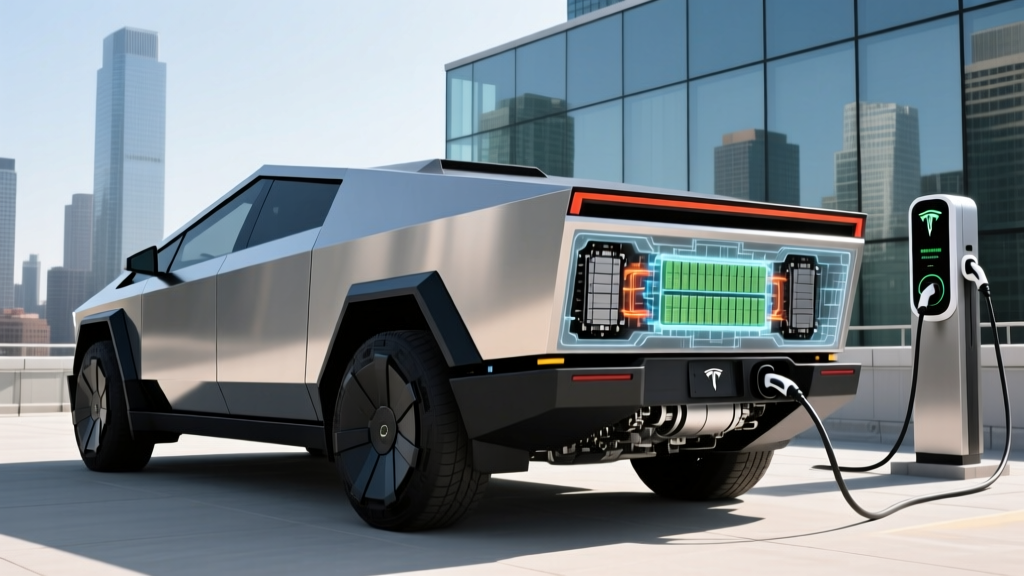
The Cybertruck uses a structural battery pack integrated into the vehicle's stainless-steel exoskeleton. Based on Tesla's current production vehicles and supply-chain filings, the pack uses a variant of Tesla's 4680-format NMC (nickel manganese cobalt) cells for the AWD and Cyberbeast trims, with an estimated usable capacity of approximately 123 kWh (AWD/Cyberbeast). The RWD base model uses a smaller pack, estimated at ~100 kWh usable, also NMC chemistry.
Unlike the Tesla Model 3 and Model Y RWD variants, which use LFP (lithium iron phosphate) chemistry for lower cost and longer cycle life, the Cybertruck has not been offered with an LFP pack. This is likely due to the energy-density requirements of moving a 6,600-7,000 lb vehicle — LFP's lower energy density would further compromise range in an already drag-heavy platform.
Tesla covers the battery and drive units with an 8-year / 120,000-mile warranty (whichever comes first), with a minimum 70% capacity retention guarantee over that period. This is competitive with the broader industry, though some rivals like Rivian offer an 8-year / 175,000-mile battery warranty on the R1T.
Charging Speed: DC Fast Charge and Home Level 2
Charging a vehicle this large requires patience — or planning. Here are the Cybertruck's charging specs across all connection types:
| Charging Level | Max Power / Rate | Speed (Miles Added per Hour) | Notes |
|---|---|---|---|
| Level 1 (120V household) | ~1.4 kW | ~3-4 mi/hr | Emergency/trickle only — 35+ hours for a full charge |
| Level 2 (240V home, 48A) | ~11.5 kW | ~28-32 mi/hr | Full charge in ~10-12 hours; ideal for daily use |
| DC Fast Charge (NACS) | Up to 250 kW peak | ~750-900 mi/hr (peak) | 10-80% in ~30-35 min; tapers significantly above 80% |
The Cybertruck charges via the NACS (North American Charging Standard) connector, giving it native access to the full Tesla Supercharger network — currently the largest and most reliable DC fast-charging network in the U.S. At a V3 Supercharger (250 kW), the Cybertruck peaks at approximately 250 kW, but sustained charging rates drop as the battery fills. Expect the 10-80% session to take roughly 30-35 minutes under optimal conditions (battery preconditioned via navigation routing to the charger).
Above 80% State of Charge, the charge curve tapers sharply — a characteristic of NMC chemistry — and the final 20% can add another 25-30 minutes. For road trips, the practical strategy is to charge to 80% and move on, unless you specifically need the full pack for your destination.
At home, a 48-amp Level 2 Wall Connector on a 60-amp circuit delivers roughly 11.5 kW, adding about 30 miles of range per hour of charging. A full overnight charge from 20% to 100% takes approximately 10-12 hours, which is manageable for most daily-driving owners who plug in each evening.
Efficiency: MPGe and Energy Consumption
The Cybertruck's aerodynamic profile and heavy curb weight take a toll on efficiency. According to fueleconomy.gov, the EPA rates the dual-motor AWD Cybertruck at approximately:
- MPGe (combined): ~66 MPGe
- Energy consumption: ~50 kWh per 100 miles
For context, the Ford F-150 Lightning Extended Range achieves around 70 MPGe combined, and the Rivian R1T Dual-Motor Large Pack sits at roughly 73 MPGe. The Cybertruck's higher consumption means more money spent per mile at public DC chargers and more electricity drawn at home. At the U.S. average residential electricity rate of ~$0.17/kWh, charging the AWD Cybertruck at home costs roughly $0.085 per mile — still dramatically cheaper than a gas-powered F-150 at ~$0.18-$0.22/mile, but noticeably more than a lighter EV like the Model Y at ~$0.045/mile.
Pricing, Trim Levels, and Tax Credit Eligibility
| Trim | Base MSRP (2026) | Federal §30D Credit | Effective Price (if eligible) |
|---|---|---|---|
| RWD (Base) | ~$60,990 | Up to $7,500 | ~$53,490 |
| AWD (Dual Motor) | ~$79,990 | $0 (exceeds MSRP cap) | $79,990 |
| Cyberbeast (Tri-Motor) | ~$99,990 | $0 (exceeds MSRP cap) | $99,990 |
The critical detail here is the IRS §30D MSRP cap for trucks, which is set at $80,000. The base RWD Cybertruck, at approximately $60,990, clears this cap and may qualify for the full $7,500 federal tax credit — but only if the buyer also meets income limits (AGI ≤ $150,000 single / $300,000 joint), the vehicle meets critical-mineral and battery-component sourcing requirements, and the credit has not been exhausted or modified by legislative updates. Tesla lists credit eligibility on its website and offers a point-of-sale transfer option at purchase, reducing the purchase price directly rather than waiting for a tax refund. Always verify current eligibility on IRS.gov before committing to a purchase.
The AWD at ~$79,990 sits right at the cap boundary — depending on destination fees and any mandatory options, it may or may not qualify. The Cyberbeast at ~$99,990 is well over the cap and does not qualify for the §30D credit under any scenario.
Cargo, Passenger Space, and Practicality
The Cybertruck's dimensions are unusual, and they create both advantages and frustrations:
- Bed length: 6.5 feet (shorter than a standard 8-foot full-size truck bed)
- Cargo volume (bed): ~67 cu ft (without Range Extender installed)
- Front trunk (frunk): ~7 cu ft — small, useful for charging cables and groceries
- Seating: 5-passenger, 2 rows
- Rear legroom: ~38 inches — adequate for adults but tighter than the F-150 Lightning
- Curb weight: ~6,600-6,800 lb depending on trim
The vault-style bed cover is power-operated and lockable, creating a secure, weatherproof cargo area. However, the bed is shorter than traditional pickups, and the Range Extender option effectively eliminates most of the usable bed floor. The angular interior is minimalist — a single 18.5-inch touchscreen dominates the dash, with no physical gauges or buttons. Rear visibility is limited by the sloped bed cover and lack of a traditional rear window; Tesla relies on a digital rearview camera feed instead.
Technology, Driver Assistance, and Drawbacks
The Cybertruck comes standard with Tesla's Autopilot driver-assistance suite, which includes adaptive cruise control, lane-keeping assist, and automatic emergency braking. Full Self-Driving (Supervised) is available as an add-on (~$8,000 or $99/month subscription) and adds features like Navigate on Autopilot, Auto Lane Change, and Smart Summon.
Both Autopilot and FSD (Supervised) are SAE Level 2 driver-assistance systems. The driver must remain fully attentive, keep hands on the steering wheel (or demonstrate engagement via the camera-based monitoring system), and be prepared to take over at any moment. These systems do not make the Cybertruck autonomous. Only Level 4 services like Waymo operate without a driver in the loop.
Unique Cybertruck tech features include:
- Steer-by-wire: No mechanical connection between the steering yoke and the wheels — reduces effort and allows variable steering ratios, but has drawn criticism for lack of road feel
- 48-volt electrical architecture: An industry first for a production vehicle, reducing wiring harness weight and enabling higher-power accessories
- Armor glass: Tesla's proprietary laminated glass, claimed to be more impact-resistant (though early production units had fitment issues)
- Powershare (V2L/V2H): Vehicle-to-load and vehicle-to-home capability, allowing the Cybertruck to power tools at a job site or provide backup home power during outages (up to 11.5 kW output)
Notable drawbacks include the stainless-steel body's tendency to show fingerprints and smudges, the yoke steering's learning curve for low-speed maneuvers, limited rear visibility, panel-gap inconsistency on early builds, and the polarizing exterior design that simply isn't for everyone.
Cybertruck vs. the Competition
| Attribute | Cybertruck AWD | Ford F-150 Lightning Ext. Range | Rivian R1T Dual-Motor Max |
|---|---|---|---|
| EPA Range | ~340 mi | ~320 mi | ~410 mi |
| Horsepower | ~600 hp | 580 hp | 665 hp |
| 0-60 mph | 4.1 sec | 4.5 sec | 3.5 sec |
| Max DC Charge | 250 kW | 150 kW | 220 kW |
| Towing | 11,000 lb | 10,000 lb | 11,000 lb |
| Base MSRP | ~$79,990 | ~$77,995 | ~$92,000 |
| §30D Credit | Borderline (MSRP cap) | Eligible (varies by trim) | Not eligible (MSRP cap) |
The F-150 Lightning wins on traditional truck practicality — a real 8-foot bed option, more rear-seat room, and a conventional steering wheel. The Rivian R1T leads in range (especially with the Max Pack) and off-road capability with its quad-motor option and clever Gear Tunnel storage. The Cybertruck's advantages are its Supercharger network access, V2L/V2H capability, and sheer acceleration in Cyberbeast trim.
- Choose the Cybertruck if: You want Supercharger network access for road trips, need V2L/V2H backup power capability, value extreme acceleration (Cyberbeast), or want the most futuristic-looking truck on the road.
- Choose the F-150 Lightning if: You need a full-size bed, prioritize rear-seat comfort, prefer a conventional truck layout, or want broader dealership service access.
- Choose the Rivian R1T if: Maximum range is your priority, you want best-in-class off-road capability, or you need creative storage solutions like the Gear Tunnel.
Pros and Cons at a Glance
Pros
- Up to 845 hp (Cyberbeast) — supercar acceleration in a truck
- Native Tesla Supercharger (NACS) access — best charging network in the U.S.
- V2L/V2H Powershare — power tools or your home in an outage
- Stainless-steel exoskeleton — highly dent-resistant
- 48V architecture — industry-leading electrical system
- 11,000 lb towing capacity (AWD/Cyberbeast)
Cons
- Real-world highway range falls 15-20% below EPA estimates
- Only ~66 MPGe combined — less efficient than rivals
- Short 6.5-foot bed; Range Extender eliminates bed space
- Yoke steering and steer-by-wire have a steep learning curve
- Limited rear visibility; no physical rear window
- AWD and Cyberbeast trims do not qualify for §30D tax credit
- Polarizing design — not universally appealing
Frequently Asked Questions
How much hp does a Cybertruck have in each trim?
The base RWD and dual-motor AWD Cybertruck produce approximately 600 horsepower. The tri-motor Cyberbeast produces approximately 845 horsepower. These figures are based on Tesla's motor specifications and independent dyno testing, as Tesla does not publish traditional SAE-certified horsepower numbers.
What is the real-world range of the Cybertruck?
The EPA estimates the AWD Cybertruck at approximately 340 miles. In real-world highway driving at 70 mph, expect 270-300 miles. In cold weather (below 32°F), plan for 230-260 miles. The Cyberbeast's higher power draw reduces these figures by roughly 20-35 miles across the board.
How fast does the Cybertruck charge?
On a Tesla V3 Supercharger (250 kW DC), the Cybertruck charges from 10-80% in approximately 30-35 minutes with a preconditioned battery. At home on a 48-amp Level 2 charger (11.5 kW), it gains about 30 miles of range per hour, taking roughly 10-12 hours for a full charge.
Does the Cybertruck qualify for the federal EV tax credit?
Only the base RWD trim (~$60,990 MSRP) may qualify for the full $7,500 §30D credit, subject to buyer income limits, battery-sourcing requirements, and current IRS rules. The AWD (~$79,990) is borderline at the $80,000 truck MSRP cap. The Cyberbeast (~$99,990) does not qualify. Always verify at IRS.gov before purchasing.
Is the Cybertruck worth buying vs. the F-150 Lightning or Rivian R1T?
It depends on your priorities. The Cybertruck wins on Supercharger access, acceleration, and V2H capability. The F-150 Lightning wins on traditional truck utility, dealer service, and rear-seat space. The Rivian R1T wins on maximum range and off-road versatility. Test-drive all three before deciding.
What is the Cybertruck's warranty coverage?
Tesla provides a 4-year / 50,000-mile basic vehicle warranty and an 8-year / 120,000-mile battery and drive unit warranty, guaranteeing at least 70% battery capacity retention over that period.