Why Cybertruck Height Matters More Than You Think
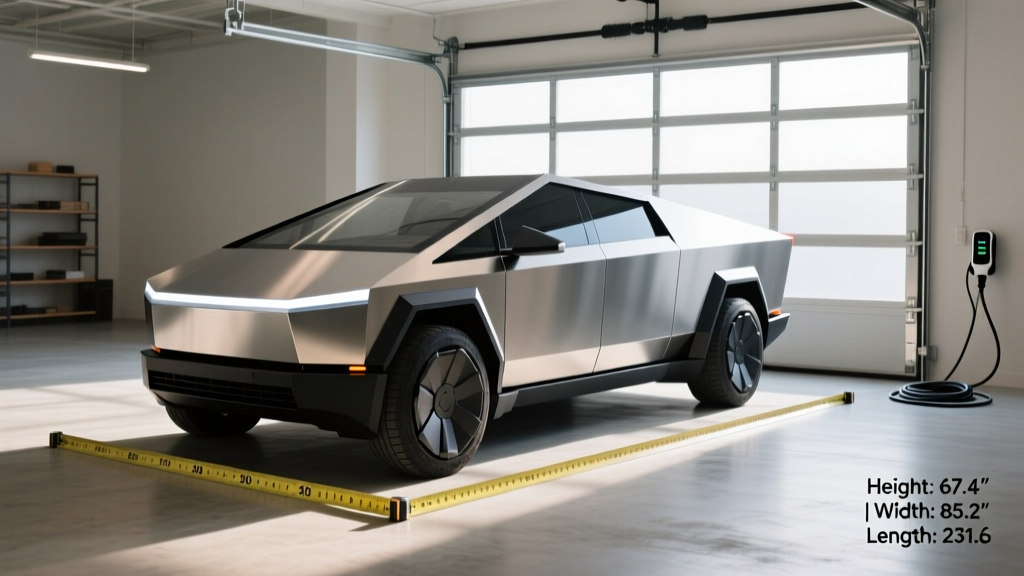
If you've searched "Cybertruck height" you're likely measuring a garage door, carport, or parking structure. The Tesla Cybertruck stands 70.5 inches (5 feet 10.5 inches) tall with the standard air suspension at its default ride height. That's taller than a Ford F-150 Lightning (78.3 in. with mirrors folded, but ~75 in. body height) and significantly taller than any Tesla sedan or crossover. Before we get into range, charging, and ownership economics, let's settle the dimensional questions that drive most garage-fitment searches.
| Dimension | Cybertruck (AWD) | Cyberbeast | F-150 Lightning (for comparison) |
|---|---|---|---|
| Height (standard ride) | 70.5 in / 179.1 cm | 70.5 in / 179.1 cm | ~79.4 in |
| Length | 223.6 in / 568.0 cm | 223.6 in | 232.7 in |
| Width (mirrors folded) | 84.0 in / 213.4 cm | 84.0 in | 83.6 in |
| Width (mirrors out) | 95.0 in / 241.3 cm | 95.0 in | 83.6 in |
| Wheelbase | 143.1 in / 363.5 cm | 143.1 in | 145.5 in |
| Ground Clearance (max) | 17.4 in / 44.2 cm | 17.4 in | 8.9 in |
| Bed Length | 72.0 in (6 ft) | 72.0 in | 67.2 in (5.5 ft) |
| Curb Weight | ~6,600 lbs | ~6,800 lbs | ~6,000 lbs |
The Cybertruck's adaptive air suspension can lower the vehicle approximately 2 inches in "Low" mode (useful for tight garages or aerodynamic highway cruising) and raise it up to 17.4 inches of ground clearance for off-road use. At its lowest setting, expect roughly 68.5 inches of height — still substantial, but enough to clear most standard 7-foot (84-inch) residential garage doors with room to spare. The real concern is width: at 84 inches with mirrors folded, the Cybertruck is wide for older single-car garages.
EPA Range vs. Real-World: What Owners Actually See
EPA Estimated Range:
- AWD (Dual-Motor): 341 miles
- Cyberbeast (Tri-Motor): 320 miles
- RWD (announced, limited availability): ~250+ miles (estimated)
Real-World Expectation: On sustained highway driving at 70-75 mph, expect 260–290 miles in the AWD and 240–270 miles in the Cyberbeast. The Cybertruck's angular stainless-steel body creates a drag coefficient around 0.34 Cd — poor by EV sedan standards but acceptable for a truck. In cold weather (below 32°F), plan for a 15–25% range reduction due to battery chemistry limitations, cabin heating load, and increased air density. The heat pump helps, but physics is physics: a 341-mile EPA truck becomes a ~260-mile truck on a 20°F January highway run.
Tesla uses an NMC (nickel manganese cobalt) lithium-ion battery pack in the Cybertruck. The usable capacity is estimated at approximately 123 kWh (Tesla does not officially publish usable kWh figures, but teardown analysis and charging data place it in this range). NMC chemistry offers high energy density — necessary to push a 6,600-lb stainless-steel vehicle past 300 miles — but it's more sensitive to sustained 100% state-of-charge storage than LFP chemistry. Daily charging to 80-90% is recommended for longevity.
Charging Speed: DC Fast, Level 2, and the Charge Curve Reality
| Charging Level | Power / Rate | Time or Miles Added | Notes |
|---|---|---|---|
| DC Fast Charge (V4 Supercharger) | Peak ~250 kW | 10–80% in ~28 minutes | Sustained rate tapers significantly above 60% SoC |
| DC Fast Charge (3rd-party CCS via adapter) | Up to ~200 kW (varies) | 10–80% in ~35–40 min | Requires Tesla CCS adapter; depends on station output |
| Level 2 (Tesla Wall Connector, 48A) | 11.5 kW | ~37 miles per hour of charging | Full charge in ~11–12 hours |
| Level 2 (standard 240V/32A outlet) | 7.7 kW | ~25 miles per hour | Common for NEMA 14-50 installations |
| Level 1 (120V household) | ~1.4 kW | ~4–5 miles per hour | Emergency/trickle only; full charge takes days |
The Cybertruck's 800-volt-class architecture enables strong DC fast-charging performance, but the charge curve matters more than peak kW. At a V4 Supercharger, the truck pulls close to 250 kW between 10–30% SoC, then gradually steps down. By 60%, you're seeing roughly 120–140 kW; above 80%, it drops to under 50 kW. This is standard for large NMC packs protecting cell health, but it means the advertised "10–80% in 28 minutes" assumes optimal battery preconditioning (navigate to a Supercharger in the nav system to trigger it automatically).
For home charging, the Cybertruck's massive battery makes a Level 2 setup essential. On a 48-amp Tesla Wall Connector, you'll add roughly 37 miles of range per hour — enough to replenish a daily commute overnight. But a full 0–100% charge takes 11+ hours. Never rely on Level 1 (120V) as a primary charging strategy with a pack this large.
Performance, Powertrain, and Efficiency
| Spec | AWD (Dual-Motor) | Cyberbeast (Tri-Motor) |
|---|---|---|
| Drivetrain | Dual-motor AWD | Tri-motor AWD |
| Horsepower | ~600 hp | ~845 hp |
| 0–60 mph | 4.1 seconds | 2.6 seconds |
| Top Speed | 112 mph (governed) | 130 mph (governed) |
| Towing Capacity | 11,000 lbs | 11,000 lbs |
| Payload Capacity | 2,500 lbs | 2,500 lbs |
| EPA Efficiency | ~2.0 kWh/mi (~50 MPGe) | ~2.2 kWh/mi (~45 MPGe) |
The Cyberbeast's 2.6-second 0–60 time is absurd for a vehicle that weighs 6,800 pounds and has a 6-foot bed. But the more relevant daily metric is efficiency: the Cybertruck consumes roughly 2.0 kWh per mile in mixed driving. That's approximately double what a Tesla Model Y uses per mile, which directly impacts charging costs. At the national average electricity rate of ~$0.16/kWh, you're paying about $0.32 per mile to drive a Cybertruck at home — still less than a gas F-150 at $0.40–0.50/mile, but not the bargain that smaller EVs represent.
Towing at or near the 11,000-lb maximum will slash range by 40–50%. This isn't a Tesla-specific issue — it's physics. A Rivian R1T and F-150 Lightning experience similar towing range penalties. Plan charging stops accordingly if you haul a trailer regularly.
Interior, Cargo, and Tech
The Cybertruck seats five across two rows. Rear legroom measures approximately 38.0 inches, which is adequate for adults but not class-leading — the F-150 Lightning SuperCrew offers more rear space. Front headroom is generous thanks to the tall roofline.
Cargo capacity includes:
- Bed (vault): 67 cu ft with the tonneau cover closed; the 6-foot bed is shorter than a full-size F-150's 6.5-foot option but wider between the wheel wells (enough for 4x8 sheets of plywood laid flat — barely).
- Front trunk (frunk): ~7.1 cu ft — useful for charging cables and groceries.
- Under-bed storage: Additional lockable compartments behind the rear wheels.
- Total enclosed cargo: ~120+ cu ft with bed and frunk combined.
The tech suite centers on an 18.5-inch front touchscreen and a 9.4-inch rear touchscreen. There are no physical stalks — turn signals are on the steering wheel rim, and gear selection is via the touchscreen (a backup capacitive strip sits on the overhead console). The steer-by-wire system (Tesla calls it no mechanical linkage between wheel and rack) provides variable-ratio steering that eliminates hand-over-hand turns. It takes adaptation, but most owners report comfort within a week.
Driver assistance comes via Tesla's Autopilot (standard) and Full Self-Driving (Supervised) as a $8,000 option or $99/month subscription. FSD Supervised is SAE Level 2 — the driver must remain fully attentive with hands on the wheel at all times. It is not autonomous driving. See NHTSA's guidance on automated vehicle safety for the regulatory framework.
Pricing, Trims, and Federal Tax Credit Eligibility
| Trim | Base MSRP | Federal §30D Credit | Effective Price (est.) |
|---|---|---|---|
| RWD (announced/limited) | ~$60,990 | Up to $7,500* | ~$53,490 |
| AWD (Dual-Motor) | ~$79,990 | Up to $7,500* | ~$72,490 |
| Cyberbeast (Tri-Motor) | ~$99,990 | Up to $7,500* | ~$92,490 |
*Federal tax credit eligibility depends on buyer income limits, battery component sourcing, and critical mineral requirements under IRS §30D. The Cybertruck is classified as a light truck, so the MSRP cap is $80,000 — meaning the AWD qualifies but the Cyberbeast at $99,990 does NOT qualify for the new-vehicle credit. Point-of-sale transfer is available at participating dealers. Consult a tax professional and see IRS.gov §30D guidelines for current-year rules.
The $80,000 MSRP cap for trucks under §30D is the critical detail. The AWD at ~$79,990 squeaks under the cap and may qualify for up to $7,500, but only if the buyer meets income thresholds ($150,000 single / $300,000 joint for modified AGI) and the battery meets critical-mineral and foreign-entity-of-concern sourcing requirements. These sourcing rules have tightened annually since 2024. Always verify current eligibility before purchase.
Warranty and Long-Term Ownership
Tesla covers the Cybertruck with:
- Basic Vehicle Limited Warranty: 4 years / 50,000 miles
- Battery & Drive Unit Warranty: 8 years / 120,000 miles (whichever comes first), with a minimum 70% capacity retention threshold during the warranty period
- Restraint System: 5 years / 60,000 miles
- Corrosion (perforation): 12 years, unlimited miles (relevant for the stainless-steel exoskeleton)
The 120,000-mile battery warranty on the Cybertruck is slightly more generous than the 100,000-mile coverage on Model 3/Y, reflecting Tesla's confidence in the pack's durability under heavier use. NMC degradation typically follows a curve: expect roughly 5–8% loss in the first 30,000 miles, then a slower linear decline. Most Tesla packs retain 85–90% capacity at 100,000 miles based on fleet data from earlier models.
Insurance costs are notably high. The Cybertruck's stainless-steel body panels, steer-by-wire system, and 48-volt electrical architecture make repairs specialized and expensive. Expect annual premiums 30–50% higher than an equivalently priced F-150 Lightning. Get quotes before purchasing.
Pros
- Class-leading acceleration (Cyberbeast: 2.6s 0–60)
- 11,000-lb towing capacity
- Stainless-steel exoskeleton resists dents and corrosion
- Adaptive air suspension with 17.4 in. max ground clearance
- Access to Tesla Supercharger network (17,000+ stalls in North America)
- Steer-by-wire enables variable ratio and easier parking
- Over-the-air updates continuously add features
Cons
- Efficiency is poor (~2.0 kWh/mi) — high charging cost per mile
- High insurance premiums due to repair complexity
- Cyberbeast ($99,990) does NOT qualify for federal tax credit
- Real-world highway range significantly below EPA (260–290 mi)
- Steep learning curve: no stalks, touchscreen-only gear selection
- 6-foot bed is shorter than many full-size truck beds
- Visibility compromised by angular design and thick pillars
- Rear touchscreen is small and mounted low for passengers
Who Should Buy the Cybertruck (and Who Shouldn't)
Buy the Cybertruck if: You want a performance electric truck with serious towing capability, you have a garage or carport that fits a 70.5-inch-tall, 84-inch-wide vehicle, you value Supercharger access for road trips, and you're comfortable with a tech-forward, minimalist driving experience. The AWD at ~$79,990 (potentially ~$72,490 after tax credit) is the value sweet spot.
Look elsewhere if: You prioritize efficiency and low per-mile charging costs (a Model Y or Rivian R1S will cost far less to fuel), you need maximum rear-seat space for car seats (F-150 Lightning is roomier), you want a traditional truck interface with physical controls, or your budget can't absorb the insurance premium.
Key competitors to cross-shop:
- Ford F-150 Lightning: More conventional, more rear-seat space, lower insurance, Pro Power Onboard for job-site use. Range tops out at ~320 mi (Extended Range).
- Rivian R1T: Quad-motor performance, excellent off-road capability, more refined interior, but pricier and no NACS native charging.
- Chevrolet Silverado EV: Massive 400+ mi range on the top battery, but availability and pricing remain in flux.
Frequently Asked Questions
What is the exact height of the Tesla Cybertruck?
The Cybertruck measures 70.5 inches (179.1 cm) tall at its standard air-suspension ride height. In the lowest suspension setting, it drops to approximately 68.5 inches. Most standard 7-foot (84-inch) garage doors will clear the Cybertruck comfortably.
What is the real-world range of the Cybertruck?
EPA ratings are 341 miles (AWD) and 320 miles (Cyberbeast). Real-world highway driving at 70–75 mph yields approximately 260–290 miles for the AWD and 240–270 for the Cyberbeast. Cold weather below freezing can reduce range by 15–25%. Towing near the 11,000-lb maximum cuts range roughly in half.
How fast does the Cybertruck charge?
On a Tesla V4 Supercharger, the Cybertruck peaks at ~250 kW and charges from 10–80% in approximately 28 minutes with proper battery preconditioning. At home on a 48-amp Level 2 Tesla Wall Connector (11.5 kW), expect about 37 miles of range per hour, or a full charge in roughly 11–12 hours.
Does the Cybertruck qualify for the $7,500 federal EV tax credit?
The AWD trim (~$79,990 MSRP) is under the $80,000 MSRP cap for light trucks and may qualify for up to $7,500 under IRS §30D, subject to buyer income limits ($150K single / $300K joint), battery sourcing requirements, and point-of-sale transfer availability. The Cyberbeast at ~$99,990 exceeds the MSRP cap and does not qualify. Always check current IRS rules before purchasing.
Is the Cybertruck worth buying over the F-150 Lightning?
It depends on priorities. The Cybertruck wins on acceleration, ground clearance, Supercharger access, and corrosion resistance. The F-150 Lightning wins on rear-seat space, conventional controls, lower insurance costs, Pro Power Onboard, and broader dealer service network. Both are capable electric trucks; neither is universally better.
What battery chemistry does the Cybertruck use?
The Cybertruck uses an NMC (nickel manganese cobalt) lithium-ion battery pack with an estimated usable capacity of ~123 kWh. NMC offers high energy density needed for a heavy truck but should be charged to 80–90% for daily use (not 100%) to maximize long-term health. The battery warranty covers 8 years / 120,000 miles with a 70% retention floor.
Can the Cybertruck's air suspension lower for garage entry?
Yes. The adaptive air suspension can lower the vehicle roughly 2 inches from its standard 70.5-inch height to approximately 68.5 inches. You can set this as an automatic geo-fenced action so the truck lowers when approaching your home garage.