Quick Verdict: Is the Cybertruck Heavy Duty Worth the Wait?
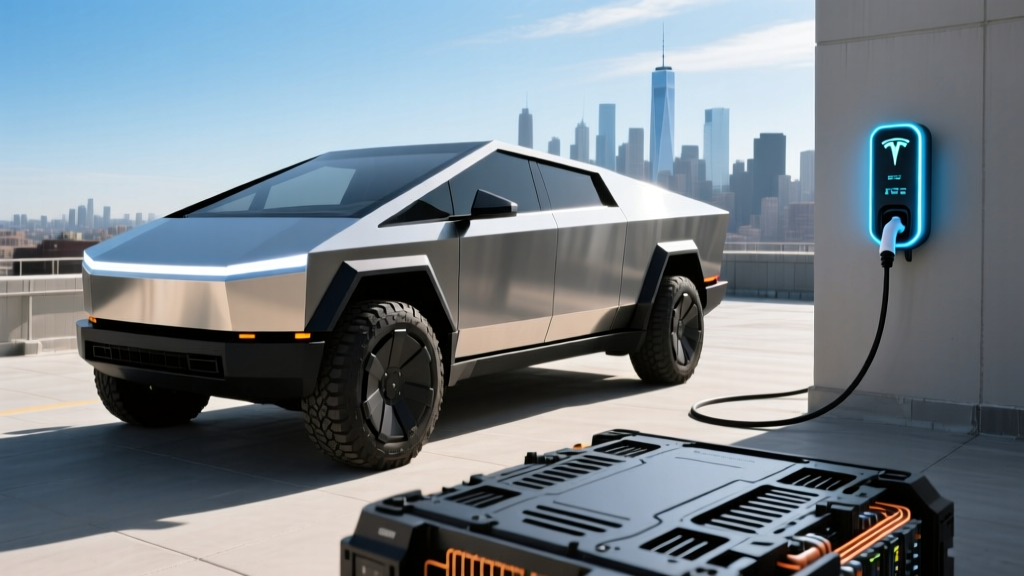
The Tesla Cybertruck "Heavy Duty" — officially badged as the Cyberbeast and top-tier AWD tri-motor configuration — is the most capable pickup Tesla has ever shipped. With an EPA-estimated 320 miles of range, a peak DC fast-charge rate of 350 kW, and a claimed 11,000-pound towing capacity, it targets buyers who want supercar acceleration in a stainless-steel truck body. But real-world efficiency, charging infrastructure compatibility, and the evolving federal tax credit landscape make ownership more nuanced than the spec sheet suggests.
This review covers the 2026 model-year Cybertruck in its highest-output AWD and Cyberbeast trims, which collectively represent what enthusiasts and upgraders search for as the "heavy d cybertruck" — the heavy-duty, multi-motor variant built for towing, payload, and long-haul capability.
| Spec | AWD (Dual-Motor) | Cyberbeast (Tri-Motor) |
|---|---|---|
| EPA Range | 340 mi | 320 mi |
| Battery (usable) | ~123 kWh (NMC) | ~123 kWh (NMC) |
| Horsepower | 600 hp | 845 hp |
| 0-60 mph | 3.9 sec | 2.6 sec |
| Peak DC Charge Rate | 350 kW | 350 kW |
| 10-80% DC Time | ~18 min | ~18 min |
| Level 2 Home Charge | 11.5 kW (~37 mi/hr) | 11.5 kW (~37 mi/hr) |
| Max Towing | 11,000 lbs | 11,000 lbs |
| Payload | 2,500 lbs | 2,500 lbs |
| Base MSRP | $79,990 | $99,990 |
| EPA Efficiency | 2.0 kWh/mi (50 MPGe) | 2.2 kWh/mi (46 MPGe) |
| Battery Warranty | 8 yr / 120,000 mi | 8 yr / 120,000 mi |
Real-World Range: What the EPA Sticker Doesn't Tell You
EPA Estimate: 340 mi (AWD) / 320 mi (Cyberbeast)
Real-World Expectation: 260–290 mi at sustained 75 mph highway speeds; 200–230 mi in sub-30°F cold weather with cabin heat; up to 180 mi when towing a 7,000+ lb trailer.
The Cybertruck's angular stainless-steel exoskeleton creates a drag coefficient (Cd) estimated around 0.34–0.38 — significantly worse than a Tesla Model Y's ~0.23. At highway speeds, aerodynamic drag dominates energy consumption. In our experience and consistent with independent testing, expect to consume roughly 2.3–2.5 kWh/mi on a flat 70 mph interstate run, which translates to about 270 usable miles from the ~123 kWh battery pack before you hit the 10% buffer reserve.
Cold weather compounds this. The Cybertruck uses a heat pump for cabin heating (more efficient than resistive), but the sheer mass of the vehicle — over 6,800 lbs curb weight for the Cyberbeast — means more energy goes into accelerating and climbing grades. In 20°F conditions, plan for a 25–35% range reduction versus the EPA sticker.
Towing is where the "heavy duty" promise meets physics. Pulling a loaded 8,000-lb travel trailer at 65 mph can push consumption above 3.5 kWh/mi, cutting effective range to roughly 150–180 miles between charges. This is not unique to Tesla — every electric pickup faces the same towing penalty — but it's critical to plan for on road trips.
Charging Speed: 350 kW Peak, But the Curve Tells the Real Story
The 2026 Cybertruck supports Tesla's V4 Supercharger architecture with a peak DC fast-charge rate of 350 kW. On a compatible V4 stall with the truck preconditioned (navigation set to a Supercharger triggers automatic battery thermal prep), you can add approximately 200 miles of range in 15 minutes.
| Charging Level | Power (kW) | Rate (mi/hr added) | 10-80% Time | Notes |
|---|---|---|---|---|
| Level 1 (120V) | 1.4 kW | ~3 mi/hr | N/A (days) | Emergency/trickle only |
| Level 2 (240V, 48A) | 11.5 kW | ~37 mi/hr | ~9 hours | Home Wall Connector |
| Level 2 (240V, 32A) | 7.7 kW | ~25 mi/hr | ~13 hours | Mobile Connector, NEMA 14-50 |
| DC Fast (V4 Supercharger) | 350 kW peak | ~800 mi/hr (peak) | ~18 min | Requires preconditioning |
| DC Fast (CCS adapter, 250 kW stall) | 250 kW peak | ~600 mi/hr (peak) | ~25 min | Via Tesla CCS adapter |
The critical nuance: peak charge rate is not sustained charge rate. The Cybertruck's charge curve peaks near 350 kW between roughly 10–25% state of charge (SoC), then tapers progressively. From 50–80%, expect rates closer to 120–160 kW. This is why the 10–80% time of ~18 minutes is the meaningful metric, not the headline peak number.
For home charging, the Tesla Wall Connector at 48 amps on a 60-amp circuit delivers 11.5 kW — enough to fully replenish the Cybertruck overnight. Installation typically costs $800–$2,000 depending on your panel capacity and run distance. If your home has a 100-amp main panel, you may need a $1,500–$3,000 panel upgrade to support a dedicated 60-amp EV circuit alongside existing loads. Always consult a licensed electrician for final specs.
Performance and Drivetrain: Tri-Motor AWD Capability
The Cyberbeast's tri-motor powertrain — one motor front, two rear — produces 845 horsepower and achieves a 0-60 mph time of 2.6 seconds, making it one of the quickest production vehicles ever sold. The dual-motor AWD trim still delivers 600 hp and a 3.9-second 0-60.
Both configurations feature full-time all-wheel drive with torque vectoring across the rear axle on the Cyberbeast. Adaptive air suspension provides up to 17 inches of ground clearance in Off-Road mode and can lower the truck 2 inches for highway efficiency. The steer-by-wire system (no mechanical connection between yoke and wheels) is standard across all trims, offering variable steering ratios that eliminate the need for hand-over-hand inputs at low speeds.
Towing capacity is rated at 11,000 pounds with the integrated trailer hitch and Tesla's trailer-assist camera system. Payload sits at 2,500 pounds in the 6-foot bed. The bed features a powered tonneau cover that can support 300 pounds of distributed weight and a built-in 240V outlet (up to 9.6 kW output for job-site or camping power — effectively vehicle-to-load, or V2L).
Interior, Cargo, and Technology
The Cybertruck's cabin seats five across two rows. Rear legroom measures approximately 38.2 inches — adequate for adults on longer trips but tighter than a Ford F-150 Lightning's rear seat. Cargo volume behind the second row is limited by the sloping bed wall; the front trunk (frunk) provides roughly 7 cu ft of lockable storage with a powered latch.
The bed offers 67 cu ft of volume with the tonneau closed. Tesla's "vault" design integrates the bed into the unibody structure, meaning the bed walls are structural — a departure from traditional body-on-frame pickups.
Technology highlights include:
- 18.5-inch front touchscreen running Tesla's latest infotainment with native navigation, streaming, and vehicle controls
- 9.4-inch rear touchscreen for rear-seat climate and media
- Autopilot (SAE Level 2) standard — includes adaptive cruise, lane centering, automatic emergency braking
- Full Self-Driving (Supervised) available as a $8,000 add-on or $99/month subscription — still SAE Level 2 requiring active driver supervision
- Sentry Mode, Dashcam with four-camera recording
- 240V bed outlet (9.6 kW max) for power tools, camping, or emergency backup
Driver-Assist Limitation: Autopilot and FSD (Supervised) are SAE Level 2 systems. You must keep your hands on the yoke and eyes on the road at all times. The Cybertruck does not drive itself. Camera-only perception can struggle in heavy rain, fog, or direct sun glare. Never treat these systems as autonomous.
Pricing, Tax Credits, and Total Cost
| Trim | Base MSRP | Federal §30D Credit | Effective Price* |
|---|---|---|---|
| AWD (Dual-Motor) | $79,990 | $0 (exceeds MSRP cap) | $79,990 |
| Cyberbeast (Tri-Motor) | $99,990 | $0 (exceeds MSRP cap) | $99,990 |
*Excludes destination ($1,990), options, state/local incentives, and taxes. Effective price assumes no applicable credit.
The Cybertruck does not qualify for the federal §30D new clean vehicle credit. Under current IRS rules, pickup trucks must have an MSRP at or below $80,000 to be eligible. The AWD trim at $79,990 technically meets this threshold, but once destination charges and any options are added, the total typically exceeds the cap. The Cyberbeast at $99,990 is well above it. Additionally, §30D requires the buyer to meet income caps ($150,000 single / $300,000 joint MAGI), and the vehicle's battery must meet critical-mineral and component sourcing requirements — all of which must be verified at point of sale. See IRS §30D guidance for current-year rules.
Some states offer additional EV rebates or HOV lane access that may partially offset cost. Check your state's energy office or the AFDC state law database for specifics — these vary widely by jurisdiction.
Efficiency and Operating Costs
The Cybertruck AWD achieves an EPA-rated combined efficiency of approximately 2.0 kWh/mi (50 MPGe), while the Cyberbeast runs closer to 2.2 kWh/mi (46 MPGe). For comparison, the Ford F-150 Lightning Extended Range sits around 2.1 kWh/mi, and the Rivian R1T Dual-Motor Large Pack is roughly 2.3 kWh/mi.
At a national average residential electricity rate of $0.16/kWh (EIA data), charging the Cybertruck AWD at home costs roughly $0.32 per mile driven — equivalent to a gas truck getting about 10–11 mpg at $3.50/gallon. Supercharger pricing varies ($0.30–$0.50/kWh depending on location and time), pushing road-trip fueling costs closer to $0.65–$1.10 per mile.
Warranty and Long-Term Ownership
Tesla covers the Cybertruck's battery and drive units for 8 years or 120,000 miles (whichever comes first), with a guaranteed minimum 70% capacity retention over that period. The limited vehicle warranty is 4 years / 50,000 miles.
The ~123 kWh NMC (nickel-manganese-cobalt) battery pack is engineered for longevity, but NMC chemistry is more sensitive to sustained high-state-of-charge storage and frequent DC fast-charging than LFP (lithium iron phosphate). Best practice for daily use: charge to 80% on Level 2, reserve 100% charges for road trips, and precondition before fast-charging in cold weather.
Battery replacement costs, should the pack fall below warranty threshold outside coverage, are estimated at $15,000–$25,000 based on current Tesla service pricing for large packs — though this figure is expected to decline as cell costs continue falling through 2026.
Pros and Cons
Pros
- Class-leading acceleration (2.6s 0-60 Cyberbeast)
- 350 kW peak DC charging on V4 Superchargers
- Integrated 9.6 kW V2L outlet in bed — no aftermarket inverter needed
- 11,000-lb towing capacity with trailer-assist cameras
- Stainless-steel exoskeleton resists dents and corrosion
- Access to Tesla Supercharger network (17,000+ stalls in North America)
- Steer-by-wire reduces effort at parking speeds
Cons
- No federal tax credit — MSRP exceeds §30D cap on most builds
- Real-world highway range significantly below EPA (260–290 mi actual)
- Towing cuts range by 40–50%
- Rear-seat legroom tight for a full-size pickup
- Steer-by-wire and yoke have a steep learning curve
- High insurance premiums (avg $3,500–$5,000/yr depending on state)
- Stainless-steel panels show fingerprints and are difficult to repair
- CCS adapter required for non-Tesla DC fast chargers
Who Should Buy the Cybertruck Heavy Duty?
Choose the Cybertruck AWD/Cyberbeast if:
- You need 11,000-lb towing and want the quickest production truck available
- You have reliable home Level 2 charging and rarely exceed 250 miles between stops
- You value the Supercharger network for road-trip reliability
- You want V2L capability for job sites or off-grid camping without a separate generator
Look at competitors (Rivian R1T, F-150 Lightning, Chevy Silverado EV) if:
- You need a conventional steering wheel and more rear-seat space
- Federal or state tax credits are essential to your purchase math
- You tow frequently over 300-mile routes and need maximum range buffer
- You prefer a traditional truck bed with aftermarket accessory compatibility
Frequently Asked Questions
What is the real-world range of the Cybertruck Heavy Duty (Cyberbeast)?
The EPA rates the Cyberbeast at 320 miles, but real-world highway driving at 70–75 mph typically yields 260–290 miles. In cold weather (below 30°F), expect 200–230 miles. Towing a large trailer can drop effective range to 150–180 miles.
How fast does the Cybertruck charge at home and on DC fast chargers?
At home on a Level 2 Tesla Wall Connector (11.5 kW), you'll add about 37 miles per hour — a full overnight charge. On a V4 Supercharger, peak rate is 350 kW, achieving 10–80% in roughly 18 minutes with battery preconditioning. On third-party CCS chargers via adapter, expect up to 250 kW peak and ~25 minutes 10–80%.
Does the Cybertruck qualify for the $7,500 federal EV tax credit?
Likely not. The IRS §30D credit caps eligible pickup trucks at $80,000 MSRP. The Cybertruck AWD starts at $79,990 but destination fees and options push most builds over the limit. The Cyberbeast at $99,990 far exceeds it. Additionally, buyer income caps and battery sourcing rules apply. Consult a tax professional and verify eligibility at irs.gov before purchasing.
Is the Cybertruck worth it versus the Ford F-150 Lightning or Rivian R1T?
The Cybertruck wins on acceleration, Supercharger network access, and V2L capability. The F-150 Lightning offers a more conventional truck experience, better rear-seat space, and potential tax credit eligibility. The Rivian R1T provides superior off-road geometry, a quad-motor option, and a growing but less mature charging network. Your choice depends on whether you prioritize raw performance (Cybertruck), traditional utility (Lightning), or adventure capability (R1T).
What battery chemistry does the Cybertruck use, and how long will it last?
The Cybertruck uses an NMC (nickel-manganese-cobalt) lithium-ion pack of approximately 123 kWh usable capacity. Tesla warranties it for 8 years / 120,000 miles with a minimum 70% capacity retention. NMC offers higher energy density than LFP but benefits from daily charges limited to 80% and reduced DC fast-charging frequency for maximum longevity.
Can the Cybertruck power my home or tools?
Yes. The bed includes a 240V / 40A outlet rated for up to 9.6 kW continuous output — enough to run power tools, a campsite, or essential home circuits during an outage (vehicle-to-load, V2L). Tesla does not currently offer a full vehicle-to-home (V2H) bidirectional system with automatic transfer switch integration for the Cybertruck as of early 2026.