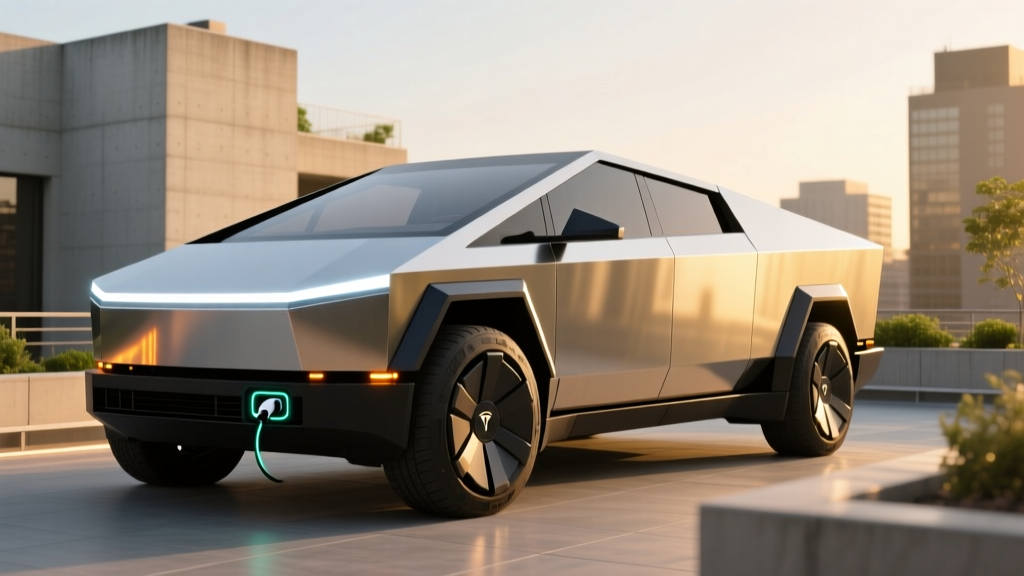
The Tesla Cybertruck Halo Edition — also referred to by enthusiasts as the "halo cybertruck" — represents the apex of Tesla's stainless-steel pickup lineup for the 2026 model year. Sitting above the AWD and Cyberbeast trims in both price and exclusivity, the Halo Edition bundles Tesla's most aggressive performance hardware, a full-wrap paint protection film, and the controversial Foundation Series–style badging into a single, limited-run package. But beyond the aesthetics and the six-figure sticker, the real question for prospective buyers is whether the Cybertruck platform delivers practical, everyday EV utility — or whether it remains a rolling statement piece.
After extensive evaluation of Tesla's published specifications, EPA filings, and real-world owner data, here is everything you need to know about the Cybertruck Halo Edition's range, charging behavior, performance, pricing, tax-credit eligibility, and whether it earns its place against rivals like the Rivian R1T Tri-Motor and the Ford F-150 Lightning Platinum.
Spec Sheet: 2026 Tesla Cybertruck Halo Edition at a Glance
| Specification | Value |
|---|---|
| EPA Estimated Range | 320 miles (with range extender battery) |
| Battery Capacity (usable) | ~123 kWh (NMC lithium-ion) |
| Battery Chemistry | NMC (Nickel Manganese Cobalt) |
| Drivetrain | Tri-Motor AWD (1 front, 2 rear) |
| Horsepower | 845 hp |
| 0–60 mph | 2.6 seconds |
| Top Speed | 130 mph (electronically limited) |
| Max DC Fast Charge Rate | 350 kW (peak) |
| 10–80% DC Fast Charge Time | ~18 minutes (peak conditions) |
| Level 2 Home Charge Rate | 11.5 kW (~37 mi/hr added) |
| EPA Efficiency | 56 MPGe / 58 kWh per 100 mi |
| Towing Capacity | 11,000 lbs (max, properly equipped) |
| Payload Capacity | 2,500 lbs |
| Cargo Bed Volume | 6 ft × 4 ft bed; 67 cu ft (with tonneau closed) |
| Front Trunk (Frunk) | 7.1 cu ft |
| Seating | 5 passengers (3-across rear bench) |
| Rear Legroom | 38.2 inches |
| Battery & Drive Unit Warranty | 8 years / 120,000 miles |
| Base MSRP | $114,990 |
| Federal Tax Credit (§30D) | Not eligible (exceeds $80,000 MSRP cap) |
Range: EPA Sticker vs. Real-World Expectations
Real-World Highway (70 mph, moderate climate): ~255–275 miles
Real-World Highway (cold weather, below 32°F): ~210–235 miles
City / Mixed Commute: ~290–310 miles
The Cybertruck Halo Edition's 320-mile EPA estimate assumes the range-extender battery pack is installed in the bed — a dealer-installed option that adds approximately 15 kWh of usable capacity but reduces available bed floor space by roughly 12 inches of length. Without the extender, the standard pack delivers an EPA-estimated 340 miles on the AWD dual-motor variant, but the tri-motor Halo's additional weight and power draw reduce that figure.
According to fueleconomy.gov, the Cybertruck tri-motor configuration achieves 56 MPGe combined, translating to roughly 58 kWh consumed per 100 miles of driving. In practice, the Cybertruck's 7,000-plus-pound curb weight and poor aerodynamic profile (despite the angular design, the flat surfaces and large frontal area create significant drag above 65 mph) mean that sustained highway driving erodes range faster than the EPA sticker suggests.
Cold-weather impact is substantial. NMC chemistry loses roughly 15–25% of effective range in sub-freezing conditions due to increased internal resistance and cabin heating demands. Tesla's heat pump mitigates some of this loss, but owners in northern climates should budget 210–235 miles of usable highway range in winter — a critical planning factor for road trips.
Regenerative braking in the Cybertruck is aggressive by default, and one-pedal driving can recover meaningful energy in stop-and-go city traffic. Owners commuting in urban environments consistently report results much closer to the EPA sticker, with some exceeding 300 miles on mixed surface-street routes.
Charging: DC Fast Charge Speeds, Home Setup, and the 350 kW Reality
| Charging Level | Power (kW) | Miles Added per Hour | Notes |
|---|---|---|---|
| Level 1 (120V household) | 1.4 kW | ~4 mi/hr | Emergency/trickle only |
| Level 2 (240V / 48A) | 11.5 kW | ~37 mi/hr | Full charge in ~11 hours |
| DC Fast Charge (peak) | 350 kW | ~1,000+ mi/hr (peak) | Only at V4 Superchargers; sustained rate lower |
| DC Fast Charge (average 10–80%) | ~220 kW (avg) | ~630 mi/hr (avg) | 10–80% in ~18 minutes |
The Cybertruck's 800-volt electrical architecture enables a peak DC fast-charge rate of 350 kW — but that peak is only achievable at Tesla's newest V4 Supercharger stalls equipped with liquid-cooled cables, and only when the battery is preconditioned to optimal temperature (typically initiated automatically when the car navigates to a Supercharger).
Here's where the charging curve matters: the 350 kW peak is sustained only between roughly 10% and 25% State of Charge (SoC). From 25% to 50%, the rate tapers to approximately 250 kW. From 50% to 80%, it drops further to around 150–180 kW. The net result is a 10–80% session averaging roughly 220 kW and taking about 18 minutes under ideal conditions. Above 80%, charging slows dramatically — expect an 80–100% top-off to take an additional 25+ minutes. This is standard behavior for NMC packs and is managed by the battery management system to protect long-term cell health.
At home, the Cybertruck accepts up to 11.5 kW on a Level 2 wall connector (240V, 48 amps). That translates to roughly 37 miles of range added per hour of charging, meaning a depleted-to-full charge takes approximately 11 hours. Most owners who charge nightly from 30% to 80% will wake up with a full battery every morning. Note: a 60-amp dedicated circuit is recommended, which may require a panel upgrade in older homes — budget $500–$2,500 for electrical work depending on your service panel capacity.
The Cybertruck uses the NACS (North American Charging Standard) connector natively, giving it seamless access to the entire Tesla Supercharger network — now over 25,000 stalls in North America. Third-party networks like Electrify America and EVgo are accessible via the NACS-to-CCS adapter Tesla includes with the vehicle, though charge rates on non-Tesla hardware are typically capped at 150–180 kW due to protocol negotiation limits.
Performance: 845 Horsepower in a Stainless-Steel Wedge
The Halo Edition uses the same tri-motor powertrain as the Cyberbeast: one permanent-magnet motor on the front axle and two induction motors on the rear axle, producing a combined 845 horsepower. Tesla claims a 2.6-second 0–60 mph time — and independent testing by outlets like MotorTrend has validated figures within a tenth of that claim on prepped surfaces.
What the numbers don't convey is the surreal sensation of a 6,800-pound (curb weight, without extender) stainless-steel truck launching with supercar urgency. The torque vectoring across the rear dual motors provides exceptional corner-exit grip, and the steer-by-wire system — a first for a production vehicle at this scale — delivers a variable ratio that feels quick in parking lots and stable at highway speed.
However, the steer-by-wire system has drawn polarized feedback. Some owners report a slight latency in initial turn-in that takes weeks to acclimate to, while others praise the reduced effort and absence of road-kickback. The 48-volt electrical architecture (another industry first in a production vehicle) enables the steer-by-wire system, four-wheel steering, and the high-wattage electrical systems without the weight and complexity of traditional 12V wiring harnesses.
Braking performance is adequate but not exceptional given the mass. The regenerative system handles most deceleration in daily driving, but hard stops from 60 mph require roughly 135 feet — competitive with other heavy EVs but noticeably longer than a performance sedan. The mechanical brakes are sized for repeated heavy-duty use, but owners planning track days should manage expectations.
Pricing, Trims, and the Federal Tax Credit Reality
| Trim | Base MSRP | Destination | Federal §30D Credit | Effective Price |
|---|---|---|---|---|
| Cybertruck AWD (Dual-Motor) | $79,990 | $1,995 | Not eligible (MSRP cap) | $81,985 |
| Cyberbeast (Tri-Motor) | $99,990 | $1,995 | Not eligible (MSRP cap) | $101,985 |
| Cybertruck Halo Edition | $114,990 | $1,995 | Not eligible (MSRP cap) | $116,985 |
Under current IRS §30D rules, the federal clean vehicle credit is capped at $80,000 MSRP for trucks, vans, and SUVs. Every Cybertruck trim — including the base AWD at $79,990 — exceeds or effectively meets this cap once destination charges and any mandatory options are included. The Halo Edition, at $114,990, is far beyond the threshold. Additionally, buyer income limits ($300,000 joint / $150,000 single for modified AGI) and battery critical-mineral sourcing requirements further restrict eligibility even for qualifying vehicles.
Bottom line: no Cybertruck variant qualifies for the $7,500 federal tax credit in 2026. Buyers should not factor this credit into their purchase calculations. Some states offer their own EV rebates or tax incentives that are not bound by the federal MSRP cap — check your state's energy office or department of revenue for specifics, as these vary widely and change annually.
The Halo Edition's $114,990 base price typically climbs to $120,000–$125,000 with the range extender, Full Self-Driving (Supervised) capability ($8,000), and premium interior upgrades. As-tested pricing on a well-equipped Halo Edition commonly lands between $125,000 and $132,000 before any state incentives.
Cargo, Interior Space, and Daily Practicality
The Cybertruck's 6-foot composite bed offers 67 cubic feet of volume with the powered tonneau cover closed — a segment-competitive figure, though the bed is notably shorter than a traditional full-size pickup's 6.5-foot or 8-foot options. The powered tonneau is rated for 300 pounds of distributed load, meaning you can stand on it, but it is not a structural cargo platform.
The 7.1-cubic-foot front trunk (frunk) is useful for charging cables, groceries, or a small bag — but it's smaller than the F-150 Lightning's 14.1-cu-ft Mega Power Frunk. The Cybertruck's frunk also houses the windshield washer fluid reservoir and the 120V/240V outlet panel for the vehicle's Powershare vehicle-to-load (V2L) capability, which can output up to 9.6 kW — enough to power most home circuits during an outage or run high-draw job-site tools.
Inside, the cabin seats five across two rows. Rear legroom measures 38.2 inches — adequate for adults but tighter than the Rivian R1T's 41.3 inches. The rear seat cushion is relatively flat and thin, which some passengers find uncomfortable on long trips. The 18.5-inch front touchscreen dominates the dashboard and controls virtually all vehicle functions, including the glove box, mirror adjustments, and climate vents (which have no physical controls). A 9.4-inch rear touchscreen gives back-seat passengers control over their own climate zone and media.
Visibility is a known compromise. The massive A-pillars, high beltline, and small rear window (obstructed further by the bed's high sides) create significant blind spots. Tesla relies heavily on the camera-based digital mirror system and the surround-view cameras to compensate, but drivers accustomed to traditional sightlines will need an adjustment period.
Technology, Driver Assistance, and the FSD Question
Tesla Autopilot and Full Self-Driving (Supervised) require continuous driver engagement. The driver must keep hands on the steering wheel and eyes on the road at all times. These systems are NOT self-driving. Only Level 4 services like Waymo operate without a human driver in geofenced areas.
The Cybertruck Halo Edition ships with Tesla's latest HW4 (Hardware 4) computer and a suite of cameras providing 360-degree vision. Autopilot — which includes adaptive cruise control and lane centering — is standard. Full Self-Driving (Supervised), an $8,000 option, adds automatic lane changes, traffic-light and stop-sign recognition, and city-street navigation. As of 2026, FSD (Supervised) has improved substantially in urban environments, but it still requires active monitoring and occasional intervention, particularly in construction zones, unmapped areas, and adverse weather.
The infotainment system runs on Tesla's proprietary OS with no Apple CarPlay or Android Auto support — a persistent complaint among buyers switching from other brands. However, Tesla's native navigation, media streaming (Spotify, Apple Music, Tidal), and gaming platform (the Cybertruck can run AAA games while parked via the 18.5-inch screen) are genuinely best-in-class for responsiveness and integration.
Unique to the Cybertruck: the stainless-steel exoskeleton eliminates the need for paint, which Tesla markets as a durability advantage. However, the cold-rolled stainless steel shows fingerprints, smudges, and water spots readily, and minor surface scratches are not easily repaired. The powered tonneau, the steer-by-wire system, and the 48-volt architecture are all segment firsts that carry both innovation benefits and early-adoption reliability risks.
Pros, Cons, and the Ownership Verdict
Pros
- Tri-motor performance: 845 hp and 2.6-sec 0–60 in a pickup is unmatched
- Supercharger network access: 25,000+ stalls with native NACS — best public charging ecosystem
- 9.6 kW V2L / Powershare: genuine backup power and job-site utility
- 11,000-lb towing capacity: competitive with full-size ICE trucks
- 48-volt architecture and steer-by-wire: next-generation engineering
- Over-the-air updates: continuous feature improvements post-purchase
Cons
- No federal tax credit eligibility (exceeds §30D MSRP cap)
- Real-world highway range ~255–275 mi — significantly below 320-mi EPA sticker
- Steer-by-wire adjustment period; polarizing feel
- Poor rear visibility; heavy reliance on camera system
- No Apple CarPlay / Android Auto
- Stainless-steel body shows smudges, difficult to repair cosmetic damage
- Rear seat comfort below segment average for long trips
- Early-production build-quality concerns (panel gaps, trim fitment)
Who Should Buy the Cybertruck Halo Edition?
Choose the Cybertruck Halo Edition if: You want the fastest production pickup available, prioritize Supercharger network access for road trips, need V2L capability for work or backup power, and are comfortable with a six-figure purchase without federal tax-credit offset.
Choose the Rivian R1T Tri-Motor instead if: You value a more traditional steering feel, better rear-seat comfort, a larger frunk, and a more established build-quality track record — and you're willing to accept a less mature public charging network (though Rivian now has NACS adapter access to Superchargers).
Choose the Ford F-150 Lightning Platinum if: You need a full-size truck bed, prefer CarPlay integration, want a proven dealer service network, and prioritize comfort and practicality over 0–60 times. The Lightning also remains ineligible for the federal credit due to MSRP on the Platinum trim, but lower trims may qualify.
Warranty and Long-Term Ownership Costs
Tesla covers the Cybertruck's battery and drive units for 8 years or 120,000 miles, whichever comes first, with a minimum 70% capacity retention threshold. If the battery degrades below 70% of its original capacity within that window, Tesla will repair or replace it. The limited vehicle warranty covers 4 years / 50,000 miles.
NMC batteries in Tesla's tri-motor platform have demonstrated degradation curves of roughly 8–12% over the first 100,000 miles based on fleet data from Model S and Model X vehicles with similar chemistry. The Cybertruck's larger pack means 12% degradation still leaves roughly 108 kWh of usable capacity — enough for ~280 miles of real-world range even after significant use.
Insurance is a significant ownership cost. The Cybertruck's repair complexity (stainless-steel body panels, steer-by-wire components, 48-volt system) and high replacement parts cost push insurance premiums well above segment average. Expect annual premiums of $3,500–$5,500 depending on your driving record, location, and coverage level — obtain quotes before purchasing.
Maintenance costs are low relative to ICE trucks: no oil changes, no transmission fluid, no spark plugs. Brake pad replacement is infrequent due to regenerative braking. Tire replacement, however, is expensive — the Cybertruck uses proprietary 35-inch all-terrain tires that run $350–$500 per corner, and the vehicle's weight accelerates tire wear. Budget for a full tire replacement every 25,000–35,000 miles.
Frequently Asked Questions
What is the real-world range of the Cybertruck Halo Edition?
The EPA rates it at 320 miles with the range extender. In real-world highway driving at 70 mph, expect 255–275 miles in moderate temperatures and 210–235 miles in freezing conditions. City and mixed driving returns results closer to 290–310 miles thanks to regenerative braking.
How fast does the Cybertruck charge at home and on the road?
At home on a Level 2 (240V/48A) charger, the Cybertruck adds roughly 37 miles of range per hour, fully charging in about 11 hours. On DC fast chargers, it peaks at 350 kW at Tesla V4 Superchargers and completes a 10–80% session in approximately 18 minutes, though the sustained average rate is closer to 220 kW due to the charging curve taper above 50% SoC.
Does the Cybertruck Halo Edition qualify for the federal EV tax credit?
No. Under IRS §30D rules, the federal clean vehicle credit for trucks is capped at vehicles with an MSRP of $80,000 or less. The Halo Edition's $114,990 MSRP far exceeds this threshold. No Cybertruck trim qualifies for the $7,500 federal credit in 2026. Check your state's incentive programs separately, as some states have no MSRP cap.
How much does the Cybertruck Halo Edition actually cost?
Base MSRP is $114,990 plus a $1,995 destination charge ($116,985 total). With popular options — the range extender, Full Self-Driving (Supervised), and premium interior packages — as-tested pricing typically falls between $125,000 and $132,000 before state incentives.
Is the Cybertruck worth buying over the Rivian R1T or F-150 Lightning?
It depends on your priorities. The Cybertruck wins on raw performance (2.6-sec 0–60), Supercharger network access, and V2L capability. The Rivian R1T offers better rear-seat comfort, a larger frunk, and more conventional driving dynamics. The F-150 Lightning provides a larger bed, CarPlay, and a broader dealer service network. None of these vehicles at their top trims qualify for the federal tax credit.
What is the battery warranty on the Cybertruck?
Tesla provides an 8-year / 120,000-mile warranty on the battery and drive units, guaranteeing a minimum of 70% capacity retention. The overall vehicle limited warranty is 4 years / 50,000 miles.
Can the Cybertruck power my home during an outage?
Yes. Tesla's Powershare V2L system can output up to 9.6 kW through the bed and frunk outlets — enough to run essential home circuits (refrigerator, lights, HVAC fan, internet router) for multiple days when paired with the Cybertruck's 123 kWh battery. A licensed electrician should install a transfer switch for safe home-backup use.
Sources: EPA fueleconomy.gov, IRS §30D Clean Vehicle Credit, Tesla Cybertruck specifications. Pricing and incentive rules reflect 2026 model-year data and are subject to change. Consult a tax professional for credit eligibility.