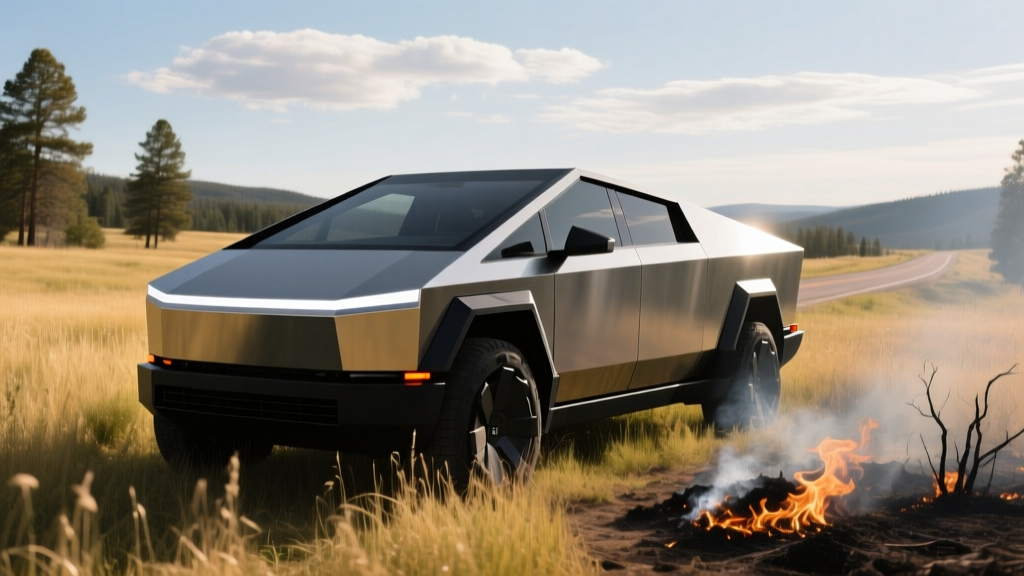
When a Tesla Cybertruck caught fire in a dry Colorado field in mid-2025, sending flames across parched grass and igniting a multi-acre brush fire, the incident went viral almost instantly. The "Tesla Cybertruck grass fire Colorado" footage raised immediate questions among EV shoppers: Is the Cybertruck's stainless-steel exoskeleton and structural battery pack a safety liability in wildfire-prone regions? Does the 4680 cell architecture pose unique thermal risks? And beyond the headlines, what is it actually like to own and drive the 2026 Tesla Cybertruck day-to-day?
This review addresses the Colorado incident head-on with available safety data, then delivers the full spec-driven Cybertruck profile that buyers actually need — EPA range, real-world efficiency, DC fast-charge curves, §30D tax credit eligibility, and how it stacks up against the Ford F-150 Lightning and Rivian R1T in 2026.
The Colorado Grass Fire Incident: What We Know
In the widely shared incident, a Cybertruck traveling on a rural Colorado road experienced a thermal event that ignited dry vegetation along the roadway. Local fire crews responded and contained the brush fire, though the vehicle was a total loss. Tesla and the NHTSA opened parallel reviews, as is standard for any high-profile EV thermal incident.
Key context often missing from social-media coverage:
- EVs do not ignite grass more often than ICE trucks. Catalytic converters on gas pickups routinely reach 1,200–1,800°F and are a documented cause of roadside fires in dry Western states. The National Fire Protection Association has long listed vehicle exhaust systems as a leading ignition source for wildland-urban interface fires.
- Battery thermal events are rare but intense. When a lithium-ion pack does enter thermal runaway, the fire burns hotter and longer than a gasoline fire and requires far more water to suppress. This is true of all large-format EV packs, not just Tesla's.
- The 4680 cells use an NMC-type chemistry (nickel-based), which has higher energy density but lower thermal stability than LFP. Tesla's structural pack integrates cells directly into the chassis with a fire-resistant barrier between the pack and cabin.
- No Cybertruck-specific recall has been issued by NHTSA as of early 2026 tied to this incident. Owners should monitor nhtsa.gov for updates.
2026 Tesla Cybertruck: Specs at a Glance
| Spec | AWD (Dual-Motor) | Cyberbeast (Tri-Motor) |
|---|---|---|
| EPA Range | 340 miles | 320 miles |
| Battery Capacity (usable) | ~123 kWh, NMC (4680 cells) | ~123 kWh, NMC (4680 cells) |
| Horsepower | 600 hp | 845 hp |
| 0-60 mph | 3.9 seconds | 2.6 seconds |
| Drivetrain | Dual-motor AWD | Tri-motor AWD |
| Max DC Fast Charge | 250 kW (peak) | 250 kW (peak) |
| 10-80% DC Charge Time | ~30 minutes | ~30 minutes |
| Level 2 Home Charge | 11.5 kW (~34 mi/hr) | 11.5 kW (~34 mi/hr) |
| Towing Capacity | 11,000 lbs | 11,000 lbs |
| MPGe (combined) | 58 MPGe (2.0 kWh/mi) | 54 MPGe (2.2 kWh/mi) |
| Base MSRP | $79,990 | $99,990 |
| Battery/Drive Unit Warranty | 8 yr / 120,000 mi | 8 yr / 120,000 mi |
Source: fueleconomy.gov and Tesla's 2026 spec sheets. The single-motor RWD variant ($60,990 MSRP) was discontinued for 2026.
Real-World Range: Highway, Cold Weather, and Towing
The EPA rates the dual-motor AWD Cybertruck at 340 miles and the Cyberbeast at 320 miles. As with every EV, the sticker number represents a blended city/highway cycle under moderate conditions. Real-world results diverge meaningfully:
- Highway driving at 75 mph: Expect 260–290 miles on the AWD. The Cybertruck's angular stainless-steel body has a high drag coefficient (~0.34 Cd), which penalizes efficiency at speed far more than in city regen-heavy driving.
- Cold weather (below 32°F): Range drops 20–30% due to battery resistance and cabin heating demands. Colorado winters can compress the 340-mile EPA figure to 240–270 miles. The Cybertruck's heat pump helps but cannot eliminate the physics.
- Towing: With an 8,000-lb trailer, expect roughly 150–180 miles of range. Tesla's range estimator on the 18.5-inch center display factors in trailer load, which is a practical advantage over competitors that lack integrated tow calculators.
- City/regenerative driving: The EPA figure is most achievable here, and some hypermilers report exceeding 340 miles in mild-climate stop-and-go.
The 123 kWh usable battery is one of the largest in any production consumer EV, which gives a substantial buffer even after real-world derating. However, it also means longer charge times at lower-power stations — a consideration we detail below.
Charging Speed: DC Fast and Home Level 2
| Charging Level | Power | Miles Added per Hour | Notes |
|---|---|---|---|
| Level 1 (120V outlet) | ~1.4 kW | ~3 mi/hr | Emergency/trickle only; 40+ hours for full charge |
| Level 2 (240V, 48A) | 11.5 kW | ~34 mi/hr | Full overnight charge in ~11 hours; requires NACS connector |
| DC Fast (Tesla Supercharger V3) | 250 kW peak | ~175 mi in 15 min | 10-80% in ~30 min; tapers sharply above 80% |
| DC Fast (Supercharger V4) | Up to 350 kW (future) | TBD | Cybertruck currently limited to 250 kW by onboard architecture |
Charging-curve reality: The Cybertruck peaks near 250 kW only between roughly 10–30% State of Charge. From 50–80%, the rate tapers to 80–120 kW, and above 80% it drops below 50 kW to protect the 4680 cells. Plan road-trip stops around 10–80% windows; charging from 80–100% at a Supercharger adds 20+ minutes for minimal range gain.
The Cybertruck uses the NACS (North American Charging Standard) connector natively — no adapter needed at Tesla Superchargers. For Electrify America or other CCS networks, a NACS-to-CCS adapter is required (Tesla sells one for ~$250).
Pricing, Tax Credits, and Ownership Cost
| Trim | MSRP | §30D Federal Credit | Effective Price |
|---|---|---|---|
| AWD (Dual-Motor) | $79,990 | $0 (over MSRP cap) | $79,990 |
| Cyberbeast (Tri-Motor) | $99,990 | $0 (over MSRP cap) | $99,990 |
Critical tax-credit detail: Under current IRS §30D rules, the federal EV tax credit caps eligible trucks at an $80,000 MSRP. The AWD Cybertruck at $79,990 squeaks under — but only if the buyer's adjusted gross income falls below the §30D thresholds ($150,000 single / $300,000 joint) and the vehicle's battery sourcing meets critical-mineral and component requirements. Tesla's US-built battery packs have generally qualified, but the rules shift annually. Always verify current eligibility at irs.gov before purchase, and confirm with a tax professional.
The Cyberbeast at $99,990 exceeds the MSRP cap entirely and does not qualify for §30D under any scenario.
Point-of-sale transfer of the credit (available since 2024) allows qualified buyers to apply the credit as an immediate price reduction at the dealer, rather than waiting for a tax refund — but again, only the base AWD trim is eligible.
Interior, Cargo, and Technology
The Cybertruck's cabin is minimalist even by Tesla standards. A single 18.5-inch center touchscreen handles infotainment, climate, and vehicle settings. A rear 9.4-inch screen serves the second row. There are no physical buttons for climate or mirrors — everything routes through the touchscreen, which draws polarized reviews.
- Front legroom: 41.3 inches
- Rear legroom: 38.5 inches (tighter than an F-150 Lightning)
- Bed length: 6 feet (with tailgate up); 70.9 cu ft cargo volume
- Front trunk (frunk): 7.1 cu ft — useful for charging cables and groceries
- Max payload: 2,500 lbs
The motorized retractable bed cover (tonneau) is standard and locks securely, but its mechanism adds weight and a potential maintenance item. The stainless-steel exoskeleton is dent-resistant but shows fingerprints aggressively and is difficult to repair after collision damage — insurance adjusters have flagged this as a cost driver.
Driver assistance: The Cybertruck ships with Tesla Autopilot (SAE Level 2) and offers Full Self-Driving (Supervised) as a $8,000 option or $99/month subscription. FSD is not autonomous — the driver must remain engaged with hands on the yoke and eyes on the road at all times. Tesla's steer-by-wire system and rear-wheel steering give the Cybertruck a surprisingly tight 35.4-foot turning circle despite its 231-inch length.
Pros, Cons, and Who Should Buy
- Massive 123 kWh battery provides genuine 300+ mile real-world buffer
- 11,000-lb towing capacity exceeds most EV competitors
- 250 kW DC charging on the Supercharger network is proven and reliable
- Stainless-steel exoskeleton is dent- and corrosion-resistant
- Steer-by-wire gives car-like maneuverability
- Standard 120V/240V bed outlets enable job-site and camping use (V2L capable)
- Highway range drops sharply due to aerodynamic drag — 260–290 mi realistic at 75 mph
- Cyberbeast trim ($99,990) gets no federal tax credit
- Steer-by-wire yoke takes significant adaptation; not for everyone
- Stainless panels are expensive to repair; insurance premiums run 20–40% above F-150 Lightning
- Rear-seat legroom trails traditional crew-cab trucks
- No CCS native charging; adapter required for non-Tesla DC networks
Who it suits: The Cybertruck is best for tech-forward buyers who want a statement vehicle with genuine truck capability — towing boats, hauling job-site gear, or camping off-grid with the onboard power. It's less ideal for buyers who prioritize rear-seat comfort, low insurance costs, or easy collision repair. For pure work-truck duty with lower upfront cost, the Ford F-150 Lightning (starting ~$55,000) remains the pragmatic choice.
Cybertruck vs. F-150 Lightning vs. Rivian R1T
Against the Ford F-150 Lightning (extended-range, 320 mi EPA, ~$69,990), the Cybertruck offers more range and towing but costs more and sacrifices rear-seat space. The Lightning qualifies more cleanly for the §30D credit and uses the CCS/NACS adapter ecosystem broadly.
Against the Rivian R1T Dual-Motor (~352 mi EPA, ~$75,900), the Cybertruck has a larger battery but less refined interior materials and a less mature service network. Rivian's quad-motor variant offers more power but at a higher price and no tax credit.
Frequently Asked Questions
What is the real-world range of the 2026 Tesla Cybertruck?
The EPA rates the AWD at 340 miles and the Cyberbeast at 320 miles. Real-world highway driving at 75 mph yields 260–290 miles; cold weather below freezing compresses range to 240–270 miles; towing an 8,000-lb trailer drops range to roughly 150–180 miles.
How fast does the Cybertruck charge at home and on the road?
On a 48-amp Level 2 home charger, it adds ~34 miles per hour (11.5 kW), fully charging overnight in about 11 hours. On a Tesla V3 Supercharger, it peaks at 250 kW and charges 10–80% in roughly 30 minutes, with significant taper above 80%.
Does the Cybertruck qualify for the federal EV tax credit?
The AWD trim at $79,990 is under the $80,000 MSRP cap for trucks and may qualify for up to $7,500 under §30D, subject to buyer income limits ($150K single / $300K joint) and battery-sourcing requirements. The Cyberbeast at $99,990 does not qualify. Verify at irs.gov before purchase.
Is the Cybertruck safe after the Colorado grass fire incident?
NHTSA has not issued a Cybertruck-specific recall related to the incident. EV thermal events during severe pack damage are a known industry-wide behavior, not unique to Tesla. All EV owners in fire-prone areas should avoid parking over dry vegetation — a precaution that applies to gas vehicles with hot catalytic converters as well.
Is the Cybertruck worth buying over the F-150 Lightning or Rivian R1T?
Choose the Cybertruck if you prioritize maximum towing (11,000 lbs), the Supercharger network, and distinctive design. Choose the F-150 Lightning for lower cost, easier tax-credit qualification, and traditional truck ergonomics. Choose the Rivian R1T for the best on-road refinement and adventure-oriented features like the gear tunnel.
What is the Cybertruck's battery warranty?
Tesla covers the battery and drive units for 8 years or 120,000 miles, whichever comes first, with a minimum 70% capacity retention threshold during the warranty period.