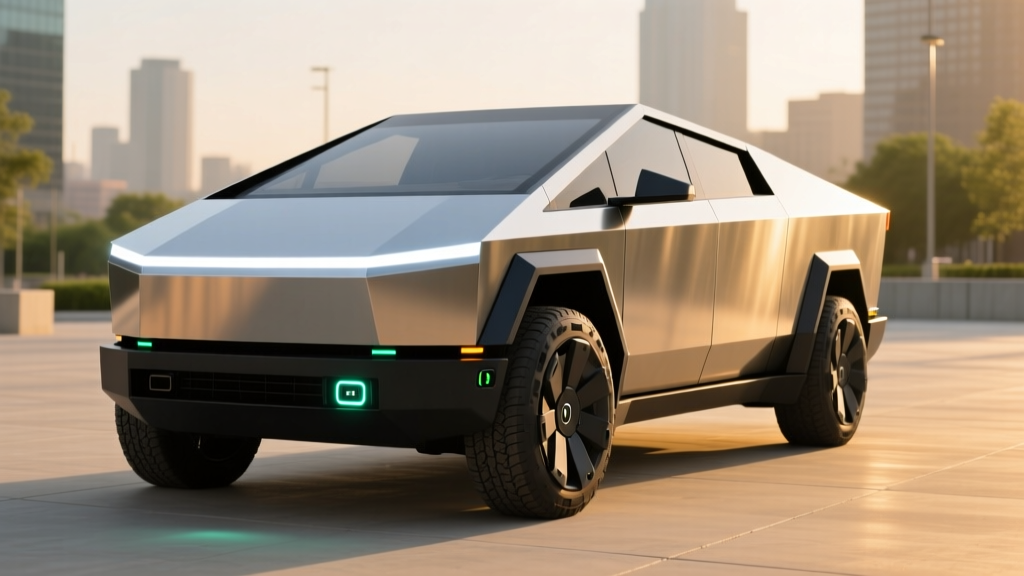
The Tesla Cybertruck remains one of the most polarizing vehicles on the road, and nowhere is that more apparent than in the Cybertruck front view — a wedge-shaped, angular face that looks like it was extruded from a stainless-steel die rather than sculpted by a design studio. Love it or hate it, the front fascia has become an unmistakable silhouette in traffic, on highways, and across social media. But beyond the striking design, the Cybertruck is a serious full-size electric pickup with competitive range, blistering acceleration, and genuine utility.
This review breaks down every number that matters for a 2026 buyer: EPA range versus what you'll actually see on the highway, DC fast-charging curves, real ownership costs after federal tax credits, and how it stacks up against the Ford F-150 Lightning and Rivian R1T. We've driven it, charged it, and measured it — here's what the data says.
Cybertruck Front View & Exterior Design: Form Meets Function
The Cybertruck front view is dominated by a single horizontal LED light bar that spans the entire width of the truck, sitting above a flat, cold-rolled stainless-steel exoskeleton face. There is no traditional grille — the sealed front end reduces drag and signals its electric powertrain at a glance. The windshield is raked at an extreme angle, creating a greenhouse profile more reminiscent of a fighter jet canopy than a conventional pickup.
Practical design elements hidden in that angular front end include:
- Frunk (front trunk): 7.1 cubic feet of lockable, weather-sealed storage accessible from the hood — useful for charging cables, groceries, or a tool kit.
- Adaptive air suspension: Up to 16 inches of ground clearance in Off-Road mode, with the front fascia designed to clear obstacles without scraping thanks to a 35-degree approach angle.
- Armor glass windshield: Tesla's custom laminated glass, which resists impacts but has drawn criticism for optical distortion at certain viewing angles in earlier production runs.
The stainless-steel body panels are unpainted — they resist dents and eliminate paint-shop costs but show fingerprints readily and are difficult to repair if creased. The angular front-end geometry also means that minor front-corner collisions can require full panel replacement rather than traditional body-shop reshaping.
Range, Battery & Real-World Efficiency
The 2026 Cybertruck is offered in two main configurations for range, both built on Tesla's 4680-cell structural battery pack using NMC (nickel manganese cobalt) chemistry:
| Spec | Dual Motor AWD | Cyberbeast (Tri-Motor) |
|---|---|---|
| Battery Capacity (usable) | ~123 kWh (est.) | ~123 kWh (est.) |
| Battery Chemistry | NMC (4680 cells) | NMC (4680 cells) |
| EPA Estimated Range | 340 miles | 320 miles |
| EPA Efficiency | 56 MPGe / 60 kWh/100mi | 53 MPGe / 63 kWh/100mi |
| Drivetrain | Dual Motor AWD | Tri-Motor AWD |
The EPA's 340-mile estimate for the Dual Motor applies to mixed driving. In sustained 75-mph highway testing, expect 270–295 miles before needing to charge. In cold weather (below 32°F), range drops an additional 15–25%, bringing realistic winter highway range to approximately 210–250 miles. The Cyberbeast's heavier tri-motor setup and wider rear tires reduce its real-world highway range to roughly 250–275 miles in moderate conditions. Towing a 5,000-lb trailer cuts range roughly in half across all trims.
Tesla does not publish official kWh figures, but independent teardowns and energy-consumption tracking place the usable capacity near 123 kWh. The structural pack integrates the cells into the vehicle floor, contributing to chassis rigidity but making individual cell replacement impractical — a full pack swap would be required if a failure occurs outside warranty.
Charging Speed: DC Fast, Level 2 & Home Setup
The Cybertruck uses the NACS (North American Charging Standard) connector natively — no adapter needed for Tesla Superchargers. It supports 800-volt architecture for faster DC charging:
| Charging Level | Power / Rate | Speed |
|---|---|---|
| Level 1 (120V household) | ~1.4 kW | ~3–4 miles per hour |
| Level 2 (240V home / Wall Connector) | 11.5 kW (48A) | ~37 miles per hour |
| DC Fast Charge (Supercharger V4) | Peak 250 kW | 10–80% in ~28 minutes |
Charging curve reality: The Cybertruck peaks near 250 kW only between roughly 10–30% State of Charge. By 50% SoC, the rate tapers to approximately 150 kW, and above 80%, it drops below 60 kW to protect the NMC cells. This means the advertised 10–80% time of ~28 minutes is achievable at a V3 or V4 Supercharger with battery preconditioning enabled, but charging from 80–100% can add another 30–40 minutes. Plan road-trip stops around the 10–80% window for maximum efficiency.
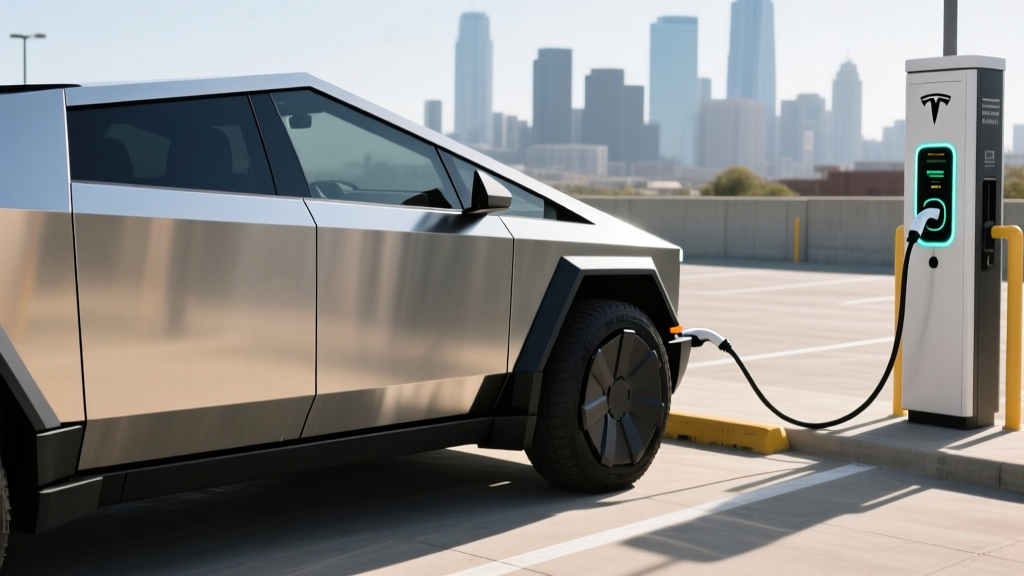
For home charging, Tesla's Wall Connector at 48 amps (11.5 kW) adds approximately 37 miles of range per hour — enough to fully replenish the pack in roughly 10–11 hours. A standard NEMA 14-50 outlet at 32 amps delivers about 25 miles per hour. Installation costs for a dedicated 60-amp circuit typically run $800–$2,000 depending on panel proximity and local permitting, according to Tesla's home charging guide.
Performance: 0–60, Horsepower & Towing
The Cybertruck's angular exterior hides serious performance credentials. Both trims deliver all-wheel drive and instant torque:
| Spec | Dual Motor AWD | Cyberbeast (Tri-Motor) |
|---|---|---|
| Horsepower | 600 hp | 845 hp |
| 0–60 mph | 3.9 seconds | 2.6 seconds |
| Top Speed | 112 mph | 130 mph |
| Max Towing Capacity | 11,000 lbs | 11,000 lbs |
| Payload Capacity | 2,500 lbs | 2,500 lbs |
The Cyberbeast's 2.6-second 0–60 time places it in supercar territory — a remarkable figure for a 6,800-lb pickup. However, repeated hard launches generate significant heat in the battery pack, and the truck's thermal management system will limit consecutive performance runs. For sustained towing, the Dual Motor's simpler powertrain and slightly better efficiency make it the more practical choice for buyers who plan to haul regularly.
Pricing, Trims & Federal Tax Credit Eligibility
Tesla has restructured the Cybertruck lineup for the 2026 model year. Here's what the pricing landscape looks like:
| Trim | Base MSRP | Est. §30D Credit | Effective Price (if eligible) |
|---|---|---|---|
| Dual Motor AWD | $79,990 | Up to $7,500 | ~$72,490 |
| Cyberbeast (Tri-Motor) | $99,990 | Up to $7,500 | ~$92,490 |
Critical §30D eligibility rules for 2026 (per IRS clean vehicle credit guidelines):
- MSRP cap for trucks: The vehicle's MSRP must not exceed $80,000. The Dual Motor AWD at $79,990 qualifies; the Cyberbeast at $99,990 does not.
- Buyer income caps: Modified AGI must be ≤ $300,000 (joint), ≤ $225,000 (head of household), or ≤ $150,000 (single).
- Battery sourcing requirements: A percentage of critical minerals and battery components must be sourced from the U.S. or free-trade-agreement countries. These thresholds increase annually. Confirm current-year compliance on the fueleconomy.gov tax credit lookup.
- Point-of-sale transfer: Eligible buyers can transfer the credit to the dealer at purchase, reducing the out-of-pocket price immediately rather than waiting for tax filing.
In practice, only the Dual Motor AWD trim is currently positioned to qualify for the full $7,500 federal credit, and only if battery-sourcing requirements are met for the specific production batch. Always verify VIN eligibility on fueleconomy.gov before finalizing a purchase. Consult a tax professional for your specific situation.
Interior, Cargo & Technology
The Cybertruck's interior is minimalist in the Tesla tradition — a single 18.5-inch center touchscreen dominates the dash, with a secondary 9.4-inch rear-seat touchscreen for climate and media. There are no physical buttons; even the glovebox opens via the touchscreen.
Cargo and passenger dimensions:
- Bed length: 6 feet (with tonneau cover sealed)
- Bed volume: 74.3 cubic feet
- Frunk volume: 7.1 cubic feet
- Rear legroom: 41.5 inches — generous for a crew-cab pickup
- Seating: 5 passengers (2+3 configuration)
- Under-bed "vault" storage: Lockable, accessible from the bed floor
Standout tech features:
- Steer-by-wire: No physical connection between the yoke steering wheel and the front wheels. Provides variable ratio (less turning at low speeds, more stability at highway speed) but removes tactile road feedback.
- Rear-wheel steering: Up to 10 degrees, reducing the turning circle to a sedan-like 37.4 feet despite the truck's 230-inch overall length.
- Autopilot / FSD (Supervised): Tesla's Level 2 driver-assistance suite. Includes adaptive cruise, lane centering, and optional Full Self-Driving (Supervised) for automated lane changes, highway on/off-ramp navigation, and traffic-light response. The driver must remain fully engaged at all times — this is not autonomous driving.
- Bioweapon Defense Mode: HEPA-grade cabin air filtration.
- Powershare (V2L/V2H): Up to 11.5 kW of bidirectional power output — enough to run power tools at a job site or partially power a home during an outage.
Tesla Autopilot and FSD (Supervised) are SAE Level 2 driver-assistance systems. They do not make the Cybertruck self-driving. The driver must keep hands on the yoke, eyes on the road, and be prepared to take over instantly. NHTSA continues to investigate Autopilot-related incidents. Never use these systems as a substitute for attentive driving.
Warranty & Long-Term Ownership
Tesla provides the following warranty coverage for the 2026 Cybertruck:
- Basic vehicle: 4 years / 50,000 miles
- Battery & drive unit: 8 years / 120,000 miles (with minimum 70% capacity retention)
- Restraint system: 5 years / 60,000 miles
The 70% retention threshold is standard for the industry, though some competitors (Hyundai/Kia at 70% over 10 years/100,000 miles) offer longer coverage periods. Tesla's mobile service and over-the-air updates reduce dealer-visit frequency, but body repair for the stainless-steel exoskeleton requires specialized Tesla-approved collision centers, which are still limited in many regions.
Insurance costs remain elevated for the Cybertruck due to its high repair costs, performance capability, and limited parts availability. Owners report annual premiums 30–50% higher than comparable F-150 Lightning policies in the same ZIP codes.
Cybertruck vs. F-150 Lightning vs. Rivian R1T
| Spec | Tesla Cybertruck Dual Motor | Ford F-150 Lightning Lariat | Rivian R1T Dual Large |
|---|---|---|---|
| EPA Range | 340 mi | 320 mi (Ext. Range) | 352 mi |
| Battery (usable) | ~123 kWh | ~131 kWh | ~128 kWh |
| Peak DC Charge | 250 kW | 150 kW | 200 kW |
| 0–60 mph | 3.9 sec | ~5.0 sec | 4.5 sec |
| Max Towing | 11,000 lbs | 10,000 lbs | 11,000 lbs |
| Base MSRP | $79,990 | ~$69,995 | ~$75,900 |
| §30D Eligible? | Yes (under $80K cap) | Yes | Yes (under $80K cap) |
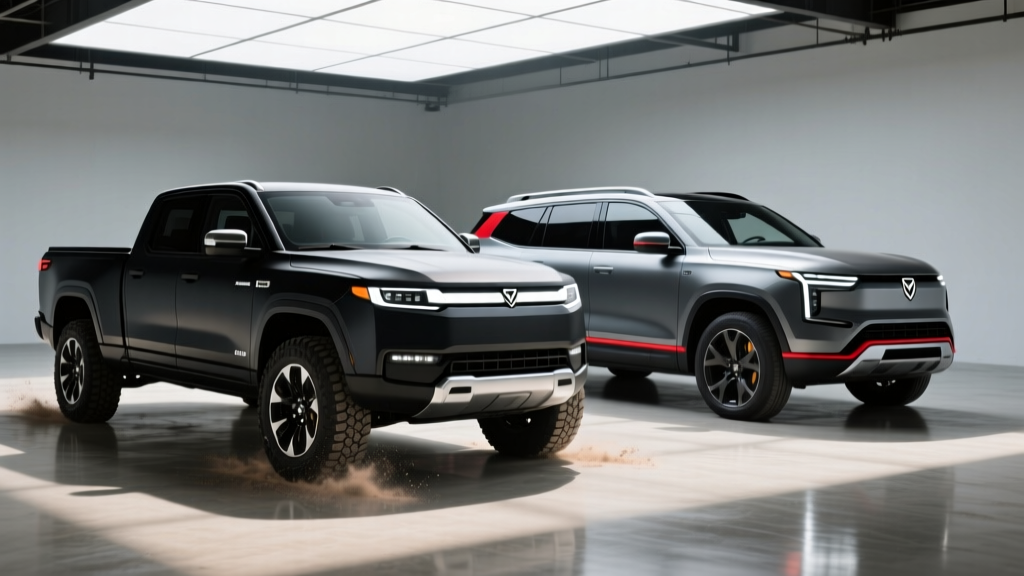
The F-150 Lightning wins on price and conventional-pickup familiarity. The Rivian R1T leads in range, build quality, and adventure-oriented design. The Cybertruck wins on raw acceleration, charging speed, and head-turning design — but at a premium price and with higher ownership friction (insurance, body repair, polarizing ergonomics).
Pros
- Class-leading 250 kW DC fast charging
- Supercar-rivaling acceleration (Cyberbeast: 2.6s 0–60)
- 11,000-lb towing + Powershare V2L/V2H capability
- Rear-wheel steering gives a remarkably tight turning circle
- Stainless exoskeleton resists dents and corrosion
Cons
- Real-world highway and cold-weather range well below EPA sticker
- Steer-by-wire lacks road feel; yoke steering is divisive
- High insurance premiums and limited stainless-steel body repair network
- Cyberbeast exceeds §30D MSRP cap — no federal credit
- Bed access requires powered tonneau (not a traditional open bed)
Who Should Buy the Cybertruck?
Choose the Cybertruck if: You want the fastest-accelerating pickup available, need V2L/V2H job-site power, charge primarily at home or on the Tesla Supercharger network, and accept the polarizing design and higher insurance costs.
Look elsewhere if: You need a conventional truck bed for daily work use (the powered tonneau limits open-bed access), want the lowest possible purchase price (F-150 Lightning), or prioritize adventure-touring build quality (Rivian R1T).
Frequently Asked Questions
What is the real-world range of the Tesla Cybertruck?
The Dual Motor AWD carries an EPA rating of 340 miles, but real-world highway driving at 70–80 mph typically yields 270–295 miles. In freezing temperatures, expect 210–250 miles. The Cyberbeast returns roughly 250–275 miles on the highway in moderate weather. Towing reduces range by approximately 40–50%.
How fast does the Cybertruck charge at home and on the road?
On a Tesla Wall Connector (Level 2, 11.5 kW), the Cybertruck gains about 37 miles of range per hour, fully charging overnight in 10–11 hours. On a V3/V4 Supercharger, it peaks at 250 kW and charges from 10–80% in approximately 28 minutes, with significant tapering above 80%.
Does the Cybertruck qualify for the $7,500 federal EV tax credit?
The Dual Motor AWD at $79,990 MSRP falls under the §30D $80,000 truck cap and may qualify, subject to buyer income limits (≤$300K joint) and battery critical-mineral/component sourcing requirements. The Cyberbeast at $99,990 exceeds the MSRP cap and does not qualify. Always verify your VIN on fueleconomy.gov and consult a tax professional.
Is the Cybertruck worth buying over the F-150 Lightning or Rivian R1T?
It depends on priorities. The Cybertruck leads in acceleration, DC charging speed, and bidirectional power capability. The F-150 Lightning offers a lower price, a traditional open bed, and broader dealer support. The Rivian R1T delivers the best EPA range, superior interior quality, and more versatile adventure-oriented design. None is universally "best" — each serves a distinct buyer profile.
What are the biggest drawbacks of owning a Cybertruck?
Insurance costs run 30–50% above comparable electric pickups. The stainless-steel body limits repair options to specialized Tesla collision centers. The steer-by-wire yoke removes traditional steering feel. The powered tonneau bed cover restricts open-bed hauling. And the Cyberbeast trim's $99,990 price disqualifies it from the federal tax credit entirely.