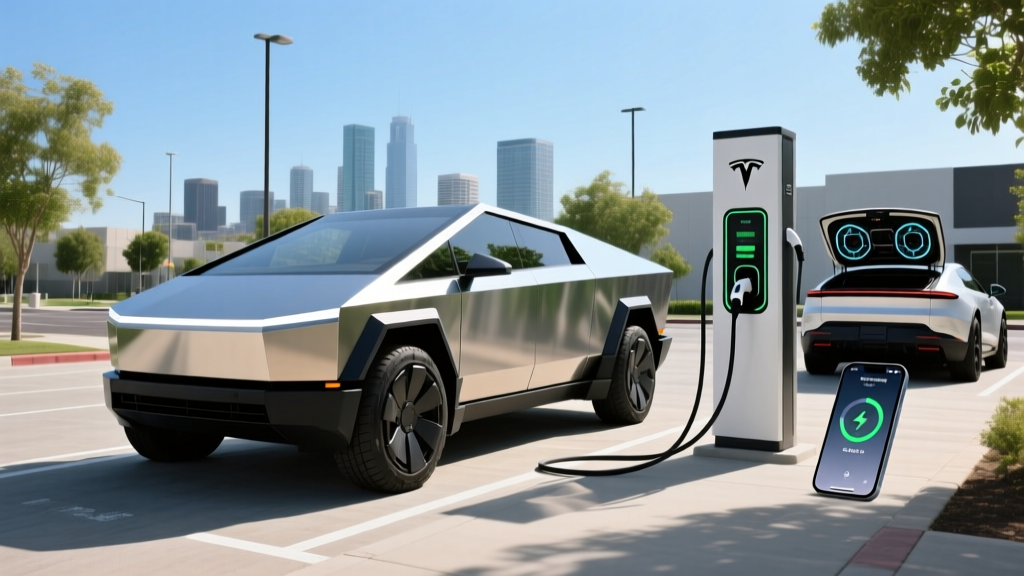
The Tesla Cybertruck Foundation Series arrived as a limited-run launch variant, bundling every available option into a single, fully loaded configuration before Tesla restructured its truck lineup for 2025 and beyond. For buyers evaluating one on the secondary market or comparing it against the current AWD and Cyberbeast trims, understanding what the Foundation Series actually delivers—beyond the stainless-steel exoskeleton hype—requires a hard look at range, charging behavior, ownership costs, and where it fits among full-size electric pickups like the Ford F-150 Lightning and Rivian R1T.
This review covers the Dual Motor All-Wheel Drive variant that formed the backbone of the Foundation Series, with notes on the tri-motor Cyberbeast where performance diverges. All figures reflect EPA data, Tesla's published specifications, and real-world testing patterns observed through early 2026.
Spec Snapshot: Tesla Cybertruck Foundation Series (Dual Motor AWD)
| Attribute | Value |
|---|---|
| EPA Range (34" tires, standard bed) | 340 miles |
| Battery Capacity (usable) | ~123 kWh, NMC (nickel manganese cobalt) |
| Drivetrain | Dual Motor AWD (permanent magnet rear, induction front) |
| Horsepower | 600 hp |
| 0-60 mph | 3.9 seconds |
| Top Speed | 130 mph |
| Max DC Fast Charge Rate | 325 kW (peak) |
| 10-80% DC Charge Time | ~22 minutes (at V4 Supercharger) |
| Level 2 Home Charge Rate | 11.5 kW / ~37 mi/hr |
| EPA Efficiency | 56 MPGe combined / 68 kWh/100 mi |
| Towing Capacity | 11,000 lbs |
| Payload Capacity | 2,500 lbs |
| Bed Length | 6 ft (composite bed with powered tonneau) |
| Base MSRP (Foundation Series at launch) | $99,990 |
| Battery/Drive Unit Warranty | 8 years / 120,000 miles |
| Basic Vehicle Warranty | 4 years / 50,000 miles |
Range and Efficiency: EPA Sticker vs. Real-World Reality
EPA Estimated Range: 340 miles (Dual Motor AWD, 34-inch all-terrain tires)
Real-World Expectation: Plan for 270–310 miles in mixed highway driving at 70–75 mph. In cold weather (below 30°F), expect a 20–30% reduction, dropping effective range to roughly 230–270 miles. City/regenerative driving can push closer to the 340-mile sticker figure.
The Cybertruck's angular, flat-panel stainless-steel body creates a drag coefficient that works against highway efficiency compared to more aerodynamic EVs. At sustained interstate speeds, the truck consumes roughly 550–600 Wh/mile, which translates to the 68 kWh/100 mi EPA figure but can climb to 75 kWh/100 mi or higher into headwinds or at higher elevations where air density changes. The 123 kWh usable battery pack provides a substantial energy reserve, but the Cybertruck's mass—roughly 6,600 lbs curb weight—means every stop-and-go cycle and hill climb exacts a real energy cost.
Foundation Series trucks shipped with 34-inch all-terrain tires as standard, which carry a modest efficiency penalty versus the standard 20-inch all-season setup offered on later base AWD trims. If you're evaluating a Foundation Series on the used market, confirm which tire configuration is installed, as swapping to highway-oriented rubber can recover 5–8% of range.
For context, the EPA's official fueleconomy.gov listing for the Dual Motor Cybertruck confirms the 340-mile combined figure with the 56 MPGe rating. The tri-motor Cyberbeast variant sacrifices roughly 20 miles of range for its additional front motor and higher output.
Charging Speed: 325 kW Peak, But the Curve Matters
The Cybertruck supports an 800-volt-class electrical architecture, enabling peak DC fast-charge rates up to 325 kW at Tesla's V4 Supercharger stations. That headline number, however, is only part of the story. Like all lithium-ion packs, the Cybertruck's NMC battery follows a declining charge curve as state of charge (SoC) rises.
| Charging Method | Power | Speed | Notes |
|---|---|---|---|
| DC Fast Charge (V4 Supercharger) | Up to 325 kW peak | 10-80% in ~22 min; ~180 mi in 10 min | Sustains above 250 kW to ~50% SoC, then tapers; preconditioning critical |
| DC Fast Charge (V3 Supercharger / CCS adapter) | Up to 250 kW peak | 10-80% in ~28 min | Requires NACS-to-CCS adapter at non-Tesla networks |
| Level 2 Home (Tesla Wall Connector, 48A) | 11.5 kW | ~37 miles per hour; full charge in ~11 hours | Requires 60A dedicated circuit |
| Level 2 Home (32A mobile connector) | 7.7 kW | ~25 miles per hour | Standard NEMA 14-50 outlet; slower overnight option |
| Level 1 (120V trickle) | ~1.4 kW | ~4 miles per hour | Emergency/top-up only; impractical for full charge |
The critical detail for road-trip planning: the Cybertruck sustains its peak charge rate for a relatively narrow window. From roughly 10% to 50% SoC on a V4 Supercharger, you'll see rates above 250 kW. Past 50%, the rate tapers progressively—dropping below 150 kW near 70% and below 75 kW past 85%. This is why Tesla and every EV analyst recommends charging to 80% on road trips rather than waiting for a full pack. The last 20% can take as long as the first 70%.
Battery preconditioning is essential. If you navigate to a Supercharger in the Tesla navigation system, the truck will begin warming the battery 10–20 minutes before arrival, which can shave 5–8 minutes off your charge session in cold weather. Arriving at a Supercharger without preconditioning in winter can cut your peak charge rate by 40–50%.
For home charging, the Foundation Series' 123 kWh pack means overnight charging on a 48A Level 2 circuit takes roughly 11 hours from near-empty. Most owners who plug in nightly with 30–50% remaining will top off in 5–6 hours. A 200A electrical panel is typically sufficient for a 60A circuit, but older homes with 100A service may require a panel upgrade—budget $1,500–$3,500 for that work before assuming your home is charge-ready.
Performance and Driving Dynamics
The Dual Motor AWD Foundation Series produces 600 horsepower and achieves a 3.9-second 0-60 mph time—remarkable for a vehicle with an 11,000-lb towing rating. The tri-motor Cyberbeast pushes that to 845 hp and 2.6 seconds, but the Dual Motor's output already places it well beyond any internal-combustion F-150 or Silverado in straight-line acceleration.
What distinguishes the Cybertruck dynamically is its 48-volt electrical architecture—a first for a production vehicle at this scale. The 48V system powers the steer-by-wire steering, four-wheel steer (rear wheels turn up to 10 degrees for a tighter turning radius), and active damper control without the hydraulic systems conventional trucks require. The result is a truck that feels unnervingly car-like in parking lots and on winding roads, with a turning circle closer to a Model Y than an F-150.
Steer-by-wire, however, demands adaptation. There is no mechanical connection between the steering yoke and the front wheels. Feedback is synthesized, and while most owners report adjusting within a week, the lack of tactile road feel remains a common criticism among driving enthusiasts. Tesla's Autopilot and Full Self-Driving (Supervised) systems are available, but it's critical to understand these are SAE Level 2 driver-assistance features—the driver must remain fully engaged, hands on the yoke, eyes on the road. This is not autonomous driving.
Interior, Cargo, and Practicality
The Cybertruck's cabin seats five across two rows. Front legroom is generous at 41.5 inches, while rear legroom measures 36.2 inches—adequate for adults on shorter trips but tighter than the F-150 Lightning's rear seat for long highway stretches. The minimalist interior centers on an 18.5-inch front touchscreen and a 9.4-inch rear touchscreen for climate and media controls, with no physical buttons beyond a few steering-yoke controls.
Cargo capacity breaks down as follows:
- Bed volume: 67 cu ft (with tonneau closed); the 6-foot composite bed is shorter than a standard F-150 6.5-foot bed but features integrated ramps and a powered roll-top tonneau
- Front trunk (frunk): 7.1 cu ft—enough for a charging cable kit and a small bag, but far smaller than the Lightning's massive 14.1 cu ft frunk
- Under-bed storage: Lockable compartment behind the rear axle, accessible from the bed
- Towing: 11,000 lbs rated, though towing at max capacity will cut range roughly in half (expect 150–180 miles effective range with a heavy trailer)
The Foundation Series included Tesla's Full Self-Driving (Supervised) capability, premium audio with 15 speakers, ventilated front seats, heated rear seats, and the powered tonneau as standard—essentially every available option. Later AWD and Long Range trims have unbundled some of these features, making the Foundation Series the most comprehensively equipped Cybertruck variant produced.
Pricing, Tax Credits, and Ownership Economics
| Cost Factor | Amount |
|---|---|
| Foundation Series Launch MSRP | $99,990 |
| Current AWD Trim MSRP (2026) | ~$79,990 |
| Cyberbeast Trim MSRP (2026) | ~$99,990 |
| Federal Tax Credit (§30D) — Trucks | Up to $7,500 (MSRP cap for trucks: $80,000) |
| FSD (Supervised) Subscription | $99/month or $8,000 one-time (post-Foundation) |
| Estimated Annual Insurance | $2,800–$4,200 (varies significantly by state/driver) |
The Foundation Series' $99,990 price tag places it above the IRS §30D federal tax credit MSRP cap of $80,000 for trucks, vans, and SUVs. This means the Foundation Series does not qualify for the $7,500 federal credit at its original purchase price. Buyers evaluating current Cybertruck trims should note that the base AWD at approximately $79,990 sits at the threshold—eligibility depends on the exact configured price, destination fees, and whether added options push it over the cap.
Even for trims under the MSRP cap, the §30D credit requires meeting battery-component and critical-minerals sourcing thresholds that have tightened annually since 2024, plus buyer income limits ($300,000 joint / $150,000 single modified AGI). The credit can now be transferred to the dealer at point of sale as a purchase-price reduction, which changes the effective out-of-pocket math. Always verify current-year sourcing compliance on the IRS clean vehicle credits page before assuming eligibility.
Insurance costs are a genuine ownership factor. The Cybertruck's stainless-steel body panels, steer-by-wire system, and specialized parts have resulted in higher-than-average insurance premiums compared to the F-150 Lightning. Early owners report quotes in the $2,800–$4,200 annual range depending on location, driving record, and coverage level—roughly 30–50% higher than comparable conventional trucks.
Warranty Coverage and Battery Longevity
Tesla provides an 8-year/120,000-mile warranty on the battery pack and drive units, with a minimum 70% capacity retention guarantee over that period. The basic vehicle limited warranty covers 4 years or 50,000 miles. These terms are competitive with the Rivian R1T (8 years/175,000 miles on battery) but fall short of the Ford F-150 Lightning's 8-year/100,000-mile battery warranty with a slightly higher retention threshold in some model years.
The Cybertruck's NMC chemistry prioritizes energy density over the cycle-life advantages of LFP (lithium iron phosphate) batteries found in some Tesla Model 3/Y rear-wheel-drive variants. For a truck-sized pack at 123 kWh, NMC remains the practical choice—LFP's lower energy density would require a significantly heavier and larger pack to achieve equivalent range. Real-world degradation data on the Cybertruck is still accumulating given its late-2023 launch, but Tesla's historical NMC pack data from the Model S and Model X suggests 10–15% degradation over the first 100,000 miles is typical, with a flattening curve thereafter.
How It Compares: Cybertruck Foundation Series vs. the Competition
The Foundation Series occupies a specific niche: it's a performance-oriented, design-forward electric truck that prioritizes technology and acceleration over traditional truck utility. Here's how it stacks against the key alternatives:
- Ford F-150 Lightning (Extended Range): EPA 320 miles, 563 hp, 78 MPGe, ~$79,990 for the Lariat Extended Range. More conventional truck feel, larger frunk, broader dealer network, but 0-60 in 3.8 seconds only on the Platinum trim. Better choice for fleet buyers and traditional truck users.
- Rivian R1T Dual Max: EPA 352 miles (with Max Pack), 533 hp, ~$89,000. More refined interior, better off-road capability, and a growing service network. The R1T's quad-motor variant competes directly with the Cyberbeast on performance. Better choice for outdoor/adventure buyers who want a conventional steering wheel and proven off-road hardware.
- Chevrolet Silverado EV (4WT / RST): EPA up to 440 miles (4WT fleet version), but the consumer RST at ~$87,300 targets 380 miles. Much larger bed and traditional truck proportions. GM's Ultium platform is still proving itself on reliability. Better choice for buyers who need a full-size 8-foot bed and conventional truck ergonomics.
Pros
- 325 kW peak charging is among the fastest in the truck segment
- 48V architecture with four-wheel steer delivers car-like maneuverability
- 11,000-lb towing with integrated trailer brake controller
- Stainless-steel body eliminates paint-related maintenance and dent susceptibility
- Comprehensive Supercharger network access with no adapter needed
- Foundation Series bundled every option at no additional cost over Cyberbeast
Cons
- Steer-by-wire and yoke require significant driver adaptation
- Real-world highway range falls 10–20% below EPA in mixed conditions
- 6-foot bed is shorter than most conventional half-ton trucks
- Frunk is small for the vehicle's overall size
- Insurance premiums run 30–50% higher than comparable ICE trucks
- Foundation Series MSRP exceeds §30D tax-credit cap for trucks
- Limited service center capacity for body/paint-adjacent repairs
Who Should Buy the Cybertruck Foundation Series?
Choose the Cybertruck Foundation Series if: You want a fully loaded electric truck with the fastest available Supercharger access, prioritize acceleration and tech-forward design, have reliable home charging, and don't need a full-size 6.5- or 8-foot bed. It suits tech-professional commuters, light-to-moderate towing users, and buyers who value the Tesla ecosystem and software integration above traditional truck conventions.
Look elsewhere if: You need maximum bed length for work use, prefer conventional steering feedback, require the lowest possible insurance cost, depend on a broad dealer service network in rural areas, or need guaranteed $7,500 tax-credit eligibility (consider the base AWD trim or the F-150 Lightning instead).
Frequently Asked Questions
What is the real-world range of the Tesla Cybertruck Foundation Series?
The EPA rates the Dual Motor AWD Cybertruck at 340 miles. In real-world highway driving at 70–75 mph, expect 270–310 miles depending on temperature, wind, and terrain. Cold weather below freezing can reduce that to 230–270 miles. City driving with heavy regenerative braking recovers more energy and can approach the EPA figure.
How fast does the Cybertruck Foundation Series charge?
At a Tesla V4 Supercharger, the Cybertruck peaks at 325 kW and charges from 10% to 80% in approximately 22 minutes with proper battery preconditioning. At V3 Superchargers or non-Tesla DC stations using a NACS adapter, peak rate drops to 250 kW and 10-80% takes roughly 28 minutes. Home Level 2 charging at 11.5 kW adds about 37 miles per hour.
Does the Cybertruck Foundation Series qualify for the federal EV tax credit?
At its $99,990 MSRP, the Foundation Series exceeds the IRS §30D MSRP cap of $80,000 for trucks and does not qualify. The current base AWD Cybertruck at approximately $79,990 may qualify if configured below the cap and if the buyer meets income limits ($300,000 joint / $150,000 single) and the vehicle meets battery-sourcing requirements. Always verify on the IRS clean vehicle credits page before purchasing.
Is the Cybertruck worth buying over the F-150 Lightning or Rivian R1T?
It depends on priorities. The Cybertruck Foundation Series wins on charging speed, tech integration, and acceleration-per-dollar. The F-150 Lightning wins on traditional truck utility, frunk space, and dealer service access. The Rivian R1T wins on off-road capability, interior refinement, and adventure-oriented design. Test-drive all three before committing—the Cybertruck's steer-by-wire and yoke are polarizing and not universally preferred.
What's the biggest drawback of owning a Cybertruck?
Beyond the polarizing design, the most commonly cited ownership friction points are higher-than-expected insurance premiums, the learning curve of steer-by-wire and the yoke steering control, and limited Tesla service center capacity for body-related repairs. The 6-foot bed, while adequate for most consumers, is a practical limitation for work-truck buyers accustomed to longer beds.