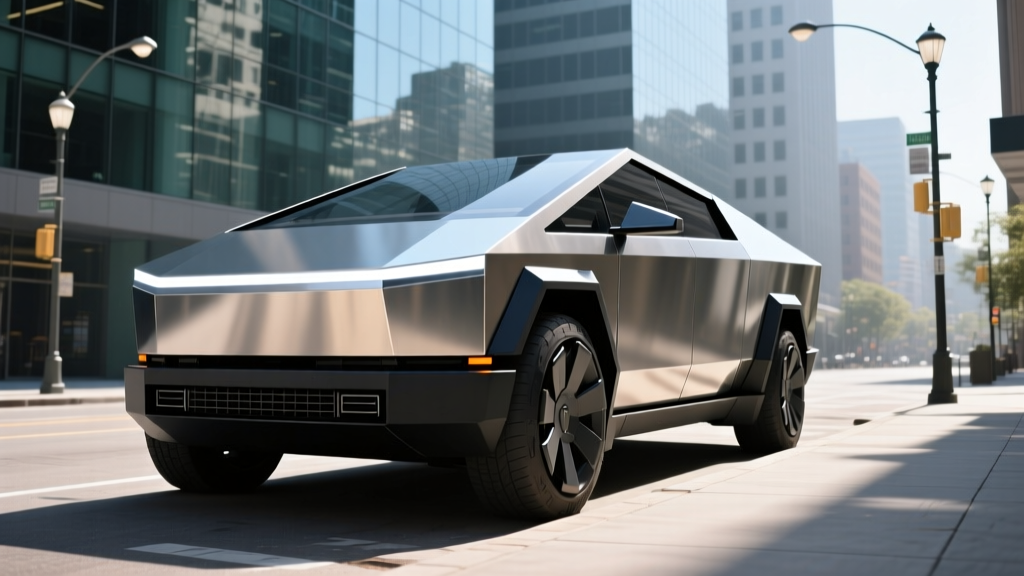
When Tesla unveiled the Cybertruck in 2019, it broke the internet. When deliveries finally began in late 2023, it broke expectations — for better and worse. Now well into 2026, with tens of thousands of units on American roads, the question echoing through forums, dealerships, and comment sections is blunt: Is the Tesla Cybertruck a flop?
The answer depends entirely on what metric you use. By Tesla's own original projection of "250,000 to 500,000 units per year," the Cybertruck has underperformed. By the standard of any other electric pickup startup — or even established automakers launching a radical new platform — it's a measurable success. Let's separate the signal from the noise with hard data on range, charging, pricing, ownership costs, and how it stacks up against the Ford F-150 Lightning and Rivian R1T.
Cybertruck Sales Reality: What the Numbers Actually Show
Estimating Cybertruck production and delivery figures requires piecing together Tesla's quarterly reports, VIN registration data, and third-party trackers, since Tesla stopped breaking out individual model sales after 2022. Industry estimates from Cox Automotive and registration data suggest Tesla delivered approximately 115,000 to 130,000 Cybertrucks globally through the end of 2025, with 2026 production ramping toward an annualized rate of roughly 75,000 to 90,000 units.
For context: the Ford F-150 Lightning sold roughly 24,000 units in its first full year (2023) and climbed to approximately 40,000 in 2024. The Rivian R1T has hovered around 20,000 to 25,000 units annually. The Cybertruck is outselling both — but it is nowhere near the volume Tesla's most bullish projections implied, and it represents a small fraction of the roughly 750,000 F-150s (all powertrains) Ford sells annually.
Is that a flop? By mainstream truck standards, yes — the Cybertruck has not disrupted the full-size pickup market the way some predicted. By EV-specific standards, it's the best-selling electric pickup in America. The truth sits in between: the Cybertruck is a niche success, not the category-defining juggernaut Tesla's marketing once implied.
Real-World Range, Efficiency, and the Cold-Weather Penalty
The Cybertruck is available in three configurations for the 2026 model year. Here's what the EPA says versus what you'll actually experience:
- Long Range AWD: EPA 340 miles — Expect ~280-300 mi highway; ~230-260 mi in freezing weather with cabin heat
- Performance (Tri-Motor AWD): EPA 301 miles (with 20" wheels) — Expect ~250-270 mi highway; ~200-230 mi in freezing weather
- RWD (base, announced for late 2026): EPA estimated 250+ miles — Preliminary; not yet available for purchase
The stainless steel exoskeleton adds significant mass (~6,800 lbs curb weight for the Performance model), and the angular shape creates a high drag coefficient relative to more aerodynamic EVs. Highway driving at 75+ mph and cold temperatures compound range loss more than in lighter, sleeker EVs. Plan conservatively on road trips.
Efficiency lands at approximately 2.0 - 2.2 kWh/mile (roughly 67-76 MPGe combined depending on trim), per fueleconomy.gov. That's notably less efficient than a Rivian R1T (~2.0 kWh/mile) and far thirstier than a sedan like the Hyundai Ioniq 6 (~0.25 kWh/mile). If electricity costs $0.16/kWh nationally, you're spending roughly $0.32 to $0.35 per mile to drive a Cybertruck — still cheaper than a gas F-150 at $0.18-$0.22/mile equivalent, but the efficiency gap matters when DC fast charging at $0.40-$0.60/kWh on road trips.
Battery, Charging Speed, and the 800-Volt Architecture
Tesla has not published the Cybertruck's exact usable battery capacity, but teardown analysis and observed charging data indicate a ~123 kWh usable NMC (nickel manganese cobalt) pack for the AWD and Performance trims. The pack uses Tesla's 4680 structural cells integrated into the vehicle's stainless steel unibody.
The Cybertruck uses an 800-volt architecture, enabling impressive peak DC fast-charge rates. Here's the full charging picture:
| Charging Level | Power / Rate | Speed | Notes |
|---|---|---|---|
| Level 1 (120V) | ~1.4 kW | ~3-4 mi/hr | Emergency/top-up only; 123 kWh pack takes days |
| Level 2 (240V, 48A) | 11.5 kW | ~30-34 mi/hr | Full charge in ~11-12 hours; standard home setup |
| Level 2 (240V, 80A) | 19.2 kW | ~50-57 mi/hr | Requires Tesla Wall Connector + 100A circuit; full charge ~7 hrs |
| DC Fast (V4 Supercharger) | Peak ~350 kW | 10-80% in ~15 min | Sustained rate tapers significantly above 60% SoC |
| DC Fast (third-party CCS/NACS) | Up to ~250 kW | 10-80% in ~20-25 min | Varies by network; preconditioning recommended |
A critical nuance for road-trippers: the Cybertruck's charge curve is aggressive at low states of charge but tapers substantially past 60%. You'll see 300+ kW only in a narrow window between roughly 10-40% SoC on a V4 Supercharger with proper battery preconditioning. Plan your stops to charge in that sweet spot — arriving at 5% and leaving at 55% is faster than arriving at 30% and leaving at 80%.
At home on a standard 48A Level 2 circuit, expect to add roughly 30-34 miles of range per hour. Most owners charging overnight from 20% to 80% will wake up fully topped off. Installation of a 60A circuit (for 48A continuous charging) typically costs $800-$2,500 depending on panel proximity, per licensed electrician estimates.
Performance, Capability, and What It Can Actually Tow
| Spec | Long Range AWD | Performance (Tri-Motor) |
|---|---|---|
| Drivetrain | Dual-motor AWD | Tri-motor AWD (Cyberbeast) |
| Horsepower | 600 hp | 845 hp |
| 0-60 mph | 3.9 seconds | 2.6 seconds |
| Top Speed | 112 mph | 130 mph |
| Towing Capacity | 11,000 lbs | 11,000 lbs |
| Payload Capacity | 2,500 lbs | 2,500 lbs |
| Bed Length | 6 ft (72 in) | 6 ft (72 in) |
| Cargo Volume (bed) | ~67 cu ft | ~67 cu ft |
| Frunk Volume | ~7 cu ft | ~7 cu ft |
| Curb Weight | ~6,600 lbs | ~6,800 lbs |
| Ground Clearance | Up to 17.4 in (adaptive air suspension) | Up to 17.4 in |
The tri-motor Performance model's 2.6-second 0-60 time makes it one of the quickest production vehicles ever sold, regardless of powertrain. But the more practical story is the 11,000-pound tow rating, which is competitive with heavy-duty gas trucks and exceeds the F-150 Lightning's 10,000-pound maximum.
The towing caveat: pulling 11,000 pounds will slash range by roughly 40-50%. In real-world towing tests, expect 150-180 miles of range when maxed out. This is a physics problem shared by every electric truck — the Rivian R1T and F-150 Lightning suffer similarly. If you tow frequently over long distances, plan charging stops every 120-140 miles.
The adaptive air suspension offers 12 inches of travel, from a 9-inch low entry height to a 17.4-inch off-road mode. Approach and departure angles are respectable for off-road use, though the Cybertruck's sheer width (86.6 inches with mirrors) limits trail capability compared to a narrower Wrangler or Tacoma.
Pricing, Tax Credits, and Total Cost of Ownership
| Trim | Base MSRP | Federal §30D Credit | Effective Price |
|---|---|---|---|
| Long Range AWD | $79,990 | $0 (exceeds MSRP cap) | $79,990 |
| Performance (Cyberbeast) | $99,990 | $0 (exceeds MSRP cap) | $99,990 |
| RWD (base, late 2026) | ~$60,990 (est.) | $0 (exceeds MSRP cap) | ~$60,990 |
Here's where the "flop" narrative gets real data behind it: the Cybertruck does not qualify for the $7,500 federal EV tax credit under IRS §30D. The reason is straightforward — the §30D credit caps eligible trucks at an $80,000 MSRP, and the Cybertruck Long Range AWD starts at $79,990 before any destination fees or options that push it over. The Performance model at $99,990 is far above the cap. Even the base RWD, when it arrives, is expected to price just above the threshold once destination charges are included.
Per IRS §30D rules, buyers must also meet income caps ($300,000 joint / $150,000 single modified AGI) and the vehicle must meet battery critical-mineral and component sourcing requirements. Even if a future trim dipped below $80,000, sourcing compliance would need to be verified for that specific model year.
5-Year Ownership Cost Snapshot (Long Range AWD, 15,000 mi/yr):
- Purchase: $79,990 (+ ~$2,000 destination/taxes)
- Home Level 2 charger install: ~$1,500
- Electricity (5 yrs, 75,000 mi at $0.14/kWh avg): ~$3,600
- Insurance (5 yrs, avg $3,200/yr for Cybertruck): ~$16,000
- Maintenance (tires, cabin filter, fluid top-offs): ~$2,500
- Estimated 5-yr depreciation (55-60%): ~$44,000-$48,000
- Estimated 5-yr total cost: ~$125,000-$130,000 (including depreciation)
Insurance is a notable pain point. Cybertruck premiums run 30-50% higher than an equivalent F-150 Lightning due to repair costs for the stainless steel body and limited collision-shop familiarity. Get quotes before committing.
Tech, Interior, and the Driver-Assist Reality
The Cybertruck's cabin is minimalist even by Tesla standards: an 18.5-inch front touchscreen, a 9.4-inch rear screen, no physical buttons, and a yoke-style steering wheel (a conventional round wheel is now available as a no-cost option). Build quality on 2025-2026 production units has improved markedly over the notoriously rough early-delivery trucks, though panel-gap consistency still trails legacy automakers.
Standout Tech:
- Steer-by-wire: No mechanical connection between the yoke/wheel and the rack. Enables variable steering ratios (fewer turns lock-to-lock at low speed). Redundant electronic systems back it up, but it remains a polarizing feature.
- 48-volt architecture: Reduces wiring harness weight and enables higher-power accessories. Industry-first for a production vehicle at this scale.
- Bioweapon Defense Mode: HEPA filtration with positive cabin pressure.
- Powered tonneau cover: Motorized, locks automatically, supports 300 lbs distributed weight. Integrated bed lighting and 120V/240V outlets (up to 11.5 kW V2L — enough to power tools or a campsite).
- Autopilot / FSD (Supervised): Tesla's Level 2 driver-assistance suite. Includes adaptive cruise, lane-keeping, auto lane-change, and the FSD "Supervised" city-street navigation feature.
Despite the "Full Self-Driving" name, Tesla's system requires continuous driver supervision. You must keep your hands on the yoke/wheel and eyes on the road at all times. The system can and will make errors — particularly at construction zones, faded lane markings, and unprotected left turns. It is not autonomous driving. Only SAE Level 4 services like Waymo operate without a human driver, and those are limited to geofenced urban areas.
Notable Drawbacks:
- Rear visibility: The small rear window and thick C-pillars create significant blind spots. The camera-based digital rearview mirror helps but takes adjustment.
- Wiper design: A single, large wiper blade covers the windshield but can leave unwiped zones in heavy rain. A washer-fluid heater helps in winter but doesn't solve the geometry problem.
- Bed access: The powered tonneau is excellent when it works, but the high bed floor (due to the under-bed battery pack) makes loading heavy items harder than in a conventional truck. No traditional tailgate — it's a fold-down ramp design.
- Stainless steel fingerprints and maintenance: The body shows fingerprints, water spots, and requires specific cleaning products. Tesla sells an official stainless steel cleaner.
- No Apple CarPlay or Android Auto: Tesla's proprietary infotainment only. This is a dealbreaker for some buyers accustomed to phone projection.
Cybertruck vs. F-150 Lightning vs. Rivian R1T
The Cybertruck doesn't exist in a vacuum. Here's how it stacks up against its two primary electric-pickup rivals on the specs that matter most:
| Spec | Tesla Cybertruck LR AWD | Ford F-150 Lightning Ext. Range | Rivian R1T Dual-Motor Max |
|---|---|---|---|
| EPA Range | 340 mi | 320 mi | 410 mi |
| 0-60 mph | 3.9 sec | 3.8 sec | 3.5 sec |
| Towing | 11,000 lbs | 10,000 lbs | 11,000 lbs |
| Bed Length | 6 ft | 5.5 ft | 4.5 ft (w/ Gear Tunnel option) |
| Base MSRP | $79,990 | $69,995 | $83,000 |
| Federal Tax Credit | Not eligible | Eligible ($7,500) | Eligible ($7,500) |
| DC Fast Peak | ~350 kW | ~150 kW | ~220 kW |
| 10-80% DCFC | ~15 min | ~41 min | ~21 min |
| Frunk | 7 cu ft | 14.1 cu ft (Mega Power Frunk) | 11 cu ft |
| Apple CarPlay | No | Yes | No |
| NACS Native | Yes | Yes (2025+) | Yes (2025+) |
- Choose the Cybertruck if: You want the fastest DC charging in the segment, value the Supercharger network experience, prioritize head-turning design, need 11,000-lb towing, and don't need the federal tax credit.
- Choose the F-150 Lightning if: You want a traditional truck experience, need the largest frunk, want Apple CarPlay, qualify for the $7,500 tax credit (bringing effective price to ~$62,500), and prefer a dealer service network.
- Choose the Rivian R1T if: You need the longest range (410 mi on Max Pack), want the most refined off-road capability, prefer a more conventional (but still modern) interior, and are willing to pay a premium for build quality.
Warranty, Reliability, and Long-Term Ownership
Tesla covers the Cybertruck with the following warranty terms:
- Basic Vehicle: 4 years / 50,000 miles
- Battery & Drive Unit: 8 years / 120,000 miles (with minimum 70% capacity retention)
- Stainless Steel Body: 5 years / 60,000 miles against corrosion perforation
The 8-year/120,000-mile battery warranty is competitive, though the 70% retention threshold means Tesla considers up to 30% degradation "acceptable" before honoring a claim. Early data from 2024-2025 delivery owners suggests the 4680 cells are holding up well, with most reporting less than 5% degradation at 20,000-30,000 miles. However, long-term data (5+ years, 100,000+ miles) does not yet exist for this specific cell format at scale.
Reliability remains a question mark. Tesla's service network is growing but still thin in rural areas, and Cybertruck-specific parts (steer-by-wire components, stainless body panels, powered tonneau motors) have shown longer wait times than conventional vehicle repairs. According to Consumer Reports, Tesla as a brand has improved in reliability rankings but still sits below Toyota, Honda, and Lexus. The Cybertruck specifically has not yet accumulated enough data for a standalone reliability score.
The Verdict: Flop, Success, or Something in Between?
- Fastest DC charging of any electric pickup (~350 kW peak, 10-80% in ~15 min)
- Class-leading 11,000-lb tow rating
- Tri-motor Performance model's 2.6-sec 0-60 is supercar territory
- Stainless steel body is dent- and corrosion-resistant
- Native Tesla Supercharger network access (20,000+ stalls in North America)
- 11.5 kW V2L (vehicle-to-load) powers tools, appliances, and campsites
- Adaptive air suspension with 12 in of travel
- Does not qualify for $7,500 federal tax credit (MSRP cap)
- Real-world highway range falls well short of EPA, especially while towing
- Insurance premiums 30-50% above comparable trucks
- Steer-by-wire and yoke are polarizing; learning curve is real
- Bed access hampered by high floor; no conventional tailgate
- No Apple CarPlay / Android Auto
- Service network and parts availability still limited in many regions
- Polarizing design limits resale appeal to a narrower buyer pool
So — is the Tesla Cybertruck a flop? If you define success as "displacing the F-150 as America's best-selling vehicle" or "selling 500,000 units a year," then yes, it has flopped. Tesla's own aspirational numbers were never realistic for a $80,000+ niche vehicle with a polarizing design.
But if you define success as "building a functional, compelling electric pickup that outsells its direct EV rivals and establishes a new design language," the Cybertruck has done exactly that. It is the best-selling electric pickup in America. Its charging speed is unmatched. Its towing capability is genuine. And it has forced every competitor to accelerate their own electric truck programs.
The Cybertruck isn't a flop. It's a $80,000 niche product that was marketed as a mass-market revolution. Judge it by what it actually is — a fast-charging, capable, head-turning electric truck for buyers who don't need a tax credit and don't mind standing out — and it makes a lot more sense.
Frequently Asked Questions
What is the real-world range of the Tesla Cybertruck?
The Long Range AWD is EPA-rated at 340 miles, but real-world highway driving at 70-80 mph typically yields 280-300 miles. In freezing temperatures with cabin heat, expect 230-260 miles. The Performance (tri-motor) model is rated at 301 miles EPA, with real-world highway range around 250-270 miles. Towing at maximum capacity cuts range to roughly 150-180 miles regardless of trim.
How fast does the Cybertruck charge at home and on the road?
On a V4 Supercharger, the Cybertruck peaks at approximately 350 kW and charges from 10-80% in roughly 15 minutes, though the charge curve tapers significantly above 60% SoC. At home on a 48A Level 2 circuit (240V), you'll add about 30-34 miles of range per hour, with a full charge taking 11-12 hours. An 80A circuit with Tesla's Wall Connector reduces that to roughly 7 hours.
Does the Cybertruck qualify for the federal EV tax credit?
No. Under current IRS §30D rules, trucks must have an MSRP at or below $80,000 to qualify for the $7,500 credit. The Cybertruck Long Range AWD starts at $79,990, and destination fees plus any options push it above the cap. The Performance model at $99,990 is well above. The upcoming base RWD model may price near the threshold, but final eligibility will depend on exact MSRP with destination, buyer income limits, and battery-sourcing compliance. Always verify current rules at IRS.gov.
Is the Cybertruck worth buying over the F-150 Lightning or Rivian R1T?
It depends on your priorities. The Cybertruck wins on DC fast-charge speed (~15 min vs. 21-41 min for rivals) and has the segment's most powerful performance variant. The F-150 Lightning wins on price (eligible for the $7,500 credit, effectively ~$62,500), frunk space, CarPlay support, and dealer service access. The Rivian R1T wins on maximum range (410 mi) and off-road refinement. None is universally "best" — each serves a different buyer profile.
How reliable is the Cybertruck's steer-by-wire system?
Tesla's steer-by-wire uses redundant electronic control units and backup power systems. There is no mechanical linkage, so failure modes are electronic rather than mechanical. No widespread failures have been reported through early 2026, but the system is new at scale and long-term reliability data (5+ years) does not yet exist. Some owners report an adjustment period of 1-2 weeks before the variable-ratio steering feels natural.
What does it cost to insure a Cybertruck?
Cybertruck insurance premiums average $2,800-$3,800 per year depending on trim, location, driving record, and coverage level — roughly 30-50% higher than an F-150 Lightning. The stainless steel body panels require specialized repair, and limited collision-shop familiarity drives up claims costs. Get at least three quotes before purchasing. Tesla Insurance is available in some states and may be competitive.
Can the Cybertruck power my home during an outage?
The Cybertruck supports vehicle-to-load (V2L) at up to 11.5 kW through its bed outlets, which can power tools, appliances, and camping equipment. Full vehicle-to-home (V2H) integration — where the truck backs up your entire house through a bidirectional charger — requires Tesla's forthcoming Powershare home integration hardware, which as of early 2026 is announced but not yet widely available. V2L through the bed outlets works today without additional hardware.