Quick Verdict: Is the Cybertruck Worth Financing?
The Tesla Cybertruck remains one of the most polarizing vehicles on the road — and one of the most expensive electric pickups to finance. With base MSRPs starting above $80,000 for the Dual Motor AWD and climbing past $100,000 for the Cyberbeast, buyers need to understand the real numbers: EPA range, charging speeds, tax credit eligibility under current IRS §30D rules, and what monthly payments actually look like. This profile breaks down every spec that matters before you sign the loan paperwork.
- Dual Motor AWD: $81,895 MSRP — 340 mi EPA range
- Cyberbeast (Tri-Motor): $101,895 MSRP — 320 mi EPA range
- Rear-Wheel Drive: ~$62,895 (limited availability) — 250 mi EPA range
Range, Battery & Efficiency: The Real Numbers
| Spec | Dual Motor AWD | Cyberbeast (Tri-Motor) | RWD |
|---|---|---|---|
| EPA Range | 340 miles | 320 miles | 250 miles |
| Battery Capacity (usable) | ~123 kWh | ~123 kWh | ~100 kWh (est.) |
| Battery Chemistry | NMC (Nickel Manganese Cobalt) | NMC | LFP (Lithium Iron Phosphate) |
| Efficiency (MPGe) | ~67 MPGe combined | ~64 MPGe combined | ~76 MPGe combined (est.) |
| Energy Consumption | ~50 kWh/100 mi | ~53 kWh/100 mi | ~44 kWh/100 mi (est.) |
| 0-60 mph | 3.9 seconds | 2.6 seconds | 6.5 seconds (est.) |
| Horsepower | 600 hp | 845 hp | ~315 hp (est.) |
| Drivetrain | Dual-Motor AWD | Tri-Motor AWD | Rear-Wheel Drive |
| Towing Capacity | 11,000 lbs | 11,000 lbs | 7,500 lbs (est.) |
| Base MSRP | $81,895 | $101,895 | ~$62,895 |
| Battery Warranty | 8 yr / 120,000 mi | 8 yr / 120,000 mi | 8 yr / 120,000 mi |
The Cybertruck's ~123 kWh usable battery pack (Dual Motor and Cyberbeast) is among the largest in any consumer EV, which explains both its impressive range and its heavy energy consumption. The NMC chemistry in the higher trims offers higher energy density — necessary to push a 6,800-pound stainless-steel truck past 300 miles. The RWD variant uses LFP chemistry, which trades energy density for longer cycle life and the ability to charge to 100% daily without accelerated degradation.
EPA Sticker: 340 miles (Dual Motor AWD)
Expect in practice: ~260-290 miles at sustained 75 mph highway speeds. In cold weather (below 30°F), plan for 20-30% range reduction — roughly 200-230 miles on a full charge. The Cybertruck's massive frontal area and weight penalize highway efficiency more than city driving, where regenerative braking recovers energy. If you tow near the 11,000-lb limit, expect range to drop to 100-140 miles.
Efficiency is the Cybertruck's weak point. At roughly 50 kWh per 100 miles (Dual Motor), it consumes nearly double the energy per mile of a Tesla Model Y (~28 kWh/100 mi). That directly affects charging costs and charging-station dwell time — you'll spend more money and more minutes plugged in per mile driven compared to lighter EVs.
Charging Speed: DC Fast Charging & Home Level 2
| Charging Level | Power (kW) | Rate (miles/hr) | Time (10-80%) |
|---|---|---|---|
| Level 1 (120V household) | ~1.4 kW | ~2-3 mi/hr | N/A (days) |
| Level 2 (240V / 48A Wall Connector) | 11.5 kW | ~22 mi/hr | ~10-11 hours |
| DC Fast Charge (V4 Supercharger) | Peak ~350 kW | ~400+ mi/hr (peak) | ~15-18 minutes |
| DC Fast Charge (third-party 150 kW) | ~150 kW | ~180 mi/hr | ~30-35 minutes |
The Cybertruck supports Tesla's 800-volt architecture, enabling peak DC fast-charge rates up to ~350 kW on V4 Supercharger stalls. However, as with all EVs, peak rate is not sustained rate. The charge curve tapers significantly above 60% state of charge (SoC). Expect the 10-80% session to average closer to 200-220 kW, which still delivers a 15-18 minute stop — competitive with the best in the segment.
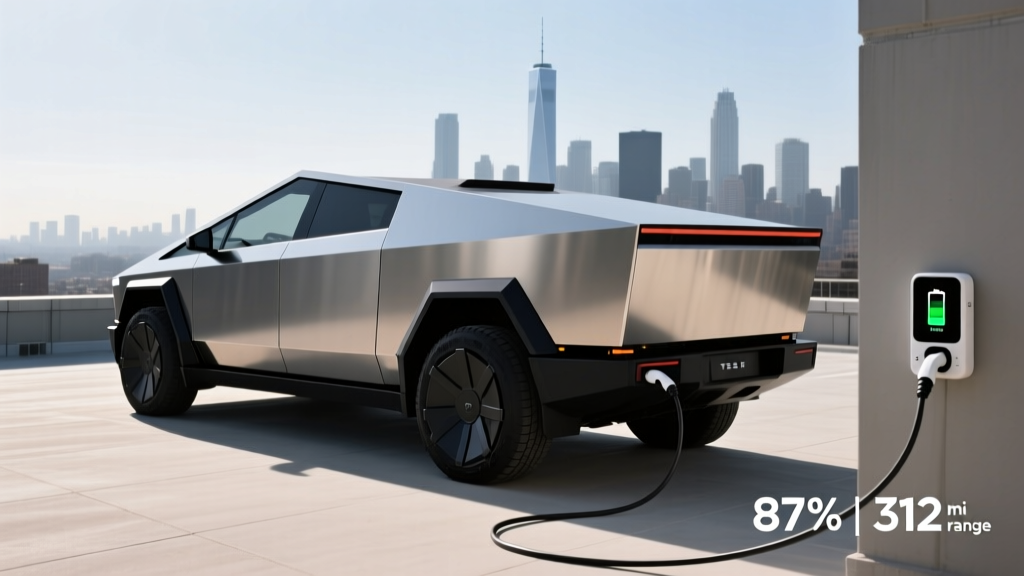
For home charging, the Tesla Wall Connector at 48 amps (11.5 kW) adds about 22 miles of range per hour. An overnight session (10 hours) replenishes roughly 220 miles — enough for most daily needs. Given the Cybertruck's large battery, a full 0-100% Level 2 charge takes approximately 12-13 hours. If your electrical panel supports a 60-amp dedicated circuit, this is the optimal home setup. Budget $500-$1,500 for professional installation depending on panel proximity and local permit costs — consult a licensed electrician for your specific situation.
One important note: the Cybertruck uses the NACS (North American Charging Standard) connector natively, which is now the industry standard adopted by Ford, GM, Rivian, and others. This means access to Tesla's Supercharger network — currently the most reliable DC fast-charging network in the U.S. — without adapters.
Pricing, Trims & Tesla Cybertruck Financing
The Cybertruck's price has climbed significantly since its original 2019 announcement. Here's the current 2026 lineup and what financing looks like in practice:
| Trim | Base MSRP | Est. As-Tested* | Est. Monthly (72-mo, 6.5% APR, 20% down) |
|---|---|---|---|
| Rear-Wheel Drive | ~$62,895 | ~$65,000 | ~$710 |
| Dual Motor AWD | $81,895 | ~$86,000 | ~$970 |
| Cyberbeast | $101,895 | ~$108,000 | ~$1,250 |
*As-tested includes typical destination fees, optional paint/film protection, and Tesla's Full Self-Driving (Supervised) package at $8,000 if selected.
Financing through Tesla: Tesla offers direct financing with terms typically between 36 and 72 months. Rates in early 2026 hover around 6.0-7.5% APR depending on creditworthiness. Third-party lenders and credit unions may offer competitive rates — always compare. A 20% down payment on the Dual Motor AWD ($16,379) keeps the financed amount around $65,516, yielding roughly $970/month at 6.5% over 60 months.
Leasing: Tesla periodically offers lease options, though availability varies by state. Lease payments on the Dual Motor have been observed in the $900-$1,100/month range with $5,000-$7,500 due at signing. Leasing avoids the depreciation risk — a real concern given the Cybertruck's steep initial pricing and uncertain long-term resale value.
Federal Tax Credit: Does the Cybertruck Qualify?
This is where many buyers face disappointment. Under current IRS §30D rules, the Cybertruck faces multiple eligibility hurdles:
- MSRP Cap for Trucks/Vans/SUVs: $80,000 maximum. The Dual Motor AWD at $81,895 and Cyberbeast at $101,895 exceed this cap and do NOT qualify. The RWD at ~$62,895 clears the cap.
- Buyer Income Cap: Modified AGI must not exceed $150,000 (single), $225,000 (head of household), or $300,000 (joint filers).
- Battery Component Sourcing: Required percentages of battery components must be manufactured or assembled in North America, and critical minerals must be sourced from the U.S. or FTA partners. Tesla has progressively improved sourcing, but verify current-year compliance on the fueleconomy.gov credit lookup tool before purchasing.
- Point-of-Sale Transfer: If eligible, the up-to-$7,500 credit can be transferred to the dealer at purchase, reducing your out-of-pocket cost immediately.
Bottom line: The RWD Cybertruck (~$62,895) may qualify for up to $7,500 if sourcing requirements are met and your income is within limits. The Dual Motor AWD and Cyberbeast almost certainly do NOT qualify due to the $80,000 MSRP cap for trucks. Consult a tax professional for your specific situation — rules are subject to change.
Performance, Tech & Daily Livability
The Cyberbeast's 2.6-second 0-60 mph time makes it one of the quickest production trucks ever built, and the 845-horsepower tri-motor setup delivers relentless acceleration well past 60 mph. The Dual Motor AWD's 3.9-second sprint is more than adequate for any real-world scenario. Both AWD variants use torque vectoring across axles, providing impressive traction in rain, snow, and off-road conditions.
Standout Technology:
- Steer-by-Wire: The Cybertruck eliminates the mechanical connection between the steering wheel and rack. This enables a variable steering ratio — fewer turns lock-to-lock at low speeds, more stability at highway speeds. It takes acclimation but works remarkably well once familiar.
- 48-Volt Electrical Architecture: An industry first in a production vehicle, reducing wiring harness weight and enabling higher-power accessories.
- Stainless Steel Exoskeleton: Ultra-hard 30X cold-rolled stainless steel panels eliminate the need for paint (though Tesla offers color PPF wraps). Dent-resistant but fingerprint-prone.
- Autopilot / FSD (Supervised): Tesla's driver-assistance suite is standard; FSD Supervised is an $8,000 option. This is SAE Level 2 — you must remain fully engaged, hands on or near the wheel, eyes on the road at all times. It is not self-driving.
- 18.5-inch Front Touchscreen: Central interface for navigation, media, climate, and vehicle controls. No physical buttons for most functions — a deal-breaker for some buyers.
Cargo & Passenger Space:
- Bed: 6-foot bed with power-retractable tonneau cover. ~67 cu ft of volume with the cover closed.
- Frunk: ~7.1 cu ft front trunk (smaller than competitors due to the 48V electronics and HVAC packaging).
- Rear Seat: Fits three adults, though the upright seatback and elevated floor (battery pack below) compromise legroom compared to the Ford F-150 Lightning. Approximately 34.5 inches of rear legroom.
- Vault: Under-bed lockable storage compartment behind the rear axle.
Notable Drawbacks: The wiper blade is a single, massive unit that struggles at high speed. Visibility is compromised by the angular design and thick A-pillars. The rear touchscreen for passengers is small. Panel gaps and early build-quality issues have improved but remain a discussion point in owner forums. Insurance premiums tend to be 20-40% higher than comparable trucks due to repair costs for the stainless-steel body.
Cybertruck vs. Competitors: Which Electric Pickup Wins?
| Spec | Tesla Cybertruck (Dual Motor) | Ford F-150 Lightning (Ext. Range) | Rivian R1T (Dual-Motor Max) | Chevy Silverado EV (4WT) |
|---|---|---|---|---|
| EPA Range | 340 mi | 320 mi | ~380 mi | ~390 mi |
| Base MSRP | $81,895 | ~$79,990 | ~$87,900 | ~$75,000 |
| 0-60 mph | 3.9 sec | ~4.0 sec | ~4.5 sec | ~5.0 sec |
| Towing | 11,000 lbs | 10,000 lbs | 11,000 lbs | 10,000 lbs |
| Bed Length | 6 ft | 5.5 ft | 4.5 ft (w/ tunnel) | 5 ft 11 in |
| §30D Credit Eligible | No (over MSRP cap) | Yes (select trims) | Yes (select trims) | Yes (select trims) |
| Charging Network | NACS / Supercharger | NACS / Supercharger | NACS / Supercharger | NACS / Supercharger |
The F-150 Lightning wins on practicality: larger frunk (14.1 cu ft), more conventional controls, broader dealer service network, and potential §30D eligibility. The Rivian R1T offers superior off-road capability and the most usable bed system with the Gear Tunnel, at a premium price. The Silverado EV targets fleet and work-truck buyers with the longest range and lowest entry price.
The Cybertruck wins on acceleration, Supercharger network reliability, and sheer distinctiveness. But if your financing application hinges on minimizing monthly cost, the Lightning and Silverado EV offer better value — especially after the federal credit.
Who Should Finance the Cybertruck?
Choose the Cybertruck if:
- You prioritize performance and want the quickest truck available (Cyberbeast)
- You have reliable access to Tesla Superchargers for road trips
- You value the stainless-steel exterior's durability and unique aesthetics
- You're comfortable with a touchscreen-centric interior and steer-by-wire
- You can absorb higher insurance premiums and potential depreciation
Look elsewhere if:
- Tax credit eligibility is a deal-breaker (the Lightning and Silverado EV may qualify)
- You need maximum rear-seat comfort or a full-size 6.5+ ft bed
- You prefer physical buttons, knobs, and a conventional driving experience
- You want the lowest monthly payment in an electric truck segment
Pros & Cons at a Glance
- Blistering acceleration (2.6s Cyberbeast, 3.9s Dual Motor)
- Access to Tesla Supercharger network (most reliable in U.S.)
- Stainless-steel body resists dents and eliminates paint maintenance
- 11,000-lb towing capacity
- Over-the-air updates continuously add features
- 800V architecture enables ~350 kW peak DC charging
- Dual Motor & Cyberbeast exceed $80K MSRP cap — no §30D credit
- Poor efficiency (~50 kWh/100 mi) means higher charging costs
- Real-world highway range significantly below EPA sticker
- Steep monthly payments; high insurance premiums
- Limited rear-seat comfort and small frunk
- Steer-by-wire and screen-only controls not for everyone
- Build-quality consistency still improving
Frequently Asked Questions
What is the real-world range of the Tesla Cybertruck?
The EPA rates the Dual Motor AWD at 340 miles and the Cyberbeast at 320 miles. In real-world highway driving at 75 mph, expect 260-290 miles. In cold weather (below 30°F), range can drop to 200-230 miles. Towing near maximum capacity cuts range to roughly 100-140 miles. The RWD variant's 250-mile EPA rating translates to approximately 190-210 miles highway.
How fast does the Cybertruck charge at home and on the road?
At home on a Level 2 Tesla Wall Connector (11.5 kW), the Cybertruck adds about 22 miles of range per hour, with a full charge taking 12-13 hours. On a V4 Supercharger (up to ~350 kW peak), a 10-80% session takes approximately 15-18 minutes. On a 150 kW third-party charger, expect 30-35 minutes for the same session. The 800V architecture gives it a charging advantage on compatible high-power stalls.
Does the Cybertruck qualify for the $7,500 federal EV tax credit?
Under current IRS §30D rules, only the Rear-Wheel Drive model (~$62,895 MSRP) falls below the $80,000 MSRP cap for trucks and may qualify — provided battery sourcing requirements are met and buyer income is within limits ($150K single / $300K joint). The Dual Motor AWD ($81,895) and Cyberbeast ($101,895) exceed the MSRP cap and do not qualify. Always verify current eligibility on fueleconomy.gov and consult a tax professional.
What will my monthly payment be on a Cybertruck?
For the Dual Motor AWD at $81,895 MSRP with a 20% down payment ($16,379), financed at 6.5% APR over 60 months, expect approximately $970/month. Over 72 months at the same rate, payments drop to roughly $830/month. The Cyberbeast at $101,895 pushes monthly payments to $1,200-$1,300 depending on terms. Tesla's direct financing and third-party lenders may offer different rates — shop around.
Is the Cybertruck worth buying vs. the F-150 Lightning or Rivian R1T?
If you want the fastest acceleration, the most reliable charging network, and a vehicle that stands apart, the Cybertruck delivers. If you need maximum practicality, a larger bed/frunk, rear-seat comfort, or federal tax credit eligibility, the F-150 Lightning is the more rational financial choice. The Rivian R1T wins on off-road capability and adventure-oriented design. Each truck serves a different buyer — test-drive all three before committing to a 60- or 72-month loan.
What is the Cybertruck's battery warranty?
Tesla covers the Cybertruck's battery and drive unit for 8 years or 120,000 miles (whichever comes first), with a minimum 70% capacity retention threshold over that period. This is slightly more generous in mileage than the standard 8yr/100,000mi warranty on Tesla sedans, reflecting the truck's heavier-duty use case. If the battery degrades below 70% within the warranty window, Tesla will repair or replace it at no cost.
How much does it cost to charge a Cybertruck vs. fueling a gas truck?
At the U.S. average electricity rate of ~$0.17/kWh, charging the Cybertruck's 123 kWh battery from 0-100% costs approximately $21 at home — yielding ~340 EPA miles, or about $0.06 per mile. At a DC fast charger averaging $0.35-$0.45/kWh, that cost rises to $43-$55 per full charge, or $0.13-$0.16 per mile. Compare this to a gas F-150 at 18 MPG combined and $3.40/gallon: roughly $0.19 per mile. Home charging delivers clear savings; exclusive DC fast charging narrows the gap considerably given the Cybertruck's high energy consumption.