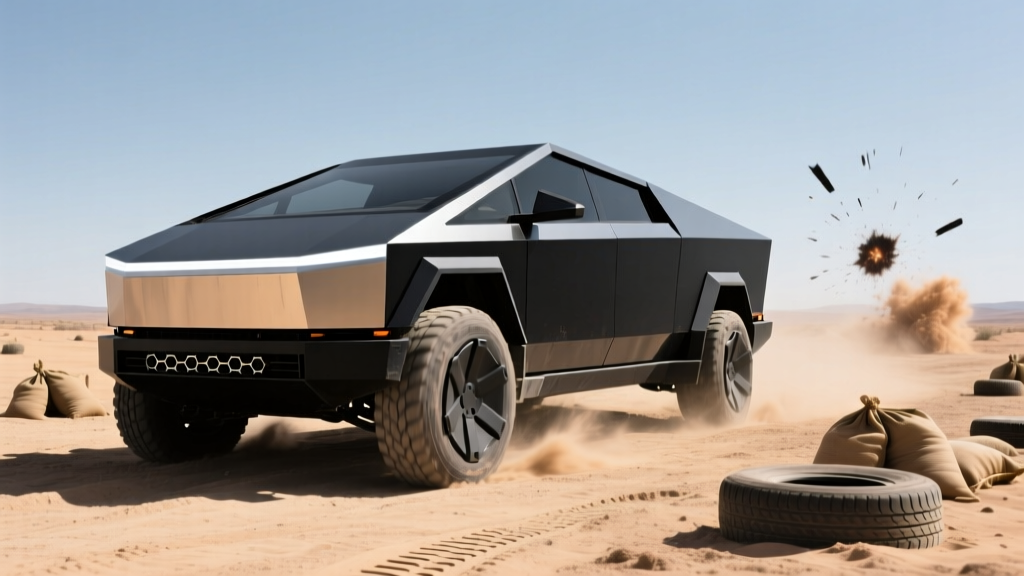
The Tesla Cybertruck has never been a conventional pickup, and recent headlines have made it even more unconventional: reports indicate the USAF wants to use Tesla Cybertrucks for target practice, specifically to evaluate the vehicle's stainless steel exoskeleton against ballistic threats and fragmentation. Whether you're tracking that defense-angle curiosity or simply shopping for a polarizing electric truck, this review covers every number that matters — range, charging, pricing, tax credits, and real-world ownership — so you can decide if the Cybertruck earns a spot in your driveway (even if the Air Force has other plans for it).
Quick Verdict: Is the Cybertruck a Practical EV or a Statement Piece?
The Cybertruck delivers genuinely impressive performance and a usable bed, but its real-world range falls short of the EPA sticker, its charging curve tapers hard above 80%, and its polarizing design limits visibility and garage fitment. For buyers who need a daily-driver electric truck with strong towing capability and don't mind the quirks, the Dual Motor AWD trim hits the sweet spot. For everyone else, the Ford F-150 Lightning or Rivian R1T offer more conventional utility with comparable — or better — efficiency.
Range, Battery & Efficiency: The Real-World Numbers
| Spec | Dual Motor AWD | Cyberbeast (Tri-Motor) |
|---|---|---|
| EPA Range | 340 miles | 320 miles |
| Battery Capacity (usable) | ~123 kWh | ~123 kWh |
| Battery Chemistry | NMC (Nickel Manganese Cobalt) | NMC |
| MPGe (combined) | 66 MPGe | 63 MPGe |
| kWh/100 mi | 51 kWh | 53 kWh |
| Drivetrain | Dual Motor AWD | Tri-Motor AWD |
The 123 kWh (usable) NMC battery pack is one of the largest in any consumer EV, which partly explains the vehicle's 6,600+ lb curb weight. Tesla uses a structural battery pack that contributes to chassis rigidity — relevant if you've seen those USAF target-practice reports, since the exoskeleton and pack together form an unusually robust structure for a production truck.
Charging Speed: DC Fast, Level 2 & the 800V Advantage
| Charging Level | Power / Rate | Time / Miles Added |
|---|---|---|
| DC Fast Charge (peak) | ~250 kW (V3 Supercharger) | 10–80% in ~30 min |
| DC Sustained (10–60%) | ~200–230 kW average | ~170 miles in 15 min |
| Level 2 (home, 48A / 11.5 kW) | 11.5 kW | ~37 miles/hr, full charge ~10.5 hrs |
| Level 2 (NEMA 14-50, 32A / 7.7 kW) | 7.7 kW | ~25 miles/hr, full charge ~16 hrs |
| Level 1 (120V, 12A) | 1.4 kW | ~4 miles/hr (emergency only) |
The Cybertruck uses an 800V architecture, which enables faster charging and better thermal efficiency than 400V systems. At a Tesla V3 Supercharger (250 kW), the charge curve is strong from 10% to about 60%, sustaining 200+ kW. Above 80%, the curve tapers sharply to protect the NMC cells — expect 80–100% to take an additional 25–30 minutes. For road trips, plan stops around the 10–80% window for optimal time efficiency.
At home, a Tesla Wall Connector on a 60A circuit delivers 48A (11.5 kW), adding roughly 37 miles of range per hour. That's adequate for overnight replenishment of even the full 123 kWh pack. If your panel can't support a 60A circuit, a 50A NEMA 14-50 outlet at 32A still provides 25 miles/hr — sufficient for most daily driving needs. According to Tesla's home charging guide, installation costs typically range from $1,200 to $3,000+ depending on panel proximity and local permitting.
Performance & Drivetrain: Quick, Heavy, and Surprisingly Capable
| Spec | Dual Motor AWD | Cyberbeast (Tri-Motor) |
|---|---|---|
| Horsepower | 600 hp | 845 hp |
| 0–60 mph | 3.9 seconds | 2.6 seconds |
| Top Speed | 130 mph | 130 mph |
| Towing Capacity | 11,000 lbs | 11,000 lbs |
| Payload Capacity | 2,500 lbs | 2,500 lbs |
| Curb Weight | ~6,650 lbs | ~6,850 lbs |
The Dual Motor's 3.9-second 0–60 time is genuinely quick for a truck of this mass, and the Cyberbeast's 2.6-second sprint puts it in supercar territory. However, the 6,600+ lb curb weight is noticeable in braking distances and tire wear — expect to replace tires more frequently than in a lighter EV. The 11,000-lb towing capacity is competitive with the F-150 Lightning (10,000 lbs max) and exceeds the Rivian R1T (11,000 lbs, similar). Towing at max capacity will cut range roughly in half — plan for 150–170 miles between charges when hauling heavy.
The steer-by-wire system and rear-wheel steering give the Cybertruck a surprisingly tight turning radius (about 37 feet curb-to-curb) for its 223-inch length, which helps in parking lots and tight trails. Off-road, the adaptive air suspension provides up to 17 inches of ground clearance in Extract Mode, with approach and departure angles competitive with dedicated off-road trucks.
Interior, Cargo & Tech: Angular Utility
The Cybertruck seats five (not six — there's no front bench option). Interior materials are minimalist and durable, with vegan leather and a single 18.5-inch front touchscreen running Tesla's latest software. Rear-seat legroom measures approximately 38.5 inches, which is adequate but less generous than the F-150 Lightning's rear cabin. Rear visibility is poor due to the sloping bed cover and thick C-pillars — the digital rearview mirror (fed by a tailgate camera) is essential and standard.
Cargo dimensions:
- Bed length: 6 ft (72 inches) with tailgate up; ~7 ft with tailgate down
- Bed width (between wheel wells): ~48 inches
- Cargo volume (bed): ~67 cu ft
- Front trunk (frunk): ~7 cu ft (shallow, good for cables/small items)
- Under-bed storage: Lockable compartment behind rear axle
The motorized tonneau cover (called the "sail") is standard and integrates with the bed's 120V and 240V power outlets — the Cybertruck can output up to 9.6 kW for tools or backup home power (via Tesla's Powershare system, analogous to Ford's Pro Power Onboard). Standout tech includes Tesla's Autopilot (Level 2 driver assist — not self-driving), a yoke-style steering wheel option, and the stainless steel exoskeleton that resists dents and corrosion but shows fingerprints aggressively.
Pricing, Tax Credits & Total Cost
| Trim | Base MSRP (2025) | Est. As-Tested | Federal §30D Credit Eligible? |
|---|---|---|---|
| Dual Motor AWD | $79,990 | $85,000–$90,000 | No — exceeds $80,000 truck MSRP cap |
| Cyberbeast (Tri-Motor) | $99,990 | $105,000–$115,000 | No — exceeds $80,000 truck MSRP cap |
The Cybertruck does not qualify for the $7,500 federal EV tax credit under IRS §30D rules. The MSRP cap for trucks is $80,000, and both current trims exceed that threshold. Additionally, buyers must meet income caps ($150K single / $300K joint) and the vehicle must satisfy battery-critical-mineral and component sourcing requirements — but the MSRP disqualification is the primary barrier here.
For buyers in states with additional incentives (California's CVRP, Colorado's state credit, etc.), check your local program — some state credits have higher MSRP thresholds or different eligibility criteria. A tax professional can confirm your specific situation.
Pros
- Exceptional acceleration (2.6s Cyberbeast, 3.9s Dual Motor)
- 11,000-lb towing + 9.6 kW vehicle-to-load power output
- Durable stainless steel body resists dents, corrosion, and (reportedly) small-arms fire
- 800V architecture enables strong DC fast-charge speeds
- Tight turning radius via rear-wheel steering
- Over-the-air updates continuously add features
Cons
- Real-world highway range ~270–290 mi, well below 340 mi EPA
- No federal tax credit (MSRP exceeds $80K truck cap)
- Poor rear visibility; heavy reliance on camera mirrors
- Large footprint — tight garage fitment (223" L × 80" W w/ mirrors)
- Steep charge-curve taper above 80% SoC
- Stainless exterior shows fingerprints and water spots
- Heavy curb weight accelerates tire wear
Cybertruck vs. F-150 Lightning vs. Rivian R1T: Which Electric Truck Wins?
| Attribute | Tesla Cybertruck (Dual Motor) | Ford F-150 Lightning (Extended Range) | Rivian R1T (Dual-Motor Max) |
|---|---|---|---|
| EPA Range | 340 mi | 320 mi | 410 mi |
| Real-World Highway | ~270–290 mi | ~260–280 mi | ~340–360 mi |
| 0–60 mph | 3.9 sec | ~4.0 sec | ~3.5 sec |
| Towing | 11,000 lbs | 10,000 lbs | 11,000 lbs |
| Base MSRP | $79,990 | ~$69,995 | ~$79,900 |
| Federal Tax Credit | No | Yes (qualifying trims/buyers) | Yes (qualifying trims/buyers) |
| Bed Length | 6 ft | 5.5 ft | 4.5 ft (+ Gear Tunnel) |
| Charging (NACS native) | Yes | Yes (2025+ models) | Yes (2025+ models) |
Choose the Cybertruck if: you prioritize acceleration and power output, want the stainless steel durability (relevant if you've read the USAF target-practice reports and value ballistic-adjacent resilience), and are comfortable without the federal tax credit.
Choose the F-150 Lightning if: you want a conventional truck experience, a larger rear cabin, federal tax credit eligibility on qualifying trims, and the broadest dealer-service network.
Choose the Rivian R1T if: real-world range is your top priority (the Max pack delivers genuinely class-leading miles), you value the Gear Tunnel for secure storage, and you prefer a more refined interior.
Warranty & Long-Term Ownership
Tesla covers the Cybertruck with the following warranty structure:
- Basic vehicle: 4 years / 50,000 miles
- Battery & drive units: 8 years / 120,000 miles (minimum 70% capacity retention)
- Corrosion (body): No separate perforation warranty stated — stainless steel is inherently corrosion-resistant
The 8-year/120,000-mile battery warranty is competitive with the industry standard. The 70% retention threshold means Tesla considers the battery within spec if it holds 86+ kWh of its original 123 kWh at year 8 or mile 120,000. NMC chemistry typically degrades faster than LFP in the first 20,000 miles before stabilizing — expect roughly 5–8% loss in year one, then ~1% per year thereafter under normal use. Avoid routinely charging to 100% for daily driving; Tesla's own recommendation is 80% daily for NMC packs, reserving 100% for trips.
Insurance costs for the Cybertruck run 20–40% higher than comparable trucks due to repair costs (stainless steel panels require specialized work) and performance classification. Get quotes before purchasing.
The USAF Target-Practice Angle: What It Means for Buyers
Reports that the USAF is evaluating the Cybertruck for target practice and survivability testing stem from the vehicle's 30X cold-rolled stainless steel exoskeleton, which Tesla claims can resist 9mm handgun rounds. Whether the Air Force ultimately adopts the truck for live-fire evaluation or not, the underlying engineering — a structural stainless shell over a reinforced battery pack — does give the Cybertruck a unique passive-survival profile among production vehicles. For civilian buyers, the practical takeaway is exceptional dent and hail resistance, lower cosmetic maintenance in harsh environments, and a body that will likely outlast the vehicle's mechanical components.
For detailed safety ratings, check NHTSA's database and IIHS as crash-test results become available for the current model year.
Frequently Asked Questions
What is the real-world range of the Tesla Cybertruck?
The Dual Motor AWD is EPA-rated at 340 miles, but real-world highway driving at 70 mph yields approximately 270–290 miles in mild weather and 210–240 miles in freezing conditions. The Cyberbeast drops to roughly 250–270 miles highway. The boxy aerodynamic profile is the main range penalty at speed.
How fast does the Cybertruck charge at home and on the road?
On a Tesla V3 Supercharger (250 kW peak), expect 10–80% in about 30 minutes, with the strongest charging (200+ kW sustained) between 10–60%. At home on a 48A Level 2 Tesla Wall Connector, the Cybertruck adds ~37 miles of range per hour, fully charging overnight in roughly 10.5 hours.
Does the Cybertruck qualify for the $7,500 federal EV tax credit?
No. Under current IRS §30D rules, trucks must have an MSRP at or below $80,000 to qualify. Both Cybertruck trims ($79,990 Dual Motor and $99,990 Cyberbeast, before destination) are at or above this cap, and destination charges push the Dual Motor over. Buyers must also meet income limits ($150K single / $300K joint) and battery-sourcing requirements, but MSRP is the disqualifying factor here.
Is the Cybertruck worth buying vs. the F-150 Lightning or Rivian R1T?
It depends on your priorities. The Cybertruck wins on acceleration, vehicle-to-load power (9.6 kW), and body durability. The F-150 Lightning wins on tax credit eligibility, dealer network, and rear-seat space. The Rivian R1T wins on real-world range (410 mi EPA with Max pack) and interior refinement. If the USAF's interest in the Cybertruck's survivability resonates with your use case — ranch work, remote-area driving, or simply wanting the most damage-resistant body available — the Cybertruck has a unique value proposition.
What are the biggest drawbacks of owning a Cybertruck?
The top complaints from owners include poor rear visibility (mitigated by the camera mirror), real-world range falling well short of EPA estimates, no federal tax credit, high insurance premiums, and the stainless exterior's tendency to show fingerprints and water spots. Garage fitment is also tight — measure your space before ordering.
How long will the Cybertruck battery last?
Tesla warranties the NMC battery for 8 years or 120,000 miles with at least 70% capacity retention. Based on Tesla's fleet data and NMC degradation curves, most packs retain 85–90% capacity at 100,000 miles with proper charging habits (daily limit of 80%, occasional 100% for trips). A full battery replacement out of warranty is estimated at $20,000–$30,000 based on current pack pricing for this capacity class.