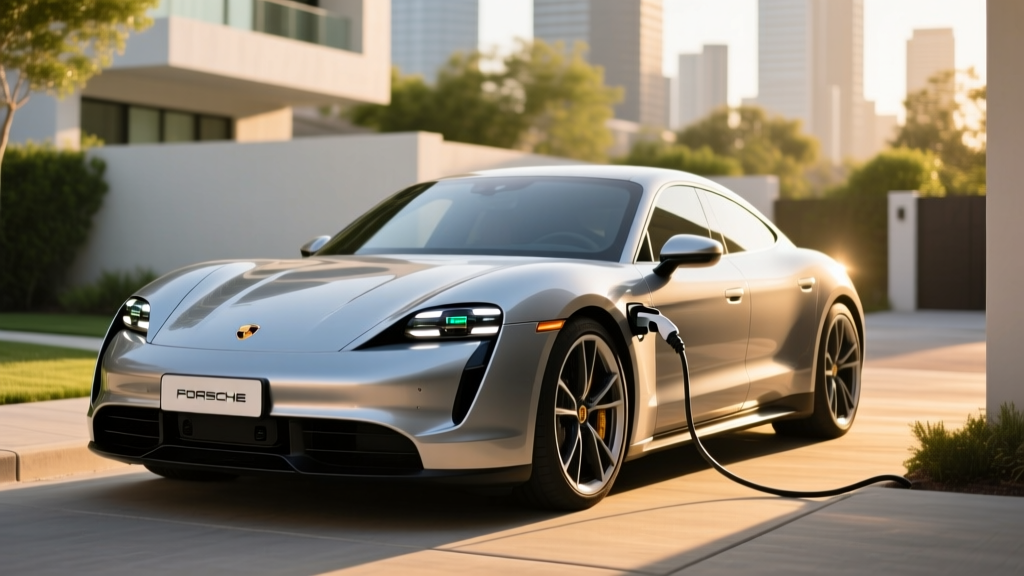
The 2021 Porsche Taycan 4S occupies a unique space in the used electric vehicle market: it's the sweet spot of the original Taycan lineup, offering dual-motor all-wheel drive, blistering acceleration, and Porsche's legendary chassis tuning without the eye-watering price of the Turbo or Turbo S variants. Now that these cars are flowing into the pre-owned market in meaningful numbers, buyers are asking the same questions we field constantly — what's the real range, how fast does it actually charge, and does it hold up as a daily driver?
We've spent time with the 2021 Taycan 4S, cross-referencing EPA data from fueleconomy.gov against real-world driving logs to give you the unvarnished picture. Here's what you need to know before buying.
2021 Taycan 4S At a Glance: Key Specifications
| Specification | Value |
|---|---|
| EPA Range (Performance Battery Plus) | 227 miles |
| EPA Range (Standard Performance Battery) | 200 miles |
| Battery Capacity (usable, Plus pack) | 83.7 kWh (NMC) |
| Battery Capacity (usable, Standard pack) | 71.0 kWh (NMC) |
| Drivetrain | Dual-motor AWD |
| Horsepower (Launch Control) | 562 hp (Plus) / 522 hp (Standard) |
| 0–60 mph | 3.8 seconds (Plus) |
| Max DC Fast Charge Rate | 270 kW (Plus) / 225 kW (Standard) |
| 10–80% DC Fast Charge Time | ~22.5 minutes (Plus) |
| Level 2 Home Charging | 9.6 kW (onboard charger) |
| Combined MPGe | 68 MPGe (Plus) |
| Efficiency | 49 kWh/100 mi (Plus) |
| Battery Warranty | 8 years / 100,000 miles |
| Original MSRP (base) | $103,800 |
Real-World Range: What the EPA Number Doesn't Tell You
EPA sticker: 227 miles
Real-world highway (70–75 mph, 65°F): ~190–210 miles
Real-world mixed city/highway (moderate climate): ~210–225 miles
Cold-weather highway (30°F or below): ~155–180 miles
Note: The Taycan's 800-volt architecture and thermal management help mitigate cold-weather losses compared to many competitors, but physics still applies — expect 15–25% range reduction in freezing temperatures at highway speeds.
The 2021 Taycan 4S with the larger Performance Battery Plus pack carries an EPA rating of 227 miles. The standard Performance Battery drops that to 200 miles. Porsche has historically been conservative with its EPA submissions, and many owners report exceeding the EPA estimate in city driving where regenerative braking recovers more energy. However, at sustained highway speeds above 70 mph, the Taycan's aerodynamic profile — impressive as it is for a sedan — can't fully offset the energy demands of pushing 4,900+ pounds through the air.
For context, the Taycan 4S uses its battery less efficiently than a Tesla Model S Long Range (which achieves 405 miles EPA from a similar-sized pack). The Porsche prioritizes consistent power delivery and thermal headroom over maximum range per kWh. If your daily commute is under 80 miles round-trip and you charge at home, this range is perfectly livable. If you regularly drive 200+ mile highway stretches, you'll need to plan charging stops.
Charging Performance: The 800-Volt Advantage
The Taycan was the first production vehicle to ship with an 800-volt electrical architecture, and this remains one of its strongest selling points on the used market. Here's what that translates to in practice:
| Charging Level | Power | Miles Added per Hour | Notes |
|---|---|---|---|
| Level 1 (120V household) | ~1.4 kW | ~3–4 mi/hr | Emergency/trickle only |
| Level 2 (240V, 40A circuit) | 9.6 kW | ~27–30 mi/hr | Full overnight charge in ~9 hrs (Plus pack) |
| DC Fast Charge (800V station) | Up to 270 kW | ~150+ mi in 10 min | Requires 350 kW-capable charger (e.g., Electrify America) |
| DC Fast Charge (400V station) | Up to ~130 kW | ~70–80 mi in 10 min | Most older CCS stations; still respectable |
With the Performance Battery Plus, the Taycan 4S can accept up to 270 kW on a compatible 800V DC fast charger. In controlled testing, Porsche's claimed 10–80% time of approximately 22.5 minutes holds up — provided you precondition the battery (using the car's navigation to route to the charger activates thermal preconditioning automatically) and the ambient temperature is moderate.
Here's what the charge curve actually looks like: the Taycan sustains peak rates (250–270 kW) from roughly 10% to about 40% State of Charge, then tapers progressively. From 55% to 80%, you're looking at roughly 150 kW average. This taper is gentler than many competitors, meaning the Taycan's 10–80% time is competitive even though its peak kW figure isn't the highest in the segment. Above 80%, charging slows dramatically — expect 40+ minutes to go from 80% to 100% on DC fast charge. Plan to charge to 80% and drive.
At home on a Level 2 charger (240V, 40-amp circuit delivering 9.6 kW to the car), a full charge from 10% to 100% takes roughly 8.5 to 9 hours for the Plus pack. This is standard for the segment and means overnight charging is effortless if you have a Level 2 installation.
Performance and Driving Dynamics
The 2021 Taycan 4S with the Performance Battery Plus produces 562 horsepower and 479 lb-ft of torque when Launch Control is engaged (standard output is 435 hp). The dual-motor AWD system provides all-weather traction, and the 0–60 mph time of 3.8 seconds puts it firmly in sports-car territory — though the heavier Turbo variants are quicker still.
What separates the Taycan from faster-on-paper competitors is chassis communication. The available Porsche Active Suspension Management (PASM) adaptive dampers, rear-axle steering (optional on 4S), and Porsche Torque Vectoring Plus create a sedan that genuinely communicates through the steering wheel and seat. The two-speed transmission on the rear motor — unique in the EV segment — gives the Taycan an extra gear for hard launches while keeping highway cruising efficient.
The standard regenerative braking system recovers up to 265 kW, which is among the highest regen rates available. However, Porsche chose not to offer true one-pedal driving (the car does not come to a complete stop via regen alone). You will still use the brake pedal in stop-and-go traffic. Some EV drivers find this a dealbreaker; others appreciate the familiar feel.
Interior, Cargo, and Daily Livability
The Taycan's cabin is unmistakably Porsche — minimalist, driver-focused, and material-rich. However, it's also a four-seat grand tourer, not a spacious family sedan.
Cargo volume: The rear trunk offers 14.3 cubic feet, and the front trunk (frunk) adds 2.9 cubic feet. Total usable cargo space is approximately 17.2 cu ft. This trails the Tesla Model S (28 cu ft behind rear seats) and is tight for road trips with four adults and luggage.
Passenger space: Front legroom is generous at 41.3 inches. Rear legroom measures 32.7 inches — adequate for adults under 5'10" on shorter trips, but tight for tall passengers on longer drives. The transmission tunnel hump (a vestige of the platform's design) further compromises the rear middle seat, making this effectively a four-passenger car.
Infotainment: The 2021 model uses a 10.9-inch touchscreen with Porsche Communication Management (PCM). Wireless Apple CarPlay is included; Android Auto was not available on the 2021 model year (it was added for 2022). An optional passenger-side display ($1,080 when new) mirrors navigation and media. The touch-sensitive climate control panel below the main screen looks sleek but draws criticism for being harder to operate while driving than physical buttons.
Driver assistance: The 2021 Taycan 4S includes standard forward collision warning, automatic emergency braking, lane-keeping assist, and front/rear parking sensors. Adaptive cruise control with stop-and-go and a surround-view camera were optional. This is SAE Level 2 driver assistance — the driver must remain fully engaged at all times. It's competent highway cruising support, not autonomous driving.
Pricing, Tax Credits, and Used Market Value
The 2021 Taycan 4S originally started at $103,800 MSRP (plus $1,350 destination). With popular options — Performance Battery Plus ($0, standard on most 4S trims but a $0-credit upgrade from Standard), Premium Package, Adaptive Cruise Control, and 21-inch wheels — as-tested prices commonly reached $120,000–$135,000.
On the used market in early 2026, expect to find 2021 Taycan 4S models ranging from approximately $55,000 to $78,000 depending on mileage, condition, battery State of Health, and option content. Low-mileage examples with the Plus pack command premiums.
Because the 2021 Taycan 4S is purchased as a used vehicle, it may qualify for the Used Clean Vehicle Credit (§25E), not the new-vehicle §30D credit.
Credit amount: 30% of the sale price, up to a maximum of $4,000
Eligibility requirements:
• Sale price must be $25,000 or less (most 2021 Taycan 4S examples will NOT qualify at current market prices)
• Buyer adjusted gross income: ≤$75,000 (single) / ≤$150,000 (joint)
• Vehicle must be purchased from a licensed dealer
• Vehicle must be at least 2 model years old (2021 qualifies in 2026)
Bottom line: At $55,000–$78,000 on the used market, the 2021 Taycan 4S exceeds the $25,000 sale-price cap for the §25E used credit. You will not receive a federal tax credit on this purchase. Verify current rules at irs.gov.
For buyers who purchased new in 2021, the Taycan 4S was not eligible for the §30D new-vehicle credit because its MSRP exceeded the $55,000 sedan cap (and the buyer income and battery-sourcing requirements further limited eligibility). This has always been a full-price luxury purchase.
Pros and Cons: Honest Assessment
- Best-in-class chassis dynamics and steering feel
- 800V architecture enables 270 kW DC fast charging
- Sustained performance — no power derating on repeat launches
- Build quality and materials exceed most EV competitors
- Strong regenerative braking (265 kW recovery)
- Quiet, refined cabin at highway speeds
- EPA range of 227 mi trails rivals (Model S: 405 mi)
- Efficiency of 49 kWh/100 mi is below segment average
- Tight rear seat — not ideal for tall passengers or families
- No one-pedal driving (car creeps without brake pedal)
- CCS1 port (no native NACS; adapter required for Tesla Superchargers)
- No Android Auto on 2021 model year
- Maintenance and repair costs remain Porsche-level
Who Should Buy the 2021 Taycan 4S?
- You prioritize driving dynamics and build quality over maximum range
- Your daily driving is under 150 miles and you charge at home
- You want a luxury EV sedan that doesn't look or feel like a tech appliance
- You value sustained performance (track days, mountain passes) without thermal derating
- You live in an area with reliable 350 kW CCS DC fast-charging infrastructure
- You regularly drive 250+ miles between charging stops (consider Model S or Lucid Air)
- You need a spacious rear seat for adult passengers or child seats
- You want access to the Tesla Supercharger network without adapters
- You want maximum efficiency and lowest cost-per-mile (consider Hyundai Ioniq 6 or Tesla Model 3)
Frequently Asked Questions
What is the real-world range of the 2021 Taycan 4S?
With the Performance Battery Plus, expect 190–210 miles at highway speeds in moderate temperatures, and up to 225 miles in mixed city driving. In cold weather (below 30°F), highway range drops to approximately 155–180 miles. The EPA sticker reads 227 miles, but highway driving at 75 mph will consistently return less.
How fast does the 2021 Taycan 4S charge?
On a 350 kW-capable 800V DC fast charger, the Taycan 4S Plus peaks at 270 kW and charges from 10% to 80% in approximately 22.5 minutes. On a standard 400V CCS charger (50–150 kW), expect 35–50 minutes for the same 10–80% session. At home on Level 2 (9.6 kW), a full charge takes about 9 hours.
Does the 2021 Taycan 4S qualify for any federal tax credit?
As a used vehicle purchase in 2026, the Taycan 4S would need to sell for $25,000 or less to qualify for the §25E Used Clean Vehicle Credit (max $4,000). Current market prices of $55,000–$78,000 exceed this cap, so most buyers will not receive a federal credit. Always verify current eligibility at irs.gov and consult a tax professional.
Is the 2021 Taycan 4S worth buying vs. a Tesla Model S or Audi e-tron GT?
The Taycan 4S wins on chassis communication, build quality, and sustained performance under repeated hard use. The Tesla Model S Long Range wins decisively on range (405 mi EPA), Supercharger access, and interior space. The Audi e-tron GT shares the Taycan's J1 platform and 800V architecture but offers slightly more rear-seat room and a different design language at a similar price point. If driving engagement is your top priority, the Taycan is the segment benchmark. If range and practicality lead your decision, the Model S is the stronger choice.
How does the Taycan 4S battery hold up over time?
Porsche warranties the high-voltage battery for 8 years or 100,000 miles against defects and capacity loss below 70% of original capacity. Early data from 2020–2021 Taycan owners suggests degradation is modest — most cars retain 90–95% State of Health after 50,000 miles, aided by the conservative buffer Porsche engineers into the pack and the robust liquid thermal management system. The NMC chemistry in the Taycan is well-proven. Out-of-warranty battery replacement, if ever needed, is estimated at $20,000–$30,000 based on current Porsche service pricing.
Can the 2021 Taycan 4S use Tesla Superchargers?
Not natively. The 2021 Taycan 4S uses a CCS1 charge port. To access Tesla's NACS Supercharger network, you need a CCS-to-NACS adapter. Porsche has not issued an official adapter for the 2021 model year as of early 2026, though third-party adapters exist. Charging speeds on Superchargers via adapter may be limited. The Electrify America and EVgo CCS networks remain the primary DC fast-charging options for this vehicle.