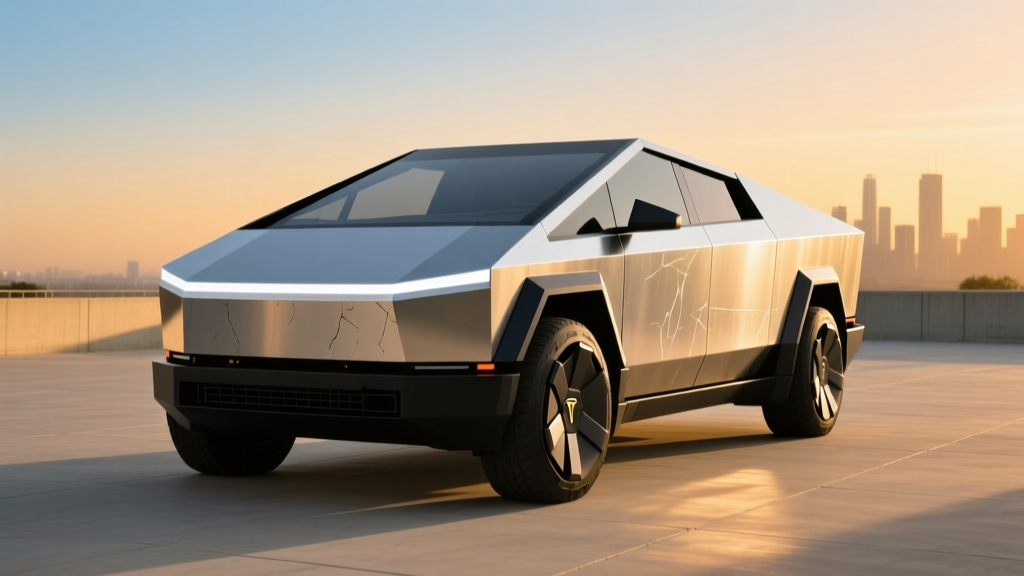
The Tesla Cybertruck divides opinion more than any other vehicle on the road. Its origami-folded stainless-steel exoskeleton looks like it rolled off a sci-fi film set, but beneath the polarizing skin sits a serious electric pickup with legitimate capability. Before we break down the 2026 Cybertruck's range, charging, and ownership economics, let's answer the question that brings thousands of searchers here every month.
Who Designed the Tesla Cybertruck?
The Tesla Cybertruck was designed by Franz von Holzhausen, Tesla's Chief Designer since 2008. Von Holzhausen, who previously led design at Mazda North America and held senior roles at Volkswagen and General Motors, sketched the Cybertruck's radical angular form as a deliberate rejection of the curved, aerodynamic pickup-truck template that Ford, Ram, and GM have followed for decades.
The design philosophy was driven by material constraints as much as aesthetics. The truck's exoskeleton uses 30X cold-rolled ultra-hard stainless steel, an alloy so rigid that it cannot be stamped on conventional automotive presses. This eliminated the possibility of curved body panels, forcing von Holzhausen's team toward flat planes and hard creases. The result was a triangular silhouette that von Holzhausen has described as inspired partly by the Lotus Esprit submarine car from The Spy Who Loved Me and partly by military armored vehicles.
Elon Musk publicly directed the project's conceptual vision — pushing for a "Blade Runner" aesthetic and bullet-resistant glass (famously demonstrated with mixed results at the 2019 unveiling). But the production vehicle's surfacing, proportions, interior layout, and panel execution are von Holzhausen's work. Tesla's design studio in Hawthorne, California, iterated on the concept from 2016 through production launch in late 2023, with significant engineering compromises made along the way — most notably the switch from the originally promised 500+ mile range to more pragmatic battery-pack sizing.
2026 Tesla Cybertruck: Quick Verdict
The 2026 Cybertruck is a capable, tech-forward electric pickup that excels at towing, acceleration, and attention-getting, but trails key competitors in interior refinement, rear-seat comfort, and real-world highway efficiency. If you need a daily-drivable work truck with Supercharger access and don't mind the polarizing styling, it's a strong choice. If you prioritize back-seat space or traditional truck ergonomics, the Ford F-150 Lightning or Rivian R1T may serve you better.
| Spec | AWD (Dual Motor) | Cyberbeast (Tri Motor) | RWD (Base) |
|---|---|---|---|
| EPA Range | 340 miles | 320 miles | ~325 miles (est.) |
| Battery (usable) | ~123 kWh, NMC | ~123 kWh, NMC | ~100 kWh (est.), LFP |
| Horsepower | 600 hp | 845 hp | ~315 hp (est.) |
| 0-60 mph | 4.1 seconds | 2.6 seconds | ~6.5 seconds (est.) |
| Peak DC Charge Rate | ~350 kW | ~350 kW | ~250 kW (est.) |
| 10-80% DC Fast Charge | ~18 minutes | ~18 minutes | ~25 minutes (est.) |
| Level 2 Home Charge | 11.5 kW (~37 mi/hr) | 11.5 kW (~37 mi/hr) | 11.5 kW (~37 mi/hr) |
| Towing Capacity | 11,000 lbs | 11,000 lbs | 7,500 lbs (est.) |
| Base MSRP | $79,990 | $99,990 | $60,990 (est.) |
| Efficiency (MPGe) | 72 MPGe combined | 68 MPGe combined | ~76 MPGe (est.) |
Range and Real-World Efficiency
The Cybertruck's stainless-steel body is heavy — the AWD variant tips the scales at over 6,600 pounds — and its flat, angular shape creates more aerodynamic drag than a sleek sedan or crossover. At fueleconomy.gov, the AWD Cybertruck is rated at 72 MPGe combined (approximately 47 kWh/100 miles). That's noticeably thirstier than the Ford F-150 Lightning Extended Range (73 MPGe combined but with a lighter curb weight) and far behind the Rivian R1T Dual-Motor's efficiency in its Standard battery configuration.
For daily commuting under 60 miles round-trip, range is a non-issue with home charging. For road trips, Tesla's Supercharger network — now with V4 stalls capable of delivering the Cybertruck's full 800V architecture potential — is the strongest ownership advantage. Plan charging stops every 200-230 miles in winter or when towing.
Charging Speed: DC Fast and Home Level 2
| Charging Level | Power / Connector | Speed (Miles Added) | Typical Use Case |
|---|---|---|---|
| Level 1 (120V) | ~1.4 kW / NACS | ~4-5 mi/hr | Emergency trickle |
| Level 2 (240V) | 11.5 kW / NACS (Wall Connector) | ~37 mi/hr | Overnight home charging |
| DC Fast (V3 Supercharger) | Up to 250 kW / NACS | ~150 mi in 15 min | Road trips (older stalls) |
| DC Fast (V4 Supercharger) | Up to ~350 kW / NACS | ~200 mi in 15 min | Road trips (newer stalls) |
The Cybertruck uses an 800-volt electrical architecture, which enables higher charge rates with lower current and reduced heat generation. On Tesla's newest V4 Supercharger cabinets, the AWD and Cyberbeast models can peak near 350 kW, sustaining above 250 kW through roughly 50% state of charge before tapering. A 10-80% session takes approximately 18 minutes under ideal thermal conditions — preconditioning the battery via the navigation system's "route to charger" feature is essential to hitting these numbers.
At home, the Tesla Wall Connector delivers 11.5 kW on a 60-amp circuit, adding roughly 37 miles of range per hour of charging. An overnight session (8-10 hours) easily replenishes a full day's driving. Installation typically runs $800-$2,000 depending on panel proximity and whether a 200-amp service upgrade is needed — factor this into your purchase budget.
A key advantage: the Cybertruck ships with the NACS (North American Charging Standard) connector natively, meaning direct access to all 60,000+ Tesla Supercharger stalls without an adapter. Non-Tesla networks (Electrify America, EVgo) also increasingly support NACS, though CCS adapters are available if needed.
Performance and Driving Dynamics
The Cyberbeast's 2.6-second 0-60 mph time makes it one of the quickest production pickups ever built — a 6,700-pound triangle that outruns a Porsche 911 Carrera off the line. The tri-motor layout (one front, two rear) enables torque vectoring across the rear axle, which you can feel during aggressive cornering. The dual-motor AWD variant's 4.1-second run is still supercar-rivaling by any truck standard.
Ride quality has improved through 2025-2026 software and suspension updates, but the Cybertruck's adaptive air suspension still delivers a firmer ride than the F-150 Lightning's available BlueCruise-equipped trims. The steer-by-wire system — which replaces the mechanical steering column with electronic actuators — takes roughly a week of daily driving to internalize. Some owners love the variable ratio (fewer hand movements at low speeds, more stability at highway speeds); others find it numb and disconnected from road feel.
The Cybertruck's 4-wheel steering (rear wheels counter-steer at low speed, align at high speed) gives it a turning circle of 42.4 feet — tighter than you'd expect for a truck over 19 feet long. This genuinely helps in parking lots and narrow driveways.
Interior, Cargo, and Practicality
The Cybertruck seats five across two rows, though the rear bench is best suited for two adults. Rear legroom measures approximately 38.2 inches, which trails the F-150 Lightning's 43.6 inches. The rear seat cushion sits relatively flat and low, which compromises thigh support on long drives.
Cargo capacity is split between the 6-foot composite bed (approximately 67 cu ft with the tonneau closed) and a front trunk (frunk) offering roughly 7.1 cu ft. The bed's power-retractable stainless-steel tonneau cover is a standout feature — it's lockable, supports distributed loads up to 300 lbs on top, and seals well against weather. The vault-style tailgate deploys as a ramp for loading ATVs or motorcycles.
Up front, the minimalist dashboard centers on an 18.5-inch touchscreen with no physical buttons — climate, mirrors, and glove-box release are all screen-controlled. A 9.4-inch rear touchscreen gives back-seat passengers climate and media control. The yoke-style steering wheel is standard; a round wheel is available as a no-cost option and is recommended for most buyers.
Notable practicality drawbacks: the bed sides are too tall for easy reach-in loading without stepping on the integrated bed step; the stainless-steel fingerprint magnet requires regular cleaning; and the absence of a traditional tailgate-down position limits some lumber-loading scenarios.
Pricing, Trims, and Federal Tax Credit Eligibility
| Trim | Base MSRP | Est. After §30D Credit | §30D Eligibility Notes |
|---|---|---|---|
| RWD (Base) | $60,990 | ~$53,490 | Under $80K truck MSRP cap; buyer income & sourcing rules apply |
| AWD (Dual Motor) | $79,990 | ~$72,490 | Under $80K truck MSRP cap; buyer income & sourcing rules apply |
| Cyberbeast | $99,990 | ~$92,490 | Under $80K truck MSRP cap; buyer income & sourcing rules apply |
Under current IRS §30D rules, the Cybertruck qualifies as a light truck, meaning the MSRP cap is $80,000 (versus $55,000 for sedans). The RWD and AWD trims fall under this cap. The Cyberbeast, at $99,990, exceeds the MSRP cap and is not eligible for the full $7,500 federal credit — though buyers should verify whether any partial credit or point-of-sale transfer arrangements apply at time of purchase.
Critical eligibility caveats for all trims:
- Buyer income caps: Modified AGI must not exceed $300,000 (joint), $225,000 (head of household), or $150,000 (single).
- Battery sourcing: The $7,500 credit is split into two $3,750 halves — one tied to critical-minerals sourcing, one to battery-component manufacturing. Tesla has progressively moved supply chains to comply, but exact eligibility can change quarterly. Verify with your tax professional before relying on the credit.
- Point-of-sale transfer: Buyers can transfer the credit to the dealer at purchase, reducing the out-of-pocket price immediately rather than waiting for a tax refund.
Warranty and Long-Term Ownership
Tesla covers the Cybertruck with:
- Basic Vehicle Limited Warranty: 4 years / 50,000 miles
- Battery & Drive Unit Warranty: 8 years / 120,000 miles (whichever comes first), with a minimum 70% battery capacity retention guaranteed over that period
- Restraint System: 5 years / 60,000 miles
- Corrosion (perforation): 12 years / unlimited miles
The stainless-steel body is inherently corrosion-resistant — it does not require paint and will not rust through in the way stamped-steel trucks can. However, the Cybertruck's surface shows water spots, fingerprints, and fine scratches readily. Tesla sells a "Satin Protective Film" option that mitigates this, but adds to the purchase price.
Insurance costs run higher than average for the segment. Multiple insurers classify the Cybertruck in a premium tier due to repair complexity (stainless-steel bodywork requires specialized tooling) and high parts costs. Expect quotes 20-40% above an equivalently priced F-150 Lightning.
Driver Assistance and Technology
Standard Autopilot includes Traffic-Aware Cruise Control and Autosteer (lane centering on marked highways). FSD Supervised adds automatic lane changes, navigation-guided on/off-ramp transitions, traffic-light and stop-sign recognition, and a "summon" feature for low-speed parking-lot maneuvers. In our experience, FSD performs well on divided highways but requires frequent intervention in construction zones, unmapped roundabouts, and heavy rain.
The Cybertruck's 15-camera surround-view system (no ultrasonic sensors — Tesla uses a vision-only "Tesla Vision" approach) powers both driver-assistance and the 360-degree camera views displayed on the main screen. Visibility out of the angular greenhouse is surprisingly good forward, though the rear view is limited by the tall bed walls and tonneau — the digital rearview camera is essential.
Who Should Buy the Cybertruck?
- You tow heavy loads (up to 11,000 lbs) and want instant electric torque for trailer launches
- You road-trip frequently and want seamless Tesla Supercharger network access
- You value acceleration and performance in a pickup (Cyberbeast: 2.6s 0-60)
- You want a lockable, weather-sealed bed vault with power tonneau
- You're drawn to the design and don't mind attention (positive and negative)
- Rear-seat passenger comfort is a priority (both offer significantly more legroom)
- You prefer a conventional steering feel (no steer-by-wire learning curve)
- You need a wider dealer/service network (Ford has 6,000+ US dealerships)
- You want a proven platform with multi-year reliability data
- Class-leading towing (11,000 lbs) with integrated trailer brake controller
- 800V architecture enables ~350 kW peak DC charging
- Tesla Supercharger network: most reliable public charging in North America
- Cyberbeast performance is supercar-rivaling (845 hp, 2.6s 0-60)
- Lockable power tonneau and 4-wheel steering for tight turning
- Stainless-steel body is dent- and corrosion-resistant
- Real-world highway range significantly below EPA sticker (~260-285 mi)
- Rear-seat legroom trails F-150 Lightning and Rivian R1T
- Steer-by-wire feel is divisive and takes adjustment
- High insurance premiums due to repair complexity
- FSD (Supervised) requires constant driver attention; not autonomous
- Cyberbeast exceeds $80K MSRP cap for federal tax credit
Frequently Asked Questions
What is the real-world range of the Tesla Cybertruck?
The AWD Cybertruck's EPA rating is 340 miles, but real-world highway driving at 70-75 mph typically yields 260-285 miles. In cold weather (below freezing), expect 220-245 miles on the highway. Towing a trailer can reduce range by 40-50%, dropping to roughly 160-190 miles per charge under load.
How fast does the Cybertruck charge at home and on the road?
At home on a Level 2 Tesla Wall Connector (11.5 kW), the Cybertruck adds approximately 37 miles of range per hour — a full overnight charge restores 280+ miles. On DC fast chargers, the 800V architecture allows peaks near 350 kW at V4 Superchargers, achieving a 10-80% charge in approximately 18 minutes with proper battery preconditioning.
Does the Cybertruck qualify for the $7,500 federal EV tax credit?
The RWD and AWD trims fall under the $80,000 MSRP cap for trucks and may qualify for up to $7,500 under IRS §30D, subject to buyer income limits ($150K-$300K AGI depending on filing status) and battery critical-minerals/components sourcing requirements. The Cyberbeast at $99,990 exceeds the MSRP cap and is not eligible for the full credit. Always verify current eligibility with a tax professional.
Is the Cybertruck worth buying vs. the F-150 Lightning or Rivian R1T?
The Cybertruck wins on Supercharger network access, towing capacity (11,000 lbs vs. Lightning's 10,000), and acceleration. The F-150 Lightning wins on rear-seat comfort, dealer service network, and conventional driving feel. The Rivian R1T wins on off-road capability, build quality, and adventure-oriented design. Your best choice depends on whether you prioritize charging infrastructure (Tesla), service convenience (Ford), or versatility (Rivian).
Who designed the Tesla Cybertruck's interior?
Franz von Holzhausen's design team handled both exterior and interior. The minimalist cabin — dominated by the 18.5-inch front screen, yoke steering, and absence of physical controls — reflects Tesla's broader interior philosophy, but the Cybertruck-specific elements (angular dashboard geometry, stainless-steel trim, vault-style bed access UI) were executed by the Hawthorne studio under von Holzhausen's direction.
What is the Cybertruck's bed size and payload?
The composite bed measures approximately 6 feet long with the tonneau closed, offering roughly 67 cubic feet of volume. Payload capacity is rated at approximately 2,500 lbs (AWD). The bed features integrated tie-downs, a 240V outlet for job-site power tools, and the power-retractable stainless-steel tonneau that supports up to 300 lbs of distributed weight on top.