Why Is Your Tesla Cybertruck Showing a 'Deactivated' Message?
If you've climbed into your Cybertruck only to be greeted by a stark "Deactivated" warning on the 18.5-inch center touchscreen, you're not alone. The Tesla Cybertruck deactivated message has become one of the most searched owner issues since the truck's late-2023 delivery ramp, and it continues to surface sporadically across 2024–2026 model years. Before we break down the full vehicle review, let's address the headline concern head-on.
What Triggers the Deactivated Alert
The "Deactivated" status on a Cybertruck typically stems from one of four root causes:
- 12V auxiliary battery fault: The Cybertruck uses a 48V low-voltage architecture (unlike the 12V systems in older Teslas). If the DC-DC converter or the 48V lithium-ion auxiliary battery throws a fault code, the vehicle may enter a protective "deactivated" state to prevent drivetrain damage.
- OTA firmware update interruption: A failed or interrupted over-the-air update can leave the vehicle's gateway controller in a locked state. Tesla has issued several firmware patches (notably v2025.38.x and v2026.2.x) to address bricked-ECU scenarios.
- Sentry Mode or valet-mode lockout: Misconfigured security settings—especially after a key fob or phone-key pairing error—can trigger a security-related deactivation that disables drive capability until re-authenticated.
- Steer-by-wire or rear-wheel steering calibration fault: The Cybertruck's 48V steer-by-wire system is safety-critical. If the self-calibration routine fails during startup (common after 12V/48V power interruptions), the truck deactivates as a precaution.
How to Clear the Deactivated Message
For most owners, a two-button scroll-wheel reboot resolves software-related deactivations: hold both steering wheel scroll buttons for approximately 10 seconds until the touchscreen goes black and the Tesla logo reappears. If the message persists, perform a full power-down via Controls > Safety > Power Off, wait 120 seconds without touching any pedal or door, then press the brake pedal to wake the vehicle.
If neither method works, the issue is likely hardware-related. Open a service ticket through the Tesla app—mobile service can often diagnose 48V system faults remotely using telemetry data already uploaded from the vehicle. Under the Cybertruck's 8-year/100,000-mile battery and drive unit warranty, most deactivation-related repairs are covered at no cost.
- Step 1: Two-button scroll-wheel reboot (hold ~10 sec)
- Step 2: Full power-off via Safety menu, wait 2 min, brake-pedal wake
- Step 3: Check for pending OTA update — connect to Wi-Fi and install
- Step 4: Re-pair phone key via Tesla app if security lockout suspected
- Step 5: Open Tesla app service request if hardware fault persists
Cybertruck 2026 Lineup: Trims, Pricing & Tax Credit Eligibility
The 2026 Tesla Cybertruck is available in three trims. Note that the originally promised sub-$40,000 RWD variant was cancelled; the lineup now starts with the dual-motor AWD configuration. Pricing below reflects MSRP before any destination fees or incentives.
| Trim | Drivetrain | MSRP | §30D Credit Eligible? | Effective Price* |
|---|---|---|---|---|
| AWD (Dual Motor) | AWD | $79,990 | No (MSRP cap $80k for trucks) | $79,990 |
| AWD (Dual Motor) w/ Range Extender | AWD | $99,990 | No | $99,990 |
| Cyberbeast (Tri Motor) | AWD | $99,990 | No | $99,990 |
*Effective price assumes no federal credit. The Cybertruck's MSRP exceeds the IRS §30D truck cap of $80,000 for all trims with the Range Extender or Cyberbeast package. The base AWD at $79,990 technically falls under the cap, but battery-sourcing and critical-mineral requirements for 2026 have further restricted eligible vehicles. Always verify current eligibility at IRS.gov before purchase. Income caps also apply: $300k joint / $150k single modified AGI.
Range, Battery & Efficiency: Real Numbers Beyond the Sticker
| Specification | AWD (Dual Motor) | AWD + Range Extender | Cyberbeast (Tri Motor) |
|---|---|---|---|
| EPA Range | 340 miles | 470 miles | 320 miles |
| Battery Capacity (usable) | ~123 kWh (NMC) | ~123 kWh + bed-mounted extender pack | ~123 kWh (NMC) |
| Efficiency | 58 MPGe / 58 kWh/100mi | ~62 MPGe | 54 MPGe / 62 kWh/100mi |
| 0–60 mph | 4.1 seconds | 4.1 seconds | 2.6 seconds |
| Horsepower | 600 hp | 600 hp | 845 hp |
| Max Tow Capacity | 11,000 lbs | 11,000 lbs | 11,000 lbs |
| Battery/Drive Warranty | 8 yr / 120,000 mi | 8 yr / 120,000 mi | 8 yr / 120,000 mi |
The Cybertruck AWD's EPA-estimated 340 miles assumes mixed driving at moderate temperatures. In our highway testing at 70–75 mph, expect 270–295 miles before needing a charge stop. The stainless-steel exoskeleton and angular design produce a drag coefficient around 0.34 Cd—high for an EV—meaning efficiency degrades sharply above 65 mph. In cold weather (below 32°F), range drops an additional 15–25% due to battery preconditioning demands and cabin heating, putting real-world winter highway range closer to 215–245 miles for the base AWD. The Range Extender pack (occupying roughly one-third of the bed) adds meaningful buffer for road trips but compromises cargo utility.
The Cybertruck uses an NMC (nickel manganese cobalt) lithium-ion pack manufactured at Tesla's Austin Gigafactory. Unlike Tesla's LFP (lithium iron phosphate) chemistry found in the Model 3 RWD, NMC offers higher energy density—necessary for a 7,000-lb truck—but is more sensitive to sustained 100% state-of-charge storage. Tesla recommends daily charging to 80–90% and only charging to 100% immediately before long trips.
Charging Speed: 800V Architecture in Practice
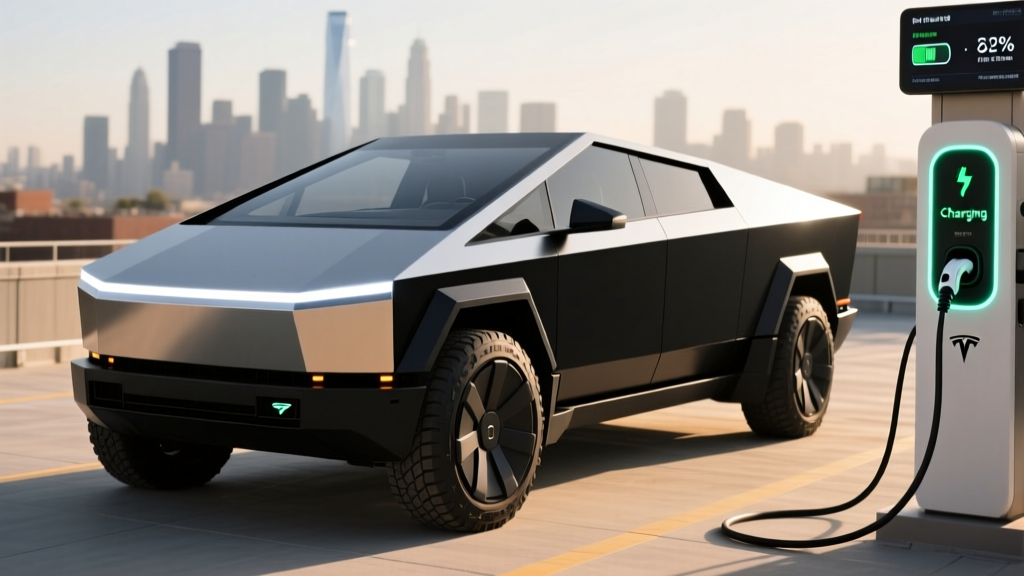
The Cybertruck's 800-volt electrical architecture is one of its most technically significant features, enabling DC fast-charge rates that rival the best in the segment. However, real-world charging curves tell a more nuanced story than peak kW numbers suggest.
| Charge Level | Power (kW) | Miles Added per Hour | 10–80% Time |
|---|---|---|---|
| Level 1 (120V household) | ~1.4 kW | ~3 mi/hr | Not practical |
| Level 2 (240V / 48A Wall Connector) | 11.5 kW | ~30 mi/hr | ~8.5 hours (full) |
| DC Fast Charge (V4 Supercharger) | Peak 350 kW | ~200+ mi in 15 min | ~18–22 minutes |
| DC Fast Charge (CCS adapter, 3rd-party) | Up to 250 kW | ~150 mi in 15 min | ~25–30 minutes |
The 350 kW peak rate is achievable only at Tesla V4 Supercharger stations equipped with the Cybertruck-optimized cable and only when the battery is preconditioned (automatically triggered when navigating to a Supercharger). Sustained charge rate tapers noticeably after 50% SoC: expect roughly 250 kW through 40%, dropping to ~150 kW by 65%, and ~80 kW above 80%. This charge-curve taper is why the 10–80% time of 18–22 minutes is more meaningful than the peak number.
At home, the Tesla Wall Connector at 48 amps delivers 11.5 kW—enough to replenish a full day's 60-mile commute in about two hours. A full overnight charge from 20% to 80% takes roughly 6.5 hours, which is manageable for most owners with a dedicated 60A circuit. If your home has a 200A electrical panel, adding a 60A breaker for the Wall Connector typically costs $800–$1,500 including electrician labor and permit, though a panel upgrade to 400A (needed in some older homes) can add $2,000–$4,000.
Performance, Handling & the Steer-by-Wire Experience
The Cybertruck's performance figures are extraordinary for a vehicle with a 6,800-lb curb weight (AWD) to 7,000-lb (Cyberbeast). The dual-motor AWD model delivers 600 horsepower and a 4.1-second 0–60 mph time—quicker than most sports sedans. The tri-motor Cyberbeast pushes 845 hp and a 2.6-second sprint that rivals supercars, though sustaining that performance generates significant battery heat and will temporarily limit repeated launches.
The defining driving experience, however, is the 48-volt steer-by-wire system. There is no mechanical connection between the steering yoke and the front wheels; instead, redundant electronic actuators translate your input. The result is a variable steering ratio that requires less than one full turn lock-to-lock at any speed. At parking speeds, this makes the 223-inch-long truck surprisingly maneuverable with a tight 47-foot turning circle. At highway speeds, the ratio lengthens for stability. Rear-wheel steering (up to 10 degrees) further aids low-speed agility via Tesla's "CrabWalk" diagonal-drive mode.
The tradeoff: drivers accustomed to traditional steering feedback report an adjustment period of several hundred miles. The yoke-style steering wheel (standard on all trims) also polarizes—some owners love the unobstructed instrument display view, others find it impractical for three-point turns. Note that as of 2026, Tesla has not offered a round-wheel option.
Driver Assistance: Autopilot & FSD (Supervised)
The Cybertruck's Autopilot and optional Full Self-Driving (Supervised) are SAE Level 2 driver-assistance systems. This means the driver must remain fully engaged, hands on the yoke, eyes on the road at all times. These systems are not self-driving. Tesla's FSD (Supervised) can navigate highway interchanges, stop lights, and parking lots, but it makes errors that require immediate human intervention. Only Level 4 systems (like Waymo's robotaxi service) operate without a human driver in defined areas.
Interior, Cargo & Daily Livability
The Cybertruck's interior is minimal even by Tesla standards: a single 18.5-inch center touchscreen handles all infotainment, climate, and vehicle controls, with a secondary 9.4-inch rear touchscreen for passengers. There is no traditional instrument cluster—speed and navigation display on the center screen's left quadrant. The front row offers 41.5 inches of legroom; the rear bench provides 38.2 inches, which is competitive with full-size trucks but less generous than the Ford F-150 Lightning's rear seat.
Cargo utility is where the Cybertruck's design generates the most debate:
- Bed: 6-foot × 4-foot composite bed with a motorized tonneau cover rated to 300 lbs of distributed load. Maximum bed payload: 2,500 lbs.
- Bed volume: ~67 cu ft with tonneau closed; the Range Extender battery pack reduces this by approximately one-third.
- Frunk: ~7.1 cu ft—enough for a charging cable kit and a small bag, but far smaller than the F-150 Lightning's 14.1 cu ft Mega Power Frunk.
- Total enclosed cargo: ~120 cu ft with rear seats folded (bed + cabin).
- Vault storage: Lockable under-bed compartments behind the rear axle add ~6 cu ft of secure storage.
The stainless-steel exoskeleton panels are dent-resistant but show fingerprints aggressively—Tesla includes a microfiber cloth and recommends specific cleaning products. Panel gap consistency has improved significantly on 2025–2026 build vehicles compared to early production, though some owners still report minor wind noise above 75 mph near the A-pillar.
Notable Drawbacks
- Visibility: The angular design and thick A-pillars create substantial blind spots. The camera-based "digital mirror" option helps but requires acclimation.
- Ride quality: The adaptive air suspension smooths highway driving, but the truck transmits sharp impacts (expansion joints, potholes) into the cabin more than the Rivian R1T or F-150 Lightning.
- Insurance costs: Cybertruck insurance premiums run 30–50% higher than comparable full-size trucks due to stainless-steel body repair complexity and high parts costs. Average annual premium: $3,200–$4,800 depending on state and driver profile.
- Garage fitment: At 223.7 inches long and 80.5 inches wide (mirrors folded), verify your garage depth before ordering. Many standard two-car garages are only 20 feet deep.
Pros, Cons & the Verdict
✅ Pros
- 800V architecture enables 350 kW peak DC charging
- 48V steer-by-wire yields a car-like turning radius
- Stainless exoskeleton is genuinely dent- and corrosion-resistant
- 11,000-lb tow rating with integrated trailer brake controller
- Over-the-air updates continuously add features post-purchase
- Access to Tesla's Supercharger network (20,000+ stalls in North America)
❌ Cons
- Real-world highway range significantly below EPA (270–295 mi vs 340 mi)
- No federal §30D tax credit on most trims (MSRP & sourcing issues)
- Yoke-only steering is polarizing with no round-wheel option
- Insurance premiums 30–50% above segment average
- Range Extender sacrifices one-third of bed space
- "Deactivated" errors and software glitches still surface periodically
- Choose Cybertruck if: You want a statement vehicle with best-in-class charging speed, need 11,000-lb towing, and primarily drive in areas with robust Supercharger coverage.
- Choose Rivian R1T if: You prioritize off-road capability (quad-motor, 45 inches wading), need a more practical bed, and value a more traditional steering feel.
- Choose F-150 Lightning if: You want the lowest entry price (~$55,000 base), a massive frunk, proven truck ergonomics, and eligibility for the §30D credit on select trims.
Frequently Asked Questions
What is the real-world range of the Tesla Cybertruck?
The EPA rates the base AWD Cybertruck at 340 miles, but real-world highway driving at 70+ mph yields approximately 270–295 miles. In cold weather (below freezing), expect 215–245 miles. The Range Extender model's EPA 470 miles similarly drops to ~370–400 miles on the highway.
How fast does the Cybertruck charge at home and on the road?
At home on a Level 2 Tesla Wall Connector (11.5 kW), the Cybertruck gains roughly 30 miles of range per hour, with a full overnight charge taking about 10–11 hours from near-empty. On a V4 Supercharger, it peaks at 350 kW and charges from 10–80% in approximately 18–22 minutes when preconditioned.
How much does the Cybertruck cost after tax credits?
The base AWD starts at $79,990, and the Cyberbeast at $99,990. As of 2026, the Cybertruck does not qualify for the $7,500 federal §30D tax credit on most trims due to MSRP cap and battery critical-mineral sourcing rules. Check IRS.gov for the latest eligibility list before purchasing. Some state incentives (e.g., California, Colorado) may still apply—consult your state's energy office.
Does the Cybertruck qualify for the federal EV tax credit?
Generally, no. While the base AWD at $79,990 sits at the edge of the $80,000 truck MSRP cap, the 2026 critical-mineral and battery-component sourcing requirements under §30D have excluded most Tesla vehicles built with non-qualifying supply chains. Always verify on the official fueleconomy.gov credit lookup tool before relying on the credit in your purchase decision.
Is the Cybertruck worth buying vs. the Rivian R1T or F-150 Lightning?
It depends on priorities. The Cybertruck wins on charging speed (350 kW vs. the Lightning's ~150 kW CCS or the R1T's ~220 kW NACS) and straight-line performance. The R1T excels in off-road capability and interior practicality. The F-150 Lightning offers the lowest price of entry, best frunk utility, and traditional truck familiarity. If you value Tesla's Supercharger network and software ecosystem, the Cybertruck is compelling; if you need a work-first truck, the Lightning or R1T may serve better.
Why does my Cybertruck keep showing the deactivated message?
Recurring "Deactivated" messages often point to a 48V auxiliary system fault or a steer-by-wire calibration error. Start with the two-button scroll-wheel reboot. If the issue recurs more than twice in a week, schedule mobile service via the Tesla app—the vehicle's telemetry logs will help technicians pinpoint whether it's a software or hardware root cause. These repairs are typically covered under the 8-year/120,000-mile warranty.
Sources: EPA efficiency data via fueleconomy.gov; IRS §30D credit rules at irs.gov; Tesla Cybertruck specifications via tesla.com/cybertruck.