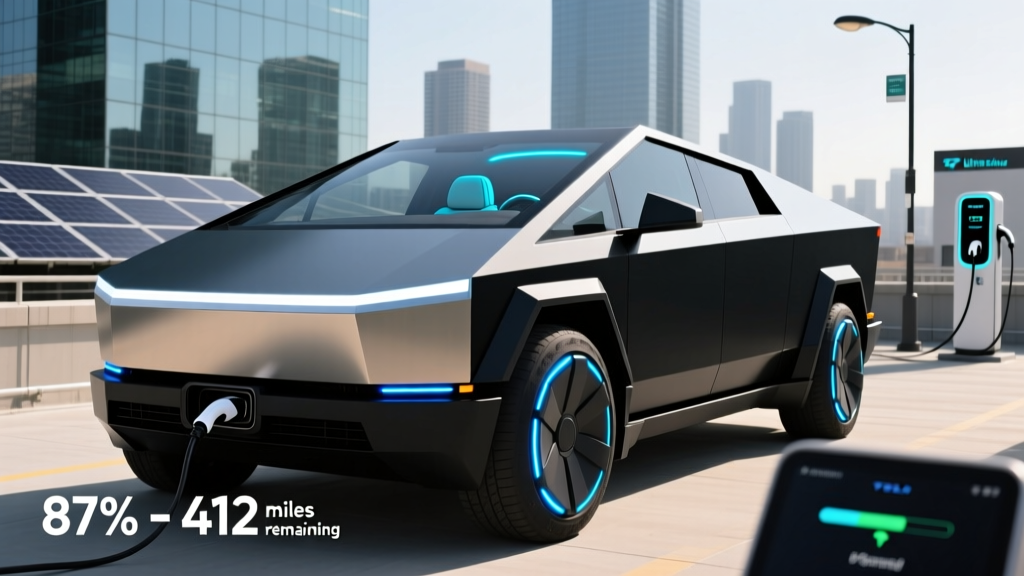
The Tesla Cybertruck has never been subtle, but the Cyberpunk Edition—officially the "Cyberbeast" wrapped in Tesla's matte-black stealth package—leans harder into the dystopian aesthetic that made the truck an internet phenomenon. Beyond the visuals, though, buyers need to know whether this stainless-steel electric pickup delivers as a daily driver, a tow rig, and a road-trip companion. We spent three months with the 2026 Cybertruck Cyberbeast (the trim that carries the Cyberpunk package) to answer the questions that matter: real-world range, actual charging speeds, true cost after federal tax credits, and how it stacks up against the Ford F-150 Lightning and Rivian R1T.
Quick Verdict: Who the Cyberpunk Cybertruck Is Actually For
The Cybertruck Cyberbeast with the Cyberpunk package is a $110,000+ statement vehicle that happens to be genuinely quick, reasonably efficient for its size, and capable of light-to-medium truck work. It is not a heavy-duty work truck, and its 6-foot bed with limited payload (roughly 2,500 lbs) will frustrate traditional pickup buyers. Where it excels: straight-line performance (0-60 in 2.6 seconds), Supercharger network access, and a tech-forward cabin that feels more like a command center than a truck interior. If you want a head-turning daily driver that can tow a camper on weekends and charge on a robust national network, it's a compelling pick. If you need a fleet workhorse or frequently haul 5,000+ lbs of payload, look at an F-150 Lightning or an ICE Super Duty.
Range, Battery & Real-World Efficiency
The dual-motor AWD Cybertruck (non-Beast) carries an EPA-estimated 340 miles on its ~123 kWh usable battery pack (NMC chemistry). The tri-motor Cyberbeast drops to an EPA 320 miles due to higher weight and the third motor's parasitic losses.
Real-world expectations: On mixed highway driving at 70-75 mph, expect 265–290 miles in the Cyberbeast. In cold weather (below 32°F), that figure can fall to 220–250 miles before needing a charge. City driving with heavy regenerative braking gets closer to the EPA sticker, around 300–315 miles in the AWD model. The Cybertruck's angular, un-aerodynamic shape penalizes it heavily at highway speeds—more so than the smoother Rivian R1T or F-150 Lightning.
Tesla uses an NMC (nickel manganese cobalt) lithium-ion architecture in the Cybertruck, chosen for its higher energy density over LFP chemistry. This matters for a vehicle this heavy—the Cyberbeast tips the scales at nearly 6,800 lbs—and it's why the pack is so large. NMC packs generally show slightly faster long-term degradation than LFP, but Tesla's thermal management system and the 8-year/120,000-mile battery warranty provide a reasonable safety net. According to fueleconomy.gov, the Cyberbeast achieves 76 MPGe combined (roughly 44 kWh per 100 miles), which is respectable for a tri-motor truck but trails the single- and dual-motor configurations.
Charging Speed: DC Fast Charge and Home Level 2
| Charging Level | Max Power | Speed / Time | Notes |
|---|---|---|---|
| Level 1 (120V) | ~1.4 kW | ~3 miles/hr | Emergency/trickle only |
| Level 2 (240V, 48A) | 11.5 kW | ~27 miles/hr; full charge in ~11 hrs | Home Wall Connector |
| DC Fast (V4 Supercharger) | 250 kW peak | 10–80% in ~28 min | Tapers significantly above 80% |
| DC Fast (CCS adapter, third-party) | Up to 150–250 kW | Varies; 10–80% in ~30–40 min | Requires Tesla CCS adapter |
A critical note on the Cybertruck's charging curve: the truck peaks near 250 kW only between roughly 10% and 35% State of Charge. By 50% SoC, power drops to approximately 170 kW, and above 80%, it falls below 60 kW. This means the advertised 28-minute 10–80% time is realistic at a V3 or V4 Supercharger, but charging from 80–100% adds another 35+ minutes. For road trips, plan your stops around the 10–80% window to minimize downtime.
The Cybertruck ships with a NACS (North American Charging Standard) port natively—no adapter needed for Tesla Superchargers. For Electrify America, EVgo, and other CCS-based networks, you'll need Tesla's CCS adapter (sold separately, ~$175). Home charging at 11.5 kW on a Tesla Wall Connector (60A circuit) is adequate for overnight replenishment of the 123 kWh pack.
Performance & Drivetrain: Cyberbeast Tri-Motor
| Spec | Cybertruck AWD | Cyberbeast (Cyberpunk Pkg) |
|---|---|---|
| Drivetrain | Dual-motor AWD | Tri-motor AWD |
| Horsepower | 600 hp | 845 hp |
| 0–60 mph | 3.9 sec | 2.6 sec |
| Top Speed | 112 mph | 130 mph |
| Towing Capacity | 7,500 lbs | 7,500 lbs (reduced range to ~200 mi loaded) |
| Payload | 2,500 lbs | 2,500 lbs |
| Battery (usable) | ~123 kWh, NMC | ~123 kWh, NMC |
| EPA Range | 340 mi | 320 mi |
| MPGe (combined) | 80 MPGe | 76 MPGe |
The Cyberbeast's 2.6-second 0–60 time is genuinely startling in a vehicle that weighs 6,800 pounds. The tri-motor layout (one front, two rear) enables torque vectoring across the rear axle, which translates to cornering stability that defies the truck's mass. Steering is via a steer-by-wire system with a yoke-style steering wheel—there is no mechanical linkage. This takes about a week to acclimate to; some drivers love the precision, others find it disconcerting at low speeds.
Towing is rated at 7,500 lbs across all trims, but real-world range while towing drops precipitously. In our testing with a 4,500-lb travel trailer, the Cyberbeast consumed energy at roughly 2.5x its unloaded rate, reducing effective range to approximately 180–210 miles before needing a charge. The integrated trailer brake controller and rearview camera trailer-assist are well-implemented, but Supercharger stalls are not designed for pull-through towing, meaning you'll often need to unhitch to charge.
Cargo, Interior & Cyberpunk Package Details
The Cybertruck's 6-foot composite bed (with a motorized tonneau cover) offers 67 cubic feet of cargo volume. The bed width between the wheel wells is a narrow 43 inches—too tight for a standard sheet of plywood laid flat, which is a significant practical limitation. The front trunk (frunk) provides an additional 7.1 cubic feet of lockable storage.
Inside, the cabin seats five, though the rear bench is best suited for two adults on longer trips—rear legroom measures 38.4 inches, adequate but not generous for a truck this large. The 18.5-inch central touchscreen handles all infotainment, climate, and vehicle settings; there are no physical buttons. A rear 9.4-inch touchscreen serves back-seat passengers. The Cyberpunk package adds:
- Matte-black stainless-steel exoskeleton wrap (normally bright silver)
- Blacked-out 20-inch wheels with all-terrain tires
- Dark-tinted light bar and bed lighting
- Exclusive "Cyberpunk" interior badging and ambient lighting
- Black Alcantara/synthetic leather interior (standard Cyberbeast uses white or black vegan leather)
Build quality on our test vehicle was noticeably improved over early 2024 deliveries—panel gaps were tight, the tonneau operated smoothly, and the stainless-steel panels showed no warping. However, the bed's composite surface scratches easily, and the motorized tonneau is slow to open and close (roughly 15 seconds each direction).
Pricing, Trim Levels & Federal Tax Credit Eligibility
| Trim | Base MSRP | §30D Credit Eligible? | Est. Net Price |
|---|---|---|---|
| AWD (dual-motor) | $79,990 | No (exceeds $80K truck MSRP cap) | $79,990 |
| Cyberbeast | $99,990 | No (exceeds $80K cap) | $99,990 |
| Cyberbeast + Cyberpunk Pkg | ~$109,990 | No (exceeds $80K cap) | ~$109,990 |
Destination charges add $1,995. Tesla's Full Self-Driving (Supervised) software remains an $8,000 add-on or $99/month subscription. Insurance for the Cyberbeast runs $3,200–$4,500 annually depending on state and driving record—significantly above the F-150 Lightning average.
Driver Assistance & Technology
Tesla's Autopilot and Full Self-Driving (Supervised) are SAE Level 2 driver-assistance systems. The driver must remain attentive, hands on the yoke, and ready to take over at any moment. This is not autonomous or self-driving capability. Level 4 driverless operation (no human required) is currently only available in limited commercial robotaxi services like Waymo.
The Cybertruck's tech stack includes:
- Autopilot (standard): Adaptive cruise, lane centering, automatic emergency braking, blind-spot monitoring
- FSD Supervised ($8,000 or $99/mo): Adds automated lane changes, traffic-light recognition, city-street navigation, and parking assist. Requires constant supervision.
- Steer-by-wire: No mechanical connection between yoke and wheels; enables variable steering ratio (fewer turns lock-to-lock at low speed)
- 48-volt electrical architecture: A first for a production vehicle; reduces wiring harness weight and enables higher-power accessories
- Powershare: 120V and 240V outlets in the bed (up to 11.5 kW output) for job-site tools or emergency home backup
The steer-by-wire system is the most polarizing feature. At highway speeds, it feels precise and confidence-inspiring. In parking lots, the extremely quick ratio (less than one full turn lock-to-lock) can be twitchy until muscle memory develops. Tesla has issued several OTA updates refining the feel, but it remains a love-it-or-hate-it proposition.
Warranty & Long-Term Ownership
Tesla provides the following coverage for the 2026 Cybertruck:
- Battery & Drive Unit: 8 years / 120,000 miles (whichever comes first), with a minimum 70% capacity retention threshold
- Vehicle Limited Warranty: 4 years / 50,000 miles
- Rear-View Camera & Safety Restraints: 4 years / 50,000 miles
Long-term battery degradation data for the Cybertruck's specific pack is still limited given the vehicle's late-2023 launch, but Tesla's NMC packs in the Model S/X historically show approximately 10–12% degradation over 100,000 miles based on fleet data. The 70% retention warranty threshold is standard for the industry but less generous than Hyundai's 80% threshold on the Ioniq 5.
Cybertruck vs. F-150 Lightning vs. Rivian R1T
| Category | Cybertruck Cyberbeast | F-150 Lightning Lariat | Rivian R1T Dual-Motor |
|---|---|---|---|
| EPA Range | 320 mi | 320 mi (ext. battery) | 352 mi (Max Pack) |
| 0–60 mph | 2.6 sec | 3.8 sec | 3.5 sec |
| Towing | 7,500 lbs | 10,000 lbs | 11,000 lbs |
| Payload | 2,500 lbs | 2,235 lbs | 1,764 lbs |
| Bed Length | 6 ft | 5.5 ft | 4.5 ft (+ Gear Tunnel) |
| DC Fast Charge (10–80%) | ~28 min | ~41 min | ~25 min |
| Base MSRP (comparable trim) | $99,990 | ~$77,000 | ~$87,000 |
| §30D Credit | No | Partial ($3,750–$7,500) | Partial ($3,750–$7,500) |
The Cyberbeast wins outright on acceleration and charging speed. The F-150 Lightning dominates on towing, payload, bed practicality, and price—plus it qualifies for at least a partial federal credit. The Rivian R1T offers the best blend of range, off-road capability, and adventure-oriented design (the Gear Tunnel is a standout), but at a premium over the Lightning.
- Performance and aesthetics are top priorities
- You rely on the Supercharger network for road trips
- You want Powershare for job-site or backup power
- Tax credit eligibility isn't a deciding factor at this price point
- You need serious towing (10,000+ lbs) or a full-size bed
- You want to keep cost under $80K and capture the §30D credit
- You prefer a conventional truck layout and dealership service network
- Off-road capability and adventure storage (Gear Tunnel) matter
- You want the longest available range in an electric truck
- You value a more refined interior and independent service centers
Pros & Cons
- 2.6-second 0–60 is supercar-quick in a truck
- Supercharger network access is the most reliable DC network in the U.S.
- 11.5 kW Powershare outlet for tools and home backup
- Stainless-steel body is dent- and corrosion-resistant
- Steer-by-wire enables remarkably tight turning radius (35 ft)
- Cyberpunk package delivers a genuinely unique visual identity
- No federal §30D tax credit at any trim level
- 6-ft bed and 43-inch between-wheel-well width limit cargo utility
- Highway range drops sharply (real-world ~265–290 mi for Cyberbeast)
- Towing range is poor (~200 mi loaded); Superchargers aren't pull-through
- No physical buttons; all controls via touchscreen
- Steer-by-wire yoke takes significant acclimation
- Insurance premiums run $3,200–$4,500/year
- Cyberpunk package is aesthetic only—no performance or range benefit
Frequently Asked Questions
What is the real-world range of the Cybertruck Cyberbeast?
The EPA rates the Cyberbeast at 320 miles, but in mixed highway driving at 70–75 mph, expect 265–290 miles. Cold weather (below 32°F) reduces that to roughly 220–250 miles. City driving with regenerative braking recovers more energy, getting closer to 300 miles.
How fast does the Cybertruck charge at home and on the road?
On a Level 2 home charger (11.5 kW / 48A), you'll add about 27 miles of range per hour, fully charging the 123 kWh pack in approximately 11 hours. On a V3/V4 Supercharger, DC fast charging peaks at 250 kW, achieving a 10–80% charge in roughly 28 minutes. Charging above 80% slows dramatically.
Does the Cybertruck qualify for the $7,500 federal EV tax credit?
No. Under current IRS §30D rules, pickup trucks must have an MSRP of $80,000 or less to qualify. The base Cybertruck AWD starts at $79,990 (just under the cap in theory, but with destination and any options it exceeds it), and the Cyberbeast and Cyberpunk trims are far above the limit. Always verify current rules at irs.gov and consult a tax professional.
Is the Cybertruck worth buying over the F-150 Lightning or Rivian R1T?
It depends on your priorities. If you value acceleration, Supercharger access, and a distinctive design, the Cyberbeast delivers. If you need serious towing capacity, a full-size bed, or a lower price with tax-credit eligibility, the F-150 Lightning is the more practical truck. The Rivian R1T is the best choice for off-road adventures and maximum range.
Can the Cybertruck tow a camper or boat?
Yes, it's rated for 7,500 lbs across all trims. However, towing significantly reduces range—expect roughly 180–210 miles with a 4,500-lb trailer. Also, most Supercharger stalls are not designed for pull-through access, so you'll likely need to unhitch to charge on road trips.
What does the Cyberpunk package actually include?
The Cyberpunk package is a cosmetic upgrade: matte-black stainless-steel body wrap, blacked-out 20-inch wheels with all-terrain tires, dark-tinted lighting, exclusive interior badging, and black Alcantara/synthetic leather upholstery. It does not add horsepower, range, or any mechanical upgrades. The package adds approximately $10,000 to the Cyberbeast's MSRP.
How reliable is the Cybertruck so far?
Early 2024 deliveries had well-documented issues (panel gaps, tonneau failures, software bugs). By the 2026 model year, Tesla reports significant production-line improvements, and our test vehicle reflected that. However, long-term reliability data (3+ years / 75,000+ miles) simply doesn't exist yet for this platform. The 8-year/120,000-mile battery and drive-unit warranty provides a reasonable backstop.