Cybertruck Crash Testing: What the Safety Data Actually Shows
The Tesla Cybertruck's angular stainless-steel exoskeleton was marketed as nearly indestructible, but real crash testing tells a more nuanced story. As of early 2026, the Cybertruck has completed NHTSA crash testing and earned partial IIHS evaluation — and the results matter for anyone considering this polarizing electric pickup. This review covers every safety rating, then moves into the full ownership picture: range, charging, pricing, tax credits, and how the Cybertruck stacks up against the Ford F-150 Lightning and Rivian R1T.
NHTSA Crash Test Results
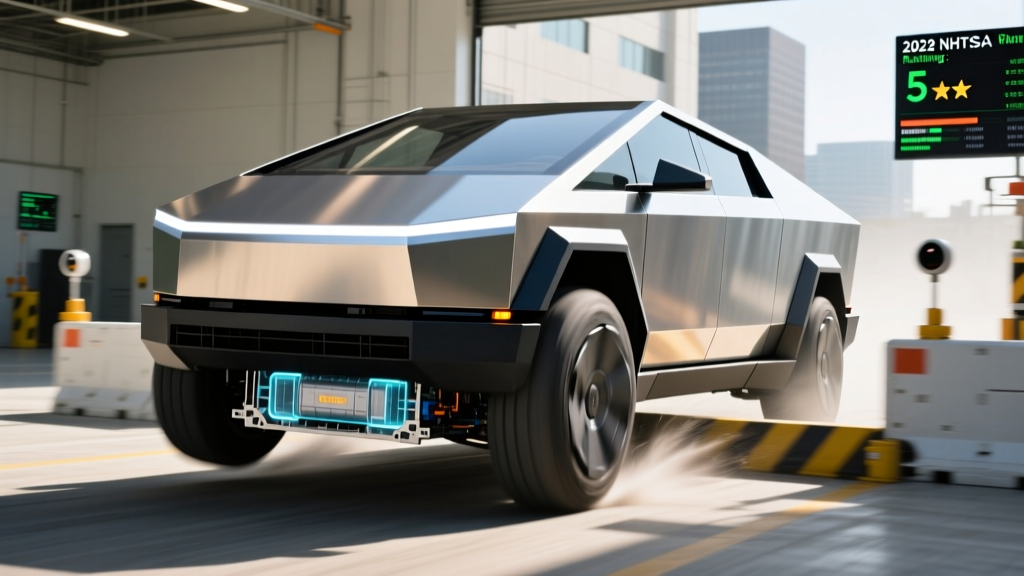
The NHTSA evaluated the Tesla Cybertruck across frontal crash, side crash, and rollover resistance categories. The Cybertruck received an overall 5-star safety rating, with 5 stars in frontal crash and side crash, and 4 stars in rollover resistance. The rollover rating reflects the truck's higher center of gravity relative to sedans, though its skateboard battery platform keeps mass low compared to conventional body-on-frame pickups.
IIHS Evaluation Status
The IIHS has tested the Cybertruck in several categories. Results have been mixed — the truck performed well in moderate overlap front and side crashworthiness, but the stainless-steel exoskeleton's rigidity created challenges in the small overlap front test, where the vehicle's structure must manage crash energy differently than conventional crumple-zone designs. As of early 2026, the Cybertruck has not earned an IIHS Top Safety Pick award. Headlight ratings and pedestrian crash prevention scores remain limiting factors.
Active Safety and Driver Assistance
Every Cybertruck comes standard with Tesla's Autopilot suite, which includes automatic emergency braking, lane-keeping assist, adaptive cruise control, and blind-spot monitoring. Full Self-Driving (Supervised) is available as an add-on, but it remains a SAE Level 2 system — meaning the driver must remain fully engaged and responsible at all times. This is not autonomous driving.
Range, Battery, and Real-World Efficiency
| Spec | AWD | Cyberbeast |
|---|---|---|
| EPA Range | 340 miles | 320 miles |
| Battery Capacity | ~123 kWh usable (NMC) | ~123 kWh usable (NMC) |
| Efficiency | 58 MPGe / 58 kWh/100mi | 56 MPGe / 60 kWh/100mi |
| Drivetrain | Dual-motor AWD | Tri-motor AWD |
| Horsepower | 600 hp | 845 hp |
| 0-60 mph | 3.9 seconds | 2.6 seconds |
| Towing Capacity | 11,000 lbs | 11,000 lbs |
Tesla uses NMC (nickel manganese cobalt) chemistry in the Cybertruck's structural battery pack, prioritizing energy density over the LFP chemistry found in some Model 3/Y variants. The ~123 kWh usable capacity is among the largest in any consumer EV, which helps offset the truck's substantial weight (nearly 7,000 lbs curb weight for the Cyberbeast) and bluff aerodynamic profile.
Charging Speed: DC Fast and Home Level 2
Charging speed is a top concern for EV truck buyers, especially those planning road trips or towing. The Cybertruck supports the NACS (North American Charging Standard) connector natively — no adapter needed at Tesla Superchargers.
| Charging Level | Power | Speed | Notes |
|---|---|---|---|
| Level 1 (120V) | ~1.4 kW | ~3 mi/hr | Emergency/top-up only |
| Level 2 (240V, 48A) | 11.5 kW | ~25 mi/hr | Full charge in ~12 hours |
| Level 2 (240V, 80A) | 19.2 kW | ~42 mi/hr | Requires Tesla Wall Connector + 100A circuit |
| DC Fast (peak) | 250 kW | ~128 mi in 15 min | 10–80% in ~28 min |
The Cybertruck's peak DC fast-charge rate is 250 kW at V3/V4 Superchargers. However, as with all EVs, peak rate is not sustained rate. The charging curve tapers significantly above 60% state of charge (SoC), and the large battery pack means the 10–80% session takes roughly 28 minutes — competitive but not class-leading. For context, the Hyundai Ioniq 5 with its 800V architecture can hit 10–80% in about 18 minutes at a 350 kW charger, though its battery is much smaller.
At home, the Cybertruck's onboard charger accepts up to 19.2 kW on Level 2, but only if you install a Tesla Wall Connector on a dedicated 100-amp circuit. Most home installations use a 60-amp circuit (48A continuous), delivering 11.5 kW and roughly 25 miles of range per hour of charging. Overnight charging from 20% to 80% takes about 7–8 hours at this rate, which is adequate for daily use.
Pricing, Trims, and Federal Tax Credit Eligibility
| Trim | Base MSRP | §30D Credit Eligible? | Est. After Credit |
|---|---|---|---|
| RWD (announced, limited availability) | ~$60,990 | Potentially (if MSRP ≤ $80,000) | ~$53,490 |
| AWD | $79,990 | Yes (at MSRP cap limit) | $72,490 |
| Cyberbeast | $99,990 | No (exceeds $80K truck cap) | $99,990 |
Federal tax credit eligibility for the Cybertruck is complicated. Under IRS §30D rules, pickup trucks must have an MSRP at or below $80,000 to qualify for the up-to-$7,500 new clean vehicle credit. This means:
- AWD trim ($79,990): Qualifies on MSRP, but you must also meet income caps ($150K single / $300K joint modified AGI) and the vehicle must satisfy battery component and critical mineral sourcing requirements, which change annually. As of 2026, Tesla's domestic sourcing has improved but verify current-year compliance on the IRS qualified vehicle list before purchasing.
- Cyberbeast ($99,990): Exceeds the $80,000 MSRP cap for trucks. Not eligible for the federal credit regardless of buyer income or sourcing.
- RWD (if/when available): Would likely qualify on price, subject to sourcing and income rules.
Interior, Cargo, and Daily Usability
The Cybertruck seats five across two rows. Rear legroom measures approximately 38.0 inches — adequate for adults on shorter trips but less generous than the F-150 Lightning's rear seat. The front trunk (frunk) offers roughly 7 cubic feet of lockable storage, useful for charging cables or groceries.
The bed measures 6 feet long with the tailgate up and features a motorized retractable tonneau cover. With the tailgate down, the effective bed floor extends to accommodate longer items, though the angled bed sides and narrow opening (compared to a conventional pickup) limit the width of flat cargo. The bed includes built-in 120V and 240V outlets for job-site power or camping — a genuine utility advantage.
Behind the rear seats, there is approximately 20 cubic feet of enclosed storage when the bed vault is sealed. Total payload capacity is rated at 2,500 lbs.
The interior design is minimalist to a fault: a single 18.5-inch front touchscreen controls nearly everything, including glove box release, mirror adjustment, and wiper speed. There are no physical buttons for climate or audio. A rear 9.4-inch touchscreen serves back-seat passengers. Build quality has improved since the initial 2024 deliveries, but panel gaps and trim inconsistencies remain more common than in legacy competitors.
Warranty and Long-Term Battery Outlook
Tesla provides the following warranty coverage for the Cybertruck:
- Basic Vehicle: 4 years / 50,000 miles
- Battery & Drive Units: 8 years / 150,000 miles (whichever comes first), with a minimum 70% capacity retention threshold
The 8-year/150,000-mile battery warranty is competitive with the F-150 Lightning (8 years/100,000 miles) and Rivian R1T (8 years/175,000 miles). The 70% retention threshold is standard for the industry — meaning Tesla will repair or replace the battery if it degrades below 70% of original capacity within the warranty period. Based on Tesla's historical fleet data across Model S/X/3/Y, most NMC packs retain 85–90% capacity at 100,000 miles, suggesting the Cybertruck's large pack should age well under normal use.
One concern unique to the Cybertruck: its stainless-steel body panels are not repairable using conventional body-shop techniques. Tesla has established specialized repair procedures, but insurance claims data from early owners suggests higher-than-average collision repair costs and longer wait times for panel replacement.
Cybertruck vs. F-150 Lightning vs. Rivian R1T
| Category | Tesla Cybertruck AWD | Ford F-150 Lightning | Rivian R1T Dual-Motor |
|---|---|---|---|
| EPA Range | 340 mi | 320 mi (Ext. Range) | 352 mi (Max Pack) |
| Starting MSRP | $79,990 | ~$54,995 | ~$79,900 |
| §30D Credit Eligible | AWD: Yes | Yes (most trims) | Yes (most trims) |
| Peak DC Charge | 250 kW | ~150 kW (CCS) | ~220 kW (NACS) |
| 0-60 mph | 3.9 sec | ~3.8 sec | ~4.5 sec |
| Max Towing | 11,000 lbs | 10,000 lbs | 11,000 lbs |
| Bed Length | 6 ft | 5.5 ft | 4.5 ft (+ Gear Tunnel) |
| NHTSA Overall | 5 stars | 5 stars | 5 stars |
Choose the F-150 Lightning if: Budget is a priority (starting ~$55K), you need a traditional truck form factor with a familiar dealer/service network, and you want Pro Power Onboard for home backup (V2H capable with Ford Charge Station Pro).
Choose the Rivian R1T if: You prioritize off-road capability, want the Gear Tunnel for secure side-access storage, prefer a more refined interior, and value Rivian's adventure-focused design language.
Pros and Cons
- Best-in-class EPA range (340 mi AWD)
- NACS native — full Supercharger network access
- Integrated 120V/240V bed outlets
- Cyberbeast tri-motor: 2.6-sec 0-60 is supercar-level
- Stainless-steel body resists dents and corrosion
- 11,000-lb towing capacity
- 5-star NHTSA overall crash rating
- Cyberbeast ineligible for §30D credit (over $80K cap)
- 250 kW peak charge rate is modest for a 123 kWh pack
- 6-foot bed is shorter than full-size truck competitors
- No physical buttons — everything runs through the touchscreen
- Rear visibility is poor; relies heavily on cameras
- Stainless-steel panels are costly and slow to repair after collision
- IIHS Top Safety Pick not achieved
- Build quality still inconsistent vs. legacy OEMs
Who Should Buy the Cybertruck?
The Cybertruck makes the most sense for buyers who:
- Road-trip frequently: The 340-mile EPA range and Supercharger network access make it the most practical EV truck for long-distance travel.
- Need job-site power: The 240V bed outlet can run power tools, welders, or campsite appliances without a separate generator.
- Want performance: The Cyberbeast's 845 hp and 2.6-second 0-60 time are unmatched in the pickup segment, electric or otherwise.
- Don't need a full-size bed: At 6 feet, the Cybertruck bed is shorter than a standard F-150 or Silverado bed. If you regularly haul 4×8 plywood sheets flat, this matters.
It's a less ideal fit for budget-conscious buyers (the AWD starts at $79,990 and the Cyberbeast at $99,990), those who need maximum rear-seat space for car seats, or anyone who prefers a traditional service-dealer experience over Tesla's mobile-ranger-and-app model.
Frequently Asked Questions
What is the real-world range of the Tesla Cybertruck?
The AWD Cybertruck has a 340-mile EPA estimate. In real-world highway driving at 75 mph, expect 270–290 miles. In cold weather below 30°F, that drops to roughly 210–250 miles. When towing a 7,000-lb trailer, plan for 150–170 miles between charges. The Cyberbeast's real-world range is approximately 10–15% lower due to its tri-motor power draw and wider tires.
How fast does the Cybertruck charge at home and on the road?
On DC fast charging, the Cybertruck peaks at 250 kW, reaching 10–80% in approximately 28 minutes at a V3/V4 Supercharger. At home on a standard 48-amp Level 2 charger (60-amp circuit), it adds about 25 miles of range per hour, requiring roughly 12 hours for a full charge. With an 80-amp Tesla Wall Connector on a 100-amp circuit, the rate increases to ~42 miles per hour.
Does the Cybertruck qualify for the $7,500 federal EV tax credit?
The AWD trim ($79,990 MSRP) sits exactly at the $80,000 truck MSRP cap and can qualify — provided the buyer meets income limits ($150K single / $300K joint MAGI) and the vehicle meets 2026 battery sourcing requirements. The Cyberbeast ($99,990) exceeds the MSRP cap and does not qualify. Always verify current eligibility on IRS.gov before purchasing.
How did the Cybertruck perform in crash testing?
The Cybertruck earned a 5-star overall NHTSA rating (5 stars frontal, 5 stars side, 4 stars rollover). IIHS testing has shown good performance in moderate overlap and side tests, but the small overlap front test and headlight ratings have prevented a Top Safety Pick award. The stainless-steel exoskeleton is extremely rigid, which helps in some crash modes but complicates energy management in offset impacts.
Is the Cybertruck worth buying over the F-150 Lightning or Rivian R1T?
It depends on your priorities. The Cybertruck wins on EPA range (340 mi), Supercharger network access, and Cyberbeast performance. The F-150 Lightning wins on price (starting ~$55K), dealer service network, and familiar truck utility. The Rivian R1T wins on off-road capability, interior refinement, and creative storage (Gear Tunnel). All three have 5-star NHTSA ratings. Test-drive all three before deciding.
What is the Cybertruck's towing impact on range?
Towing at the 11,000-lb maximum reduces range dramatically — expect roughly 50% of the EPA figure, or about 150–170 miles for the AWD trim. Aerodynamic drag from a trailer is the primary factor, compounded by the Cybertruck's already bluff frontal area. For frequent heavy towing, plan charging stops every 120–140 miles to maintain a safety margin.