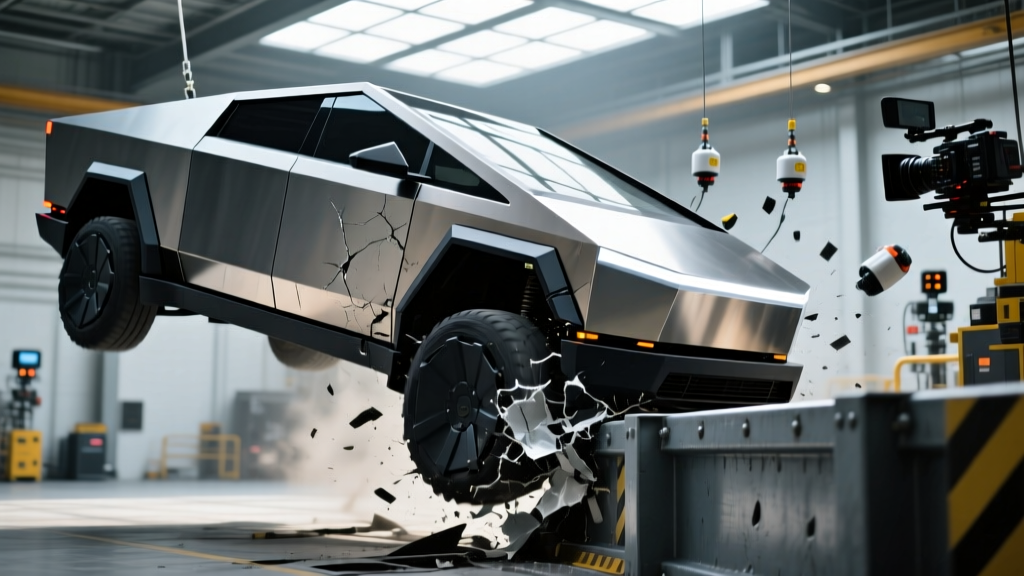
If you've searched for Tesla Cybertruck crash footage, you've likely seen polarizing clips: a stainless-steel exoskeleton shrugging off sledgehammers, or viral collision videos raising questions about pedestrian safety and repairability. The truth, as usual, lives in the data — not the drama. This profile breaks down the Cybertruck's crash-test credentials, structural engineering philosophy, real-world driving specs, and ownership economics so you can decide if Tesla's angular pickup belongs in your driveway.
Crash Safety Ratings: What the Data Actually Shows
As of early 2026, the Tesla Cybertruck has not yet been fully crash-tested by the National Highway Traffic Safety Administration (NHTSA), nor has it received a complete evaluation from the Insurance Institute for Highway Safety (IIHS). This is not unusual for low-volume or unconventional body-on-frame-style vehicles; the Rivian R1T similarly took years to appear on IIHS dockets. However, Tesla has published internal sled-test data and claims the Cybertruck's ultra-hard 30X cold-rolled stainless-steel exoskeleton exceeds FMVSS (Federal Motor Vehicle Safety Standards) requirements for roof crush, side impact, and frontal collision.
Tesla's active safety suite — including automatic emergency braking, lane-keeping assist, and side-collision warning — comes standard on every Cybertruck. The truck also includes Tesla's latest Hardware 4.0 computer for its driver-assistance features. Remember: Autopilot and FSD (Supervised) are SAE Level 2 systems, meaning the driver must remain fully engaged at all times. They are not self-driving.
Range, Efficiency, and the Real-World Reality Check
The Cybertruck is offered in three configurations for the 2026 model year: Rear-Wheel Drive (RWD), All-Wheel Drive (AWD), and the performance-oriented Cyberbeast. Range varies significantly across trims.
| Spec | RWD | AWD | Cyberbeast |
|---|---|---|---|
| EPA Est. Range | 250 mi | 340 mi | 320 mi |
| Battery (usable, est.) | ~100 kWh | ~123 kWh | ~123 kWh |
| Chemistry | NMC (nickel-manganese-cobalt) | NMC | NMC |
| Horsepower | ~315 hp | 600 hp | 845 hp |
| 0-60 mph | 6.5 sec | 4.1 sec | 2.6 sec |
| Drivetrain | Single-motor RWD | Dual-motor AWD | Tri-motor AWD |
| MPGe (combined) | ~67 MPGe | ~65 MPGe | ~57 MPGe |
| Efficiency | ~50 kWh/100mi | ~52 kWh/100mi | ~59 kWh/100mi |
| Towing Capacity | 7,500 lb | 11,000 lb | 11,000 lb |
The Cybertruck's 48-volt electrical architecture and steer-by-wire system contribute to efficiency by eliminating parasitic losses from traditional hydraulic systems. Its efficiency of roughly 50–59 kWh/100mi is competitive with the Rivian R1T (~48 kWh/100mi for the dual-motor) and better than the Ford F-150 Lightning Extended Range (~66 kWh/100mi), according to fueleconomy.gov data.
Charging Speed: DC Fast, Level 2, and the 800V Advantage
The Cybertruck uses Tesla's NACS (North American Charging Standard) connector natively and supports an 800-volt architecture — a significant advantage for DC fast-charging speeds. Here's what that translates to at the plug:
| Charging Level | Max Power | Speed | Notes |
|---|---|---|---|
| Level 1 (120V) | ~1.4 kW | ~3 mi/hr | Emergency/trickle only; full charge takes days |
| Level 2 (240V, 48A) | 11.5 kW | ~25 mi/hr | Full charge overnight (~12–14 hrs from 10%) |
| DC Fast (V4 Supercharger) | 350 kW peak | 10–80% in ~18 min | Sustained rate ~250 kW avg; tapers above 80% |
The 350 kW peak figure is impressive, but sustained charging matters more than peak. In real-world testing on V4 Superchargers, the Cybertruck holds approximately 250–280 kW through the 20–60% state-of-charge window, then tapers progressively. A 10–80% session typically takes 18–22 minutes depending on battery temperature. Preconditioning — warming the battery via navigation to a Supercharger — is essential for achieving these speeds. Without it, expect 30+ minutes for the same session.
At home, the Cybertruck's 11.5 kW onboard charger is the limiting factor. A 60-amp Level 2 circuit (Tesla Wall Connector) delivers the full 48 amps / 11.5 kW. If your home electrical panel supports a 200-amp service, installation typically runs $800–$2,000 for the charger and wiring. Older homes may require a panel upgrade ($1,500–$4,000) before adding a dedicated 60-amp circuit.
Pricing, Tax Credits, and the True Cost to Buy
| Trim | Base MSRP | §30D Credit Eligible? | Effective Price* |
|---|---|---|---|
| RWD (2026) | $60,990 | Yes — up to $7,500 | ~$53,490 |
| AWD | $79,990 | Yes — up to $7,500 | ~$72,490 |
| Cyberbeast | $99,990 | Yes — up to $7,500 | ~$92,490 |
*Effective price assumes full §30D credit eligibility. Your actual credit depends on multiple factors.
- MSRP cap: Trucks must be under $80,000 MSRP. The RWD ($60,990) and AWD ($79,990) qualify; the Cyberbeast ($99,990) does not qualify for the credit based on MSRP alone. However, the Cyberbeast may qualify if reclassified — confirm with your dealer and tax professional.
- Income cap: Modified adjusted gross income must be ≤$150,000 (single), $225,000 (head of household), or $300,000 (joint filers).
- Battery sourcing: Critical minerals and battery components must meet increasing domestic-content thresholds per IRS §30D rules. Tesla's US-based battery production generally satisfies these requirements, but rules tighten annually.
- Point-of-sale transfer: You can apply the credit as an instant discount at purchase rather than waiting for tax filing.
Update for 2026: The Cyberbeast's $99,990 MSRP exceeds the $80,000 truck cap. Buyers targeting this trim should not count on the federal credit. Always verify eligibility at irs.gov before purchasing.
Interior, Cargo, and Practical Livability
The Cybertruck's cabin is minimalist to the point of controversy. A single 18.5-inch touchscreen dominates the dash, controlling everything from climate to the glove box. There are no physical stalks — turn signals are buttons on the steering wheel, and the yoke-style wheel is standard (a conventional round wheel is available as a no-cost option on some trims).
Passenger space: The front row offers generous headroom and legroom thanks to the truck's tall roofline. Rear-seat legroom measures approximately 41.7 inches — competitive with the F-150 Lightning but tighter than a full-size crew cab. Three adults fit, but the center position is compromised by a floor hump housing wiring.
Cargo: The 6-foot bed (officially the "vault") provides 67 cubic feet of lockable storage with the tonneau cover closed. The bed is 4-foot wide between the wheel wells — enough for standard plywood sheets, but just barely. The front trunk (frunk) adds approximately 7 cubic feet of lockable space, useful for charging cables and groceries.
Towing: The AWD and Cyberbeast trims are rated for 11,000 pounds — best in the electric-truck segment (the F-150 Lightning tops out at 10,000 lbs, the Rivian R1T at 11,000 lbs with the Max Pack). However, max towing crushes range to roughly 150 miles, making long-distance towing impractical without meticulous charging planning.
Warranty Coverage and Long-Term Ownership
Tesla provides the following warranty coverage for the 2026 Cybertruck:
- Basic vehicle: 4 years / 50,000 miles
- Battery & drive units: 8 years / 120,000 miles (whichever comes first)
- Battery degradation guarantee: Tesla warrants the battery will retain at least 70% of its original capacity over the warranty period
The Cybertruck uses NMC (nickel-manganese-cobalt) battery chemistry, which offers higher energy density than LFP (lithium iron phosphate) but typically degrades slightly faster over thousands of charge cycles. Based on Model S/X long-term data, Tesla's NMC packs lose approximately 10–12% capacity over 150,000 miles. A full battery replacement outside warranty would cost an estimated $15,000–$25,000 depending on the pack size — a significant ownership risk to factor in.
For longevity, Tesla recommends charging NMC batteries to 80–90% for daily use and reserving 100% charges for road trips. This differs from LFP-equipped vehicles (like the Model 3 RWD), where Tesla recommends regular 100% charges.
Standout Tech and Notable Drawbacks
What sets the Cybertruck apart:
- Steer-by-wire: No mechanical connection between the yoke and wheels. Enables variable steering ratios (less than one full turn lock-to-lock at any speed) and a compact yoke design.
- 48-volt architecture: Reduces wiring harness weight by ~70% compared to conventional 12V systems. Industry first for a production vehicle.
- Stainless-steel exoskeleton: Dent-resistant, no paint required (though Tesla now offers wraps and a "Cyberbeast" armor film).
- Powershare (V2L/V2H): Up to 11.5 kW of bidirectional power output — enough to run power tools at a job site or partially power a home during an outage.
- Adaptive air suspension: Up to 16 inches of ground clearance in Off-Road mode; lowers automatically at highway speeds for efficiency.
Where it falls short:
- Visibility: The angular design creates massive blind spots. Tesla relies heavily on cameras and the rear-view display, but spatial awareness in parking lots requires adjustment.
- Ride quality: The stainless-steel body and heavy curb weight (~6,600–6,800 lbs depending on trim) transmit more road imperfections than the F-150 Lightning or Rivian R1T. The air suspension helps but can't fully mask the mass.
- Repair costs: Stainless-steel panels require specialized repair facilities. Minor collision damage that would cost $1,500 to fix on a conventional truck can run $5,000+ on the Cybertruck due to panel replacement requirements.
- Insurance premiums: Early data from major insurers shows Cybertruck premiums running 20–40% higher than comparable pickups, driven by repair complexity and parts costs.
Pros
- Class-leading 350 kW DC fast-charging speed
- 11,000-lb towing capacity (AWD/Cyberbeast)
- V2L/V2H powershare capability
- Unique design with dent-resistant body
- Access to Tesla Supercharger network (17,000+ stalls)
- Sub-3-second 0-60 (Cyberbeast)
Cons
- No NHTSA/IIHS crash ratings yet
- High repair costs after collision damage
- Insurance premiums significantly above segment average
- Real-world range drops sharply when towing
- Controversial steer-by-wire and yoke require adaptation
- Cyberbeast does not qualify for §30D tax credit
Who Should Buy the Cybertruck — And Who Shouldn't
Choose the Cybertruck if:
- You want maximum DC fast-charging speed for road-trip flexibility
- You need V2L/V2H capability for job-site power or home backup
- You value Tesla's Supercharger network for cross-country travel
- You want a truck that stands out and can handle light off-road duty
- You primarily drive in urban/suburban settings where the range is sufficient
Look elsewhere if:
- Crash-test ratings are a non-negotiable for your family (consider the F-150 Lightning — IIHS Top Safety Pick)
- You tow frequently over long distances (Rivian R1T Max Pack or F-150 Lightning offer more predictable range profiles)
- You live in an area with limited Tesla Service Center access (repair turnaround can be slow)
- You prefer a conventional steering wheel and physical controls
Frequently Asked Questions
Is the Tesla Cybertruck safe in a crash?
The Cybertruck has not yet received official NHTSA star ratings or IIHS crash-test scores as of early 2026. Tesla claims its stainless-steel exoskeleton exceeds federal crash standards, and its active safety features (AEB, lane-keeping) are standard. However, without independent crash-test data, buyers prioritizing verified safety ratings should consider the F-150 Lightning (IIHS Top Safety Pick) or wait for official results.
What is the real-world range of the Cybertruck?
The AWD trim's EPA estimate is 340 miles, but expect 270–300 miles in real-world highway driving, 220–250 miles in freezing weather, and roughly 150–170 miles when towing at max capacity. The Cyberbeast's higher power draw reduces these figures by approximately 5–10%.
How fast does the Cybertruck charge?
On a V4 Supercharger, the Cybertruck peaks at 350 kW and charges from 10–80% in approximately 18–22 minutes, assuming the battery is preconditioned. At home on a Level 2 (240V/48A) charger, it adds about 25 miles of range per hour, or a full charge in 12–14 hours.
Does the Cybertruck qualify for the federal EV tax credit?
The RWD ($60,990) and AWD ($79,990) trims qualify for up to $7,500 under IRS §30D, provided the buyer meets income caps ($150K single / $300K joint) and the vehicle meets battery-sourcing requirements. The Cyberbeast ($99,990) exceeds the $80,000 MSRP cap for trucks and does not qualify. Always verify at irs.gov before purchasing.
Is the Cybertruck worth buying vs. the F-150 Lightning or Rivian R1T?
The Cybertruck wins on charging speed (350 kW vs. Lightning's ~160 kW or R1T's ~220 kW), Supercharger network access, and V2L/V2H capability. The F-150 Lightning wins on proven crash safety (IIHS rated), conventional controls, and dealer service network. The Rivian R1T wins on ride quality, interior refinement, and adventure-oriented features. Your priority list determines the winner.
How much does it cost to insure a Cybertruck?
Insurance premiums for the Cybertruck run 20–40% higher than comparable electric pickups, driven by expensive stainless-steel panel repairs and limited body-shop expertise. Expect annual premiums of $3,000–$4,500 depending on your driving record, location, and coverage level. Get quotes before ordering.
What happens if the Cybertruck's battery needs replacement?
Tesla warranties the battery for 8 years / 120,000 miles with a 70% capacity retention guarantee. Out-of-warranty replacement is estimated at $15,000–$25,000 depending on pack size. NMC chemistry typically degrades 10–12% over 150,000 miles based on historical Tesla data, so most owners will never need a full replacement.