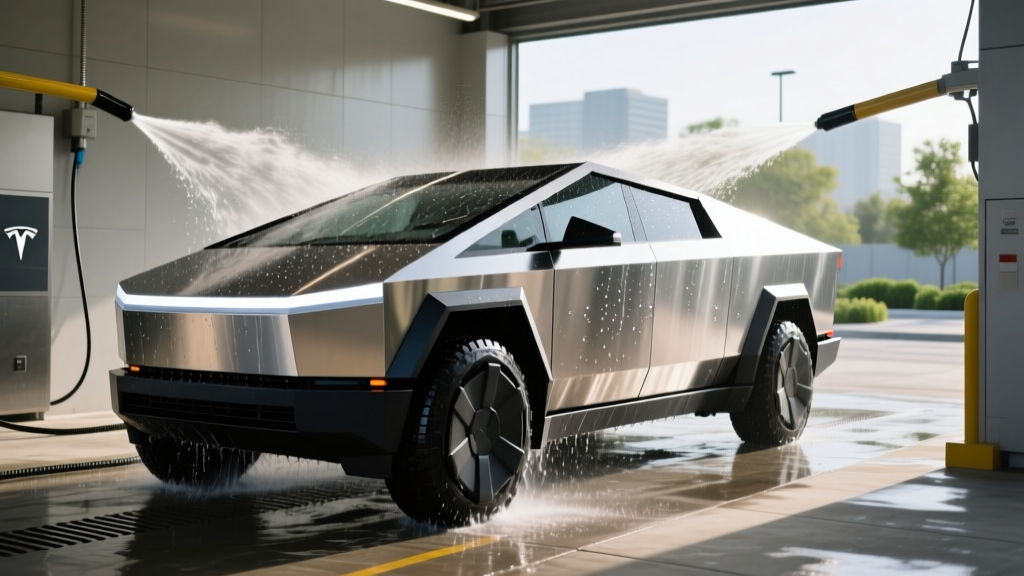
If you've spent $80,000+ on a stainless-steel electric pickup, one of the first practical questions that surfaces is deceptively simple: can the Tesla Cybertruck go through a carwash? The answer is yes — but with important caveats. Tesla built a dedicated Car Wash Mode into the Cybertruck's software specifically to address owner concerns about water ingress, sensor protection, and automated-brush damage to the exoskeleton panels. This guide covers everything you need to know about washing a Cybertruck safely, alongside the hard EV data that actually drives ownership satisfaction: real-world range, 800-volt charging performance, pricing after federal tax credits, and how it stacks up against the Ford F-150 Lightning and Rivian R1T.
Why "Cybertruck Carwash" Is a Real Ownership Question
The Cybertruck's angular stainless-steel body, sealed bed vault, and sensor-dense exterior create a unique set of washing considerations that don't apply to conventional pickups. Tesla's engineering choices — including active aero panels, ultrasonic proximity sensors, and a powered tonneau cover — mean that running the truck through an automatic wash without preparation can trigger error codes, force-unwanted panel movement, or leave residue trapped in panel gaps.
Car Wash Mode, accessible from the vehicle's Controls > Service menu, does several things simultaneously:
- Locks the powered tonneau cover and bed vault to prevent accidental opening
- Disables automatic wiper activation so brushes don't trigger unexpected wiper movement
- Suspends walk-away locking to prevent the truck from locking itself mid-wash
- Closes all windows and seals the HVAC intake to prevent water intrusion
- Disables parking sensor chimes to eliminate constant false alarms from wash equipment
For touchless automatic washes, Car Wash Mode alone is sufficient. For brush-style automatic washes, Tesla's owner's manual recommends hand washing or touchless only — the stainless panels can show micro-scratches from aggressive bristles, and the geometric panel gaps can trap debris that brushes push deeper into seams.
Cybertruck Specs at a Glance: Range, Battery, and Efficiency
| Specification | AWD (Dual Motor) | Cyberbeast (Tri Motor) | RWD (2026) |
|---|---|---|---|
| EPA Range | 340 miles | 320 miles | ~250 miles (est.) |
| Battery Capacity (usable) | ~123 kWh | ~123 kWh | ~100 kWh (est.) |
| Battery Chemistry | NMC (nickel manganese cobalt) | NMC | LFP (expected) |
| MPGe (combined) | 72 MPGe | 68 MPGe | TBD |
| Efficiency (kWh/100 mi) | 47 kWh/100 mi | 50 kWh/100 mi | TBD |
| 0-60 mph | 3.9 seconds | 2.6 seconds | ~6.5 seconds (est.) |
| Horsepower | 600 hp | 845 hp | ~315 hp (est.) |
| Drivetrain | Dual Motor AWD | Tri Motor AWD | Rear-Wheel Drive |
| Max Towing | 11,000 lbs | 11,000 lbs | 7,500 lbs (est.) |
| Base MSRP (2026) | $79,990 | $99,990 | $60,990 |
Charging Performance: 800V Architecture and Real Charge Curves
The Cybertruck uses an 800-volt battery architecture, which enables faster DC fast charging with lower current (and therefore less heat generation) compared to 400V systems. Here's what that translates to at the plug:
| Charging Level | Power (kW) | Speed (miles of range per hour) | Notes |
|---|---|---|---|
| Level 1 (120V household) | ~1.4 kW | ~3-4 mi/hr | Emergency/trickle only |
| Level 2 (240V, 48A home) | 11.5 kW | ~30-34 mi/hr | Full charge in ~10-12 hours |
| DC Fast (Tesla V4 Supercharger) | Up to 350 kW (peak) | ~1,000+ mi/hr (peak) | 10-80% in ~15-20 minutes |
| DC Fast (CCS adapter, 250 kW) | Up to 250 kW | ~800 mi/hr (peak) | With Tesla CCS adapter |
A critical ownership insight: the Cybertruck's peak 350 kW rate is only achievable at Tesla's newest V4 Supercharger cabinets, which are still rolling out. At the more common V3 Superchargers (250 kW max), you'll see 10-80% in roughly 20-25 minutes. The 800V architecture does sustain higher power deeper into the charge curve than 400V competitors — where an F-150 Lightning might taper sharply above 80%, the Cybertruck holds usable charge rates to about 90% SoC before dropping off.
For home charging, you'll want a Tesla Wall Connector on a 60-amp circuit (48A continuous). This delivers a full overnight charge from near-empty. Budget $500-$1,500 for professional installation depending on your electrical panel's proximity to the parking spot and whether a panel upgrade (200A service) is needed.
Interior, Cargo, and Utility: Dimensions That Matter
The Cybertruck seats five across two rows, though the rear bench is tighter than a full-size F-150 or Silverado. Key interior and cargo dimensions:
- Front legroom: 41.0 inches
- Rear legroom: 36.1 inches
- Bed length: 6 feet (72 inches) with tailgate down
- Bed width (between wheel wells): 43.3 inches
- Cargo bed volume: ~67 cu ft (sealed bed vault with tonneau closed)
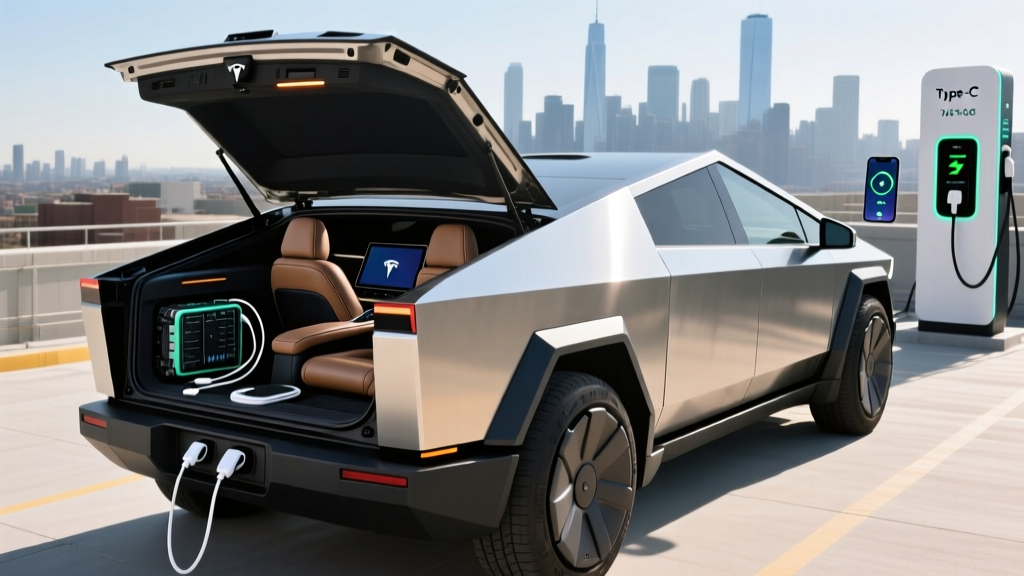
- Frunk (front trunk): ~7.1 cu ft — fits a charging cable kit and small bag
- Max payload: 2,500 lbs
- Max towing: 11,000 lbs (AWD and Cyberbeast)
The powered stainless-steel tonneau cover is a standout feature — it retracts electrically and locks, creating a sealed, weatherproof cargo vault. This is genuinely useful for secure gear storage, but be aware that the mechanism adds weight and complexity. Early production units saw some tonneau alignment issues that Tesla addressed through service bulletins.
Tech, Driver Assistance, and Standout Features
The Cybertruck runs Tesla's latest infotainment stack on an 18.5-inch center touchscreen with a secondary 9.4-inch rear display for passengers. Notable tech includes:
- Autopilot (standard): SAE Level 2 adaptive cruise + lane centering — driver must remain fully engaged with hands on the yoke
- Full Self-Driving Supervised ($8,000 option or $99/mo): Also Level 2 — handles city streets, stop signs, and highway interchanges but requires constant driver supervision. This is not autonomous driving.
- Steer-by-wire: No physical steering column connection — the yoke uses electronic signals, enabling variable-ratio steering (less turning at low speeds, more stability at highway speeds)
- 48-volt electrical architecture: Replaces the traditional 12V system, reducing wiring harness weight and enabling higher-power accessories
- Powershare (V2L/V2H): Bi-directional charging can power tools at a job site (up to 9.6 kW from bed outlets) or feed your home during an outage with the Powerwall integration
- Armor glass: Laminated composite windshield and windows — more impact-resistant than standard automotive glass, though not bulletproof despite the marketing
Pricing, Trims, and Federal Tax Credit Eligibility (2026)
| Trim | Base MSRP | Est. As-Tested | §30D Credit Eligible? | Effective Price (after max credit) |
|---|---|---|---|---|
| RWD | $60,990 | $62,000-$65,000 | Potentially — see rules below | ~$53,490 |
| AWD (Dual Motor) | $79,990 | $82,000-$88,000 | Potentially — see rules below | ~$72,490 |
| Cyberbeast (Tri Motor) | $99,990 | $102,000-$110,000 | No — exceeds MSRP cap | $99,990+ |
The IRS §30D federal tax credit offers up to $7,500 for qualifying new EVs, but the Cybertruck's eligibility is trim-dependent and subject to multiple conditions per current IRS rules:
- MSRP cap: Trucks, SUVs, and vans must have an MSRP at or below $80,000 to qualify. The RWD ($60,990) and AWD ($79,990) clear this cap. The Cyberbeast ($99,990) does not.
- Buyer income limits: Modified AGI must not exceed $300,000 (joint), $225,000 (head of household), or $150,000 (single).
- Battery sourcing: The credit is split into two $3,750 halves — one for critical minerals sourcing and one for battery component manufacturing. Tesla's North American battery production and supply chain have improved, but exact sourcing compliance varies by production batch. Check the fueleconomy.gov credit lookup for the specific VIN before purchasing.
- Point-of-sale transfer: As of 2024+, you can transfer the credit to the dealer at purchase to reduce your out-of-pocket cost rather than waiting to claim it on your tax return.
Tax credit rules are subject to change. Consult a tax professional and verify current eligibility on irs.gov before finalizing a purchase.
Cybertruck vs. F-150 Lightning vs. Rivian R1T: Is It Worth It?
| Attribute | Tesla Cybertruck AWD | Ford F-150 Lightning (ER) | Rivian R1T (Dual Max) |
|---|---|---|---|
| EPA Range | 340 mi | 320 mi | 410 mi |
| Base MSRP | $79,990 | $69,995 | $87,900 |
| Max Towing | 11,000 lbs | 10,000 lbs | 11,000 lbs |
| 0-60 mph | 3.9 sec | ~4.5 sec | 3.0 sec |
| Bed Length | 6 ft | 5.5 ft | 4.5 ft (standard bed) |
| DC Fast Peak | 350 kW | 150 kW | 220 kW |
| 10-80% Charge | ~15-20 min | ~41 min | ~30 min |
| §30D Eligible (AWD/equiv.) | Yes (AWD trim) | Yes | Yes |
Warranty and Long-Term Ownership
Tesla's warranty coverage for the Cybertruck:
- Basic vehicle limited warranty: 4 years / 50,000 miles
- Battery and drive unit warranty: 8 years / 120,000 miles (whichever comes first), with a minimum 70% capacity retention threshold during the warranty period
- Stainless exoskeleton: Covered under the basic warranty for corrosion and structural defects, though surface rust (tea-staining) on stainless panels is a known cosmetic issue that Tesla has addressed with cleaning guidance rather than warranty replacement
The NMC battery in the AWD and Cyberbeast trims should retain 85-90% capacity at 100,000 miles based on Tesla's historical pack data from Model S/X. The expected RWD trim with LFP chemistry will likely show even slower degradation (LFP cells tolerate daily 100% charging better and have longer cycle life), though at lower energy density.
Pros and Cons: The Honest Cybertruck Verdict
- Fastest DC charging in the pickup segment (350 kW peak, 15-20 min 10-80%)
- Sealed 6-ft bed vault with powered tonneau — best-in-class secure cargo
- 9.6 kW Powershare for job-site tool power and home backup
- 48V electrical architecture reduces wiring weight and improves accessory performance
- Steer-by-wire enables tight low-speed maneuvering despite 223-inch length
- AWD trim qualifies for §30D credit (subject to sourcing/income rules)
- Real-world highway range ~260-280 mi (AWD) — below EPA 340 mi sticker
- Efficiency of 47-50 kWh/100 mi means expensive charging vs. lighter EVs
- Rear seat legroom (36.1 in) is tight for a truck in this price class
- Stainless panels show fingerprints, water spots, and potential tea-stain rust
- Cyberbeast exceeds $80K MSRP cap — no federal tax credit on top trim
- Steer-by-wire and yoke steering polarizing — test drive before committing
- Service center wait times remain a Tesla ownership pain point in many markets
Choose the F-150 Lightning if: You want the lowest entry price, need a familiar truck platform with broad dealer service access, or you're buying for a fleet. Better for traditional truck buyers who want EV benefits without a learning curve.
Choose the Rivian R1T if: Range is your top priority (410 mi EPA on Dual Max), you want best-in-class adventure capability with the gear tunnel, and you don't mind a shorter bed and higher price.
Cybertruck Carwash FAQ
Can I take the Tesla Cybertruck through an automatic carwash?
Yes. Activate Car Wash Mode from Controls > Service before entering. Touchless automatic washes are preferred. Tesla recommends against brush-style automatic washes, as aggressive bristles can micro-scratch the stainless-steel panels and push debris into panel seams.
What does Cybertruck Car Wash Mode actually do?
It locks the tonneau cover, disables auto-wipers and walk-away locking, closes all windows, seals the HVAC intake, and silences parking sensors. This prevents water intrusion, accidental panel movement, and false sensor alarms during the wash cycle.
Can I hand-wash the Cybertruck?
Yes, and this is Tesla's recommended method. Use a pH-neutral automotive soap, microfiber mitts, and rinse thoroughly to prevent soap residue from drying in the panel gaps. The stainless panels benefit from a dedicated stainless-steel cleaner for water-spot removal — avoid abrasive polishes.
Will water damage the Cybertruck's sensors or electronics?
The Cybertruck is designed with sealed sensor housings and waterproof connectors rated for weather exposure. Car Wash Mode ensures that all openings are secured. Driving through rain or a standard carwash will not damage the vehicle's electronics. Avoid high-pressure spray directly into panel seams or the bed vault seal at close range.
What is the Cybertruck's real-world range?
The AWD is EPA-rated at 340 miles. In real-world highway driving at 70+ mph, expect 260-280 miles. In cold weather (below 32°F), plan for 220-240 miles. Towing cuts range roughly in half regardless of the truck.
Does the Cybertruck qualify for the $7,500 federal EV tax credit?
The RWD ($60,990) and AWD ($79,990) trims are under the $80,000 MSRP cap for trucks and may qualify, subject to buyer income limits ($300K joint / $150K single) and battery-sourcing requirements. The Cyberbeast ($99,990) exceeds the MSRP cap and does not qualify. Verify your specific VIN on fueleconomy.gov and consult a tax professional.
How fast does the Cybertruck charge at home?
On a 240V Level 2 Tesla Wall Connector (48A / 11.5 kW), the Cybertruck gains roughly 30-34 miles of range per hour, fully charging from near-empty in about 10-12 hours — easily overnight.
Is the Cybertruck a good daily driver and commuter?
It works well as a commuter if you have home charging and your commute is under 150 miles round-trip. The steer-by-wire system makes parking easier than its size suggests. However, the 47-50 kWh/100 mi efficiency means higher electricity costs than a sedan or crossover, and the firm ride quality is noticeable on rough urban roads.