BYD's Fast-Charging Promise Meets Reality: What 2026 Buyers Need to Know
BYD has spent the last three years building a reputation around its Blade Battery — a lithium iron phosphate (LFP) cell design that prioritizes thermal stability and cycle life over raw energy density. But for EV shoppers evaluating the brand's growing global lineup, one question matters more than chemistry press releases: how fast do these cars actually charge?
As of early 2026, BYD's passenger EV portfolio available outside China includes models like the Atto 3 (compact SUV), Dolphin (subcompact hatch), Seal (sport sedan), and the newly refreshed Seagull (budget hatch). None are sold in the United States — BYD has not entered the US passenger vehicle market — but understanding BYD fast charge capabilities is relevant for import-curious buyers, international readers, and anyone benchmarking how Chinese LFP technology compares to Hyundai, Tesla, and Kia's NMC-dominant architectures.
This review examines BYD's current DC fast-charging performance, real-world range, battery technology, and what the numbers mean if you're cross-shopping globally or watching for a potential US entry.
BYD Fast Charge Specs: DC Charging Speeds Across the 2026 Lineup
BYD's e-Platform 3.0 underpins most of its current EVs and supports 400-volt architecture (with 800V reserved for premium Yangwang and Denza models). That 400V ceiling directly constrains peak DC fast-charge rates compared to 800V competitors like the Hyundai Ioniq 5 or Porsche Taycan.
| Model | Battery (kWh, usable) | Chemistry | Peak DC kW | 10–80% Time | EPA-Equiv. Range* | 0–60 mph | HP |
|---|---|---|---|---|---|---|---|
| Atto 3 (Standard) | 49.9 kWh | LFP Blade | 80 kW | ~34 min | ~210 mi | 7.3 s | 201 |
| Atto 3 (Extended) | 60.5 kWh | LFP Blade | 88 kW | ~29 min | ~260 mi | 7.3 s | 201 |
| Dolphin (Standard) | 44.9 kWh | LFP Blade | 60 kW | ~35 min | ~186 mi | 12.3 s | 95 |
| Dolphin (Extended) | 60.4 kWh | LFP Blade | 88 kW | ~29 min | ~260 mi | 7.0 s | 201 |
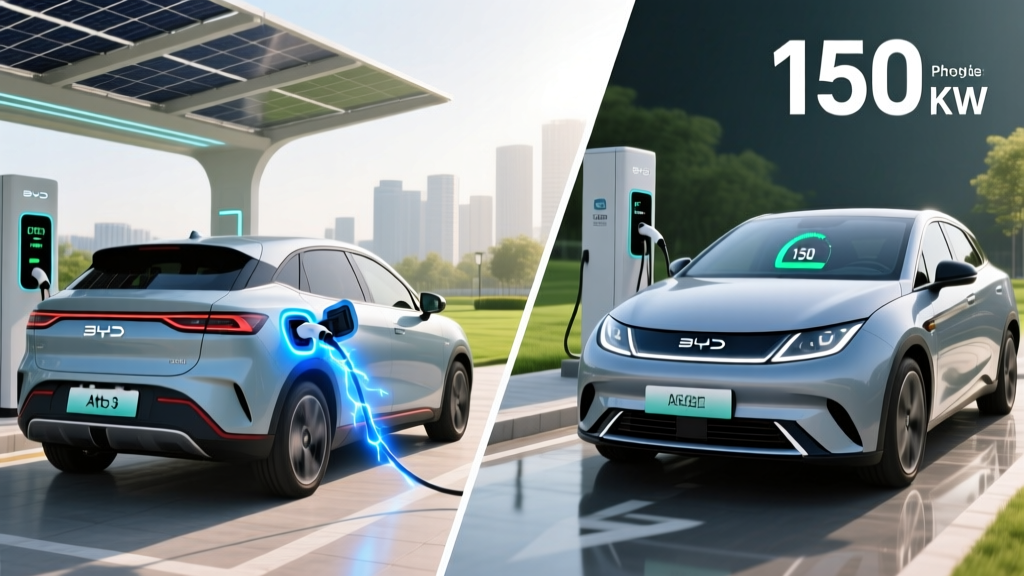
| Seal (RWD) | 82.5 kWh | LFP Blade | 150 kW | ~26 min | ~354 mi | 5.9 s | 313 |
| Seal (AWD Perf.) | 82.5 kWh | LFP Blade | 150 kW | ~26 min | ~323 mi | 3.8 s | 530 |
*EPA-equivalent ranges are estimated from WLTP figures using a ~0.78 conversion factor typical for LFP vehicles. BYD does not publish official EPA numbers as it does not sell in the US. WLTP source: BYD Global.
The BYD Seal RWD's WLTP rating of ~454 km (282 mi) translates to roughly 354 EPA-equivalent miles on paper — but real-world highway driving at 70+ mph typically yields 280–310 miles in moderate temperatures. In cold weather (below 32°F / 0°C), expect a 20–30% reduction, bringing usable highway range down to 210–250 miles. The smaller Atto 3 Extended Range will realistically deliver 200–220 miles on a highway road trip in mild conditions, and 150–170 miles in deep winter. LFP batteries also exhibit more voltage sag at low states of charge, making the final 10% less predictable than NMC packs.
The Blade Battery Advantage (and Its Charging Trade-Off)
BYD's Blade Battery is a cell-to-pack LFP design that eliminates modular grouping, packing long, thin prismatic cells directly into the structural battery tray. The engineering payoff is impressive thermal runaway resistance — BYD demonstrated nail-penetration tests where the Blade Battery did not ignite, a significant safety advantage over some NMC chemistries.
However, LFP chemistry imposes inherent fast-charging constraints:
- Lower energy density (~150–170 Wh/kg cell-level vs. 220–270 Wh/kg for high-nickel NMC) means heavier packs for the same range, or less range for the same weight.
- Charge-rate sensitivity at low temperatures: LFP cells accept charge more slowly when cold. Without robust battery preconditioning (which BYD's thermal management provides but less aggressively than Tesla or Hyundai), cold-weather DC fast charging can add 5–10 minutes to a 10–80% session.
- Flat voltage curve: LFP's famously flat discharge curve makes state-of-charge estimation harder, and some owners report the car's range estimator being less accurate between 20–80% SoC compared to NMC vehicles.
- Peak kW vs. sustained kW: The Atto 3 Extended's 88 kW peak is typically held from ~10–55% SoC, then tapers to 60–65 kW through 80%. The Seal's 150 kW peak sustains from roughly 10–40%, dropping to ~110 kW by 60% and ~75 kW approaching 80%. This taper behavior means the advertised 10–80% time is more honest than just quoting peak kW, but real-world sessions at non-preconditioned batteries will run longer.
The upside? LFP cells tolerate regular 100% charging without the accelerated degradation that plagues NMC packs. BYD recommends charging the Blade Battery to 100% at least once a week for cell-balancing calibration — the opposite of the 80% daily limit most NMC owners follow. Over a 5-year ownership period, this means BYD owners get full use of their pack's capacity daily without guilt.
Home Charging and Level 2 Speeds
For daily use, home Level 2 charging is where most BYD owners will spend 90% of their charging time. Here's how the onboard chargers perform:
| Model | Onboard Charger | 240V / 32A (7.7 kW) | Miles Added per Hour | Full Charge Time (0–100%) |
|---|---|---|---|---|
| Atto 3 (Std.) | 7.0 kW | Limited to 7.0 kW | ~22 mi/hr | ~7.5 hours |
| Atto 3 (Ext.) | 7.0 kW | Limited to 7.0 kW | ~22 mi/hr | ~9.0 hours |
| Dolphin (Std.) | 7.0 kW | Limited to 7.0 kW | ~22 mi/hr | ~6.5 hours |
| Dolphin (Ext.) | 7.0 kW | Limited to 7.0 kW | ~22 mi/hr | ~9.0 hours |
| Seal (RWD/AWD) | 7.0 kW | Limited to 7.0 kW | ~25 mi/hr | ~12 hours |
BYD's 7.0 kW onboard charger is a weak point compared to competitors. The Hyundai Ioniq 5 offers an 11 kW onboard charger (adding ~36 mi/hr on a 48A Level 2 circuit), and the Tesla Model Y charges at 11.5 kW on a Wall Connector. This means BYD owners with larger packs like the Seal's 82.5 kWh battery face overnight-only full charges — you cannot top up from 20% to 100% during a 4-hour evening at home.
For a typical 40-mile daily commute with overnight charging, this is irrelevant — you'll replenish what you use in under two hours. But for high-mileage drivers or those without workplace charging, the slower onboard charger is a meaningful limitation.
BYD vs. Competitors: Fast-Charging Head-to-Head
How does BYD fast charge performance compare to vehicles US buyers can actually purchase? Here's a direct comparison using the Atto 3's segment (compact electric SUV) and the Seal's segment (mid-size electric sedan):
| Spec | BYD Atto 3 (Ext.) | 2026 Hyundai Kona Electric | 2026 Kia Niro EV |
|---|---|---|---|
| Battery | 60.5 kWh LFP | 64.8 kWh NMC | 64.8 kWh NMC |
| Range (EPA/Equiv.) | ~260 mi (est.) | 261 mi (EPA) | 239 mi (EPA) |
| Peak DC Charge | 88 kW | 100+ kW | 85 kW |
| 10–80% Time | ~29 min | ~43 min | ~45 min |
| Level 2 Rate | 7.0 kW | 11 kW | 11 kW |
| 0–60 mph | 7.3 s | 7.6 s | 7.8 s |
| Base Price | ~$35,000 (intl.) | $34,975 (US MSRP) | $39,600 (US MSRP) |
Sources: fueleconomy.gov, Hyundai News, Kia USA.
The Atto 3's 88 kW DC fast-charge rate is competitive in its segment — notably faster than the Niro EV and on par with the Kona Electric in 10–80% time. However, the Kona Electric's superior 11 kW Level 2 onboard charger gives it a decisive home-charging advantage, and its EPA-certified 261-mile range is a verified number, not an WLTP-to-EPA estimate.
In the sedan segment, the BYD Seal's 150 kW DC charging is respectable but trails the Hyundai Ioniq 6 (up to 350 kW on 800V architecture, 10–80% in ~18 minutes) and Tesla Model 3 Long Range (~250 kW peak on V3 Superchargers, 10–80% in ~25 minutes). The Seal compensates with a larger battery and strong real-world efficiency, but on a road trip, the Ioniq 6's charging speed advantage is substantial — roughly 10 fewer minutes per stop.
Pricing, Tax Credits, and the US Availability Question
Here's the critical context for American readers: BYD does not sell passenger vehicles in the United States as of 2026. The company has focused its international expansion on Europe, Southeast Asia, Australia, Latin America, and the Middle East. A US entry faces steep barriers including 100%+ tariffs on Chinese-built EVs, the absence of a US dealer network, and IRS §30D tax credit rules that exclude vehicles with battery components or critical minerals from "foreign entities of concern" — a designation that effectively targets Chinese supply chains.
| Vehicle | International MSRP | US MSRP | Federal Tax Credit (§30D) | Effective US Price |
|---|---|---|---|---|
| BYD Atto 3 (Ext.) | ~€38,000 / ~A$48,000 | Not available | N/A — not US-sold | N/A |
| BYD Seal (RWD) | ~€45,000 / ~A$52,000 | Not available | N/A — not US-sold | N/A |
| Hyundai Kona Electric SEL | — | $34,975 | Up to $7,500* | ~$27,475* |
| Tesla Model 3 RWD | — | $38,990 | Up to $7,500* | ~$31,490* |
| Chevrolet Equinox EV 2LT | — | $33,600 | Up to $7,500* | ~$26,100* |
*§30D credit eligibility requires meeting MSRP caps ($55,000 sedans / $80,000 SUVs), buyer income limits ($150K single / $300K joint AGI), and battery component + critical mineral sourcing requirements that exclude Chinese-manufactured cells. Point-of-sale transfer is available at participating dealers. Verify current eligibility at IRS.gov before purchasing.
The takeaway: BYD's international pricing is compelling — the Atto 3 undercuts most global competitors — but US buyers cannot access these vehicles, and even if BYD entered the market, the §30D credit's foreign-entity-of-concern rules would likely disqualify BYD's China-sourced Blade Batteries from the full $7,500 credit.
Interior, Tech, and Daily Livability
BYD interiors in 2026 have improved substantially from the brand's earlier efforts. The Atto 3 features a distinctive "muscle fiber" textured dashboard, a rotating 12.8-inch center touchscreen (portrait for navigation, landscape for media), and a 5-inch driver display. The Seal upgrades to a 15.6-inch rotating screen and a full digital cluster.
Standout features:
- Rotating center display (unique to BYD — gimmicky but functional)
- Standard heat pump across most trims (improves cold-weather range by 10–15% vs. resistive heating)
- V2L (Vehicle-to-Load) capability — power a laptop, camping gear, or small appliances from the car's charge port via an adapter
- BYD DiPilot ADAS suite: adaptive cruise, lane-keep, AEB, 360° camera (SAE Level 2 — driver must remain engaged)
Notable drawbacks:
- Infotainment software can feel sluggish compared to Tesla, Hyundai, or Google-based systems
- Some EU-market owners report inconsistent over-the-air update delivery
- No Apple CarPlay wireless on all trims (wired only on some markets)
- Driver-assist systems are competent but less refined than Hyundai's Highway Driving Assist 2 or GM's Super Cruise
- Charge port location varies by market (some left-side, some right-side) — check your region's spec
Cargo and Passenger Space
The Atto 3 offers 440 liters (15.5 cu ft) of rear cargo space with seats up, expanding to 1,340 liters (47.3 cu ft) with the 60/40 split folded. Rear legroom is generous at 970 mm (38.2 in), competitive with the Kona Electric. The Seal sedan provides 400 liters (14.1 cu ft) trunk space and a small 53-liter frunk — enough for a charging cable kit but not a carry-on bag.
Battery Warranty and Long-Term Degradation
BYD provides an 8-year / 160,000 km (~100,000 mile) warranty on the Blade Battery in most international markets, covering capacity retention below 70% of original. The powertrain (motor, inverter, reduction gear) carries the same 8-year / 160,000 km coverage.
LFP chemistry gives BYD a longevity edge: laboratory cycle-life testing shows LFP cells sustaining 3,000+ full charge cycles before hitting 80% capacity, compared to 1,000–2,000 cycles for typical NMC cells. In practical terms, a BYD owner who charges daily from 20–100% could theoretically drive 300,000+ miles before the battery degrades to 80% — far beyond the vehicle's likely service life.
The caveat: BYD's warranty infrastructure in newer markets (Europe, Australia) is still maturing. Replacement battery logistics and service-center expertise are less established than legacy brands with decades of dealer networks. This is a real ownership risk for early adopters in BYD's expansion markets.
Who Should Buy a BYD — And Who Should Look Elsewhere
- Live in a market where BYD sells directly (Europe, Australia, Southeast Asia, Latin America) with established dealer support
- Prioritize battery longevity and safety over maximum fast-charging speed
- Want a competitive EV at a price point below Tesla and Hyundai in your region
- Can charge primarily at home and don't rely on road-trip DC fast charging
- Value the ability to charge to 100% daily without long-term degradation concerns
- Are a US buyer (BYD is not available, and tariff/credit barriers make near-term entry unlikely)
- Need the fastest possible DC charging for frequent road trips (Hyundai/Kia 800V or Tesla Supercharger network)
- Want a mature infotainment ecosystem with OTA reliability
- Require Level 2 driver-assist features on par with BlueCruise hands-free or Super Cruise
Frequently Asked Questions
What is the real-world range of the BYD Atto 3 and Seal?
The Atto 3 Extended Range delivers approximately 200–220 miles on a highway trip in mild weather (65–75°F), dropping to 150–170 miles in freezing conditions. The Seal RWD achieves roughly 280–310 highway miles in moderate temperatures, and 210–250 miles in cold weather. These figures are below the WLTP-derived estimates, which is typical — WLTP testing cycles are less aggressive than real-world American highway driving.
How fast does a BYD charge on DC fast chargers and at home?
DC fast charging peaks at 88 kW (Atto 3/Dolphin Extended) or 150 kW (Seal), achieving 10–80% in roughly 26–29 minutes under ideal conditions. At home on a Level 2 charger, BYD's 7.0 kW onboard charger adds about 22–25 miles per hour — slower than the 11 kW chargers in the Kona Electric or Ioniq 5. A full home charge for the Atto 3 Extended takes about 9 hours.
Does BYD qualify for the US federal EV tax credit?
No. BYD vehicles are not sold in the United States as of 2026. Even if they were, the IRS §30D credit's battery component and critical mineral sourcing rules — which exclude components from "foreign entities of concern" (a category encompassing Chinese manufacturers) — would likely disqualify BYD's Blade Battery from the full $7,500 credit. Always verify current rules at IRS.gov.
Is the BYD Blade Battery safer than NMC batteries?
BYD's LFP Blade Battery demonstrates superior thermal runaway resistance in nail-penetration and crush testing — it is significantly less likely to catch fire under physical damage than high-nickel NMC cells. However, "safer" is relative: modern NMC packs from CATL, LG, and Panasonic use advanced fire-suppression barriers and have strong real-world safety records. The Blade Battery's safety advantage is meaningful but should be weighed alongside other factors like range, charging speed, and service infrastructure.
Is BYD worth buying over a Hyundai, Kia, or Tesla?
In markets where BYD competes on price (Australia, parts of Europe, Southeast Asia), the Atto 3 and Seal offer strong value — competitive range, excellent battery longevity, and lower pricing. However, US buyers should choose from available alternatives: the Hyundai Kona Electric and Chevrolet Equinox EV offer similar range with EPA certification, established dealer networks, federal tax credit eligibility, and faster Level 2 home charging. For road-trip-heavy drivers, Hyundai/Kia's 800V architecture or Tesla's Supercharger network provide a decisive fast-charging advantage.
What is BYD's biggest weakness for EV buyers?
The combination of slower 7.0 kW Level 2 home charging (vs. 11 kW from competitors), 400V architecture limiting DC fast-charge speeds, and — for US buyers — complete market unavailability. Additionally, BYD's infotainment refinement and driver-assist polish lag behind Hyundai, Tesla, and GM's current offerings.
Pros
- LFP Blade Battery offers exceptional cycle life and thermal safety
- Can charge to 100% daily without NMC-style degradation concerns
- Competitive pricing in international markets
- Standard heat pump improves cold-weather efficiency
- V2L capability for off-grid and emergency power
- Strong 8-year / 100,000-mile battery warranty
Cons
- Not available in the United States
- 7.0 kW onboard charger is slower than competitors
- 400V architecture caps DC fast-charge speeds below 800V rivals
- Infotainment software less polished than Tesla/Hyundai/GM
- WLTP range figures overstate real-world US-style highway range
- No federal tax credit eligibility even if US availability changes