Tesla Cybertruck Bed Opening: Dimensions That Define the Truck
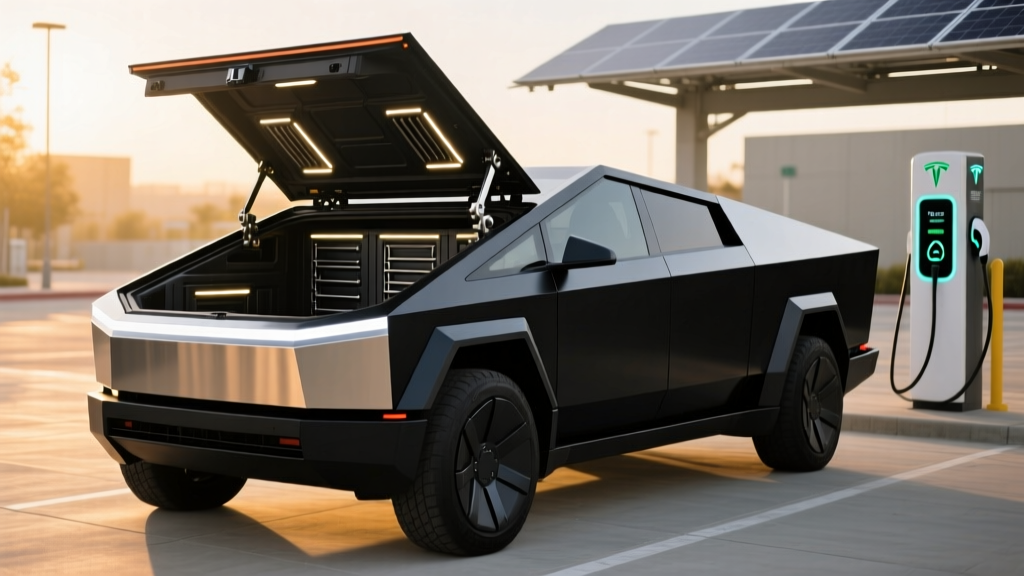
If you've searched for "Tesla truck bed opening" dimensions, you're likely comparing the Cybertruck against legacy pickups like the Ford F-150 Lightning or Rivian R1T. The Cybertruck's bed — which Tesla officially calls the "vault" — measures 72 inches long, 43 inches wide at the wheel wells, and 48 inches wide between the fenders at the tailgate opening. The tailgate opening height sits at approximately 22 inches from the bed floor, and the overall bed depth is roughly 26 inches.
Those numbers matter because the Cybertruck's stainless-steel exoskeleton and angular fender design create a narrower, more enclosed cargo area than a traditional open-bed pickup. You won't slide a standard 4×8 sheet of plywood flat between the wheel wells (43 inches falls short of 48). However, the vault's enclosed, lockable tonneau-style cover and integrated 120V/240V power outlets make it uniquely suited for secure, weatherproof gear hauling — a trade-off worth understanding before you buy.
| Spec | AWD | Cyberbeast |
|---|---|---|
| EPA Range | 340 miles | 320 miles |
| Battery Capacity (usable) | ~123 kWh | ~123 kWh |
| Battery Chemistry | NMC (nickel manganese cobalt) | NMC |
| Max DC Fast Charge | 250 kW | 250 kW |
| 10–80% DC Charge Time | ~30 min | ~30 min |
| Level 2 Home Charge Rate | 11.5 kW (~34 mi/hr) | 11.5 kW (~34 mi/hr) |
| 0–60 mph | 3.9 sec | 2.6 sec |
| Horsepower | 600 hp | 845 hp |
| Drivetrain | Dual-motor AWD | Tri-motor AWD |
| Towing Capacity | 11,000 lbs | 11,000 lbs |
| Payload Capacity | 2,500 lbs | 2,500 lbs |
| Bed Length | 72 in (6 ft) | |
| Bed Width (wheel wells) | 43 in | |
| Bed Width (tailgate opening) | 48 in | |
| Bed Depth | ~26 in | |
| Cargo Volume (bed + frunk + gear closet) | ~121 cu ft total | |
| MPGe (combined) | ~70 MPGe | ~65 MPGe |
| Efficiency (kWh/100 mi) | ~48 kWh | ~52 kWh |
| Base MSRP | $79,990 | $99,990 |
| Battery/Drive Unit Warranty | 8 yr / 120,000 mi | |
| Basic Vehicle Warranty | 4 yr / 50,000 mi | |
Real-World Range vs. EPA Estimates
Real-World Highway: ~260–290 miles at 70–75 mph
Cold-Weather (below 30°F): ~220–260 miles, depending on cabin heat and terrain
Mixed Commute: ~290–320 miles with regenerative braking
The Cybertruck's blunt aerodynamic profile — a drag coefficient around 0.38 — punishes it on the highway compared to sedans and crossovers. In independent real-world testing at sustained 70–75 mph speeds, the AWD variant consistently returns 260–290 miles before hitting the 10% reserve warning. City driving with aggressive regenerative braking recovers meaningful energy, pushing mixed-use range closer to the EPA figure.
Cold weather compounds the issue. The NMC battery pack loses roughly 20–30% of usable capacity in sub-freezing temperatures, and the Cybertruck's large cabin volume demands significant energy for heating. Tesla's heat pump helps, but expect 220–260 miles in winter conditions above 5,000 feet or in northern-tier states. If your daily commute is under 80 miles round-trip, this is academic — you'll charge at home every night. For road trips, plan stops every 250 miles to stay comfortable.
According to fueleconomy.gov, the Cybertruck AWD posts approximately 70 MPGe combined, which translates to roughly 48 kWh per 100 miles — thirsty by EV standards but competitive for a full-size truck.
Charging Speed: DC Fast and Home Level 2
The Cybertruck supports a peak DC fast-charge rate of 250 kW on V3 and V4 Tesla Superchargers. In practice, the large ~123 kWh NMC battery means the truck sustains high charge rates longer than smaller-battery EVs, but you still won't hold peak speed to 80%. Expect a 10–80% session in approximately 30 minutes, with the curve tapering significantly above 80% — a final 80–100% top-off can add another 25–35 minutes.
| Charge Level | Power (kW) | Speed (mi/hr added) | Notes |
|---|---|---|---|
| Level 1 (120V outlet) | ~1.4 kW | ~4 mi/hr | Emergency/trickle only |
| Level 2 (240V / 48A Wall Connector) | 11.5 kW | ~34 mi/hr | Full charge in ~11 hours |
| Level 2 (240V / 32A Mobile Connector) | 7.7 kW | ~23 mi/hr | Common NEMA 14-50 setup |
| DC Fast (V3 Supercharger) | 250 kW peak | ~300 mi/hr at peak | 10–80% in ~30 min |
| DC Fast (V4 Supercharger) | 250 kW peak | ~300 mi/hr at peak | Cable length improved for truck |
At home, the Tesla Wall Connector on a 60-amp circuit delivers 11.5 kW, adding roughly 34 miles of range per hour and fully replenishing the pack overnight in about 11 hours. Most Cybertruck owners install a 60-amp circuit with 6-gauge wire — budget $800–$1,500 for a licensed electrician if your panel supports it. If you're limited to a NEMA 14-50 outlet on a 40-amp breaker, expect 7.7 kW and roughly 23 miles per hour, which still covers most daily driving needs.
Preconditioning the battery via the Tesla app or navigation-routed Supercharger prep is essential for fast charging in cold weather. Without preconditioning, a cold-soaked battery may limit initial charge rates to under 50 kW until the thermal management system warms the cells — adding 15–20 minutes to your stop.
Performance and Drivetrain
The dual-motor AWD Cybertruck produces 600 horsepower and rockets to 60 mph in 3.9 seconds — absurdly quick for a 6,700-pound stainless-steel triangle. The tri-motor Cyberbeast ups the output to 845 hp with a 2.6-second 0–60 time, making it one of the fastest production trucks ever built.
Both trims feature adaptive air suspension with up to 16 inches of ground clearance, a 35-degree approach angle, and an electronically locking rear differential. The steer-by-wire system eliminates the mechanical connection between the steering wheel and rack, enabling the yoke-style steering wheel and a variable steering ratio that requires less than a full turn lock-to-lock at low speeds. It takes getting used to — some drivers love the precision, others find it disorienting at parking-lot speeds.
Towing capacity is rated at 11,000 pounds, competitive with the F-150 Lightning's 10,000-pound max. However, towing a heavy trailer cuts range roughly in half — expect 150–180 miles between charges with a 7,000-pound boat or camper in tow. Tesla's integrated trailer brake controller and tow-mode camera views are well-executed, but Supercharger stalls aren't designed for pull-through towing, meaning you'll need to unhitch at many stops.
Pricing, Trims, and Federal Tax Credit Eligibility
As of the 2026 model year, the Cybertruck lineup includes two trims:
- AWD: $79,990 MSRP (before destination)
- Cyberbeast: $99,990 MSRP (before destination)
Neither trim qualifies for the full $7,500 federal EV tax credit under IRS §30D rules. The Cyberbeast exceeds the $80,000 MSRP cap for trucks outright. The AWD trim sits just under the cap, but eligibility depends on battery critical-mineral sourcing and component manufacturing requirements that shift annually — and Tesla's supply chain sourcing for the Cybertruck's large NMC pack has not consistently met the full domestic-content threshold.
| Trim | MSRP | MSRP Cap (Trucks) | Max Federal Credit | Buyer Income Cap (MFJ) | Est. After-Credit Price |
|---|---|---|---|---|---|
| AWD | $79,990 | $80,000 ✓ | $0–$7,500* | $300,000 | $72,490–$79,990 |
| Cyberbeast | $99,990 | $80,000 ✗ | $0 | N/A | $99,990 |
* Credit amount depends on battery-sourcing compliance at time of purchase. Verify current eligibility on fueleconomy.gov and consult a tax professional. Point-of-sale transfer available for eligible buyers.
Key §30D requirements to verify before purchase:
- Buyer modified adjusted gross income must not exceed $300,000 (married filing jointly), $225,000 (head of household), or $150,000 (single).
- Vehicle MSRP must not exceed $80,000 for trucks and vans.
- Battery critical minerals and component sourcing must meet annual escalating thresholds.
- Credit can be transferred to the dealer at point of sale as a price reduction, or claimed on your federal tax return.
Cargo, Passenger Space, and Interior
The Cybertruck seats five across two rows. Front legroom is generous at approximately 41.5 inches, while rear legroom measures about 38.5 inches — adequate for adults on longer trips but tighter than the F-150 Lightning's back seat. The rear bench folds flat to extend cargo capability into the cabin.
Total enclosed cargo volume across the vault (bed), front trunk (frunk), and the "sail pillar" gear closet totals approximately 121 cubic feet — a significant advantage over open-bed trucks when you need lockable, weather-sealed storage. The power-operated tonneau cover supports up to 300 pounds of distributed weight and integrates with the vehicle's alarm system.
The bed features two integrated 120V outlets and one 240V outlet capable of delivering up to 9.6 kW of continuous power via Tesla's "Powershare" vehicle-to-load (V2L) system — enough to run power tools at a job site, power a campsite, or provide emergency home backup during an outage. This is where the Cybertruck's enclosed vault design pays off: gear stays dry, locked, and out of sight.
Technology, Driver Assistance, and Drawbacks
The Cybertruck runs Tesla's latest infotainment stack on an 18.5-inch front touchscreen and a 9.4-inch rear screen for passengers. The interface is fast, responsive, and controls nearly every vehicle function — there are almost no physical buttons, including the glovebox release, mirror adjustments, and turn-signal stalks (replaced by steering-wheel-mounted buttons). This minimalist approach divides opinion: enthusiasts appreciate the clean aesthetic, while practical truck buyers often find it frustrating to adjust mirrors or activate wipers through menus.
Autopilot comes standard and includes adaptive cruise control, lane-keeping, and automatic emergency braking. Full Self-Driving (Supervised) is available as a $8,000 add-on or $99/month subscription, adding automated lane changes, traffic-light recognition, and city-street navigation.
- FSD (Supervised) may not detect construction zones, stopped emergency vehicles, or complex intersections reliably.
- Steer-by-wire requires adaptation — no mechanical feedback from the road.
- Stainless-steel body panels are fingerprint magnets and difficult to repair; insurance premiums are typically 25–40% higher than comparable trucks.
- Supercharger stalls are not pull-through; towing requires unhitching at most stops.
- Washer-fluid fill port is hidden behind a panel requiring a tool to open.
Who the Cybertruck Suits — and Who Should Look Elsewhere
The Cybertruck is best for tech-forward truck buyers who prioritize secure, enclosed cargo storage, job-site V2L power capability, and straight-line performance over traditional bed dimensions. If you haul tools, camping gear, or motorcycles in a locked vault and rarely need a flat 4×8 load floor, it's a compelling package.
It's a harder sell for commercial fleet operators who need standardized bed accessories, traditional truck buyers who want a conventional steering column and physical controls, or anyone whose budget can't absorb the insurance premium and potential lack of a federal tax credit. The Rivian R1T offers a more refined interior, a pass-through gear tunnel, and better real-world efficiency. The F-150 Lightning provides a familiar truck experience with a larger, more usable bed and broader dealer-service infrastructure.
- Enclosed, lockable vault with 120V/240V Powershare (9.6 kW V2L)
- Tri-motor Cyberbeast: 2.6-sec 0–60, 845 hp
- Air suspension with 16 in ground clearance
- 11,000-lb towing capacity
- Extensive Supercharger network access
- Stainless-steel body resists dents and corrosion
- Bed width (43 in at wells) won't fit 4×8 plywood flat
- Real-world highway range drops to ~260–290 mi
- Steer-by-wire and button-turn-signals require adaptation
- Insurance premiums 25–40% above comparable trucks
- Cyberbeast exceeds $80K MSRP cap — no federal credit
- Limited third-party body repair network for stainless panels
Frequently Asked Questions
What is the real-world range of the Tesla Cybertruck?
The EPA rates the AWD at 340 miles and the Cyberbeast at 320 miles. In real-world highway driving at 70–75 mph, expect 260–290 miles. Cold weather below 30°F can drop range to 220–260 miles. Mixed city/highway commuting with regenerative braking typically yields 290–320 miles.
How fast does the Cybertruck charge at home and on the road?
On a Level 2 Tesla Wall Connector (11.5 kW), the Cybertruck adds about 34 miles of range per hour and fully charges in roughly 11 hours. On a V3 or V4 Supercharger at 250 kW peak, a 10–80% session takes approximately 30 minutes, with significant tapering above 80%.
Does the Cybertruck qualify for the federal EV tax credit?
The AWD trim's $79,990 MSRP falls under the $80,000 truck cap, making it potentially eligible — but actual credit amount depends on battery-sourcing compliance at the time of purchase, which has varied. The Cyberbeast at $99,990 exceeds the MSRP cap and does not qualify. Buyer income limits also apply ($300K MFJ, $150K single). Always verify on fueleconomy.gov and consult a tax professional before relying on the credit.
Is the Cybertruck worth buying vs. the F-150 Lightning or Rivian R1T?
The Cybertruck wins on enclosed cargo security, V2L power output (9.6 kW), and raw acceleration. The F-150 Lightning offers a more traditional truck experience with a wider, more usable bed and broader service infrastructure. The Rivian R1T provides a more refined ride, a unique gear tunnel, and better real-world efficiency. Your choice depends on whether you prioritize Tesla's tech ecosystem and vault design versus conventional truck practicality.
Can you fit a sheet of plywood in the Cybertruck bed?
A standard 4×8-foot sheet of plywood will not lie flat between the wheel wells (43 inches wide). It can fit at an angle or with the tailgate down, but the enclosed vault design and tonneau cover limit vertical clearance. If flat-load capability is essential, the F-150 Lightning or a conventional pickup is a better fit.
What is the Cybertruck's battery warranty?
Tesla covers the battery and drive units for 8 years or 120,000 miles, whichever comes first, with a minimum 70% capacity retention threshold. The basic vehicle warranty covers 4 years or 50,000 miles.
How much does it cost to charge the Cybertruck at home?
At the US average residential electricity rate of roughly $0.16/kWh, fully charging the ~123 kWh battery costs about $19.68 — equating to approximately $0.077 per mile. Compare that to a gas truck at 18 MPG and $3.40/gallon, which costs about $0.189 per mile. Annual fuel savings for a 15,000-mile driver are approximately $1,680.