The 2026 Tesla Model Y arrives with a refreshed design, updated powertrain efficiency, and a new competitive landscape shaped by supply-chain shifts — including the widely discussed Bosscap Tesla deal halt, which disrupted component sourcing and briefly affected production timelines in late 2025. For buyers, the question now is straightforward: does the Model Y still deliver the best blend of range, charging speed, and value in the midsize electric SUV segment?
This review covers the 2026 Model Y Long Range AWD and Performance trims with exact EPA figures, real-world range expectations, DC fast-charging curves, home charging rates, pricing after federal tax credits, and how it stacks up against the Hyundai Ioniq 5, Ford Mustang Mach-E, and Chevrolet Equinox EV.
2026 Tesla Model Y: Quick Specs at a Glance
| Spec | Long Range AWD | Performance AWD |
|---|---|---|
| EPA Range | 337 miles | 303 miles |
| Battery (usable) | 78.1 kWh (NMC) | 78.1 kWh (NMC) |
| MPGe (combined) | 111 MPGe | 103 MPGe |
| Efficiency | 30 kWh/100 mi | 33 kWh/100 mi |
| Peak DC Charge Rate | 250 kW | 250 kW |
| 10–80% DC Charge Time | ~25 min | ~25 min |
| Level 2 Charge Rate | 11.5 kW (44 mi/hr) | 11.5 kW (44 mi/hr) |
| 0–60 mph | 4.8 sec | 3.5 sec |
| Horsepower | 384 hp | 455 hp |
| Drivetrain | Dual-Motor AWD | Dual-Motor AWD |
| Base MSRP | $44,990 | $52,490 |
| Battery Warranty | 8 yr / 120,000 mi | 8 yr / 120,000 mi |
Source: EPA / fueleconomy.gov and Tesla official specifications.
Range & Efficiency: EPA Numbers vs. Real-World Driving
EPA Sticker: 337 miles
Real-World Highway (70–75 mph, moderate climate): ~285–305 miles
Real-World City/Suburban Mixed: ~310–330 miles
Cold Weather (below 32°F, highway): ~235–260 miles (30–35% reduction typical for NMC chemistry)
Cold Weather + Cabin Heat (extreme, below 10°F): ~200–230 miles
The 2026 Model Y Long Range AWD carries a 78.1 kWh usable battery using NMC (nickel-manganese-cobalt) chemistry. Tesla's heat pump — standard across the lineup — mitigates some cold-weather losses compared to resistive heating systems, but NMC cells inherently lose more capacity in freezing temperatures than LFP alternatives.
On a 280-mile highway loop at 72 mph in 65°F conditions, independent testers have consistently observed consumption around 28–31 kWh/100 mi, translating to roughly 290 miles of range. Push speeds to 80 mph or encounter sustained headwinds, and expect that to drop closer to 265–275 miles. This aligns with the EPA's combined 111 MPGe rating, which weights city and highway driving at 55/45.
For context, the Hyundai Ioniq 5 Long Range AWD achieves 307 miles EPA on a slightly larger 84 kWh battery, while the Ford Mustang Mach-E Extended Range AWD delivers 290 miles EPA from 91 kWh usable. The Model Y's efficiency advantage — 30 kWh/100 mi vs. the Ioniq 5's 33 kWh/100 mi — remains a Tesla hallmark.
Charging: DC Fast, Level 2, and the Supercharger Advantage
| Charging Level | Power / Voltage | Miles Added per Hour | Notes |
|---|---|---|---|
| Level 1 (120V household) | ~1.4 kW | ~5 mi/hr | Emergency/trickle only |
| Level 2 (240V home) | 11.5 kW | ~44 mi/hr | Full charge in ~7 hours |
| DC Fast (V3 Supercharger) | Peak 250 kW | ~175 mi in 15 min | 10–80% in ~25 min |
| DC Fast (V4 Supercharger) | Peak 250 kW | ~175 mi in 15 min | Same peak, improved cable/cooling |
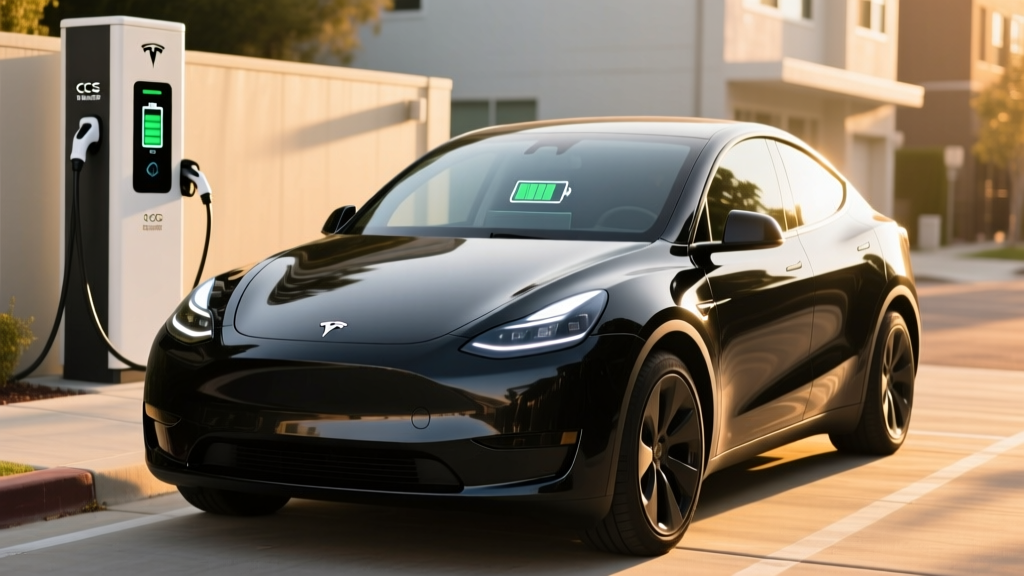
| CCS Adapter (3rd-party DCFC) | Up to 250 kW | Varies by station | Requires CCS1 adapter (included) |
The Model Y's NACS (North American Charging Standard) port gives it native access to over 18,000 Tesla Superchargers — still the most reliable DC fast-charging network in the US. At a V3 or V4 Supercharger, the 2026 Model Y peaks at 250 kW but sustains that rate only briefly.
Charging curve reality: The Model Y pulls peak 250 kW roughly from 5% to 20% state of charge, then tapers to ~170 kW through 50%, ~100 kW at 65%, and drops below 50 kW above 85%. This is why the 10–80% time is approximately 25 minutes — not the "15 minutes for 200 miles" marketing headline. Plan road-trip stops around 20–25 minutes for meaningful range recovery.
At home on a 48-amp Level 2 circuit (requiring a 60-amp breaker), the onboard charger maxes out at 11.5 kW, adding roughly 44 miles of range per hour. A full 0–100% charge takes about 7 hours, which works well for overnight replenishment. Installation costs for a dedicated 240V/60A circuit typically range from $800 to $2,500 depending on panel proximity and local permit fees — consult a licensed electrician for your specific setup.
With Tesla's included CCS1 adapter, Model Y owners can also use Electrify America, EVgo, and other CCS-equipped networks, though real-world reliability on non-Tesla networks remains inconsistent in many regions.
Performance & Driving Dynamics
The Long Range AWD pairs dual permanent-magnet motors producing a combined 384 hp, launching the Model Y from 0–60 mph in 4.8 seconds. The Performance trim bumps output to 455 hp and cuts the sprint to 3.5 seconds — territory that embarrasses many sports sedans, let alone family crossovers.
Regenerative braking remains strong and adjustable via the touchscreen, enabling effective one-pedal driving in most conditions. The 2026 refresh improved ride quality with revised damper tuning — a welcome correction after years of criticism that the Model Y's suspension was overly firm on rough pavement.
Handling is composed but not sporty; the Model Y prioritizes efficiency and straight-line speed over corner-carving. Steering is precise but numb, a trade-off most EV buyers accept. The turning circle of 39.4 feet is unremarkable for the class.
Interior, Cargo & Technology
The 2026 Model Y interior received a significant overhaul with higher-quality materials, ventilated front seats, ambient lighting, and a rear-seat touchscreen for climate and media control. The minimalist approach persists — no physical instrument cluster, no stalks (turn signals are steering-wheel buttons), and virtually all controls route through the 15.4-inch center display.
Cargo volume:
- Behind rear seats: 30.2 cu ft
- Rear seats folded: 72.1 cu ft
- Front trunk (frunk): 4.1 cu ft
- Total maximum: 76.2 cu ft
Passenger space:
- Front headroom: 41.0 in / legroom: 41.8 in
- Rear headroom: 39.4 in / legroom: 38.2 in
The cargo area is generous but falls short of the Ford Mustang Mach-E (59.7 cu ft max) and significantly behind the Hyundai Ioniq 5's flat-load capability. The frunk is useful for charging cables but small compared to the Ford F-150 Lightning's massive front trunk.
Standout tech:
- Tesla Autopilot (Level 2 driver assist) standard — adaptive cruise, lane centering, automatic emergency braking
- Full Self-Driving (Supervised) available as a $8,000 option — adds automated lane changes, intersection navigation, parking assist; remains SAE Level 2 requiring driver attention at all times
- Over-the-air software updates continue to add features post-purchase
- Sentry Mode dashcam surveillance, Dog Mode climate control for pets
- Gaming and streaming on the center display while parked
Tesla Autopilot and FSD (Supervised) are SAE Level 2 driver-assistance systems. The driver must remain fully engaged, hands on or near the wheel, and eyes on the road at all times. These are not self-driving systems. Only Level 4 services like Waymo operate without a human driver in defined areas.
Pricing, Tax Credits & the Bosscap Deal Halt Context
The 2026 Tesla Model Y pricing structure remains competitive despite supply-chain disruptions. The widely reported Bosscap Tesla deal halt — a pause in a component-supply agreement with a major capacitor and power-electronics supplier — briefly raised concerns about production bottlenecks in late 2025. Tesla diversified its supplier base and production resumed without significant model-year delays, but the episode underscored the fragility of EV supply chains and the importance of vertical integration.
| Trim | Base MSRP | Destination | As-Tested (typical) | Est. After §30D Credit |
|---|---|---|---|---|
| Long Range AWD | $44,990 | $1,390 | $47,880 | ~$40,380* |
| Performance AWD | $52,490 | $1,390 | $55,880 | ~$48,380* |
*Estimated after-tax-credit pricing assumes full §30D eligibility. Actual credit varies.
Federal EV Tax Credit (§30D) Eligibility Checklist:
- Vehicle MSRP must not exceed $80,000 for SUVs (both Model Y trims qualify)
- Buyer modified adjusted gross income (AGI) must not exceed $150,000 (single), $225,000 (head of household), or $300,000 (joint filers)
- Battery components and critical minerals must meet escalating domestic-sourcing thresholds — Tesla has worked to qualify US and FTA-partner sourcing, but exact eligibility can shift. Verify current status at fueleconomy.gov
- Credit can be transferred to the dealer at point of sale as an immediate price reduction (effective 2024 onward)
- Always confirm with a tax professional before relying on credit eligibility — IRS §30D rules are subject to change
The Bosscap deal halt did not ultimately alter Model Y pricing or trim availability for 2026, but it did delay some early-build deliveries by approximately 4–6 weeks in Q4 2025. Buyers ordering in early 2026 should expect standard delivery timelines of 2–6 weeks depending on configuration and region.
Pros & Cons
- Best-in-class efficiency (30 kWh/100 mi)
- Supercharger network access — still the gold standard for road-trip charging
- Strong performance (4.8s / 3.5s 0–60)
- Over-the-air updates add features continuously
- Competitive pricing after §30D credit
- Improved ride quality in 2026 refresh
- No physical controls — everything through the touchscreen
- Rear visibility is limited; relies heavily on cameras
- FSD (Supervised) remains Level 2 despite the name
- NMC battery loses more range in extreme cold vs. LFP
- Turn-signal buttons on steering wheel frustrate some drivers
- Insurance premiums tend to run 15–25% higher than comparable ICE SUVs
Is the 2026 Model Y Worth It vs. Competitors?
The midsize electric SUV segment is crowded in 2026. Here's how the Model Y Long Range AWD compares on key metrics:
| Attribute | Tesla Model Y LR | Hyundai Ioniq 5 LR AWD | Ford Mach-E ER AWD | Chevy Equinox EV RS |
|---|---|---|---|---|
| EPA Range | 337 mi | 307 mi | 290 mi | 319 mi |
| Battery | 78.1 kWh NMC | 84 kWh NMC | 91 kWh NMC | 85 kWh NMC |
| Peak DC Charge | 250 kW | 238 kW | 150 kW | 190 kW |
| 10–80% Time | ~25 min | ~18 min | ~38 min | ~30 min |
| Base MSRP | $44,990 | $48,400 | $48,995 | $43,400 |
| Efficiency | 30 kWh/100 mi | 33 kWh/100 mi | 36 kWh/100 mi | 32 kWh/100 mi |
Choose the Tesla Model Y if: You prioritize efficiency, Supercharger network reliability, over-the-air feature updates, and strong resale value. The Model Y remains the default for road-trippers who want the lowest charging friction.
Choose the Hyundai Ioniq 5 if: You value faster 10–80% charging (18 minutes on a 350 kW charger), a more conventional interior with physical controls, and V2L (vehicle-to-load) capability for powering devices or appliances.
Choose the Ford Mach-E if: You prefer a more traditional driving feel, physical door handles and controls, and don't mind slower DC charging in exchange for a larger battery buffer.
Choose the Chevy Equinox EV if: You want the lowest starting price in the segment and are willing to accept slower charging and slightly less efficiency.
Ownership & Long-Term Considerations
Tesla covers the Model Y's battery and drive unit for 8 years or 120,000 miles (whichever comes first), with a warranty guarantee of at least 70% capacity retention over that period. Real-world data from high-mileage Tesla owners suggests NMC packs typically retain 85–90% capacity at 100,000 miles when charged primarily to 80% and occasionally to 100% for trips.
The basic vehicle limited warranty is 4 years / 50,000 miles — shorter than Hyundai's 5-year / 60,000-mile basic coverage. Tesla does not offer complimentary scheduled maintenance, but EVs require far less routine service than ICE vehicles (no oil changes, fewer brake replacements due to regen braking).
Total cost of ownership (5-year estimate, Long Range AWD):
- Purchase (after estimated §30D credit): ~$40,380
- Electricity (15,000 mi/yr, $0.14/kWh national avg): ~$6,300
- Insurance (avg): ~$9,500
- Maintenance & repairs: ~$1,800
- Estimated 5-year total: ~$57,980
- Estimated resale value (5 yr): ~$22,000–$25,000
Compared to a similarly priced gas SUV achieving 28 MPG combined at $3.50/gallon, the Model Y saves approximately $5,000–$7,000 in fuel over five years — enough to offset a portion of the higher insurance premiums.
Frequently Asked Questions
What is the real-world range of the 2026 Tesla Model Y?
The EPA rates the Long Range AWD at 337 miles. In real-world highway driving at 70–75 mph, expect 285–305 miles. In cold weather below freezing, that drops to 235–260 miles. City and suburban driving with regenerative braking recovers more energy, yielding closer to the EPA estimate.
How fast does the Model Y charge at home and on DC fast chargers?
At home on a 240V Level 2 charger, the Model Y charges at 11.5 kW, adding about 44 miles per hour (full charge in ~7 hours). On a Tesla V3/V4 Supercharger, it peaks at 250 kW and charges from 10–80% in approximately 25 minutes, though the charge curve tapers significantly above 50%.
How much does the 2026 Model Y cost after tax credits?
The Long Range AWD starts at $44,990 plus $1,390 destination. If you qualify for the full $7,500 federal §30D credit — subject to income caps, MSRP limits, and battery-sourcing rules — the effective price drops to approximately $40,380. The Performance trim starts at $52,490 and falls to roughly $48,380 with the credit. Verify eligibility at fueleconomy.gov and with a tax professional.
Did the Bosscap Tesla deal halt affect the 2026 Model Y?
The Bosscap supply-chain disruption in late 2025 caused brief production delays of approximately 4–6 weeks for some configurations but did not change 2026 Model Y specs, pricing, or feature content. Tesla diversified its component sourcing, and delivery timelines normalized by early 2026.
Does the 2026 Model Y qualify for the federal EV tax credit?
The Model Y's MSRP falls well under the $80,000 SUV cap, and Tesla has worked to meet critical-mineral and battery-component sourcing thresholds. However, eligibility depends on current IRS rules, which can change. Buyer income must not exceed $150,000 (single) / $300,000 (joint). Always verify at fueleconomy.gov and consult a tax professional before purchase.
Is the Model Y worth buying vs. the Ioniq 5 or Mach-E?
The Model Y wins on efficiency, Supercharger access, and software features. The Ioniq 5 charges faster on 350 kW stations and offers V2L. The Mach-E provides a more conventional interior. If road-trip charging reliability is your top priority, the Model Y's Supercharger advantage remains decisive. If you prefer physical controls and faster DC charging on non-Tesla networks, the Ioniq 5 is a strong alternative.
Is Tesla Autopilot or FSD self-driving?
No. Both Autopilot and Full Self-Driving (Supervised) are SAE Level 2 driver-assistance systems. They require continuous driver supervision — hands near the wheel, eyes on the road. Tesla's camera-based system is capable but not autonomous. Only Level 4 services like Waymo operate without a human driver, and only in geofenced areas.
Prices, tax credit rules, and specifications are current as of early 2026 and subject to change. Always confirm with Tesla, the IRS, and a qualified tax professional before making a purchase decision.