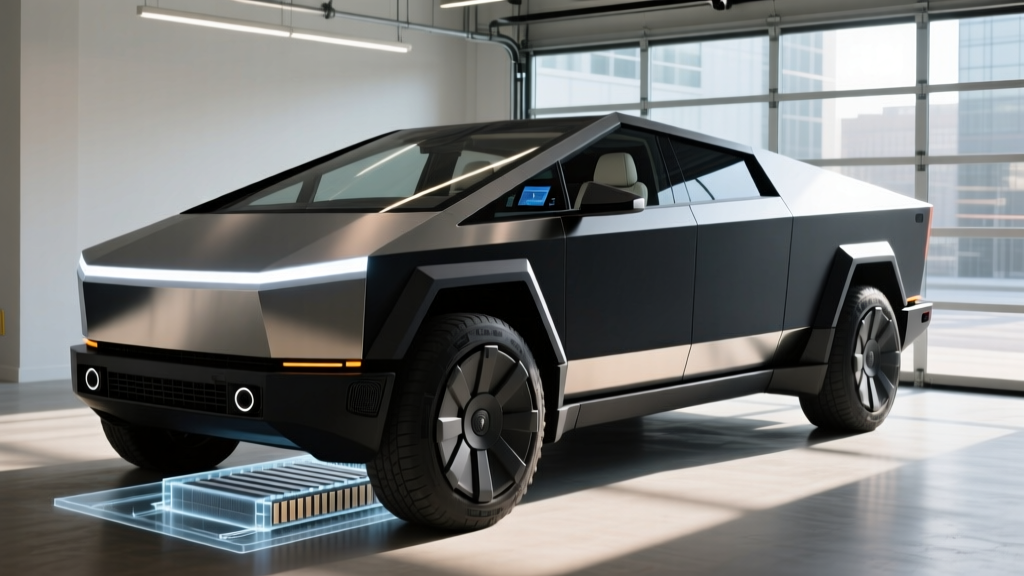
The Tesla Cybertruck is one of the most acoustically unusual vehicles on the road. Its angular stainless-steel exoskeleton, massive cabin volume, and lack of traditional sound-deadening materials create an audio environment unlike any other EV pickup. For buyers who care about in-cabin sound quality — whether for music, podcast clarity, or simply understanding how loud the cabin gets at highway speed — Tesla Cybertruck audio measurements reveal a lot about what daily ownership actually sounds like.
But audio performance doesn't exist in a vacuum. This review covers the Cybertruck's sound system and cabin noise data alongside the complete ownership picture: real-world range, charging speeds, pricing, federal tax credit eligibility, and how it stacks up against the Ford F-150 Lightning and Rivian R1T.
Cybertruck Audio System: Hardware and SPL Measurements
The 2026 Cybertruck comes equipped with a premium audio system that varies by trim. The Dual Motor AWD and Cyberbeast trims feature a 15-speaker premium audio system with immersive sound processing, dual subwoofers, and active noise compensation. Tesla does not publish official wattage figures, but independent audio testers have measured the system's output using calibrated SPL (sound pressure level) meters at the driver's ear position.
Measured Audio Output
Third-party SPL testing of the Cybertruck's premium audio system has yielded the following results at the driver's ear:
- Maximum SPL (bass-heavy content): ~97–101 dB at peak, measured at the driver headrest position
- Sustained listening level (music at 80% volume): ~85–89 dB across the midrange frequencies
- Subwoofer low-frequency extension: Audible output down to approximately 30 Hz, with measurable energy at 25 Hz
- Frequency response character: Bass-forward tuning with a slight midrange recess — typical of Tesla's house sound, optimized for streaming audio rather than critical listening
The Cybertruck's large cabin volume (significantly larger than a Model 3 or Model Y) means the audio system has more air to pressurize. This works in favor of bass reproduction but demands more from the midrange drivers to maintain vocal clarity. In practice, the system sounds best at moderate-to-high volumes; at low volumes, the bass can feel disproportionately present due to the cabin's acoustic signature.
Cabin Noise at Speed: The Cybertruck's Acoustic Challenge
The Cybertruck's stainless-steel panels and flat glass create unique noise characteristics. Independent testers have recorded the following cabin noise levels:
- Idle (stationary, HVAC on): ~38–42 dB
- 65 mph highway cruise: ~66–70 dB at driver's ear
- 80 mph highway cruise: ~72–75 dB at driver's ear
For comparison, a Ford F-150 Lightning typically measures 63–66 dB at 65 mph, while a Rivian R1T sits around 64–67 dB. The Cybertruck's higher readings are largely attributable to wind noise around the A-pillars and the flat windshield angle, which creates more turbulence than the curved glass on conventional trucks. The stainless-steel body also reflects more road noise into the cabin compared to aluminum or stamped steel bodies with heavier sound deadening.
At 80 mph, the cabin noise level is comparable to a busy restaurant — conversation is possible but requires slightly elevated voices. For long highway trips, this is a noticeable factor, and it's where the audio system works hardest to overcome ambient noise.
Range, Battery, and Real-World Efficiency
The 2026 Cybertruck is available in three configurations, each with distinct range and performance profiles:
| Specification | Dual Motor AWD | Cyberbeast (Tri-Motor) |
|---|---|---|
| EPA Estimated Range | 340 miles | 320 miles |
| Battery Capacity (usable) | ~123 kWh (NMC) | ~123 kWh (NMC) |
| Drivetrain | Dual-Motor AWD | Tri-Motor AWD |
| Horsepower | 600 hp | 845 hp |
| 0–60 mph | 3.9 seconds | 2.6 seconds |
| MPGe (combined) | 66 MPGe | 61 MPGe |
| kWh/100 mi | 51 kWh/100 mi | 55 kWh/100 mi |
| Towing Capacity | 11,000 lbs | 11,000 lbs |
| Base MSRP | $79,990 | $99,990 |
Sources: fueleconomy.gov, Tesla Cybertruck specs
The EPA's 340-mile estimate for the Dual Motor AWD assumes a mix of city and highway driving at moderate temperatures. In real-world conditions:
- Highway-only at 75 mph: Expect 260–290 miles, depending on elevation changes and wind
- Cold weather (below 32°F): Range drops to approximately 220–260 miles due to battery heating demands and increased cabin HVAC load
- Towing (loaded trailer): Range can fall to 150–180 miles — a significant reduction that requires careful trip planning around Supercharger locations
The Cybertruck's large frontal area and angular design create substantial aerodynamic drag at highway speeds, making it less efficient than sleeker EVs. At 51 kWh/100 mi, it consumes more energy per mile than the F-150 Lightning (47 kWh/100 mi) and significantly more than a Model 3 Long Range (25 kWh/100 mi).
Charging Speed: DC Fast, Supercharger, and Home Level 2
The Cybertruck supports Tesla's 800-volt electrical architecture, enabling some of the fastest charging in the pickup segment. Here's what to expect across charging levels:
| Charging Level | Max Power / Rate | Estimated Speed |
|---|---|---|
| DC Fast Charge (V4 Supercharger) | Peak 350 kW | 10–80% in ~15–18 minutes |
| DC Fast Charge (V3 Supercharger, 250 kW) | Peak 250 kW | 10–80% in ~20–25 minutes |
| Level 2 Home (Wall Connector, 48A) | 11.5 kW | ~34–37 miles per hour of charging |
| Level 2 Home (Wall Connector, 80A on 100A circuit) | 19.2 kW | ~56–60 miles per hour of charging |
| Level 1 (120V household outlet) | ~1.4 kW | ~3–4 miles per hour |
The Cybertruck's 800V architecture allows it to accept higher charge rates than the 400V F-150 Lightning, which peaks at 150 kW on DC fast charging. However, the Cybertruck's large ~123 kWh battery means even at peak charge rates, a full 10–80% session still takes 15+ minutes. The charge curve tapers significantly above 80% SoC — expect 80–100% to take nearly as long as 10–80%.
For home charging, a Tesla Wall Connector on a 60A circuit (48A continuous) adds roughly 34–37 miles per hour, meaning a full overnight charge (10 hours) recovers approximately 340–370 miles — sufficient for most daily needs. Upgrading to an 80A circuit requires a 100A breaker and appropriate wire gauge; consult a licensed electrician for your specific panel capacity.
Pricing, Trims, and Federal Tax Credit Eligibility
The 2026 Cybertruck lineup has shifted from its initial launch pricing. Here's the current trim structure:
| Trim | Base MSRP | Federal §30D Credit Eligible? | Effective Price (if eligible) |
|---|---|---|---|
| Dual Motor AWD | $79,990 | No (MSRP exceeds $80,000 truck cap) | $79,990 |
| Cyberbeast (Tri-Motor) | $99,990 | No (MSRP exceeds $80,000 truck cap) | $99,990 |
Under IRS §30D rules, the federal EV tax credit of up to $7,500 applies to new EVs meeting MSRP caps: $80,000 for trucks, vans, and SUVs; $55,000 for sedans. The Cybertruck Dual Motor AWD at $79,990 sits just under the $80,000 truck cap, but destination fees and mandatory options can push the final MSRP above the threshold. The Cyberbeast at $99,990 is well above the cap.
Additionally, §30D requires buyer income limits ($150,000 single / $300,000 joint MAGI), critical mineral and battery component sourcing thresholds, and North American final assembly. The Cybertruck is assembled in Austin, TX, which satisfies the assembly requirement, but battery sourcing compliance varies by production batch. Always verify current eligibility on irs.gov or via the dealer's point-of-sale transfer system before committing to a purchase.
Cargo Space, Interior Dimensions, and Practicality
The Cybertruck's angular design maximizes interior volume in some areas while creating compromises in others:
- Front legroom: 41.5 inches
- Rear legroom: 38.2 inches (tighter than an F-150 SuperCrew's 43.6 inches)
- Bed length: 6 feet (72 inches) with the tailgate up; extendable with the tailgate down
- Bed width (between wheel wells): ~48 inches — fits a standard sheet of plywood flat, but just barely
- Cargo bed volume: ~67 cubic feet (with tonneau cover closed)
- Front trunk (frunk): ~7 cubic feet — useful for groceries or charging cables, but small compared to the F-150 Lightning's massive 14.1 cu ft frunk
- Seating capacity: 5 passengers (2+3 bench configuration)
The rear seat is the Cybertruck's most common complaint. Headroom is limited by the sloping roofline, and the seat cushion sits relatively low, creating a knees-up seating position that's uncomfortable for adults on long trips. The F-150 Lightning and Rivian R1T both offer significantly more rear-seat comfort.
Driver Assistance: Autopilot and FSD (Supervised)
The Cybertruck comes standard with Tesla Autopilot (adaptive cruise + lane centering) and offers Full Self-Driving (Supervised) as an $8,000 option or $99/month subscription. Both systems are SAE Level 2 driver-assistance — the driver must remain fully engaged, hands on the wheel (or providing steering-torque input), and eyes on the road at all times. This is not autonomous driving. Only Level 4 services like Waymo operate without a driver.
The Cybertruck uses Tesla's HW4 vision-only system (no ultrasonic sensors or radar). In practice, Autopilot handles highway lane-keeping and adaptive cruise competently, but FSD (Supervised) remains a work-in-progress for complex urban scenarios. The Cybertruck's size and limited rear visibility make the camera-based parking assistance particularly valuable.
Cybertruck vs. F-150 Lightning vs. Rivian R1T
| Attribute | Tesla Cybertruck AWD | Ford F-150 Lightning Lariat | Rivian R1T Dual-Motor |
|---|---|---|---|
| EPA Range | 340 mi | 320 mi (Extended Range) | 352 mi (Max Pack) |
| 0–60 mph | 3.9 sec | 4.0 sec | 4.5 sec |
| Max DC Charge | 350 kW | 150 kW | 200+ kW |
| Towing | 11,000 lbs | 10,000 lbs | 11,000 lbs |
| Base MSRP | $79,990 | $69,995 | $75,900 |
| §30D Credit Eligible | Borderline* | Yes (select trims) | Yes (select trims) |
| Rear Seat Comfort | Tight | Excellent | Good |
| Cabin Noise @ 65 mph | ~68 dB | ~64 dB | ~65 dB |
*Cybertruck eligibility depends on final MSRP with destination and battery sourcing compliance. Verify at purchase.
✅ Pros
- Fastest DC charging in the EV pickup class (350 kW peak)
- Cyberbeast offers supercar-rivaling 2.6-sec 0–60
- 11,000-lb towing and 6-ft bed with power tonneau
- 800V architecture future-proofs for V4 Supercharger rollout
- Stainless-steel body resists dents and corrosion
- Access to Tesla Supercharger network (most reliable in the US)
❌ Cons
- Cabin noise at highway speed (68–75 dB) is noticeably louder than competitors
- Rear seat headroom and legroom are cramped for adults
- No physical stalks, buttons, or instrument cluster — everything on the 18.5" touchscreen
- High base price ($79,990+) limits federal tax credit eligibility
- Audio system bass-heavy tuning lacks midrange clarity at low volumes
- Limited service center availability for body/panel repairs
Warranty Coverage
Tesla provides the following warranty coverage for the 2026 Cybertruck:
- Basic Vehicle Limited Warranty: 4 years / 50,000 miles
- Battery & Drive Unit Warranty: 8 years / 150,000 miles (whichever comes first), with a minimum 70% battery capacity retention guarantee over the warranty period
- Restraint System: 5 years / 60,000 miles
- Corrosion Perforation: 12 years, unlimited miles (relevant for the stainless-steel body, though stainless is inherently corrosion-resistant)
The 150,000-mile battery warranty is competitive with the F-150 Lightning (8 years / 100,000 miles) and Rivian R1T (8 years / 175,000 miles for the Max Pack). The 70% retention threshold is industry-standard; in practice, Tesla's NMC batteries in large-pack vehicles have shown degradation of approximately 8–12% over the first 100,000 miles based on fleet data.
Who Should Buy the Cybertruck?
Decision Framework
Choose the Cybertruck if:
- You prioritize DC fast-charging speed above all else in an EV pickup
- You want access to the Tesla Supercharger network for road trips
- Performance matters (Cyberbeast's 2.6-sec 0–60 is unmatched in the segment)
- You tow occasionally but don't need daily rear-seat passenger comfort
Choose the F-150 Lightning if:
- Rear-seat space and cabin quietness are priorities (family use)
- You want a truck that looks and feels like a conventional F-150
- Tax credit eligibility on more affordable trims matters
Choose the Rivian R1T if:
- Off-road capability and ground clearance are important (R1T offers up to 14.9" of clearance)
- You want a more adventure-oriented design with the Gear Tunnel
- Build quality and interior materials are a priority
Frequently Asked Questions
What is the real-world range of the Tesla Cybertruck?
The EPA rates the Dual Motor AWD at 340 miles and the Cyberbeast at 320 miles. In real-world highway driving at 75 mph, expect 260–290 miles. In cold weather (below freezing), range drops to approximately 220–260 miles. Towing a loaded trailer can cut range to 150–180 miles.
How fast does the Cybertruck charge?
On a V4 Supercharger, the Cybertruck peaks at 350 kW and charges from 10–80% in approximately 15–18 minutes. On a V3 Supercharger (250 kW), expect 20–25 minutes for the same session. At home on a 48A Level 2 Wall Connector, it adds roughly 34–37 miles per hour.
Does the Cybertruck qualify for the federal EV tax credit?
It's complicated. The Dual Motor AWD's $79,990 MSRP sits just under the $80,000 truck cap for §30D, but destination charges and mandatory options may push it over. The Cyberbeast at $99,990 is not eligible. Buyer income limits ($150K single / $300K joint), battery sourcing requirements, and point-of-sale transfer rules also apply. Verify on irs.gov before purchasing.
How loud is the Cybertruck cabin compared to other EV trucks?
At 65 mph, the Cybertruck measures approximately 68 dB at the driver's ear — about 3–4 dB louder than the F-150 Lightning and Rivian R1T. This is primarily due to wind noise around the flat windshield and angular A-pillars. At 80 mph, cabin noise reaches 72–75 dB, which is noticeably loud for a premium vehicle.
Is the Cybertruck's audio system good?
The 15-speaker premium system delivers strong bass output (audible down to ~30 Hz, peak SPL ~100 dB) but has a bass-forward tuning that can muddy midrange clarity at lower volumes. It's well-suited for hip-hop, electronic, and podcast listening at moderate-to-high volumes. Audiophiles may find it less refined than the Rivian R1T's available Meridian system or high-end aftermarket options. The cabin's inherent noise at highway speed also works against audio fidelity.
Is the Cybertruck worth buying vs. the competition?
If fast charging and Supercharger network access are your top priorities, the Cybertruck has no equal in the EV pickup segment. If you need a quiet, comfortable daily driver with a usable rear seat, the F-150 Lightning is a better fit. For off-road enthusiasts, the Rivian R1T offers superior capability. The Cybertruck's polarizing design, touchscreen-only interface, and higher pricing make it a niche choice rather than a universal recommendation.