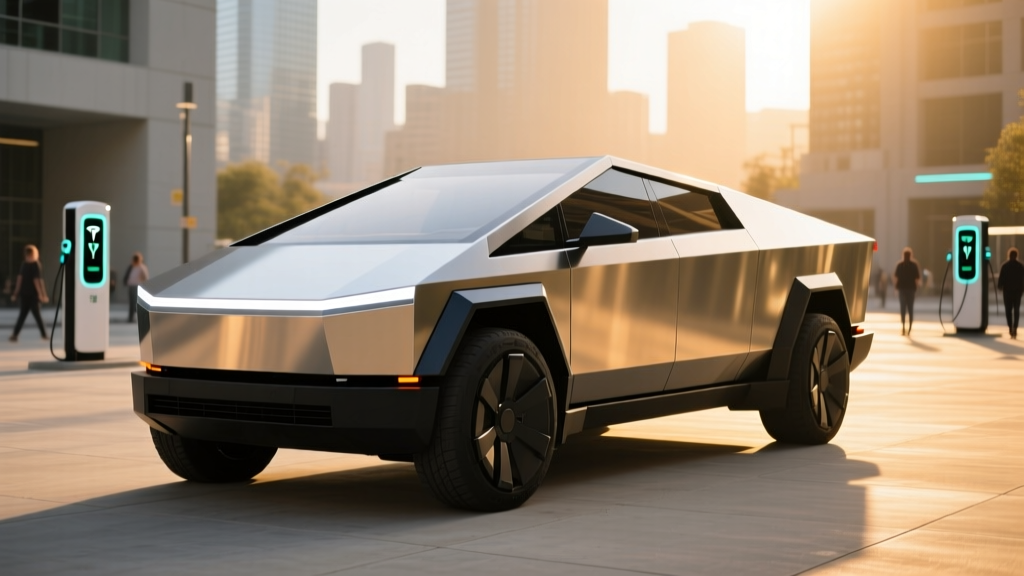
When Elon Musk revealed the Tesla Cybertruck on November 21, 2019, the broken-window demo and polarizing angular design instantly dominated headlines. That Cybertruck announcement date feels like a lifetime ago in EV years. Four years of delays, production retooling, and shifting specs later, the Cybertruck finally reached customer driveways in late 2023 — and by 2026, it has settled into its role as Tesla's low-volume, high-attention electric pickup.
If you've been tracking this truck since the announcement and are wondering whether the production version lives up to the original promises, this review breaks down exactly what you get in the 2026 model year: real-world range, actual charging speeds, current pricing, and whether the federal tax credit applies.
What Changed Between the Cybertruck Announcement Date and Production
The November 2019 reveal promised a base price under $40,000, up to 500 miles of range on the tri-motor variant, and a stainless-steel exoskeleton that would shrug off 9mm handgun rounds. The production Cybertruck that exists in 2026 tells a different story.
The base rear-wheel-drive model was quietly canceled before production began. The dual-motor AWD and tri-motor "Cyberbeast" variants that Tesla actually builds start significantly higher than the 2019 promises. Range figures were revised downward from the announcement-day claims. And the stainless-steel body, while genuinely distinctive, requires careful maintenance to avoid fingerprint smudges and surface staining.
The gap between announcement hype and production reality is a useful lesson for EV shoppers: always verify current-year specs against the manufacturer's official order page rather than relying on reveal-event claims.
2026 Cybertruck Specs at a Glance
| Specification | AWD (Dual-Motor) | Cyberbeast (Tri-Motor) |
|---|---|---|
| EPA Range | 340 miles | 320 miles |
| Battery (usable, est.) | ~123 kWh, NMC | ~123 kWh, NMC |
| Drivetrain | Dual-motor AWD | Tri-motor AWD |
| Horsepower | 600 hp | 845 hp |
| 0–60 mph | 4.1 sec | 2.6 sec |
| Max DC Fast Charge | ~250 kW peak | ~250 kW peak |
| 10–80% DC Charge Time | ~28 min | ~28 min |
| Level 2 Home Charge Rate | 11.5 kW (~34 mi/hr) | 11.5 kW (~34 mi/hr) |
| MPGe (combined) | 79 MPGe | 76 MPGe |
| kWh/100 mi | 43 kWh | 45 kWh |
| Towing Capacity | 11,000 lbs | 11,000 lbs |
| Payload | 2,500 lbs | 2,500 lbs |
| Bed Length | 6 ft (72 in) | 6 ft (72 in) |
| Cargo Volume (bed + frunk) | ~67 cu ft bed + ~10 cu ft frunk | ~67 cu ft bed + ~10 cu ft frunk |
| Rear Legroom | ~38.4 in | ~38.4 in |
| Base MSRP (2026) | $79,990 | $99,990 |
| Battery Warranty | 8 yr / 120,000 mi | 8 yr / 120,000 mi |
| Basic Warranty | 4 yr / 50,000 mi | 4 yr / 50,000 mi |
Real-World Range: What the EPA Number Doesn't Tell You
EPA sticker: 340 miles (AWD) / 320 miles (Cyberbeast)
Real-world highway (70 mph, mild weather): ~270–290 miles
Real-world cold weather (below 32°F): ~230–260 miles
Mixed city/highway driving: ~290–310 miles
The Cybertruck's angular, flat-panel stainless-steel body is aerodynamically compromised compared to smoother EVs. Tesla quotes a drag coefficient around 0.34 — respectable for a truck, but significantly worse than a sedan like the Model S (0.208). That boxy profile punishes you at highway speeds, where air resistance dominates energy consumption.
In 70 mph steady-state highway driving in moderate temperatures, expect the AWD model to deliver roughly 270–290 miles before you need to find a charger. The Cyberbeast, with its more aggressive performance tuning and higher rolling resistance, falls a bit shorter. In cold weather, the large battery's energy demands for cabin heating and battery preconditioning can drop usable range to the 230–260 mile window.
For context, the EPA's fueleconomy.gov listing confirms the combined efficiency at 79 MPGe for the AWD, which translates to 43 kWh per 100 miles. That's thirsty by EV standards — a Model Y uses roughly 28 kWh/100 mi. The Cybertruck moves a lot of mass (nearly 6,800 lbs curb weight) through a lot of air.
Charging Speeds: DC Fast, Home, and the Charge Curve Reality
| Charging Level | Power | Speed (Approx.) | Notes |
|---|---|---|---|
| Level 1 (120V household) | ~1.4 kW | ~4 mi/hr | Emergency/top-up only |
| Level 2 (240V home) | 11.5 kW max | ~34 mi/hr | Full charge in ~11 hours |
| DC Fast (Tesla Supercharger V3/V4) | ~250 kW peak | 10–80% in ~28 min | Peak rate not sustained; tapers above 60% |
| DC Fast (CCS adapter, third-party) | Up to ~250 kW | Varies by station | Requires Tesla CCS adapter (included) |
The Cybertruck uses a 400-volt architecture (not 800V like the Hyundai Ioniq 5 or Porsche Taycan), which limits its peak charge rate relative to its massive battery. At 250 kW peak, you're adding roughly 180–200 miles of range in a 15-minute session at a V3 Supercharger — useful, but not class-leading.
The charge curve matters more than the peak number. The Cybertruck sustains its highest charge rates up to roughly 50–60% state of charge, after which the rate tapers progressively. A 10–80% session takes approximately 28 minutes at a V3 or V4 Supercharger, but pushing from 80–100% adds another 30+ minutes. For road trips, plan your stops around the 10–80% window and skip the temptation to top off completely.
At home, the 11.5 kW onboard charger means you'll need a 60-amp dedicated circuit (typically a NEMA 14-60 or hardwired Wall Connector) to achieve the full 34 miles of range per hour. A full overnight charge from 10% takes about 11 hours. Given the Cybertruck's efficiency penalty, home charging is strongly recommended — relying on public DC fast charging at $0.30–0.50/kWh will cost roughly $15–25 per 100 miles of driving, erasing much of the EV cost advantage.
Performance, Drivetrain, and the Cyberbeast Question
The dual-motor AWD Cybertruck delivers 600 horsepower and a 4.1-second 0–60 mph time. That's genuinely quick for a 6,800-pound truck and sufficient for any real-world merging, passing, or towing scenario. The tri-motor Cyberbeast pushes 845 horsepower and hits 60 mph in 2.6 seconds — supercar territory in a vehicle with a six-foot bed.
But here's where ownership reality diverges from spec-sheet excitement. The Cyberbeast's performance comes at a measurable cost: lower EPA range (320 vs. 340 miles), higher energy consumption (45 vs. 43 kWh/100 mi), and a $20,000 price premium. Unless you're committed to the novelty of a sub-3-second pickup truck, the AWD variant is the rational choice.
Towing capacity is rated at 11,000 pounds for both trims — competitive with the Ford F-150 Lightning (10,000 lbs max) and Rivian R1T (11,000 lbs). However, towing at or near max capacity will slash range by 40–50%. Expect roughly 150–180 miles of range when pulling a heavy trailer on the highway, which makes long-distance towing impractical without meticulous charging-stop planning.
Pricing, Trims, and Federal Tax Credit Eligibility
| Trim | Base MSRP (2026) | Est. As-Tested | Federal Tax Credit |
|---|---|---|---|
| AWD (Dual-Motor) | $79,990 | $82,000–$86,000 | Not eligible (MSRP cap) |
| Cyberbeast (Tri-Motor) | $99,990 | $102,000–$110,000 | Not eligible (MSRP cap) |
The Cybertruck does not qualify for the $7,500 federal EV tax credit under current IRS rules. The §30D credit imposes an MSRP cap of $80,000 for trucks, vans, and SUVs. The AWD trim's base MSRP of $79,990 technically sits at the boundary, but once destination fees and any factory options are added, the vehicle exceeds the cap. The Cyberbeast at $99,990 is well above it.
Additionally, §30D has buyer income caps ($150,000 single / $300,000 joint) and battery critical-mineral sourcing requirements. Even if a base AWD Cybertruck with zero options could technically meet the MSRP threshold, buyers should verify eligibility against the IRS §30D guidelines and consult a tax professional before assuming credit availability.
The absence of the federal credit is a significant ownership-cost consideration. Compared to a Ford F-150 Lightning XLT (starting around $55,000 and eligible for the credit on qualifying trims), the Cybertruck's effective purchase price is $20,000–30,000 higher after accounting for incentives.
Tech, Interior, and Daily Livability
The Cybertruck's interior is minimalist even by Tesla standards. An 18.5-inch center touchscreen handles nearly all vehicle functions — there are no physical buttons for climate, media, or navigation. Rear passengers get a smaller 9.4-inch touchscreen for climate and entertainment control.
Notable tech features:
- Steer-by-wire system with variable ratio (no mechanical connection between steering wheel and wheels)
- 48-volt electrical architecture (industry-first for a production vehicle at this scale)
- Tesla Autopilot standard; Full Self-Driving (Supervised) available as a paid add-on — this is SAE Level 2 driver assistance, not autonomous driving
- Powered tonneau cover with lockable bed, integrated 120V and 240V bed outlets
- Adaptive air suspension with up to 16 inches of ground clearance in Off-Road mode
- Armor glass (laminated) — more durable than the 2019 demo suggested, but not indestructible
Notable drawbacks:
- Stainless-steel body shows fingerprints, water spots, and requires specific cleaning products
- Large vehicle footprint (231.7 in long, ~84 in wide with mirrors) makes parking challenging
- No Apple CarPlay or Android Auto — Tesla's proprietary infotainment only
- Steer-by-wire has a learning curve; some drivers report a disconnected feel at highway speeds
- Panel gap consistency has improved since early production but still draws criticism
- Rear visibility is compromised by the sloping bed cover design
Tesla Autopilot and Full Self-Driving (Supervised) are SAE Level 2 driver-assistance systems. The driver must remain fully engaged, hands on the yoke, and eyes on the road at all times. These systems do not make the Cybertruck self-driving. FSD (Supervised) can navigate highways and some city streets, but it makes errors, misreads construction zones, and requires constant supervision.
Cargo, Passenger Space, and Practical Utility
The Cybertruck's six-foot bed is shorter than the 5.5-foot beds found on some crew-cab gas trucks, but it's enclosed by a powered roller-shutter tonneau cover that creates a secure, lockable cargo area. The bed offers approximately 67 cubic feet of volume with the cover closed.
A front trunk (frunk) adds roughly 10 cubic feet of lockable storage — useful for groceries, charging cables, or gear you don't want in the bed. The tailgate functions as a ramp when lowered, and Tesla rates it to support 1,000 pounds of load, which is handy for loading ATVs or motorcycles.
Inside, the cabin seats five. Rear legroom measures approximately 38.4 inches — adequate for adults on shorter trips but tight for long highway drives. The rear bench is relatively flat and firm, and the sloping roofline cuts into rear headroom for taller passengers. This is not a family-hauler; it's a truck that happens to have a back seat.
How the Cybertruck Stacks Up Against Competitors
| Spec | Tesla Cybertruck AWD | Ford F-150 Lightning (Ext. Range) | Rivian R1T (Dual-Motor Max) |
|---|---|---|---|
| EPA Range | 340 mi | 320 mi | 410 mi |
| Base MSRP | $79,990 | ~$69,995 | ~$83,000 |
| Federal Credit Eligible | No (MSRP cap) | Yes (qualifying trims) | No (MSRP cap) |
| 0–60 mph | 4.1 sec | ~3.8 sec | ~4.5 sec |
| Towing | 11,000 lbs | 10,000 lbs | 11,000 lbs |
| Max DC Charge | ~250 kW | ~150 kW | ~200 kW |
| Bed Length | 6 ft | 5.5 ft | 4.5 ft (+ Gear Tunnel) |
The F-150 Lightning wins on value, practicality, and tax-credit eligibility. It's a more conventional truck shape, easier to park, and the extended-range battery offers competitive range at a lower price point. The Rivian R1T leads on range (with the Max Pack) and offers superior off-road capability and build quality, though at a premium price. The Cybertruck's advantages are its Supercharger network access (though competitors now have adapters), its polarizing-but-unique design, and its tech-forward features like steer-by-wire and the 48V architecture.
Who Should Buy the 2026 Cybertruck?
- Distinctive design — nothing else on the road looks like it
- Access to Tesla Supercharger network (most reliable DC fast-charging in the US)
- Strong towing and payload ratings
- Integrated bed power outlets (120V/240V) for job-site or camping use
- Quick DC fast-charging relative to truck competitors
- Air suspension with adjustable ride height
- No federal tax credit due to MSRP cap
- Poor energy efficiency (43–45 kWh/100 mi) drives up charging costs
- Real-world highway range significantly below EPA estimate
- Stainless-steel body is high-maintenance
- Large footprint makes urban driving and parking difficult
- No Apple CarPlay or Android Auto
- Steer-by-wire learning curve
- Rear seat comfort lags behind conventional crew-cab trucks
The Cybertruck is best for: Tech-enthusiast truck buyers who prioritize design differentiation and Supercharger access, don't need maximum rear-seat comfort, and can charge at home. It works as a commuter vehicle if your garage can accommodate its 231.7-inch length, and the bed outlets make it genuinely useful for job-site power or overlanding.
Look elsewhere if: You need a practical family truck, want to minimize cost-per-mile, rely on the federal tax credit, or frequently drive in tight urban environments where the Cybertruck's 84-inch width (with mirrors) becomes a liability. The F-150 Lightning is the pragmatic electric truck choice; the Rivian R1T is the premium adventure truck.
Frequently Asked Questions
When was the Tesla Cybertruck announcement date?
Tesla announced the Cybertruck on November 21, 2019. Customer deliveries of the production version began on November 30, 2023, at a "delivery event" at Giga Texas. The roughly four-year gap between announcement and delivery was due to production challenges with the stainless-steel body, steer-by-wire system, and 48-volt architecture — all of which required significant manufacturing retooling.
What is the real-world range of the Cybertruck?
The EPA rates the AWD model at 340 miles and the Cyberbeast at 320 miles. In real-world highway driving at 70 mph, expect approximately 270–290 miles (AWD) in mild weather. Cold weather (below freezing) can reduce range to 230–260 miles. The truck's boxy aerodynamics and 6,800-pound weight work against efficiency at speed.
How fast does the Cybertruck charge?
On a Tesla V3/V4 Supercharger, the Cybertruck peaks at approximately 250 kW and charges from 10–80% in about 28 minutes. At home on a 240V Level 2 charger, it accepts up to 11.5 kW, adding roughly 34 miles of range per hour. The charge curve tapers noticeably above 60% SoC — don't plan road-trip stops expecting sustained peak rates.
Does the Cybertruck qualify for the federal EV tax credit?
Effectively, no. The IRS §30D credit caps eligible truck MSRP at $80,000. The AWD trim starts at $79,990, but destination fees and any options push it over. The Cyberbeast at $99,990 is well above the cap. Even the base AWD, if configured at exactly the cap, faces additional hurdles around buyer income limits and battery critical-mineral sourcing requirements. Consult a tax professional before assuming eligibility.
Is the Cybertruck worth buying versus the F-150 Lightning or Rivian R1T?
It depends on priorities. If value, practicality, and tax-credit eligibility matter most, the F-150 Lightning is the stronger pick. If you want maximum range, off-road capability, and build quality, the Rivian R1T (Max Pack) leads. The Cybertruck appeals to buyers who want Tesla's Supercharger network, the most distinctive design in the segment, and integrated tech features — and who are willing to pay a premium and accept the efficiency trade-offs for those advantages.
What is the Cybertruck's battery warranty?
Tesla covers the Cybertruck's battery and drive unit for 8 years or 120,000 miles, whichever comes first, with a minimum 70% capacity retention threshold. The basic vehicle limited warranty is 4 years or 50,000 miles. This is competitive with the segment — Ford offers 8 years/100,000 miles on the Lightning's battery, and Rivian provides 8 years/175,000 miles on the R1T.