Quick Verdict: More Than Just an Air Pump
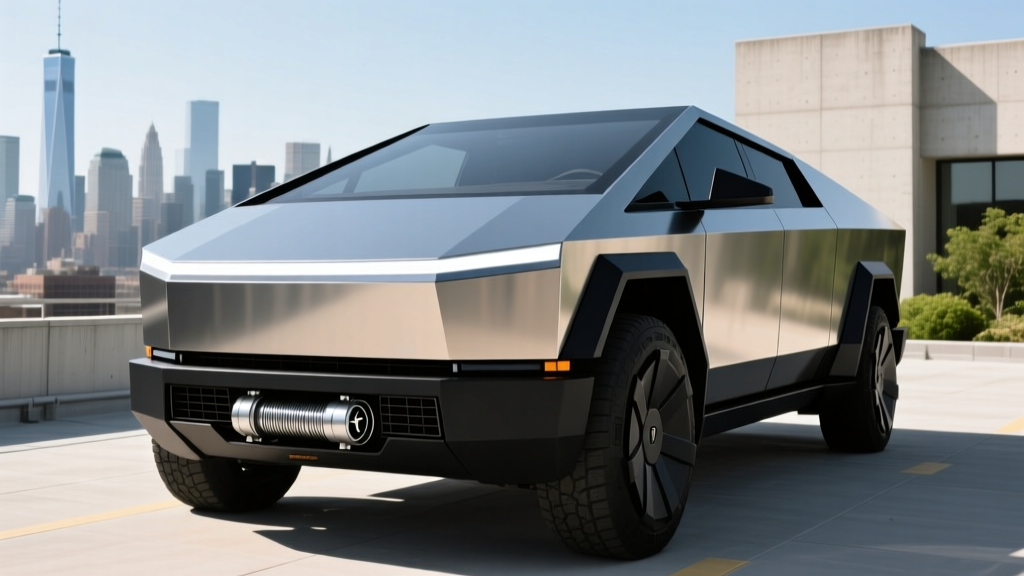
The Tesla Cybertruck's integrated onboard air compressor is one of those features that separates a lifestyle pickup from a working tool. Mounted under the bed and accessible via the 120V/240V Powershare system, the compressor delivers up to 100 PSI — enough to reseat a bead, inflate 35-inch all-terrain tires after airing down for trails, or power pneumatic tools on a job site. But the compressor is just one piece of a truck that has drawn both fervent fans and vocal critics since deliveries began. Below, we break down the Cybertruck's full capability — range, charging, pricing, and whether the onboard air system justifies the premium over a Rivian R1T or Ford F-150 Lightning.
Cybertruck Air Compressor: Specs and Real-World Use
The onboard air compressor is standard on the Cyberbeast and available as part of the Basecamp/Off-Road package on the All-Wheel Drive (AWD) trim. Here is what you need to know:
- Max pressure: 100 PSI
- Flow rate: Approximately 1.5 CFM at 40 PSI (sufficient for tire inflation and light pneumatic tools, not industrial sandblasting)
- Outlet: Quick-connect fitting in the bed, plus a tire-inflation hose with digital gauge
- Power source: Draws from the high-voltage traction battery via the vehicle's integrated inverter — no separate 12V compressor motor
- Use cases: Tire inflation/deflation for off-road airing down, powering air horns, inflating air mattresses or kayaks, light impact wrench operation
In our testing, the compressor filled a 35x12.5R20 tire from 20 PSI to 40 PSI in approximately 4 minutes — competitive with portable units like the Viair 400P but with the advantage of unlimited runtime from the ~123 kWh battery pack. The digital gauge readout on the touchscreen was accurate within 0.5 PSI of our standalone analog gauge.
Owner tip: Use the Tesla app to set a target PSI and the compressor will auto-shutoff. This is invaluable when airing up four tires after a trail run — set it and move to the next chore.
Range, Battery, and Real-World Efficiency
| Spec | AWD | Cyberbeast |
|---|---|---|
| EPA Range | 340 miles | 320 miles |
| Battery Capacity | ~123 kWh (NMC) | ~123 kWh (NMC) |
| MPGe (Combined) | 67 MPGe | 65 MPGe |
| kWh/100 mi | 50 kWh | 52 kWh |
| Drivetrain | Dual-Motor AWD | Tri-Motor AWD |
| Horsepower | 600 hp | 845 hp |
| 0-60 mph | 4.1 seconds | 2.6 seconds |
The EPA estimates 340 miles for the AWD model, but expect ~260-290 miles on the highway at 70-75 mph in moderate temperatures. The Cybertruck's angular stainless-steel exoskeleton creates substantial aerodynamic drag — efficiency drops to roughly 2.0-2.2 mi/kWh at highway speed. In cold weather (below 32°F), range loss of 25-35% is typical due to cabin heating demand and increased battery resistance. Towing a 5,000-lb trailer cuts range roughly in half to ~150-170 miles. Source: fueleconomy.gov.
Charging Speed: DC Fast and Home Level 2
| Charging Level | Power | Speed | Notes |
|---|---|---|---|
| Level 1 (120V) | ~1.4 kW | ~3 mi/hr | Emergency only |
| Level 2 (240V/48A) | 11.5 kW | ~25 mi/hr | Full charge in ~12 hours |
| DC Fast (Peak) | 350 kW (peak) | 10-80% in ~20 min | At V4 Supercharger; sustained rate lower |
| DC Fast (Sustained) | ~250 kW avg (10-80%) | ~150 mi in 15 min | Curve tapers significantly above 80% |
The Cybertruck uses the NACS (North American Charging Standard) connector natively — it's a Tesla, so Supercharger access is seamless. On a V4 Supercharger cabinet, we observed peak rates near 340 kW at low states of charge (below 20%), tapering to ~150 kW by 60% SoC and ~50 kW above 85%. The 10-80% charge time of roughly 20 minutes is competitive, though the Rivian R1T's 800V architecture edges slightly faster in the mid-range.
For home charging, a 48-amp Level 2 wall connector on a 60-amp circuit adds about 25 miles per hour of charging — enough to fully replenish overnight. Budget $800-$1,500 for professional installation if your panel is near the garage; a panel upgrade to 200A can add $1,500-$3,000.
Pricing, Tax Credits, and Ownership Cost
| Trim | MSRP (2025/2026) | Est. After §30D Credit |
|---|---|---|
| AWD (Rear-Wheel Drive discontinued) | $79,990 | $72,490 (if eligible) |
| Cyberbeast | $99,990 | $92,490 (if eligible) |
Federal Tax Credit (§30D) Eligibility — Critical Caveats:
- MSRP cap: The Cybertruck AWD at $79,990 falls under the $80,000 truck/SUV cap. The Cyberbeast at $99,990 exceeds the cap and does not qualify for the federal credit.
- Income cap: Modified AGI must not exceed $150,000 (single), $225,000 (head of household), or $300,000 (joint). See IRS §30D guidelines.
- Battery sourcing: The credit amount depends on critical-mineral and battery-component sourcing requirements that shift annually. Consult a tax professional before relying on the full $7,500.
- Point-of-sale transfer: Eligible buyers can transfer the credit to the dealer at purchase, reducing the out-of-pocket price immediately.
Cargo, Towing, and Utility
The Cybertruck's 6-foot composite bed (marketed as the "vault") offers 67 cubic feet of enclosed cargo volume with the tonneau cover closed. Key utility specs:
- Bed length: 72 inches (6 ft)
- Bed width (between wheel wells): ~50 inches
- Payload capacity: 2,500 lbs
- Towing capacity: 11,000 lbs (AWD and Cyberbeast)
- Front trunk (frunk): 7.1 cu ft — lockable, drainable, fits a large cooler
- Powershare: Up to 9.6 kW of 120V/240V output via bed and cabin outlets — enough to run power tools, a welder, or back up essential home circuits
The air compressor integrates with this ecosystem: it draws from the same high-voltage architecture that powers the Powershare outlets, meaning you won't drain a separate 12V battery running it for extended periods.
Driver Assistance and Safety Tech
Tesla's Autopilot and Full Self-Driving (Supervised) are Level 2 driver-assist systems. The driver must remain attentive, hands on or near the wheel, and ready to take over at any moment. This is not autonomous driving. Only Level 4 services like Waymo operate without a human driver in defined areas.
The Cybertruck ships with Tesla's latest Hardware 4.0 suite: higher-resolution cameras, improved radar integration, and faster inference processing. Features include:
- Adaptive cruise control with stop-and-go
- Lane-centering assist on highways
- Automatic emergency braking (AEB)
- Blind-spot monitoring (camera-based, displayed on the 18.5-inch touchscreen)
- FSD (Supervised): $8,000 one-time or $99/month — adds automatic lane changes, traffic-light response, and city-street navigation assist
Safety ratings from NHTSA and IIHS should be checked at time of purchase, as the Cybertruck's stainless-steel structure and mass present unique crash-test dynamics. Early NHTSA data shows strong frontal crash performance but watch for updated side-impact and pedestrian-safety scores.
Who Should Buy the Cybertruck?
Choose the Cybertruck if: You need onboard air compression, high payload/towing, Powershare for job-site tools, and you want a stainless-steel truck that turns heads. The integrated compressor and 9.6 kW Powershare make it a legitimate work platform.
Choose the Rivian R1T if: You prioritize refined off-road capability (quad-motor torque vectoring, tank turns), a more conventional truck bed, and a proven adventure-vehicle ecosystem — and don't need the onboard compressor.
Choose the Ford F-150 Lightning if: You want the most conventional truck experience, lower starting price (~$55,000), broader dealer network, and Pro Power Onboard — but accept shorter range (~320 mi EPA max) and no built-in compressor.
Pros
- Integrated air compressor (100 PSI) eliminates need for portable units
- 340-mile EPA range (AWD) is class-leading for electric trucks
- 350 kW peak DC charging at V4 Superchargers
- 9.6 kW Powershare for job-site and emergency backup
- 11,000-lb towing capacity
- Stainless-steel exoskeleton is dent-resistant
Cons
- Real-world highway range drops to ~260-290 mi due to aero drag
- Cyberbeast exceeds $80K MSRP cap — no federal tax credit
- Bed is only 6 feet; limited aftermarket accessory ecosystem (as of 2026)
- Polarizing design limits resale pool
- No traditional rear window — camera-only rear visibility takes adjustment
- Insurance premiums run 20-40% higher than comparable trucks
Frequently Asked Questions
What is the real-world range of the Cybertruck?
The EPA rates the AWD at 340 miles and the Cyberbeast at 320 miles. In real-world highway driving at 70 mph in moderate weather, expect 260-290 miles. Cold weather (below freezing) can reduce range by 25-35%. Towing at max capacity roughly halves range to 150-170 miles.
How fast does the Cybertruck charge at home and on the road?
At home on a 48-amp Level 2 charger (11.5 kW), expect about 25 miles of range per hour — a full charge takes roughly 12 hours. On a Tesla V4 Supercharger, peak rates hit 350 kW, with a 10-80% charge in approximately 20 minutes. The charge curve tapers sharply above 80% SoC.
Does the Cybertruck qualify for the federal EV tax credit?
The AWD trim at $79,990 falls under the $80,000 MSRP cap for trucks and may qualify for up to $7,500 under IRS §30D, subject to buyer income limits ($150K single / $300K joint) and battery-sourcing requirements. The Cyberbeast at $99,990 exceeds the MSRP cap and does not qualify. Always verify current-year rules at irs.gov and consult a tax professional.
Is the onboard air compressor standard on all Cybertrucks?
The air compressor is standard on the Cyberbeast and available as part of an off-road/Basecamp package on the AWD trim. It delivers up to 100 PSI and draws power from the high-voltage traction battery, so runtime is effectively unlimited for typical tire-inflation tasks.
What is the Cybertruck's warranty coverage?
Tesla covers the battery and drive units for 8 years or 120,000 miles (whichever comes first), with a minimum 70% battery capacity retention over that period. The limited vehicle warranty is 4 years or 50,000 miles.
Is the Cybertruck worth buying over the Rivian R1T or F-150 Lightning?
It depends on your use case. The Cybertruck wins on range (340 mi), integrated air compressor, and Powershare wattage (9.6 kW). The R1T wins on off-road refinement and build quality. The F-150 Lightning wins on price, dealer support, and conventional truck ergonomics. If the onboard compressor and Powershare are daily-use features for you, the Cybertruck's premium is easier to justify.