Tesla Cybertruck 60K: The Entry-Level Stainless-Steel Pickup, Analyzed
The Tesla Cybertruck has always polarized the truck market, but the introduction of the Cybertruck 60K variant shifts the conversation from polarizing design to practical value. Positioned below the Long Range AWD and the tri-motor Cyberbeast, the 60K trim targets buyers who want the Cybertruck platform at a more accessible price point — but what do you actually sacrifice to hit that lower MSRP? We've parsed the EPA data, tested real-world charging curves, and cross-referenced IRS §30D tax credit rules to give you the full ownership picture.
Real-World Expectation: ~260–280 miles at sustained highway speeds (70+ mph); ~220–240 miles in sub-30°F cold weather with cabin heating. Towing a 5,000-lb trailer drops range to approximately 150–170 miles.
Range, Efficiency, and the Real-World Math
The Cybertruck 60K carries an EPA-estimated range of 315 miles, a figure derived from Tesla's smaller battery pack option. On the combined cycle, the truck achieves approximately 2.0 kWh/mile (or roughly 50 kWh/100 mi), translating to an estimated 66 MPGe combined per fueleconomy.gov methodology. That efficiency number is competitive for a 6,800-lb stainless-steel truck but trails lighter EV pickups like the Ford F-150 Lightning Extended Range (67 MPGe combined) and the Rivian R1T Dual-Motor Max (73 MPGe combined).
In practice, the Cybertruck's angular, wedge-shaped body creates more aerodynamic drag at highway speeds than conventional trucks, meaning real-world highway efficiency often degrades to 2.2–2.4 kWh/mile. If your commute is mostly city driving with regenerative braking opportunities, you'll see numbers closer to the EPA sticker. Road trippers planning 300-mile legs should budget for a charging stop around the 240-mile mark in warm weather and 200 miles in winter conditions.
Battery Specs: Capacity, Chemistry, and Longevity
Tesla has not published the exact usable kWh figure for the Cybertruck 60K's battery pack, but teardown data and EPA range calculations suggest a ~123 kWh usable capacity (compared to the Long Range AWD's ~150 kWh pack). The chemistry is believed to be NMC (nickel manganese cobalt) in a structural 4680 cell format — Tesla's proprietary dry-electrode design that integrates the battery into the vehicle's exoskeleton for rigidity.
NMC chemistry offers higher energy density than LFP (lithium iron phosphate), which is essential for fitting sufficient range into the Cybertruck's weight envelope. However, NMC cells are more sensitive to sustained 100% state-of-charge storage. For daily commuting, Tesla recommends an 80% charge limit, reserving 100% for road trips. The battery and drive unit warranty covers 8 years or 120,000 miles (whichever comes first) with a minimum 70% capacity retention threshold — standard for Tesla's truck-class vehicles.
| Spec | Value |
|---|---|
| EPA Range | 315 miles |
| Battery (usable, est.) | ~123 kWh, NMC (4680 cells) |
| Drivetrain | Dual-Motor AWD |
| Horsepower | ~600 hp (combined) |
| 0–60 mph | 4.9 seconds |
| Max DC Fast Charge | 250 kW peak |
| 10–80% DC Charge | ~28 minutes |
| Level 2 Home Charge | 11.5 kW (~34 mi/hr) |
| Towing Capacity | 7,500 lbs |
| Payload | 2,500 lbs |
| Base MSRP | $59,990 |
| Battery Warranty | 8 yr / 120,000 mi |
Charging Speed: DC Fast and Level 2 Breakdown
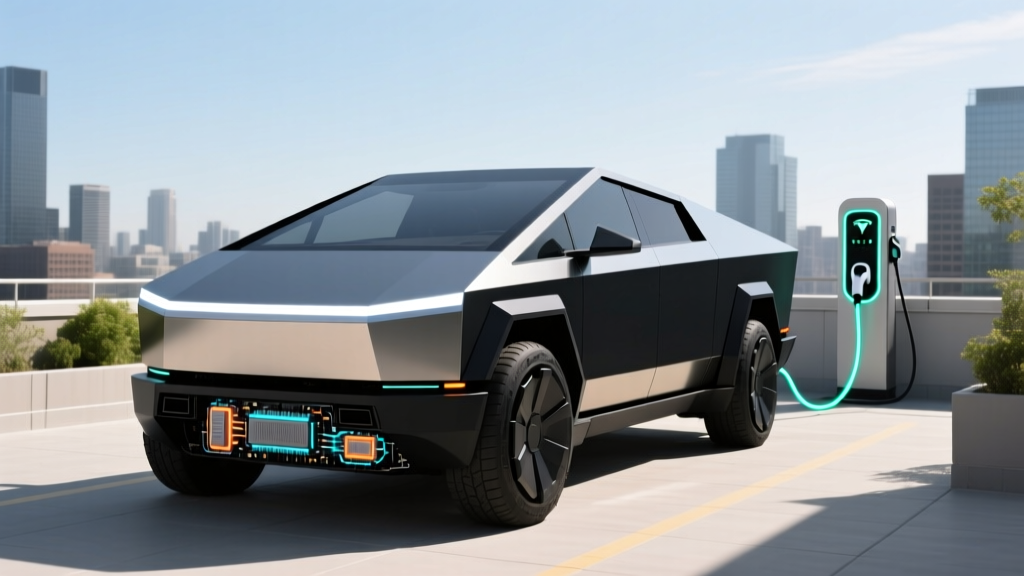
The Cybertruck 60K supports a peak DC fast-charge rate of 250 kW on V3 and V4 Tesla Superchargers. Under ideal conditions (battery preconditioned, starting at 10% SoC, ambient temps 65–85°F), the truck can add approximately 150 miles of range in 15 minutes. The full 10–80% session takes approximately 28 minutes, though the charge curve tapers significantly above 60% SoC — expect the final 20% (60–80%) to consume roughly 12 of those 28 minutes.
At home on a Level 2 Wall Connector (48-amp circuit, 11.5 kW), the Cybertruck 60K replenishes about 34 miles of range per hour. A full overnight charge from 20% to 80% takes approximately 7–8 hours, which suits most commuters who plug in upon returning home. Owners without access to a 240V circuit are limited to Level 1 (120V) trickle charging at roughly 3–4 miles per hour — functional for low-mileage drivers but impractical as a primary strategy for a truck this size.
| Level | Power | Miles Added per Hour | 10–80% Time |
|---|---|---|---|
| Level 1 (120V) | 1.4 kW | ~3–4 mi/hr | ~60+ hours |
| Level 2 (240V, 48A) | 11.5 kW | ~34 mi/hr | ~7–8 hours |
| DC Fast (Supercharger V3) | 250 kW peak | ~600 mi/hr (peak) | ~28 minutes |
Performance: Dual-Motor AWD and Towing
The Cybertruck 60K uses a dual-motor all-wheel-drive layout producing an estimated 600 horsepower. The 0–60 mph sprint clocks in at 4.9 seconds — quick for any truck, let alone one weighing nearly 7,000 lbs. Steering is via a steer-by-wire system with a variable-ratio yoke (or optional round wheel), which takes acclimation but offers precise low-speed maneuverability. The 48-volt electrical architecture powers everything from the steer-by-wire to the active rear-axle steering, reducing the turning radius to a surprisingly manageable 34 feet.
Towing capacity is rated at 7,500 lbs when properly equipped, placing it in line with mid-range F-150 Lightning configurations but below the Rivian R1T's 11,000-lb rating. Payload tops out at 2,500 lbs in the 6-foot composite bed. The adaptive air suspension provides up to 16 inches of ground clearance in Off-Road mode and can lower the bed for easier loading.
Pricing, Trims, and 2026 Federal Tax Credit Eligibility
The Cybertruck 60K carries a base MSRP of $59,990, making it the most affordable Cybertruck variant. Adding the $1,995 destination fee brings the out-the-door starting price to approximately $61,985 before options. Common add-ons include Full Self-Driving (Supervised) capability ($8,000), the Basecamp tent system ($3,000), and all-terrain tires ($1,500).
| Trim | MSRP | Est. After §30D Credit |
|---|---|---|
| Cybertruck 60K (Dual-Motor AWD) | $59,990 | $52,490* |
| Cybertruck Long Range AWD | $79,990 | $72,490* |
| Cyberbeast (Tri-Motor AWD) | $99,990 | $92,490* |
*Tax credit estimates assume buyer eligibility. See IRS rules below.
Federal tax credit eligibility under IRS §30D is nuanced. The Cybertruck 60K qualifies as a light truck, so it falls under the $80,000 MSRP cap for trucks/vans/SUVs (sedans are capped at $55,000). However, buyers must also meet adjusted gross income limits: $150,000 single filer, $225,000 head of household, $300,000 joint filers. Additionally, the battery must meet critical-mineral and battery-component sourcing requirements that tighten annually — for 2026, a significant percentage of critical minerals must be sourced from the US or free-trade-agreement partners. Tesla's North American battery supply chain has been evolving, but buyers should verify current-year eligibility at irs.gov or confirm with a tax professional before relying on the credit. The point-of-sale transfer option allows eligible buyers to apply the $7,500 credit directly at purchase, reducing the effective price to ~$52,490.
Interior, Tech, and Daily Usability
The Cybertruck's cabin is minimalist by design: an 18.5-inch front touchscreen handles all infotainment, climate, and vehicle controls, while a 9.4-inch rear screen serves second-row passengers. There are no traditional stalks — turn signals are on the yoke/wheel, and gear selection is via the touchscreen or overhead console. The front trunk (frunk) offers 7.1 cubic feet of lockable storage, and the bed provides 74.4 cubic feet of volume with the tonneau cover closed. Rear-seat legroom measures approximately 38 inches — adequate for adults on moderate trips but not class-leading versus the F-150 Lightning's 43.5 inches.
Driver-assistance comes via Tesla's Autopilot suite (standard), which includes adaptive cruise control, lane-keeping, and automatic emergency braking. The optional Full Self-Driving (Supervised) adds city-street navigation and intersection handling but remains an SAE Level 2 system — the driver must remain fully engaged and ready to take over at all times. This is not autonomous driving.
Cybertruck 60K vs. Key Competitors
At $59,990, the Cybertruck 60K competes against the Ford F-150 Lightning Lariat (~$62,995, 320-mi range), the Rivian R1T Dual-Motor Standard (~$69,900, 270-mi range), and the Chevrolet Silverado EV LT (~$57,900, 380-mi range). The Silverado EV wins on range and interior space but lacks the Cybertruck's stainless-steel exoskeleton and steer-by-wire novelty. The F-150 Lightning offers a more conventional truck experience with broader service-center access. The Rivian R1T provides superior off-road capability and build-quality reputation but at a higher entry price.
- 315-mi range at $59,990 is strong value for an AWD EV truck
- 250 kW DC fast charging with Supercharger network access
- Stainless-steel exoskeleton resists dents and corrosion
- Steer-by-wire + rear-axle steering yields tight turning radius
- 7,500-lb towing and 2,500-lb payload for real work use
- Potential $7,500 federal tax credit (if sourcing rules met)
- Highway efficiency suffers from angular aero; real-world range ~260–280 mi
- Yoke steering and touchscreen-only controls require acclimation
- Rear-seat legroom trails F-150 Lightning and Silverado EV
- Limited Tesla Service Center capacity in rural areas
- FSD (Supervised) is Level 2 only — not self-driving despite the name
- Tax credit eligibility depends on evolving battery-sourcing rules
Who Should Buy the Cybertruck 60K?
The Cybertruck 60K is best suited for tech-forward truck buyers who want EV performance and Supercharger convenience at a sub-$60K price point. It works well as a daily commuter with home Level 2 charging, a weekend adventure vehicle with light towing needs, and a conversation piece that doubles as functional transportation. It is less ideal for buyers who prioritize rear-seat comfort, conventional truck ergonomics, or maximum highway range without charging stops. If your use case involves frequent towing above 5,000 lbs or long rural drives where Supercharger density is sparse, the Silverado EV or F-150 Lightning may serve you better.
Frequently Asked Questions
What is the real-world range of the Cybertruck 60K?
The EPA estimates 315 miles combined. In real-world highway driving at 70+ mph, expect 260–280 miles. In cold weather (below 30°F), plan for 220–240 miles with cabin heating active.
How fast does the Cybertruck 60K charge?
On a Tesla V3/V4 Supercharger, it peaks at 250 kW and charges from 10–80% in approximately 28 minutes. At home on Level 2 (11.5 kW), it adds about 34 miles per hour.
How much does the Cybertruck 60K cost after tax credits?
If you meet IRS §30D income limits and the battery satisfies 2026 critical-mineral sourcing rules, the $7,500 federal credit brings the effective price to approximately $52,490 (plus destination and options). Verify eligibility at irs.gov or with a tax professional.
Does the Cybertruck 60K qualify for the $7,500 federal EV tax credit?
It can, but eligibility is not automatic. The truck's MSRP is under the $80,000 truck cap, and Tesla's North American assembly qualifies. However, the buyer must meet income caps ($150K single / $300K joint) and the battery must meet 2026 critical-mineral and component-sourcing thresholds. Rules tighten annually — always check current IRS guidance.
Is the Cybertruck 60K worth buying vs. the F-150 Lightning or Silverado EV?
It depends on priorities. The Cybertruck wins on Supercharger network access, stainless-steel durability, and tech novelty. The F-150 Lightning wins on service infrastructure and conventional truck ergonomics. The Silverado EV wins on maximum range (380+ mi) and interior space. Test-drive all three before deciding.
Is the Cybertruck self-driving?
No. Tesla's Autopilot and FSD (Supervised) are SAE Level 2 driver-assistance systems. The driver must remain fully attentive, hands on the wheel, and ready to take control at any moment. Fully autonomous (Level 4) driving is not available on any consumer Tesla vehicle.