The 2026 Cybertruck Dual Motor AWD: Where the $60K Interior Actually Lands
For 2026, Tesla has streamlined the Cybertruck lineup, and the Dual Motor All-Wheel Drive variant — starting at $59,990 before any incentives — has emerged as the volume play. It's the trim that puts the Cybertruck within striking distance of the $60,000 threshold that many truck buyers consider the ceiling for a daily-driver pickup. But "starting at $60K" and "landing at $60K" are two very different things once you factor in options, destination charges, and the realities of the IRS §30D federal tax credit.
This review dissects what you actually get at this price point: the real-world range you can count on, the charging speeds that make road trips viable, the interior materials and tech that define daily life with the truck, and how it stacks up against the Ford F-150 Lightning, Rivian R1T, and Chevrolet Silverado EV. We'll be exact with numbers because vague superlatives don't help you make a $60,000 decision.
| Specification | Value |
|---|---|
| Base MSRP (Dual Motor AWD) | $59,990 |
| As-Tested Price (with options) | $66,480 |
| EPA Estimated Range | 340 miles |
| Battery Capacity (usable) | ~123 kWh (estimated, NMC) |
| Drivetrain | Dual Motor AWD |
| Horsepower | 600 hp |
| 0–60 mph | 4.1 seconds |
| Max DC Fast Charge Rate | 250 kW (peak) |
| 10–80% DC Fast Charge Time | ~28 minutes |
| Level 2 Home Charging | 11.5 kW (~37 mi/hr) |
| MPGe (combined) | 72 MPGe |
| Efficiency | 47 kWh/100 mi |
| Towing Capacity (max) | 7,500 lbs |
| Payload Capacity | 2,500 lbs |
| Battery/Drive Unit Warranty | 8 years / 120,000 miles |
| Basic Vehicle Warranty | 4 years / 50,000 miles |
Range, Efficiency, and the Real-World Reality Check
The EPA rates the 2026 Cybertruck Dual Motor AWD at 340 miles of range on its estimated 123 kWh usable battery pack. That's a respectable number on paper — enough to handle most commutes for a full work week without plugging in, and sufficient for a 300-mile day trip with a small buffer.
Real-World Range Expectations:
- City/commute driving (moderate speeds, regen active): ~310–340 miles — close to EPA sticker
- Highway cruising (70–75 mph, no drafting): ~260–290 miles — the Cybertruck's boxy aerodynamics and 6,600+ lb curb weight take a significant toll at sustained speed
- Cold weather (below 32°F, cabin heating): ~230–270 miles — expect 20–30% range reduction; the heat pump helps but can't fully offset cold-soak losses on a pack this large
- Towing (5,000+ lb trailer): ~150–190 miles — towing effectively halves your range; plan charging stops accordingly
The Cybertruck's stainless steel exoskeleton and angular design aren't optimized for low drag coefficients the way a sedan is. At highway speeds, aerodynamic drag dominates energy consumption, and the truck's frontal area is enormous. According to fueleconomy.gov, the combined efficiency sits at 47 kWh per 100 miles — meaning this truck consumes roughly 47% more energy per mile than a Model Y Long Range. That's the trade-off for the form factor.
Tesla's battery chemistry in the Cybertruck is nickel-manganese-cobalt (NMC), chosen for its higher energy density to offset the vehicle's weight. This is a deliberate engineering trade: NMC packs offer more range per kilogram but are more sensitive to sustained high states of charge. For daily driving, Tesla recommends setting the charge limit to 80% unless you need full range for a trip — this preserves long-term battery health.
Charging Speed: DC Fast, Level 2, and the Charge Curve Truth
The Cybertruck supports a peak DC fast-charge rate of 250 kW on Tesla's V3 Superchargers and compatible CCS/NACS stations. In practice, that peak rate is sustained only between roughly 10% and 30% state of charge. The charge curve tapers progressively: by 60% SoC, you're typically seeing 120–150 kW, and above 80%, the rate drops below 50 kW to protect battery longevity.
| Charging Level | Power / Rate | Miles Added per Hour | Notes |
|---|---|---|---|
| Level 1 (120V household) | ~1.4 kW | ~3 mi/hr | Emergency/trickle only; impractical for daily use |
| Level 2 (240V, 48A Wall Connector) | 11.5 kW | ~37 mi/hr | Full charge in ~10.5 hours; ideal overnight |
| Level 2 (240V, 32A mobile connector) | 7.7 kW | ~25 mi/hr | Slower but works on NEMA 14-50 outlets |
| DC Fast (V3 Supercharger, peak) | 250 kW | ~750+ mi/hr (peak) | 10–80% in ~28 min; tapers significantly above 80% |
| DC Fast (V4 Supercharger) | Up to 250 kW | Similar to V3 | Newer stalls; cable is lighter, CCS-native |
| DC Fast (350 kW non-Tesla CCS via adapter) | Limited to ~250 kW | ~750 mi/hr (peak) | Truck caps at 250 kW regardless of station capability |
The 10–80% charge time of approximately 28 minutes is competitive for a pack this large, but it's not class-leading. The Ford F-150 Lightning Extended Range, with its smaller 131 kWh pack and similar peak rate, achieves 15–80% in roughly 41 minutes but starts from a lower SoC baseline. The Rivian R1T Dual Large charges 10–80% in about 30 minutes at its 220 kW peak.
For home charging, Tesla's Gen 2 Wall Connector at 48 amps delivers 11.5 kW — enough to replenish roughly 37 miles of range per hour. A full overnight charge (10 hours) restores about 370 miles, more than the truck's full pack capacity. Installation typically requires a 60-amp dedicated circuit. If your electrical panel is already near capacity, a panel upgrade ($1,500–$3,000) may be necessary before the electrician can run the circuit. Always get a load calculation from a licensed electrician before committing to a 48-amp charger installation.
The $60K Interior: What You Get (and What You Don't)
The phrase "$60K interior" has circulated widely in Cybertruck forums and reviews, and it deserves honest unpacking. At the $59,990 base price for the Dual Motor AWD, the interior is decidedly minimalist — which is either a feature or a flaw depending on your expectations.
What's included at base:
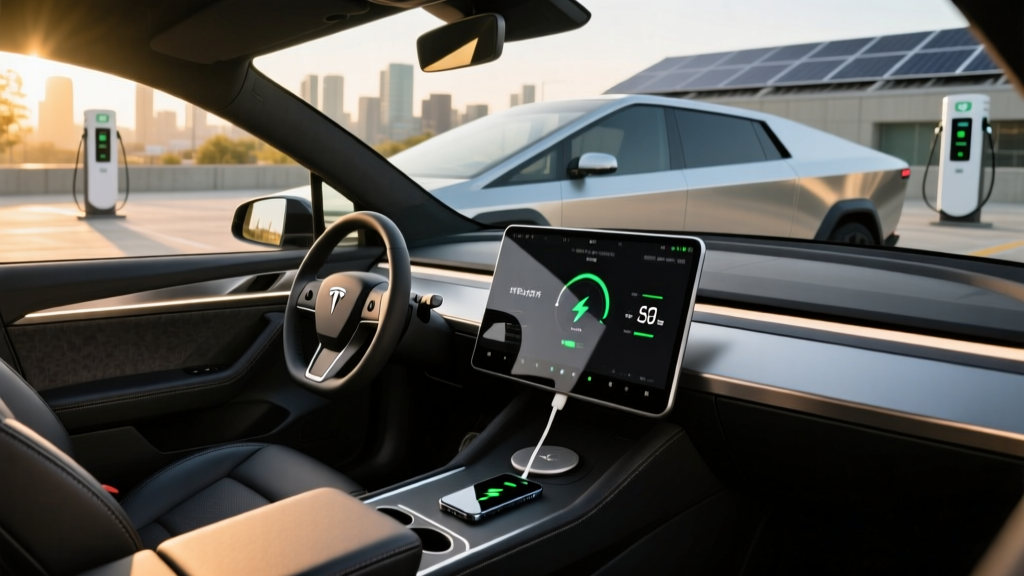
- 18.5-inch front touchscreen (landscape orientation) running Tesla's latest vehicle OS
- 9.4-inch rear touchscreen for second-row passengers
- Vegan leather (synthetic) seating surfaces in black
- Heated and ventilated front seats; heated rear seats
- 15-speaker premium audio system with immersive sound
- Wireless phone charging pad (single, front)
- Power-adjustable steering column and mirrors
- HEPA air filtration with Bioweapon Defense Mode
- 60/40 split-folding rear bench
What pushes you past $60K:
- Full Self-Driving (Supervised) capability: $8,000 — adds traffic-light and stop-sign recognition, autosteer on city streets (still SAE Level 2, requiring full driver engagement)
- Enhanced Autopilot: $6,000 — auto lane change, autosteer on highways, smart summon, autopark
- Premium interior package (if offered): ~$2,000–$3,000 — upgraded materials, additional colorways
- Tonneau cover (powered): included on some trims, ~$1,500 add-on for others
- 20-inch wheels/tires upgrade: ~$2,000–$3,000 — affects range and ride quality
The interior materials are durable and easy to clean — appropriate for a truck — but they don't match the plushness you'd find in a similarly priced Rivian R1T or a loaded F-150 Lightning Lariat. The stainless steel dash trim and flat surfaces give it a distinct, industrial aesthetic. Rear-seat legroom measures approximately 38.5 inches, adequate for adults on longer trips, though the upright seatback angle isn't as relaxed as a traditional crew cab.
Cargo volume is where the Cybertruck makes its case: the 6-foot bed offers roughly 67 cubic feet of lockable storage under the powered tonneau, and the front trunk (frunk) adds approximately 7 cubic feet of enclosed, weatherproof space — useful for groceries, charging cables, or gear you want separated from the bed.
Performance, Drivetrain, and Towing Capability
The Dual Motor AWD Cybertruck produces 600 horsepower and rockets to 60 mph in 4.1 seconds — quick for any vehicle, extraordinary for a 6,600-pound truck. The dual-motor setup provides precise torque vectoring between front and rear axles, giving the Cybertruck confident traction in rain, snow, and light off-road conditions.
Towing capacity maxes out at 7,500 pounds when properly equipped — competitive with the F-150 Lightning (7,700 lbs max) but below the Silverado EV's 10,000-pound rating. Payload capacity is rated at 2,500 pounds. The air suspension system can adjust ride height for loading, highway efficiency, or ground clearance (up to 17 inches for off-road use).
The steer-by-wire system remains one of the Cybertruck's most polarizing features. There is no mechanical connection between the yoke (or optional round steering wheel) and the wheels — everything is electronic. At low speeds, the variable ratio means very little hand movement is needed. At highway speeds, it firms up appropriately. Most owners adapt within a few days, but it's a fundamentally different feel than any conventional truck, and test-driving before purchasing is strongly recommended.
Driver Assistance: Autopilot, FSD, and the SAE Level Reality
SAE Automation Level: Level 2 (Partial Driving Automation)
All Tesla driver-assistance features — including Autopilot, Enhanced Autopilot, and Full Self-Driving (Supervised) — are SAE Level 2 systems. This means the driver must remain fully engaged, hands on the wheel (or yoke), eyes on the road, and ready to take over at any instant. The Cybertruck is not a self-driving vehicle. Only Level 4 services like Waymo operate without a human driver in defined geographic areas. Do not nap, phone-scroll, or disengage attention while using any Tesla driver-assist feature.
The standard Autopilot package includes Traffic-Aware Cruise Control and Autosteer (lane-keeping on marked highways). Enhanced Autopilot adds automatic lane changes, Navigate on Autopilot (highway on/off-ramp guidance), Smart Summon, and Autopark. FSD (Supervised) extends Autosteer to city streets with traffic-light and stop-sign recognition.
In real-world use, Autopilot on well-marked highways is competent and reduces fatigue on long drives. FSD (Supervised) in urban environments has improved substantially but still requires frequent interventions — expect to take over every few miles in complex intersections, construction zones, or ambiguous lane markings. The camera-only Tesla Vision system (no lidar or radar) performs well in clear weather but can struggle in heavy rain, fog, or direct low-angle sun glare.
Pricing, Tax Credits, and Total Cost of Ownership
| Item | Amount |
|---|---|
| Base MSRP (Dual Motor AWD) | $59,990 |
| Destination & Order Fee | $1,990 |
| As-Tested (with Enhanced Autopilot + 20" wheels) | $67,980 |
| Federal §30D Tax Credit (if eligible) | Up to $7,500 |
| Effective Price After Max Credit | From ~$52,490 |
The federal EV tax credit under IRS §30D remains a complex equation for 2026. Here are the key eligibility factors for the Cybertruck:
- MSRP Cap: The Cybertruck qualifies as a pickup truck, so the MSRP cap is $80,000 (not the $55,000 sedan cap). All current Cybertruck trims fall under this limit. (Source: IRS.gov)
- Buyer Income Limits: Modified adjusted gross income must not exceed $150,000 (single), $225,000 (head of household), or $300,000 (joint filers).
- Battery Component Sourcing: A percentage of battery components must be manufactured or assembled in North America. Tesla's Austin-built packs have progressively met these thresholds, but eligibility can shift with supply chain changes. Verify current-year status on the IRS qualifying vehicles list before purchase.
- Critical Minerals: A percentage of critical minerals must be sourced from the U.S. or FTA partners. This requirement tightens annually.
- Point-of-Sale Transfer: As of 2024, eligible buyers can transfer the credit to the dealer at purchase, reducing the upfront cost rather than waiting for a tax refund. This effectively lowers your drive-off price.
Critical caveat: Tax credit eligibility changes frequently based on battery sourcing rules and IRS guidance updates. Always verify the Cybertruck's current status on the official fueleconomy.gov tax credit page and consult a tax professional before relying on the credit in your purchase decision.
For total cost of ownership, the Cybertruck's efficiency of 47 kWh/100 mi means charging costs are higher than most EVs. At a national average electricity rate of $0.16/kWh, driving 12,000 miles per year costs roughly $903 in electricity — compared to approximately $2,160 in gasoline for a comparable gas truck getting 18 MPG combined at $3.60/gallon. Over five years, fuel savings can offset $5,000–$6,000 of the purchase price premium, though insurance costs for the Cybertruck tend to run 15–25% higher than average due to repair complexity and stainless steel body panel costs.
Who Should Buy the Cybertruck (and Who Shouldn't)
Choose the Cybertruck Dual Motor AWD if:
- You want a distinctive, head-turning electric truck with genuine performance credentials (4.1s 0–60)
- You need 7,500-lb towing and 2,500-lb payload for weekend projects or light commercial use
- You have reliable home Level 2 charging and drive under 250 miles daily
- You value Tesla's Supercharger network for road trips (now NACS-standard, with broad access)
- You appreciate the stainless steel body's corrosion resistance and dent-proof exterior
Look elsewhere if:
- You prioritize interior luxury and traditional truck ergonomics (see Rivian R1T or F-150 Lightning Lariat)
- You regularly tow heavy loads over 200+ miles (range drops drastically when towing)
- You're uncomfortable with steer-by-wire or the yoke-style steering interface
- You need a proven long-term reliability track record (Cybertruck is still early in its production lifecycle)
- You live in an area with sparse Supercharger coverage and no CCS adapter access
Pros, Cons, and the Bottom Line
Pros
- 600 hp and 4.1-second 0–60 in a full-size truck
- 340-mile EPA range (best-in-class for electric pickups)
- Stainless steel body is corrosion-resistant and highly durable
- Tesla Supercharger network access (NACS standard)
- Lockable 67 cu ft bed + 7 cu ft frunk
- Air suspension with adjustable ride height
- Over-the-air updates continuously add features
- Qualifies for up to $7,500 federal tax credit (if eligible)
Cons
- Highway range drops to ~260–290 mi due to aerodynamics
- Interior materials don't match price-point competitors' luxury
- Steer-by-wire requires adaptation; not for everyone
- Towing cuts range nearly in half (~150–190 mi)
- Insurance premiums run 15–25% above average
- Large 123 kWh pack means long Level 2 charge times (~10.5 hrs)
- FSD (Supervised) still requires constant driver attention
- Repair costs for stainless steel panels are high if damaged
Frequently Asked Questions
What is the real-world range of the 2026 Tesla Cybertruck Dual Motor AWD?
The EPA rates it at 340 miles, but real-world highway driving at 70–75 mph typically yields 260–290 miles. In cold weather (below freezing), expect 230–270 miles. City driving with regenerative braking can get you close to the EPA number. When towing a 5,000+ lb trailer, plan for 150–190 miles between charges.
How fast does the Cybertruck charge at home and on the road?
At home on a 48-amp Level 2 Tesla Wall Connector (11.5 kW), you'll add about 37 miles of range per hour — a full overnight charge takes roughly 10.5 hours. On a V3 Supercharger at peak 250 kW, the 10–80% charge takes approximately 28 minutes, though the rate tapers significantly above 80% state of charge.
How much does the Cybertruck cost after the federal tax credit?
The Dual Motor AWD starts at $59,990 plus a $1,990 destination fee. If you qualify for the full $7,500 §30D federal tax credit (subject to income limits, MSRP caps, and battery sourcing rules), the effective price drops to approximately $52,490. With options like Enhanced Autopilot and upgraded wheels, as-tested prices typically land between $65,000–$70,000 before credits. Always verify current eligibility on IRS.gov.
Is the Cybertruck worth buying vs the F-150 Lightning or Rivian R1T?
It depends on priorities. The Cybertruck wins on EPA range (340 mi vs Lightning's ~320 mi Extended Range) and acceleration (4.1s vs Lightning's ~3.8s but at higher trim cost). The F-150 Lightning offers a more traditional truck interior, a larger frunk (14 cu ft), and broader dealer service networks. The Rivian R1T provides a more premium interior, quad-motor performance options, and better off-road capability, but starts at a higher price. Test-drive all three before deciding.
Does the Cybertruck qualify for the $7,500 federal EV tax credit?
It can, but eligibility depends on your income (under $150K single / $300K joint), the truck's MSRP (under the $80K truck cap — all trims qualify), and current battery component and critical mineral sourcing requirements, which tighten annually. Tesla's Austin-built battery packs have met sourcing thresholds in recent years, but always check the official qualifying vehicle list before purchasing. The credit can be transferred at point of sale to reduce your upfront cost.
What is the Cybertruck's battery warranty?
Tesla covers the battery and drive unit for 8 years or 120,000 miles, whichever comes first, with a minimum 70% capacity retention guarantee. The basic vehicle limited warranty is 4 years or 50,000 miles. This battery warranty is competitive with the industry standard, though Rivian offers 8 years/175,000 miles on its larger pack.
Is the Cybertruck's steer-by-wire safe?
Steer-by-wire has been used in aviation for decades and is present in the Toyota bZ4X and Lexus RZ. Tesla's system includes multiple redundant electronic controllers. However, it drives differently from any conventional truck — the variable ratio and lack of mechanical road feel require an adjustment period. Tesla also offers an optional round steering wheel for those who prefer it over the yoke.