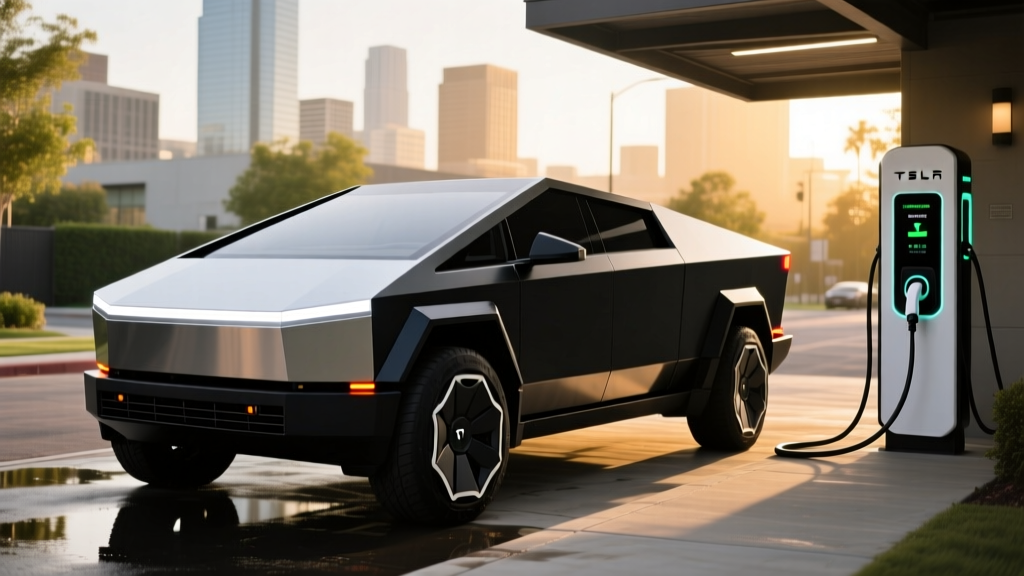
The Tesla Cybertruck occupies a strange space in the electric-vehicle market. It's marketed as a truck, sized like a midsize pickup, but many buyers cross-shop it against large electric SUVs. If you've been searching for an suv cybertruck comparison, you're not alone — the Cybertruck's enclosed bed, five-seat cabin, and air suspension blur the line between utility vehicle and pickup. This review breaks down whether the 2026 Cybertruck actually delivers as a daily-driver SUV alternative, with exact specs, real-world range data, and ownership costs.
2026 Cybertruck Trims, Pricing, and Tax Credit Eligibility
Tesla streamlined the Cybertruck lineup for 2026 after the initial Launch Series pricing controversy. Here's where each trim stands before and after potential federal incentives:
| Trim | Drivetrain | Base MSRP | Est. After §30D Credit | 0-60 mph |
|---|---|---|---|---|
| Long Range AWD | Dual Motor AWD | $79,990 | $72,490* | 4.1 sec |
| Cyberbeast | Tri Motor AWD | $99,990 | $92,490* | 2.6 sec |
*Tax credit estimates assume buyer meets all IRS §30D requirements. See eligibility details below.
Federal §30D Tax Credit: Does the Cybertruck Qualify?
The Cybertruck's MSRP falls under the $80,000 cap for trucks/vans/SUVs (the Long Range qualifies; the Cyberbeast does not at $99,990). However, eligibility depends on several factors that change frequently:
- Buyer income caps: $300,000 joint / $225,000 head of household / $150,000 single (modified AGI)
- Battery sourcing: Critical minerals and battery components must meet phased-in domestic/free-trade thresholds per IRS §30D rules
- Point-of-sale transfer: Eligible buyers can apply the credit at purchase, reducing out-of-pocket cost immediately
- FEOC restriction: Vehicles with battery components from foreign entities of concern are disqualified
Always verify current eligibility on irs.gov or consult a tax professional before purchasing. Tesla's website also lists current credit-eligible configurations.
EPA Range vs. Real-World Expectations
The Cybertruck's angular stainless-steel exoskeleton creates significant aerodynamic drag, which directly impacts highway efficiency. Here's what the EPA says versus what owners actually experience:
| Trim | EPA Est. Range | Real-World Highway (70 mph) | Cold Weather (20°F) |
|---|---|---|---|
| Long Range AWD | 340 miles | ~265–285 miles | ~210–240 miles |
| Cyberbeast | 320 miles | ~245–270 miles | ~195–225 miles |
Why the gap? The Cybertruck's 0.38+ drag coefficient (estimated; Tesla has not published an official Cd) means highway speeds punish range far more than city driving. Regenerative braking recovers energy in stop-and-go traffic, so expect better results around town. In sub-freezing temperatures, battery chemistry limitations and cabin heating draw reduce range by 25–35%, consistent with most large EVs without a dedicated heat pump optimized for extreme cold.
For context, the EPA's fueleconomy.gov lists the Long Range AWD at approximately 2.0–2.2 kWh/mile depending on conditions — thirsty by EV standards, comparable to the Rivian R1T and significantly less efficient than a Tesla Model X.
Battery Capacity, Chemistry, and Longevity
Tesla does not officially publish usable battery capacity for the Cybertruck, but teardowns and EPA filing data indicate a usable pack size of approximately 123 kWh (Long Range) using a structural 4680-cell NMC (nickel manganese cobalt) architecture. The Cyberbeast uses a similar pack tuned for higher discharge rates.
| Spec | Long Range AWD | Cyberbeast |
|---|---|---|
| Battery Chemistry | NMC (4680 cells) | NMC (4680 cells) |
| Usable Capacity (est.) | ~123 kWh | ~123 kWh |
| Thermal Management | Active liquid cooling/heating | Active liquid cooling/heating |
| Battery Warranty | 8 yr / 120,000 mi (≥70% retention) | 8 yr / 120,000 mi (≥70% retention) |
| Powertrain Warranty | 8 yr / 120,000 mi | 8 yr / 120,000 mi |
Chemistry note: NMC cells offer higher energy density than LFP (lithium iron phosphate), which is necessary for a vehicle this heavy (~6,600–6,800 lbs curb weight). The trade-off is that NMC batteries degrade slightly faster over time and Tesla recommends charging to 80% for daily use, reserving 100% for road trips. LFP packs (used in the Model 3 RWD) tolerate 100% daily charges — but you won't find LFP in the Cybertruck.
Charging Speed: DC Fast, Level 2, and the 800V Advantage
The Cybertruck uses an 800-volt electrical architecture, which enables faster DC charging with less current (and less heat) compared to 400V systems. Here's the full charging picture:
| Charging Level | Power / Rate | Miles Added per Hour | Notes |
|---|---|---|---|
| Level 1 (120V household) | ~1.4 kW | ~2–3 mi/hr | Emergency/trickle only; impractical for daily use |
| Level 2 (240V home, 48A) | ~11.5 kW | ~20–23 mi/hr | Full charge in ~11–12 hours; overnight-ready |
| DC Fast (Tesla Supercharger V4) | Peak ~350 kW | ~200+ mi in 15 min | 10–80% in ~18–22 minutes |
| DC Fast (CCS adapter, 3rd-party) | Up to ~250 kW | Varies by station | Requires Tesla CCS adapter (included) |
Charging curve reality: The Cybertruck peaks near 350 kW only at low state-of-charge (10–25% SoC) on a V4 Supercharger. By 50% SoC, the rate tapers to roughly 200–220 kW, and above 80% it drops sharply to protect the battery. Plan road-trip stops to 80% for the best time efficiency — charging from 80–100% can add 15+ minutes for only ~60 miles of range.
For home charging, a Tesla Wall Connector on a 60A circuit (48A continuous) delivers about 11.5 kW. If your home has a 200A electrical panel with spare capacity, expect installation costs of $500–$1,500 for the circuit and Wall Connector. Older homes or those needing a panel upgrade could see $2,000–$4,000+ in electrical work. Always get a quote from a licensed electrician before committing.
Performance, Towing, and SUV-Style Utility
| Spec | Long Range AWD | Cyberbeast |
|---|---|---|
| Horsepower | ~600 hp | ~845 hp |
| 0-60 mph | 4.1 sec | 2.6 sec |
| Top Speed | 112 mph | 130 mph |
| Drivetrain | Dual Motor AWD | Tri Motor AWD (torque vectoring) |
| Max Towing Capacity | 11,000 lbs | 11,000 lbs |
| Payload Capacity | ~2,500 lbs | ~2,500 lbs |
| Bed Length | 6 ft (72 in) | 6 ft (72 in) |
| Cargo Volume (bed + frunk) | ~67 cu ft bed + ~7 cu ft frunk | ~67 cu ft bed + ~7 cu ft frunk |
| Rear Legroom | ~38.4 in | ~38.4 in |
| Ground Clearance (max) | ~17.4 in (air suspension) | ~17.4 in (air suspension) |
| Approach/Departure Angle | ~35° / ~39° | ~35° / ~39° |
The Cybertruck's adaptive air suspension provides up to 12 inches of travel and can lower the vehicle for highway efficiency or raise it for off-road clearance. As an SUV alternative, the enclosed lockable bed (with a powered tonneau cover) functions similarly to a hatchback cargo area for gear, groceries, or luggage — though the bed walls are tall and the opening is narrower than a traditional SUV liftgate.
Towing caveat: While the 11,000-lb rating is impressive, towing near max capacity cuts range roughly in half. Expect ~150–170 miles of range when towing a 10,000-lb trailer at highway speeds. Plan charging stops accordingly.
Tech, Driver Assistance, and Interior
The Cybertruck's cabin is minimalist even by Tesla standards: an 18.5-inch center touchscreen handles all vehicle controls, navigation, and entertainment. Rear passengers get a 9.4-inch touchscreen for climate and media. There are no physical buttons, no instrument cluster, and no traditional stalks — turn signals are on the steering wheel rim, and gear selection is via the touchscreen or a backup overhead panel.
Autopilot and Full Self-Driving (Supervised)
SAE Level 2 — Driver Supervision Required. Tesla's Autopilot (standard) and available FSD (Supervised) are Level 2 driver-assistance systems. They provide steering, acceleration, and braking support on highways and some city streets, but the driver must remain fully attentive at all times. These systems do not make the Cybertruck self-driving. FSD (Supervised) costs $8,000 as a one-time purchase or $99/month as of 2026.
Standard Autopilot includes traffic-aware cruise control and autosteer on marked highways. The Cybertruck also features Tesla's vision-based parking assist, 360-degree camera views, and the new steer-by-wire system that eliminates the mechanical connection between the steering wheel and wheels — providing a variable ratio that requires less hand movement at low speeds.
Steer-by-Wire: What to Know
The Cybertruck is the first US-market production vehicle with a fully steer-by-wire system (no mechanical column). While it provides redundancy through dual motors and a backup power supply, some drivers report an adjustment period with the lack of traditional road feel. If you test drive, spend at least 20 minutes in varied conditions before evaluating.
Cybertruck vs. SUV Competitors: Is It Worth It?
Buyers cross-shopping the Cybertruck against large electric SUVs should consider how utility needs map to each vehicle type:
| Factor | Cybertruck LR AWD | Tesla Model X LR | Rivian R1T (Dual) | Kia EV9 GT-Line AWD |
|---|---|---|---|---|
| Base MSRP | $79,990 | $79,990 | $75,900 | $73,900 |
| EPA Range | 340 mi | 335 mi | 352 mi | 270 mi |
| Seating | 5 | 5–7 | 5 | 6–7 |
| Cargo (max) | ~74 cu ft (bed + frunk) | ~88 cu ft | ~54 cu ft bed + gear tunnel | ~81 cu ft |
| Towing | 11,000 lbs | 5,000 lbs | 11,000 lbs | 5,000 lbs |
| Efficiency (est.) | ~2.1 kWh/mi | ~2.0 kWh/mi | ~2.2 kWh/mi | ~2.4 kWh/mi |
Choose the Cybertruck If:
- You need serious towing capacity (11,000 lbs) with an EV
- You want a lockable, weatherproof bed for gear without a camper shell
- Off-road clearance and approach/departure angles matter
- You prefer a smaller footprint than a full-size SUV (the Cybertruck is ~224 in long vs. the Model X at ~200 in but narrower)
Choose an Electric SUV Instead If:
- You need 3-row seating for 6–7 passengers
- Easier parking-garage and drive-through access matters (the Cybertruck is wide at ~80 in and tall)
- You want a traditional cargo area with a low load floor and liftgate
- Maximum efficiency and lowest cost per mile are priorities
Pros, Cons, and Final Verdict
Pros
- 350 kW peak DC charging on Tesla Supercharger V4 network
- 11,000-lb towing capacity with integrated trailer brake controller
- Stainless-steel exoskeleton is dent- and corrosion-resistant
- Air suspension with 12 in of travel and adaptive height
- Steer-by-wire enables tight turning radius (~35 ft) for its size
- Access to Tesla Supercharger network (17,000+ stalls in North America)
- Lockable powered tonneau cover with 300-lb dynamic load rating
Cons
- Highway range falls significantly short of EPA due to aerodynamic drag
- No third-row seating option — limited to 5 passengers
- Steer-by-wire requires an adjustment period; no traditional road feel
- Stainless-steel panels show fingerprints and are difficult to repair
- Wide footprint (80+ in) makes tight parking structures challenging
- Cyberbeast trim exceeds $80K MSRP cap — no federal tax credit
- Bed access requires reaching over tall walls; no pass-through to cabin
- Vision-only Tesla Autopilot lacks radar redundancy
Bottom line: The 2026 Cybertruck Long Range AWD is a compelling option if you need truck capability (towing, payload, off-road clearance) in an EV and can work within a 5-seat configuration. As an SUV substitute, it falls short on passenger capacity, cargo convenience, and real-world highway efficiency compared to purpose-built electric SUVs. The $79,990 Long Range trim is the sweet spot — it qualifies for the §30D credit (if sourcing and income rules are met), bringing effective cost to ~$72,490. The Cyberbeast is a performance showcase but offers diminishing utility returns at $20K more.
Frequently Asked Questions
What is the real-world range of the Tesla Cybertruck?
The Long Range AWD is EPA-rated at 340 miles, but expect 265–285 miles at sustained 70 mph highway speeds and 210–240 miles in freezing weather. City driving with regenerative braking can approach or slightly exceed the EPA figure. The Cyberbeast delivers roughly 10–15 fewer miles in all scenarios due to its tri-motor power draw.
How fast does the Cybertruck charge at home and on the road?
At home on a Level 2 Tesla Wall Connector (48A, 240V), the Cybertruck charges at ~11.5 kW, adding about 20–23 miles of range per hour — a full overnight charge from 10–100% takes about 11–12 hours. On a Tesla V4 Supercharger, it peaks at ~350 kW and charges from 10–80% in roughly 18–22 minutes, though the rate tapers significantly above 50% SoC.
How much does the Cybertruck cost after the federal tax credit?
The Long Range AWD at $79,990 qualifies for up to $7,500 under IRS §30D if you meet income caps ($300K joint / $150K single), the vehicle meets battery-sourcing requirements, and it is not assembled with FEOC components. That brings the effective price to ~$72,490. The Cyberbeast at $99,990 exceeds the $80K truck MSRP cap and does not qualify for the federal credit.
Does the Cybertruck qualify for the federal EV tax credit?
The Long Range AWD qualifies in principle — its MSRP is under the $80,000 truck/SUV cap. However, final eligibility depends on your income, the battery's critical-mineral and component sourcing for the specific production batch, and current IRS rules. Check IRS §30D guidance and Tesla's point-of-sale eligibility indicator before purchasing.
Is the Cybertruck worth buying over an electric SUV?
It depends on your use case. If you tow boats, trailers, or need a weatherproof bed for work gear, the Cybertruck's 11,000-lb rating and enclosed bed are genuine advantages no 3-row SUV can match. If you need 6–7 seats, easy parking-garage access, and maximum cargo versatility, a Tesla Model X, Rivian R1S, or Kia EV9 will serve you better at similar or lower prices.
Can the Cybertruck's bed replace an SUV cargo area?
Partially. The 6-foot bed with a powered tonneau cover is lockable and weatherproof — excellent for muddy gear, bikes, or luggage. However, the bed walls are tall (~30 in), the load floor is higher than an SUV's, and there's no pass-through to the cabin for long items. For groceries and daily cargo, you'll use the ~7 cu ft frunk more than you'd expect.