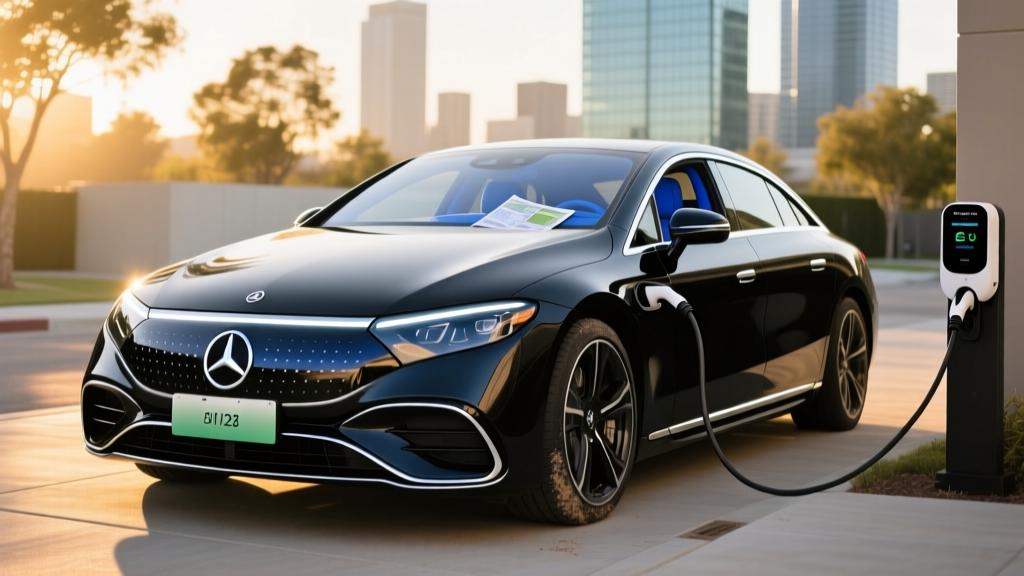
The Mercedes-Benz EQS Sedan has occupied a peculiar space in the luxury EV market since its debut: it offers flagship comfort, cutting-edge technology, and one of the largest battery packs in any production sedan, yet it has struggled to match the sales momentum of rivals like the Tesla Model S or the BMW i7. For 2026, the EQS Sedan returns with subtle refinements aimed at addressing early criticisms — most notably a larger 118 kWh battery pack (up from the original 107.8 kWh) and updated software. But does the formula work for real buyers navigating daily commutes, road trips, and the realities of public charging in 2026?
After spending time with the EQS 450+ and EQS 580 4MATIC trims, here is our data-driven breakdown of what this luxury EV actually delivers — and where it falls short.
Range & Efficiency: The 390-Mile Promise vs. Reality
The 2026 EQS 450+ (rear-wheel drive) carries an EPA-estimated range of 390 miles, placing it among the longest-range luxury sedans available. The dual-motor EQS 580 4MATIC drops to an EPA-estimated 365 miles due to added weight and drivetrain losses. Efficiency for the 450+ is rated at 97 MPGe combined, translating to roughly 34 kWh per 100 miles — a reasonable figure for a 5,800-pound vehicle.
- EPA estimate: 390 mi (450+) / 365 mi (580 4MATIC)
- Highway driving (70-80 mph): Expect 310-340 mi (450+) due to aerodynamic drag at sustained speeds
- Cold weather (below 32°F): Plan for 20-30% range reduction, bringing real-world range to ~270-310 mi without preconditioning
- City/mixed commuting: 360-380 mi is achievable with regenerative braking doing heavy lifting
The EQS benefits from excellent aerodynamics (a 0.20 Cd drag coefficient) and Mercedes' sophisticated thermal management system, which includes a heat pump. Preconditioning the battery via the Mercedes me app before departure significantly reduces cold-weather losses.
For context, the EPA's testing methodology blends city and highway cycles. In our experience, luxury EV buyers who predominantly drive highway miles should budget 15-20% below the sticker range, especially without access to garage parking for overnight temperature moderation.
Battery, Chemistry & Degradation
| Spec | EQS 450+ | EQS 580 4MATIC |
|---|---|---|
| Battery capacity (usable) | 118 kWh | 118 kWh |
| Chemistry | NMC (Nickel Manganese Cobalt) | NMC |
| EPA range | 390 mi | 365 mi |
| MPGe (combined) | 97 MPGe | 91 MPGe |
| kWh/100 mi | 34 | 37 |
| Drivetrain | RWD (single motor) | AWD (dual motor) |
| Horsepower | 355 hp | 536 hp |
| 0-60 mph | 5.9 sec | 4.1 sec |
| Top speed | 130 mph | 130 mph |
| Curb weight | ~5,600 lbs | ~5,888 lbs |
The EQS uses NMC (nickel manganese cobalt) cell chemistry, which prioritizes energy density over the cycle-life advantages of LFP (lithium iron phosphate). This choice is typical for luxury EVs where maximizing range within a fixed vehicle footprint matters more than the ultra-long-life characteristics of LFP. NMC batteries generally show 10-15% capacity loss over 150,000-200,000 miles when properly managed — meaning avoiding frequent 100% charges and DC fast-charging to full.
Mercedes provides a battery warranty of 10 years or 155,000 miles (whichever comes first) with a capacity retention threshold of 70%. This is competitive within the luxury segment, though Hyundai/Kia's 10-year/100,000-mile warranty at the same 70% threshold covers fewer miles. Battery replacement cost, should it ever be needed out of warranty, is estimated at $20,000-$32,000 depending on labor and whether individual modules can be serviced.
Charging Speed: DC Fast, Level 2 & the Charge Curve Reality
The EQS Sedan supports a peak DC fast-charge rate of 200 kW via its CCS1 connector. On a compatible 350 kW Electrify America or EVgo station, the EQS can add approximately 186 miles of range in 15 minutes under optimal conditions (low state of charge, preconditioned battery, moderate ambient temperature).
| Charging Level | Power | Speed / Time | Notes |
|---|---|---|---|
| Level 1 (120V household) | ~1.4 kW | ~3-4 mi/hr | Emergency/trickle only; full charge in ~80+ hrs |
| Level 2 (240V home/public) | 9.6 kW (onboard charger) | ~28 mi/hr; 10-100% in ~12 hrs | Ideal for overnight home charging |
| DC Fast Charge (CCS1) | Up to 200 kW peak | 10-80% in ~31 min | Tapers significantly above 80% SoC |
Understanding the charge curve matters here. The EQS sustains close to its 200 kW peak between roughly 10% and 40% state of charge, then begins tapering. From 40% to 60%, expect ~150 kW; from 60% to 80%, speeds drop to ~90-110 kW. Above 80%, charging slows dramatically to protect the NMC cells — expect 30+ additional minutes to go from 80% to 100%. For road trips, the practical strategy is 10-80% charges at each stop, keeping total charging time around 30 minutes.
At home, the 9.6 kW onboard Level 2 charger means a full charge from near-empty takes about 12 hours. Most owners will plug in nightly and wake up to a full battery, making daily range a non-issue. A home Level 2 installation typically requires a 240V/50A circuit (NEMA 14-50 or hardwired), costing $800-$2,000 for equipment and electrician labor, depending on panel proximity and whether a service upgrade is needed.
Performance & Driving Dynamics
The EQS 450+ delivers 355 horsepower through a single rear-mounted motor, reaching 60 mph in 5.9 seconds. That's brisk but not supercar territory — Mercedes positions this as effortless luxury acceleration rather than a performance car. The EQS 580 4MATIC's dual-motor setup produces 536 hp and cuts the 0-60 time to 4.1 seconds, which is genuinely quick for a vehicle of this mass.
Ride quality is where the EQS earns its flagship badge. Standard AIRMATIC air suspension with adaptive damping absorbs road imperactions with composure. Rear-axle steering (standard on 580, optional on 450+) shrinks the car's effective turning radius to that of a compact car, making parking maneuvers surprisingly easy for a 207-inch sedan. Regenerative braking offers multiple levels selectable via steering-wheel paddles, though true one-pedal driving (automatic hold at stop) requires the strongest regen setting and still isn't as aggressive as a Nissan LEAF or Tesla Model 3.
Interior, Cargo & Technology
The EQS Sedan's cabin is dominated by the available MBUX Hyperscreen — a 56-inch curved glass panel spanning the entire dashboard, combining a 17.7-inch central OLED display with dedicated screens for the driver and front passenger. The system runs Mercedes' latest MBUX software with wireless Apple CarPlay and Android Auto, over-the-air updates, and a built-in navigation system that intelligently plans charging stops based on battery state, terrain, and weather.
Passenger space is generous: 41.7 inches of front legroom and 41.2 inches of rear legroom accommodate tall adults comfortably. The cabin is whisper-quiet at highway speeds, aided by acoustic glass and extensive sound deadening. However, the sloping roofline — designed for aerodynamic efficiency — reduces rear headroom compared to a traditional luxury sedan like the S-Class.
Cargo volume is 22 cubic feet behind the rear seats, expanding to 63 cubic feet with the rear seats folded. This hatchback-style trunk (the entire rear glass lifts) is a practical advantage over conventional sedans and makes loading bulky items straightforward. There is no front trunk (frunk), as Mercedes uses that space for HVAC and electronics.
Driver assistance comes via Mercedes' Driver Assistance Package, which includes adaptive cruise control, lane-centering steering, automatic emergency braking, and blind-spot monitoring. This is an SAE Level 2 system — the driver must remain fully engaged with hands on the wheel and eyes on the road. Mercedes also offers DRIVE PILOT, a SAE Level 3 conditional automation system approved in Nevada and California for use in heavy traffic at speeds up to 40 mph on suitable highways. Level 3 means the driver can legally look away from the road in approved conditions, though the system will request takeover with advance notice. This is a meaningful distinction from Level 2 systems and one of the few Level 3 offerings available in the US market.
Pricing, Tax Credits & Ownership Costs
| Trim | Base MSRP | §30D Federal Credit | Effective Price (est.) |
|---|---|---|---|
| EQS 450+ Sedan | $104,400 | Not eligible (MSRP cap) | $104,400 |
| EQS 580 4MATIC Sedan | $120,450 | Not eligible (MSRP cap) | $120,450 |
The 2026 EQS Sedan starts at $104,400 for the 450+ and $120,450 for the 580 4MATIC, before a $1,150 destination charge. These prices place the EQS firmly in the ultra-luxury segment.
Critically, the EQS Sedan does not qualify for the federal §30D EV tax credit of up to $7,500. The reason: IRS rules cap eligible sedans at an MSRP of $55,000, and the EQS exceeds this threshold by a wide margin. (The cap is $80,000 for SUVs, trucks, and vans.) Additionally, buyer income limits apply ($150,000 single / $300,000 joint filers), and the credit now requires point-of-sale transfer with battery critical-mineral and component sourcing requirements per current IRS guidance. None of these rules change the outcome here — the EQS Sedan's MSRP alone disqualifies it.
Some states offer separate EV incentives that may apply regardless of MSRP. California's Clean Vehicle Rebate, for instance, has its own income-based eligibility tiers. Check your state's energy or environmental agency for details, as these programs change frequently.
On the ownership-cost side, the EQS benefits from lower "fuel" costs (electricity vs. premium gasoline for a comparable S-Class), but insurance premiums run 15-25% higher than a gas S-Class due to repair costs and parts pricing. Mercedes includes 4 years/50,000 miles of basic warranty coverage and 10 years/155,000 miles on the battery.
EQS Sedan vs. Key Competitors
The EQS Sedan's most direct rivals are the BMW i7 (EPA 318 mi, from $119,300), the Tesla Model S (EPA 402 mi Long Range, from $79,990), and the Lucid Air (EPA 516 mi Pure, from $69,900). Each makes a different set of compromises:
- Class-leading cabin quietness and ride refinement
- Available DRIVE PILOT Level 3 autonomy (limited markets)
- Hatchback-style trunk with 22 cu ft cargo volume
- 10-year/155,000-mile battery warranty
- Hyperscreen is visually stunning and functional
- No federal tax credit eligibility (MSRP too high)
- 200 kW peak DC charging trails rivals (Lucid Air: 300+ kW)
- High starting price vs. Tesla Model S and Lucid Air
- Sloping roofline limits rear headroom
- No frunk for additional storage
- Styling polarizes — not as traditionally "sedan-like" as the S-Class
If range-per-dollar is your priority, the Lucid Air Pure offers 516 EPA miles starting under $70,000. If brand cachet and a traditional luxury-sedan silhouette matter, the BMW i7 competes closely. The EQS wins on interior technology spectacle and available Level 3 automation, but it charges slower than its competition and costs significantly more.
Who Should Buy the 2026 EQS Sedan?
- You want the longest-range luxury sedan from a legacy automaker
- Your commute is under 100 miles round-trip and you have home Level 2 charging
- You value cabin silence and ride quality over outright acceleration
- You drive in markets where DRIVE PILOT Level 3 is approved (Nevada, California)
- You need all-wheel drive for snow/ice climates
- You want sub-4.5-second 0-60 performance without sacrificing luxury
- Passenger space and tech features outweigh range maximization
- Tax credit eligibility is a deciding factor (consider Model S or Lucid Air)
- You frequently road-trip and need 300+ kW charging speeds
- You need a traditional sedan profile with maximum rear headroom
Frequently Asked Questions
What is the real-world range of the 2026 EQS Sedan?
The EQS 450+ carries an EPA estimate of 390 miles. In real-world highway driving at 70-80 mph, expect 310-340 miles. In cold weather (below freezing), range can drop to 270-310 miles without battery preconditioning. City driving with regenerative braking recovers more energy, typically yielding 360-380 miles.
How fast does the EQS charge on DC fast chargers and at home?
The EQS peaks at 200 kW on DC fast chargers, achieving a 10-80% charge in approximately 31 minutes when the battery is preconditioned. Charging tapers significantly above 80% SoC. At home on a Level 2 (240V) charger at 9.6 kW, a full charge takes about 12 hours, adding roughly 28 miles of range per hour.
Does the EQS Sedan qualify for the federal EV tax credit?
No. Under current IRS §30D rules, sedans must have an MSRP at or below $55,000 to qualify. The EQS starts at $104,400, well above this cap. State-level incentives may still apply depending on your jurisdiction and income.
How much does the 2026 EQS cost after incentives?
The EQS 450+ starts at $104,400 and the 580 4MATIC at $120,450 (plus $1,150 destination). With no federal credit available, the effective price equals MSRP minus any applicable state rebates. Well-optioned examples with the Hyperscreen, rear-axle steering, and AMG Line packages can exceed $130,000.
Is the EQS Sedan worth buying over the Tesla Model S or Lucid Air?
It depends on priorities. The EQS offers superior cabin refinement, available Level 3 DRIVE PILOT, and a traditional luxury dealership experience. The Tesla Model S costs $25,000+ less, offers more range (402 mi), and has access to the Supercharger network. The Lucid Air delivers the most range (516 mi) and the fastest charging (300+ kW) at a lower starting price. If brand prestige and ride quality are paramount, the EQS delivers; if value and charging speed matter more, look at Tesla or Lucid.
What is the battery warranty on the EQS Sedan?
Mercedes covers the EQS battery for 10 years or 155,000 miles (whichever comes first) against capacity loss below 70% of original capacity. The basic vehicle warranty is 4 years/50,000 miles, and roadside assistance is included for 4 years.
Does the EQS have a front trunk (frunk)?
No. Mercedes uses the under-hood space for HVAC components and power electronics. All cargo space is in the rear hatchback-style trunk, which offers 22 cubic feet (63 cu ft with seats folded).