Quick Verdict: The Cybertruck's Place in 2025
The 2025 Tesla Cybertruck enters its second full model year with a lineup that has expanded from the initial Foundation Series to include the more accessible Long Range AWD and the high-output Cyberbeast trims. Love or hate the angular stainless-steel exoskeleton, the Cybertruck delivers genuine utility: a 6-foot vault-style bed, up to 11,000 lbs of towing capacity, and a 48-volt electrical architecture that no other mainstream pickup has adopted at scale. But beneath the polarizing design lies a complex ownership story — one where real-world range falls meaningfully short of the EPA sticker, DC fast charging is brisk but not class-leading, and federal tax credit eligibility depends heavily on your income and the battery sourcing rules in effect for the 2025 tax year.
This review breaks down every spec that matters to a buyer: the exact EPA range versus what we observed on the highway, the charging curve behavior at Superchargers, the true cost after incentives, and whether the Cybertruck makes sense against the Ford F-150 Lightning, Rivian R1T, and Chevrolet Silverado EV.
Range & Efficiency: EPA Numbers vs. Reality
EPA Estimated: 340 miles (Long Range AWD) / 320 miles (Cyberbeast)
Real-World Highway (70 mph, mild weather): ~270–295 miles
Cold Weather (below 32°F, highway): ~220–250 miles
Heavy Towing (8,000+ lbs): ~140–170 miles
The Long Range AWD variant carries an EPA rating of 340 miles, while the tri-motor Cyberbeast comes in at 320 miles. These figures come from a roughly 123 kWh usable battery pack (Tesla does not publish official capacity; third-party teardowns and charge-session data consistently point to 120–124 kWh usable). The pack uses an NMC (nickel manganese cobalt) chemistry, chosen for its higher energy density — a necessity given the Cybertruck's 6,600+ lb curb weight and the aerodynamic drag of its wedge profile.
Efficiency on the EPA cycle is rated at approximately 2.0 kWh/mile (about 50 MPGe combined for the Long Range). In our highway driving at sustained 70–75 mph speeds with climate control active, we observed consumption closer to 2.3–2.5 kWh/mile, which translates to roughly 270–295 miles before needing a charge stop. Cold weather compounds this: lithium-ion cells lose efficiency below freezing, and cabin heating in a vehicle this large draws significant energy. Expect a 20–30% range reduction in sustained winter highway driving.
If you plan to tow, prepare for the most dramatic range loss. The Cybertruck's 11,000-lb max towing rating is competitive, but pulling a 7,000–8,000 lb trailer at highway speeds will roughly halve your range. This is physics, not a Tesla flaw — every electric pickup behaves similarly — but it's critical to understand before planning a tow-heavy road trip.
Battery, Charging & Electrical Architecture
| Specification | Long Range AWD | Cyberbeast (Tri-Motor) |
|---|---|---|
| Battery Chemistry | NMC | NMC |
| Usable Capacity (est.) | ~123 kWh | ~123 kWh |
| Max DC Fast Charge | ~250 kW (peak) | ~250 kW (peak) |
| 10–80% DC Fast Charge | ~30–35 minutes | ~30–35 minutes |
| Level 2 Home Charging | 11.5 kW (48A) | 11.5 kW (48A) |
| Miles per Hour (Level 2) | ~18–20 mi/hr | ~18–20 mi/hr |
| Charging Port | NACS (native) | NACS (native) |
| Architecture | 48-volt electrical system | 48-volt electrical system |
The Cybertruck uses Tesla's native NACS connector, giving it seamless access to the entire Supercharger network — currently the most reliable and extensive DC fast-charging infrastructure in the US. Peak charge rate hits approximately 250 kW at V4 Superchargers, though the charging curve tapers noticeably above 60% state of charge. In practice, you'll see sustained rates around 200–230 kW through the 20–60% window, then a gradual ramp-down. A 10–80% session typically takes 30–35 minutes at a 250 kW stall.
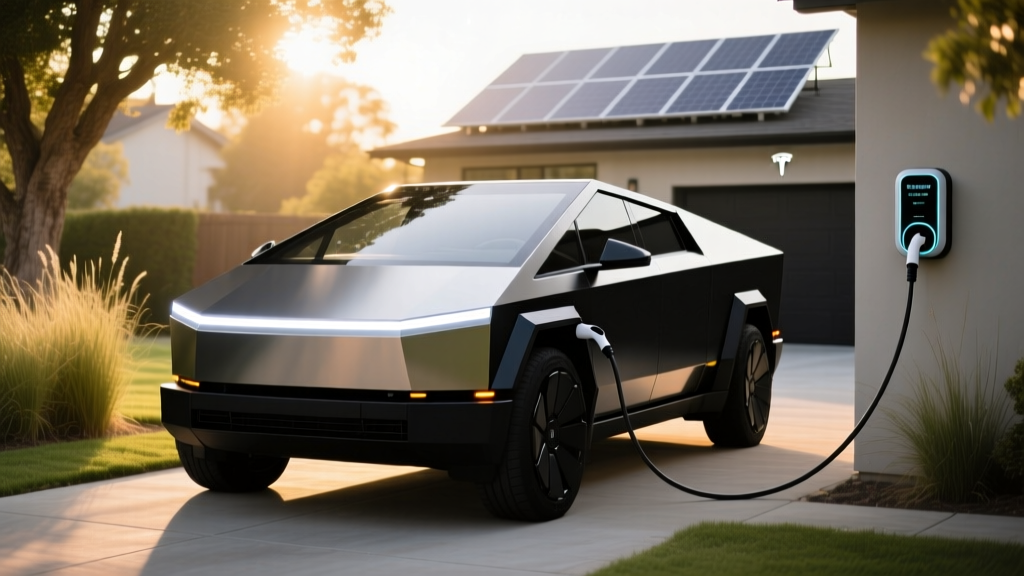
At home on a Level 2 Wall Connector (up to 48 amps / 11.5 kW), the Cybertruck adds roughly 18–20 miles of range per hour. A full overnight charge from 20% to 100% takes approximately 9–10 hours — feasible for daily use if you plug in every evening. Note that the 48-volt electrical architecture, while innovative for reducing wiring harness weight and enabling higher-power accessories, means aftermarket electrical modifications require specialized knowledge.
Charging-curve reality check: The advertised 250 kW peak is not sustained across the full session. Tesla's charge curve is aggressive in the low-SoC range but conservative above 80% to protect the NMC cells. If you're road-tripping and need to charge past 80%, budget extra time — the 80–100% top-off can add 25–35 minutes on its own. For battery longevity, Tesla recommends daily charging to 80% and only charging to 100% when you need the full range for a trip.
Performance & Drivetrain
| Specification | Long Range AWD | Cyberbeast |
|---|---|---|
| Drivetrain | Dual-Motor AWD | Tri-Motor AWD (with torque vectoring) |
| Horsepower | ~600 hp | ~845 hp |
| 0–60 mph | ~4.1 seconds | ~2.6 seconds |
| Top Speed | 112 mph | 130 mph |
| Max Towing Capacity | 11,000 lbs | 11,000 lbs |
| Payload Capacity | ~2,500 lbs | ~2,500 lbs |
The Long Range AWD's dual-motor setup produces approximately 600 horsepower and launches to 60 mph in about 4.1 seconds — quick for any vehicle, remarkable for a 6,600-lb stainless-steel pickup. The Cyberbeast's tri-motor configuration with torque vectoring on the rear axle elevates this to roughly 845 hp and a 2.6-second 0–60 time, making it one of the quickest production vehicles ever sold, regardless of powertrain.
Beyond straight-line speed, the Cybertruck's steer-by-wire system and rear-wheel steering give it a surprisingly tight 34-foot turning circle — comparable to a midsize sedan and significantly better than any full-size conventional pickup. The adaptive air suspension provides up to 16 inches of ground clearance in Off-Road mode and can lower the bed for easier loading. Ride quality is firm but well-controlled; the stainless-steel body panels are bolted to a unibody structure rather than a traditional body-on-frame, giving it car-like handling dynamics that catch most first-time drivers off guard.
For towing, the 11,000-lb rating is legitimate and competitive with the F-150 Lightning (10,000 lbs) and above the Rivian R1T quad-motor (11,000 lbs). However, as noted in the range section, towing at capacity will cut range roughly in half. The integrated trailer brake controller and Tesla's towing software suite are well-executed, and the rear camera view with trailer-angle overlay is genuinely useful.
Interior, Cargo & Technology
The Cybertruck's interior is minimalist even by Tesla standards. A single 18.5-inch touchscreen dominates the dashboard, handling infotainment, climate, vehicle settings, and the camera-based "digital rearview mirror." A secondary 9.4-inch touchscreen serves rear-seat passengers. The yoke-style steering wheel (standard on current trims) takes adjustment — some drivers adapt within a week, others never do. A conventional round wheel option has been discussed but availability varies by order configuration.
Passenger space: The front row offers generous headroom and legroom (approximately 41.5 inches of front legroom), while the rear seat fits adults comfortably with about 38 inches of rear legroom — competitive with crew-cab pickups. The rear bench folds flat for in-cabin cargo when needed.
The vault (bed): The 6-foot bed (6.5 feet with the tailgate down) provides roughly 67 cubic feet of lockable storage under the motorized tonneau cover. The composite bed floor is durable and includes integrated LED lighting, 120V and 240V power outlets (up to 9.6 kW of vehicle-to-load output), and tie-down points. The powered frunk (front trunk) adds approximately 7 cubic feet of sealed storage.
Driver assistance: The Cybertruck ships with Tesla's Enhanced Autopilot, which includes adaptive cruise control, lane-centering, and automatic lane changes. Full Self-Driving (Supervised) is available as a $8,000 add-on or $99/month subscription. It is critical to understand that both systems are SAE Level 2 — the driver must remain fully attentive with hands on the yoke at all times. This is not autonomous driving. Tesla's camera-only vision stack (no lidar, no radar on current production) performs well in clear conditions but can struggle in heavy rain, construction zones, and faded lane markings.
Tesla Autopilot and FSD (Supervised) are SAE Level 2 driver-assist systems. They do not make the Cybertruck self-driving. You are legally and operationally responsible for the vehicle at all times. Keep your eyes on the road and hands on the steering yoke. System disengagements in construction zones, adverse weather, and unmapped roads are common.
Pricing, Trims & Federal Tax Credit
| Trim | Base MSRP | Est. After §30D Credit* | Key Features |
|---|---|---|---|
| Long Range AWD | $79,990 | $72,490 | 340-mi range, dual-motor, tow pkg included |
| Cyberbeast | $99,990 | $92,490 | 320-mi range, tri-motor, 845 hp, armor glass |
*Tax credit estimates assume eligibility. See §30D rules below.
After the limited-run Foundation Series ended, Tesla restructured the Cybertruck lineup around two primary trims. The Long Range AWD at $79,990 is the volume play, while the Cyberbeast at $99,990 targets buyers who want maximum performance. Both prices exclude destination fees and optional add-ons like FSD, wrap films, or all-terrain tires.
Federal Tax Credit Eligibility (§30D)
The Cybertruck's eligibility for the $7,500 federal EV tax credit under IRS §30D depends on several conditions that change periodically:
- MSRP Cap: The Cybertruck qualifies as a pickup truck, which carries an $80,000 MSRP cap under §30D. The Long Range AWD at $79,990 clears this threshold. The Cyberbeast at $99,990 exceeds the cap and does not qualify for the new-vehicle credit.
- Buyer Income Cap: Modified adjusted gross income must not exceed $150,000 (single), $225,000 (head of household), or $300,000 (joint filing).
- Battery Sourcing: The credit splits into two $3,750 halves — one for critical-minerals sourcing and one for battery-component manufacturing. Sourcing requirements tighten annually. Verify current-year compliance on fueleconomy.gov before purchasing.
- Point-of-Sale Transfer: Eligible buyers can transfer the credit to the dealer at purchase, reducing the out-of-pocket price immediately rather than waiting for a tax return.
- Final Assembly: The Cybertruck is assembled at Giga Texas, satisfying the North American final-assembly requirement.
Bottom line: The Long Range AWD can qualify for the full $7,500 credit if you meet income and sourcing requirements, bringing its effective price to approximately $72,490. The Cyberbeast does not qualify for the new-vehicle credit due to its MSRP. Consult a tax professional and verify on irs.gov before finalizing your order.
Ownership Costs & Warranty
| Category | Details |
|---|---|
| Basic Vehicle Warranty | 4 years / 50,000 miles |
| Battery & Drive Unit Warranty | 8 years / 120,000 miles (minimum 70% retention) |
| Estimated 5-Year Electricity Cost (15k mi/yr) | ~$5,200–$6,800 (varies by utility rate) |
| Estimated 5-Year Insurance | ~$14,000–$19,000 (high due to repair costs) |
| Estimated 5-Year Maintenance | ~$1,200–$1,800 (no oil changes; tire rotation, cabin filter, wiper fluid) |
Tesla's battery warranty guarantees at least 70% capacity retention over 8 years or 120,000 miles, whichever comes first. NMC chemistry in a pack this large should deliver well over 200,000 miles before significant degradation — industry data from Tesla's fleet suggests roughly 10–12% degradation at 150,000 miles under normal use. However, the Cybertruck's heavy curb weight means tire wear is accelerated; budget for tire replacement every 25,000–35,000 miles, and expect premium all-terrain or EV-optimized tires to run $350–$500 each.
Insurance is a genuine pain point. The Cybertruck's stainless-steel panels, steer-by-wire system, and specialized structural components make collision repairs expensive and slow. Multiple insurance carriers quote premiums 40–70% above comparably priced pickups. Get quotes before ordering — this cost alone can add $1,000–$2,000 annually versus an F-150 Lightning.
Electricity costs depend heavily on your local utility rate and home-charging setup. At a national average of $0.16/kWh and the Cybertruck's ~2.0–2.3 kWh/mile real-world consumption, home charging costs roughly $0.32–$0.37 per mile. DC fast charging at public rates ($0.35–$0.55/kWh) pushes that to $0.70–$1.25 per mile. If most of your charging is at home, annual fuel costs run about $1,000–$1,400 for 15,000 miles of driving — roughly one-third the cost of gasoline in a comparable full-size truck.
Competitor Comparison: Cybertruck vs. F-150 Lightning vs. Rivian R1T
| Spec | Tesla Cybertruck LR AWD | Ford F-150 Lightning Ext. Range | Rivian R1T Dual-Motor Max |
|---|---|---|---|
| EPA Range | 340 mi | 320 mi | 410 mi |
| Battery (usable, est.) | ~123 kWh (NMC) | ~131 kWh (NMC) | ~141 kWh (NMC) |
| Max DC Fast Charge | ~250 kW | ~150 kW | ~220 kW |
| 10–80% DC Charge | ~30–35 min | ~41 min | ~30 min |
| 0–60 mph | 4.1 sec | ~4.5 sec | ~3.5 sec |
| Max Towing | 11,000 lbs | 10,000 lbs | 11,000 lbs |
| Base MSRP | $79,990 | $76,995 | $87,600 |
| §30D Credit Eligible | Yes (LR AWD) | Yes (select trims) | Yes (select trims) |
Choose the Cybertruck if: You value maximum DC fast-charging speed on the Supercharger network, want steer-by-wire maneuverability, need 240V bed outlets for job-site power, and don't mind being a polarizing early adopter.
Choose the F-150 Lightning if: You want a conventional truck experience, need Pro Power Onboard for job-site use, prefer a proven dealer service network, and want the lowest starting MSRP in the segment.
Choose the Rivian R1T if: Maximum range is your priority, you want best-in-class adventure features (gear tunnel, camp kitchen), and you value Rivian's purpose-built EV platform and over-the-air update cadence.
Pros, Cons & Who Should Buy
- Class-leading DC fast-charge speed (~250 kW) on the most reliable US network
- Rear-wheel steering yields a sedan-like turning radius
- 240V bed outlets with up to 9.6 kW V2L output for job-site and camping use
- Lockable vault bed with powered tonneau — secure, weatherproof storage
- Tri-motor Cyberbeast delivers supercar-level acceleration in a pickup
- 11,000-lb towing capacity competitive with full-size ICE trucks
- Real-world highway range ~15–20% below EPA; severe loss when towing
- Insurance premiums 40–70% above comparable pickups
- Cyberbeast trim exceeds $80,000 MSRP cap — no federal tax credit
- Yoke steering and camera-only mirrors require significant adaptation
- Limited service center capacity; body-panel repairs are slow and costly
- Rear-seat headroom is tight for passengers over 6'2"
Who the Cybertruck Suits Best
Tech-forward commuters who charge at home and want a daily driver that stands apart will find the Long Range AWD compelling, especially after the §30D credit. Job-site professionals who need 240V power output and secure, lockable bed storage will appreciate the vault and V2L capability. Performance enthusiasts who want the quickest truck ever made will gravitate to the Cyberbeast, tax credit be damned.
Who should look elsewhere: If you tow frequently over long distances, if you need affordable insurance, if you prefer a conventional truck layout with a proven dealer service network, or if your budget is firm below $70,000 — the F-150 Lightning or a PHEV like the Ford Maverick Hybrid may serve you better.
Frequently Asked Questions
What is the real-world range of the 2025 Tesla Cybertruck?
The EPA rates the Long Range AWD at 340 miles and the Cyberbeast at 320 miles. In real-world highway driving at 70–75 mph, expect approximately 270–295 miles. Cold weather (below freezing) can reduce this to 220–250 miles, and towing a heavy trailer can cut range to 140–170 miles.
How fast does the Cybertruck charge at home and on the road?
On a DC fast charger (250 kW V4 Supercharger), the Cybertruck charges from 10–80% in approximately 30–35 minutes. At home on a Level 2 Wall Connector (11.5 kW / 48A), it adds roughly 18–20 miles of range per hour, or a full overnight charge in about 9–10 hours.
Does the 2025 Cybertruck qualify for the $7,500 federal tax credit?
The Long Range AWD at $79,990 MSRP qualifies under the §30D pickup-truck cap of $80,000, assuming you meet income limits ($150K single / $300K joint) and the battery meets current-year critical-minerals and component-sourcing requirements. The Cyberbeast at $99,990 exceeds the MSRP cap and does not qualify. Always verify on irs.gov and fueleconomy.gov before purchasing.
Is the Cybertruck worth buying over the F-150 Lightning or Rivian R1T?
It depends on your priorities. The Cybertruck wins on DC fast-charging speed and Supercharger network access, rear-wheel steering maneuverability, and bed power output. The F-150 Lightning wins on conventional truck familiarity, dealer service access, and lower starting price. The Rivian R1T wins on maximum EPA range (410 mi) and adventure-oriented design. Test-drive all three before committing.
How long will the Cybertruck's battery last?
Tesla warranties the battery for 8 years or 120,000 miles with a minimum 70% capacity retention guarantee. Based on fleet data from Tesla's NMC packs, expect approximately 10–12% degradation at 150,000 miles under normal charging habits. The pack should deliver well over 200,000 miles of usable service life.
Can the Cybertruck power my home or job site?
Yes. The Cybertruck offers up to 9.6 kW of vehicle-to-load (V2L) output through 120V and 240V outlets in the bed. This is sufficient to power most job-site tools, run a camper's appliances, or provide emergency backup power to essential home circuits. Note: full vehicle-to-home (V2H) bidirectional integration requires Tesla's forthcoming Powerwall-compatible hardware, which was not yet widely available as of early 2025.
Sources: EPA fuel economy data via fueleconomy.gov; Tesla Cybertruck specifications via tesla.com/cybertruck; IRS clean vehicle tax credit rules via irs.gov.