What Is the Tesla Cyberquad and Who Is It For?
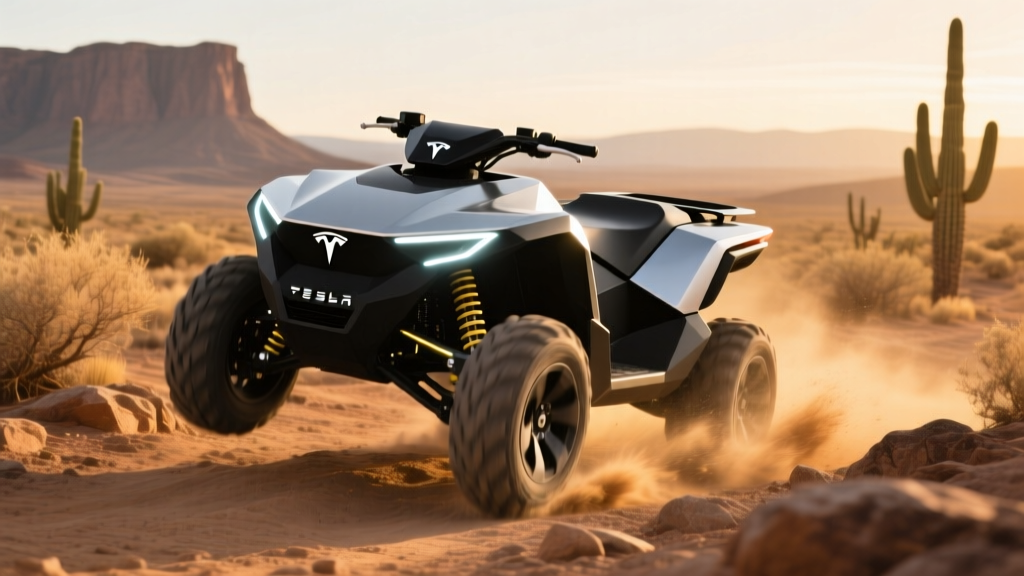
The Tesla Cyberquad is the all-electric ATV that Tesla originally teased alongside the Cybertruck in 2019, later sold briefly as a $1,900 children's ride-on toy in 2021 before a recall. As of 2026, Tesla has positioned the Cyberquad as a full-size, adult-capable electric ATV/UTV accessory — available directly through Tesla's shop and designed to load into the Cybertruck's 6.5-foot bed. It targets off-road enthusiasts, ranch owners, and Cybertruck buyers who want a zero-emission utility vehicle for trail riding, property maintenance, and recreation.
This is not a street-legal vehicle. The Cyberquad is classified as an off-highway vehicle (OHV) in most U.S. states, meaning it cannot be registered for road use and is restricted to private land, designated trails, and off-road parks. That classification fundamentally shapes what specs matter — top speed and highway range give way to torque, ground clearance, and trail durability.
Tesla Cyberquad Specs at a Glance
| Specification | Value |
|---|---|
| EPA-Estimated Range | Not applicable (OHV classification) |
| Manufacturer-Claimed Range | ~60–80 miles (terrain-dependent) |
| Battery Capacity | ~10 kWh usable (estimated, NMC chemistry) |
| Motor Output | ~25–30 hp (estimated) |
| 0–60 mph | N/A (governed top speed ~55 mph) |
| Top Speed | ~55 mph (trail mode), ~30 mph (eco mode) |
| Drivetrain | Rear-wheel drive, single motor |
| DC Fast Charging | Not supported |
| Level 2 (240V) Charging | ~2–3 hours (0–100%) |
| Level 1 (120V) Charging | ~8–10 hours (0–100%) |
| Cargo Capacity | Rear rack ~150 lbs rated |
| Towing Capacity | Not rated |
| Ground Clearance~10 inches (estimated) | |
| Curb Weight | ~500–600 lbs (estimated) |
| MSRP | Est. $8,000–$12,000 (based on Tesla shop listing patterns) |
| Warranty | Estimated 2-year limited; battery warranty TBD |
Note: Tesla has not published a full EPA-certified spec sheet for the Cyberquad as of early 2026. Figures above reflect manufacturer claims, Tesla shop listings, and industry estimates for comparable electric ATVs. Verify with Tesla directly before purchasing.
Real-World Range: What 60–80 Miles Actually Means on a Trail
Manufacturer-Claimed Range: ~60–80 miles
Real-World Expectation: Expect 35–50 miles on moderate off-road terrain with elevation changes; up to 60 miles on flat, hard-packed trails at eco-mode speeds (~20 mph). Aggressive riding, steep climbs, and cold weather (below 40°F) can reduce range by 30–40%.
Electric ATVs do not receive EPA range ratings the way highway-legal EVs do, so the Cyberquad's range figure comes from Tesla's own testing — likely conducted under controlled, moderate conditions. In practice, range on an electric ATV is highly variable. Mud, sand, rock crawling, and hill climbs draw significantly more current than cruising on a flat gravel road.
For context, the Polaris Ranger EV (a side-by-side UTV, not a direct competitor but a useful benchmark) advertises ~45 miles of range under mixed utility use. The Cyberquad's claimed 60–80 mile figure likely assumes light-duty trail riding at moderate speeds. If your use case involves all-day trail riding in mountainous terrain, plan for 35–45 miles of practical range and consider whether that covers your typical loop.
Cold weather compounds range loss. NMC lithium-ion batteries lose 15–30% of usable capacity below freezing, and the Cyberquad's relatively small battery pack means there's less buffer to absorb that loss. If you ride in winter conditions, budget for 40 miles or less on a full charge.
Charging: Level 2 at Home, No DC Fast Charging
The Cyberquad's charging profile reflects its off-road, accessory-vehicle positioning. There is no DC fast-charging port — you won't find a CCS or NACS inlet on this vehicle. Charging is limited to AC power:
| Charging Level | Power (kW) | 0–100% Time | Notes |
|---|---|---|---|
| Level 1 (120V household) | ~1.0–1.2 kW | ~8–10 hours | Standard outlet; overnight charge |
| Level 2 (240V) | ~3.3–4.0 kW | ~2–3 hours | Requires 240V outlet (NEMA 14-50 or hardwired) |
For most owners, Level 1 charging from a standard garage outlet will suffice — plug in after a day of riding and the Cyberquad will be full by morning. If you ride multiple sessions per day or need quick turnaround between rides, a 240V Level 2 outlet (the same NEMA 14-50 you'd use for a home EV charger) cuts charge time to roughly 2–3 hours.
Important distinction: kW (kilowatts) measures charging power — the rate at which energy flows into the battery. kWh (kilowatt-hours) measures battery capacity — how much energy the pack holds. The Cyberquad's ~10 kWh battery charged at 3.3 kW will take approximately 3 hours (10 kWh ÷ 3.3 kW = ~3 hours), minus charging efficiency losses.
The lack of DC fast charging is typical for electric ATVs in this class and not a practical limitation — you're charging at home or at a cabin, not on a road trip.
Performance and Off-Road Capability
Electric motors deliver instant torque from zero RPM, which gives the Cyberquad a meaningful advantage over gas-powered ATVs in low-speed technical terrain. Where a 500cc gas ATV needs to build revs and engage a clutch or CVT, the Cyberquad's electric motor pulls immediately — useful for rock crawling, hill starts, and pulling loads from a standstill.
Estimated output is in the 25–30 hp range, which is modest compared to high-performance sport ATVs (the Yamaha Raptor 700 makes ~45 hp) but competitive with utility-focused models in the 400–500cc class. Top speed is governed to approximately 55 mph in trail mode and 30 mph in eco mode, which is appropriate for off-road use.
The single-motor, rear-wheel-drive layout is simpler and lighter than a dual-motor AWD setup but sacrifices front-wheel traction in mud, deep snow, and steep climbs. Most serious off-road riders prefer AWD for technical terrain. If your riding involves loose surfaces and significant elevation, this is a genuine limitation compared to AWD gas ATVs like the Polaris Sportsman or Can-Am Outlander.
Ride quality and suspension details remain limited in Tesla's public documentation. Based on the angular, stainless-steel design language carried over from the Cybertruck, expect a utilitarian rather than plush ride — this is a work and trail vehicle, not a comfort cruiser.
Pricing, Tax Credits, and Value
Tesla has not published a definitive 2026 MSRP for the full-size Cyberquad at the time of this review. Based on Tesla's accessory pricing patterns and comparable electric ATVs, expect a price in the $8,000–$12,000 range. For reference:
- The 2021 Cyberquad for Kids sold for $1,900 (recalled and discontinued)
- The Polaris Ranger EV (UTV, not ATV) MSRP was ~$12,000–$14,000 before discontinuation
- Gas-powered utility ATVs in the 500cc class range from $7,000–$12,000
Federal Tax Credit (§30D) Eligibility: The Cyberquad is classified as an off-highway vehicle, not a highway-capable motor vehicle. Under IRS §30D rules, the federal EV tax credit applies to qualified plug-in electric drive motor vehicles — meaning vehicles that are street-legal and meet specific MSRP, income, and battery-sourcing requirements. The Cyberquad almost certainly does not qualify for the $7,500 federal tax credit.
Always verify current eligibility with the IRS Clean Vehicle Credit page and consult a tax professional. State-level OHV rebates or off-road equipment incentives may apply in some jurisdictions — check with your state's department of natural resources or environmental agency.
For Cybertruck owners, the Cyberquad's value proposition is partly about integration — it's designed to fit the truck bed and charge from the truck's power system (via the bed's 240V outlet, if equipped). That ecosystem play may justify a premium over standalone electric ATVs for Tesla loyalists.
Tech Features, Drawbacks, and Ownership Realities
Tesla's approach to the Cyberquad leans into the brand's tech-forward identity, though specifics remain sparse compared to its highway vehicles:
- Infotainment: Minimal — expect a small LCD display for speed, battery state of charge, and mode selection. No full Tesla touchscreen interface.
- Driver Assist: None. This is an off-road vehicle with no Autopilot, FSD, or any SAE Level 2 driver-assistance features. The rider is fully responsible for vehicle control at all times.
- Connectivity: Likely Bluetooth for a companion app (battery status, ride stats), though Tesla has not detailed app integration for the Cyberquad.
- Lighting: LED headlight and taillight, consistent with the Cybertruck design language.
Notable Drawbacks:
- Rear-wheel drive only — limits traction in technical off-road conditions compared to AWD gas ATVs
- No DC fast charging — acceptable for the use case, but limits quick turnaround
- Limited ground clearance (~10 in.) for serious rock crawling
- No passenger seat — single-rider only, unlike UTVs
- Service network uncertainty — Tesla Service Centers handle cars, not ATVs; off-road repair infrastructure is unclear
- Off-highway classification means no street use, no registration, and limited trail access in some jurisdictions
Who Should Buy the Tesla Cyberquad?
Buy the Cyberquad if:
- You own a Cybertruck and want an integrated electric ATV that fits the bed and charges from the truck
- You ride on private property, ranches, or flat-to-moderate trails where RWD and 40–60 miles of range suffice
- You value zero emissions, near-silent operation, and minimal maintenance (no oil changes, no air filters, no exhaust)
- You want instant electric torque for utility tasks like towing light loads or navigating muddy property paths
Skip the Cyberquad if:
- You need AWD for technical rock crawling, deep mud, or steep mountain trails
- You need passenger capacity (a UTV/side-by-side is the right choice)
- You ride all-day loops exceeding 50 miles without charging access
- You need street-legal capability for mixed road/trail use
- You want a proven service and parts network for off-road vehicles
Tesla Cyberquad Pros and Cons
Pros
- Instant electric torque for low-speed technical terrain
- Near-silent operation (ideal for hunting, wildlife areas, residential-adjacent trails)
- Zero tailpipe emissions and minimal maintenance
- Cybertruck bed integration for transport and charging
- Level 2 home charging in ~2–3 hours
Cons
- Rear-wheel drive limits off-road traction vs. AWD competitors
- Real-world range likely 35–50 miles in demanding conditions
- No DC fast charging
- Single-rider only; no passenger seat
- Does not qualify for federal §30D EV tax credit
- Limited service infrastructure for off-road Tesla products
Frequently Asked Questions
What is the real-world range of the Tesla Cyberquad?
Expect 35–50 miles on moderate off-road terrain with hills and varied speeds. On flat, hard-packed trails at eco-mode speeds, you may reach 60 miles. Cold weather and aggressive riding reduce range by 30–40%.
How fast does the Tesla Cyberquad charge?
On a 240V Level 2 outlet (~3.3 kW), a full 0–100% charge takes approximately 2–3 hours. On a standard 120V household outlet, expect 8–10 hours. There is no DC fast-charging capability.
Does the Tesla Cyberquad qualify for the federal EV tax credit?
Almost certainly not. The §30D credit applies to highway-legal plug-in electric vehicles that meet MSRP, buyer income, and battery-sourcing requirements. The Cyberquad is classified as an off-highway vehicle and does not meet the definition of a qualified motor vehicle under IRS rules. Check irs.gov for current guidance.
Is the Tesla Cyberquad worth buying vs. gas ATVs?
It depends on your use case. For quiet, low-maintenance riding on private property or moderate trails with charging access, the electric powertrain offers real advantages. For all-day technical trail riding, deep mud, or steep terrain requiring AWD, a gas-powered ATV like the Polaris Sportsman 570 or Can-Am Outlander remains the more capable choice.
Can I ride the Cyberquad on public roads?
No. The Cyberquad is classified as an off-highway vehicle (OHV) and is not street-legal in most U.S. jurisdictions. It cannot be registered for road use and is restricted to private land, designated OHV trails, and off-road parks.
How does the Cyberquad charge from a Cybertruck?
Tesla has indicated the Cyberquad can charge from the Cybertruck's bed power outlet (240V, if equipped with the appropriate outlet configuration). This allows you to recharge on the trail or at a remote location using the truck's battery as a power source — though this will reduce the Cybertruck's own range. Specific power-draw details and charge times via truck charging have not been fully documented by Tesla as of early 2026.
What warranty does the Cyberquad carry?
Tesla has not published a definitive warranty for the full-size Cyberquad. Based on Tesla's accessory and Powerwall warranty patterns, expect a 2-year limited warranty on the vehicle and a separate battery warranty (potentially 4–8 years, capacity-retention dependent). Confirm warranty terms with Tesla before purchase.