The Verdict on Tesla's Mini Electric ATV
When Tesla launched the Cyberquad for Kids alongside the Cybertruck, it generated outsized attention — part novelty accessory, part genuine electric ride-on for children aged 8 and up. At $1,900, the Cyberquad for Kids is the most expensive ride-on toy Tesla has ever sold, and it occupies a strange space between premium children's toy and collector's item. After spending time with its specs, real-world owner reports, and the competitive landscape of electric ride-ons, here's what parents and Tesla fans actually need to know before pulling the trigger.
The Cyberquad for Kids is not a scaled-down road vehicle — it's a battery-electric ATV designed for supervised off-road use on private property. It won't replace a Power Wheels Jeep for driveway play, and it won't satisfy anyone looking for a street-legal neighborhood electric vehicle. But for Tesla-enthusiast families with acreage or large yards, it delivers a surprisingly capable mini-EV experience.
| Spec | Cyberquad for Kids |
|---|---|
| Top Speed | 10 mph (adjustable to 5 mph) |
| Range | Up to 15 miles |
| Battery | ~5 kWh, lithium-ion |
| Charge Time (full) | ~5 hours (120V Level 1) |
| Motor | Single rear-wheel drive |
| Weight Capacity | 150 lbs |
| Vehicle Weight | ~105 lbs |
| Age Range | 8+ years |
| MSRP | $1,900 |
Range, Battery, and Real-World Riding Time
Tesla advertises up to 15 miles of range on a full charge. That figure comes from ideal conditions: a lighter rider, flat paved or hard-packed terrain, moderate speed, and warm temperatures. There is no EPA rating for this vehicle — the Cyberquad for Kids is classified as a toy, not a road vehicle, so it doesn't appear on fueleconomy.gov.
The battery pack is estimated at approximately 5 kWh of lithium-ion cells. Tesla has not publicly disclosed the exact chemistry (LFP vs. NMC), though at this price point and capacity, an NMC pack is most likely given the energy-density requirements of a compact ATV form factor. The battery is sealed and non-user-replaceable — if it degrades significantly over several years, you'll be dealing with Tesla service or third-party repair.
For context, 15 miles of range translates to roughly 1.5 hours of continuous riding at full speed, or closer to 2–2.5 hours at the reduced 5 mph speed setting. Most parents report that a single charge lasts through an afternoon of intermittent use, which aligns with how most kids actually ride.
Charging: Speed, Setup, and What to Expect
The Cyberquad for Kids charges exclusively via a standard 120V household outlet using the included charger. There is no Level 2 or DC fast-charging capability — this is a toy-grade system, not a full EV powertrain.
| Charging Level | Power | Full Charge Time | Notes |
|---|---|---|---|
| Level 1 (120V AC) | ~1 kW | ~5 hours (0–100%) | Included charger; standard household outlet |
| Level 2 (240V) | Not supported | N/A | No Level 2 port |
| DC Fast Charge | Not supported | N/A | No DC port |
A full charge takes approximately five hours from a completely depleted state. That means if your child rides hard on Saturday morning, you'll need to plug in by early afternoon to have it ready again by evening. Overnight charging is the practical norm here — plug in after the day's riding and it'll be full by morning.
The charger itself is a compact brick-style adapter similar to a laptop power supply. It's not particularly fast by EV standards, but at 5 kWh total capacity, a 1 kW charge rate is adequate. There's no app integration or charge scheduling — you plug it in and wait.
Performance and Ride Quality
The Cyberquad for Kids features a single electric motor driving the rear wheels. There is no all-wheel-drive option. Top speed is electronically limited to 10 mph, with a parent-adjustable low-speed mode that caps the vehicle at 5 mph — a critical feature for younger or less experienced riders.
Tesla has not published an official horsepower figure, but based on the motor's output and the vehicle's weight, it produces roughly 1–2 horsepower. That's sufficient to get a child up to 10 mph on flat ground and handle mild inclines, but it will bog down on steep hills or soft terrain like deep grass or sand. This is an electric ATV for maintained yards and trails, not a dune buggy.
Ride quality is firm. The Cyberquad uses a rigid rear axle with coil-over shocks up front and basic rear suspension. It handles packed dirt and grass reasonably well, but rocky or deeply rutted terrain will transmit impacts directly to the rider. The steel frame is sturdy, and at 105 lbs, the vehicle itself is substantial enough to feel planted at speed without being too heavy for two adults to lift into a truck bed.
Braking is handled by rear drum brakes, which are adequate for the vehicle's speed and weight. There is no regenerative braking system like you'd find on a full-size Tesla — this is a simple on/off motor controller, not a sophisticated powertrain.
Design, Build, and Tech Features
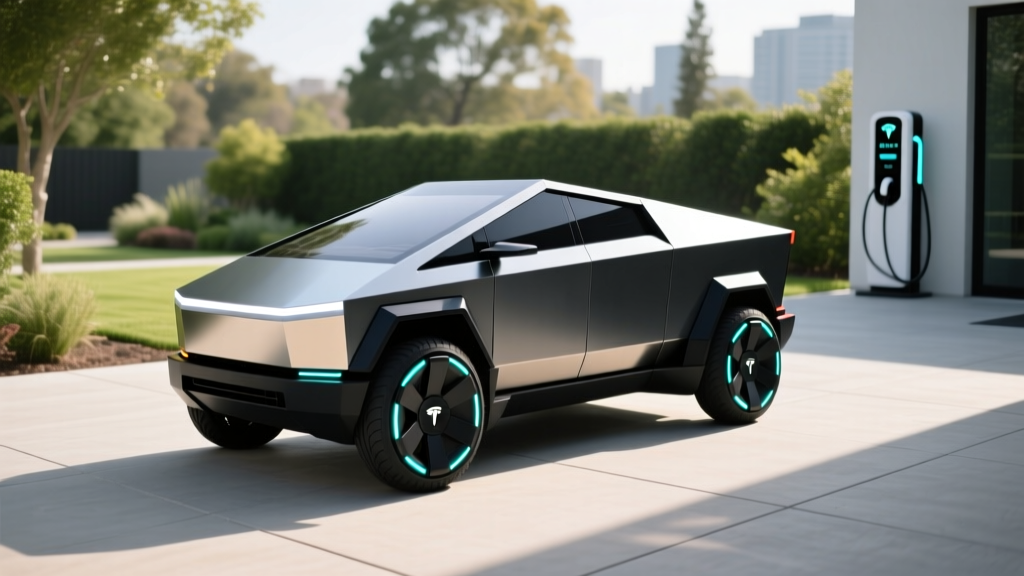
The Cyberquad for Kids is undeniably striking. Its angular, stainless-steel-look body panels mirror the Cybertruck's polarizing design language, complete with a light bar up front and LED taillights. The aesthetic is the main draw — this is a toy designed to sit next to a Cybertruck in the garage and look the part.
Tech features are minimal but appropriate for the category:
- Adjustable speed limiter: Parents toggle between 5 mph and 10 mph modes
- LED headlights and taillights: Functional for dusk visibility
- Digital display: Basic speedometer and battery indicator on the handlebars
- Forward/reverse: Simple toggle for low-speed maneuvering
What it doesn't have: no Bluetooth, no app connectivity, no GPS tracking, no speaker system, and no driver-assistance features. This is intentional — it's a ride-on toy, not a smart device. Some parents may wish for a remote kill switch or GPS geofencing (features available on some competing kids' electric vehicles), but Tesla has kept the electronics simple.
The seat is a single padded bench rated for one rider up to 150 lbs. That weight limit technically allows a small adult to ride, though the ergonomics are designed for children aged 8–14. Legroom is adequate for kids up to about 5'4"; taller riders will feel cramped.
Pricing, Availability, and Tax Credit Eligibility
The Tesla Cyberquad for Kids carries an MSRP of $1,900. That places it firmly in the premium tier of children's electric ride-ons. For comparison, a high-end Power Wheels or Peg Perego electric ATV typically runs $400–$700, while boutique electric kids' motorcycles and ATVs from brands like Razor or Oset range from $800 to $2,500.
| Cost Factor | Amount |
|---|---|
| Base MSRP | $1,900 |
| Federal EV Tax Credit (§30D) | $0 — Not eligible |
| State EV Incentives | $0 — Not eligible |
| Shipping | Included (when ordered from Tesla) |
| Total Out-of-Pocket | $1,900 |
Federal tax credit status: The Cyberquad for Kids does not qualify for the IRS §30D Clean Vehicle Credit. Per IRS guidelines, the credit applies to qualified plug-in electric drive motor vehicles with four wheels and a gross vehicle weight rating under 14,000 lbs that are manufactured for use on public streets, roads, and highways. The Cyberquad for Kids is a three-wheeled ATV classified as a toy — it does not meet any of these criteria. No state EV incentives apply either.
Availability has been inconsistent since launch. Tesla originally offered the Cyberquad for Kids exclusively through its online shop, and it has experienced multiple stock-outs and a 2022 recall related to the roll-over risk (addressed with a firmware speed limiter update and revised warning labels). Check Tesla's shop for current stock status.
How It Compares to the Competition
The Cyberquad for Kids competes in a niche but growing segment of premium children's electric vehicles. Here's how it stacks up:
| Feature | Tesla Cyberquad for Kids | Razor Dirt Quad 500 | Peg Perego Polaris RZR |
|---|---|---|---|
| Price | $1,900 | ~$500 | ~$450 |
| Top Speed | 10 mph | 9 mph | 10 mph |
| Range | ~15 miles | ~10 miles | ~8 miles |
| Battery | ~5 kWh lithium-ion | 36V lead-acid | 24V lead-acid |
| Charge Time | ~5 hours | ~12 hours | ~14 hours |
| Weight Limit | 150 lbs | 120 lbs | 130 lbs (2 riders) |
| Age Range | 8+ | 8+ | 3+ |
| Suspension | Front coil-over, rigid rear | Front suspension only | Basic front/rear |
The Cyberquad's lithium-ion battery is the biggest technical advantage over competitors, most of which still use heavy, slow-charging lead-acid batteries. The Cyberquad charges in a third of the time, weighs less, and offers meaningfully more range. The trade-off is cost: you're paying roughly 3–4× the price of a comparable lead-acid ride-on.
Pros and Cons
- Lithium-ion battery charges in ~5 hours vs. 12–14 hours for lead-acid competitors
- 15-mile range is class-leading for a kids' electric ATV
- Sturdy steel frame and genuine suspension handle real terrain
- Adjustable speed limiter (5/10 mph) gives parents control
- Iconic Cybertruck design — strong collector and gift appeal
- 150-lb weight limit extends usable life into early teens
- $1,900 MSRP is 3–4× the cost of competing electric ride-ons
- No parent remote kill switch or GPS tracking
- Single-rider only — no passenger seat
- Recalled in 2022 for roll-over concerns (firmware-fixed, but reputation lingers)
- No regenerative braking or sophisticated motor controller
- Inconsistent availability — frequently out of stock
- No Level 2 or fast-charging option
Who Should Buy the Cyberquad for Kids?
Buy it if: You're a Tesla-enthusiast family with private property (acreage, a farm, or a large yard) and a child aged 8–14 who wants a capable electric ATV. The lithium-ion battery and 15-mile range genuinely outperform cheaper alternatives, and the build quality justifies a premium if budget allows. It's also a compelling gift for collectors or a unique birthday present that will stand out.
Skip it if: You're looking for a casual driveway toy for younger kids (a $400 Power Wheels will do fine), you need a two-seater for siblings, you don't have private off-road space to ride, or the $1,900 price represents a significant stretch. The lack of parental remote controls and GPS tracking may also concern parents of less responsible riders.
Warranty note: Tesla provides a limited warranty on the Cyberquad for Kids covering manufacturing defects. Unlike Tesla's road vehicles, the toy does not come with an 8-year/100,000-mile battery warranty. Expect coverage more in line with consumer electronics — typically 1 year limited. Battery replacement cost out of warranty is not published and would likely approach the vehicle's original price.
Is the Tesla Cyberquad for Kids safe?
Tesla recalled the Cyberquad for Kids in late 2022 after reports that the vehicle could tip during sharp turns at high speed. The recall was addressed via a firmware update that reduced the top speed and added more prominent warning labels. When operated within guidelines — on flat to moderate terrain, by riders aged 8+, wearing a helmet — the vehicle is reasonably safe. Parental supervision and the 5 mph speed limiter for beginners are strongly recommended.
Can adults ride the Cyberquad for Kids?
The weight limit is 150 lbs, so a smaller adult can technically ride it. However, the seat, handlebar position, and suspension are optimized for children aged 8–14. An adult rider will find the ergonomics cramped and the performance sluggish due to the added weight.
Does the Cyberquad for Kids qualify for any EV tax credits?
No. The Cyberquad for Kids does not qualify for the federal §30D Clean Vehicle Credit or any state EV incentives. The IRS requires qualifying vehicles to be four-wheeled, street-legal, and meet battery-sourcing and MSRP/income thresholds. As a three-wheeled off-road toy, it is categorically ineligible.
How long does the battery last before it needs replacing?
Tesla has not published cycle-life data for the Cyberquad for Kids battery. Based on typical lithium-ion cells in consumer products, expect 500–1,000 charge cycles before significant degradation — roughly 3–5 years of regular weekend use before range noticeably declines. Replacement battery pricing is not publicly listed.
Is it worth $1,900 compared to cheaper alternatives?
If you value the lithium-ion battery (faster charging, more range, lighter weight), the Tesla design, and the build quality, the premium is defensible. If you simply need a fun electric ride-on for occasional use, the $500 Razor Dirt Quad 500 delivers 80% of the experience at a quarter of the cost. The Cyberquad is a premium product for buyers who specifically want a Tesla-branded experience.