What Is the Tesla Quad? Understanding the Cybercab Robotaxi
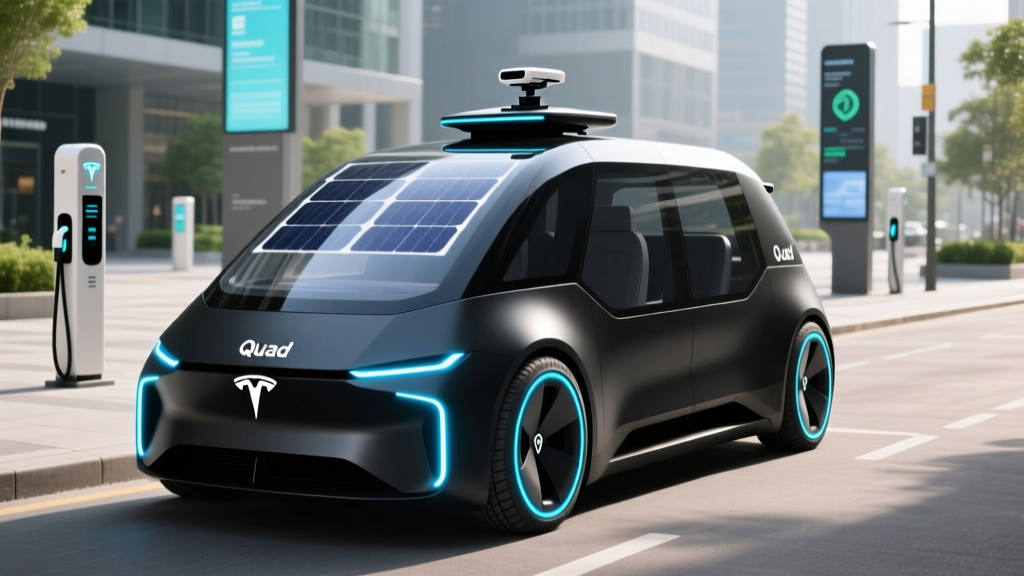
If you've been searching for the Tesla quad, you've likely encountered a tangle of rumors, concept renders, and Elon Musk's onstage promises. The term "quad" in Tesla circles most commonly refers to the Tesla Cybercab — the dedicated two-seat, steering-wheel-free robotaxi that Tesla unveiled in October 2024 and has positioned as the cornerstone of its autonomous ride-hailing ambitions. Some early speculation also applied "quad" to a rumored four-motor variant of the Cybertruck or a hypothetical quad-motor Roadster, but neither has reached production as of early 2026.
This review focuses on what actually exists: the Cybercab as a planned Level 4 autonomous vehicle, its confirmed and estimated specifications, and what the current regulatory and production landscape means for anyone hoping to ride in — or own — one.
The Cybercab is designed as an SAE Level 4 vehicle — meaning it operates without a human driver within a defined operational design domain (specific geofenced areas, weather conditions, and routes). This is fundamentally different from Tesla's current consumer vehicles, which run FSD (Supervised) at SAE Level 2 and require full driver attention at all times. Level 4 is the same class as Waymo's driverless service in Phoenix and San Francisco.
Range, Battery, and Efficiency: What We Know So Far
Tesla has not published a final EPA range certification for the Cybercab as of Q1 2026. Based on the prototype specifications and Tesla's statements at the 2024 unveiling event, the Cybercab is expected to use a battery pack in the 50–60 kWh usable capacity range, likely employing Tesla's latest-generation structural battery pack with 4680 cells. Chemistry has not been officially confirmed, but industry analysts and Tesla's cost-reduction targets point toward an LFP (lithium iron phosphate) cathode for the standard robotaxi configuration — prioritizing cycle life and low cost over maximum energy density.
Tesla has targeted approximately 250 miles of range for the Cybercab. For a robotaxi operating in a geofenced urban environment, this is more than sufficient — most urban ride-hail trips are under 15 miles, and the vehicle can return to a charging depot between shifts. Real-world caveat: In stop-and-go city driving with climate control running, expect effective range closer to 180–210 miles. Cold-weather operations in northern cities could reduce this further by 15–25%, though Tesla's heat pump system mitigates some of that loss. For a fleet vehicle that charges at a depot overnight and tops up mid-day, range is less of a consumer concern than it is for a personal EV.
| Spec | Estimated / Confirmed |
|---|---|
| Battery Capacity | ~50–60 kWh usable (4680 cells, LFP expected) |
| EPA Range (est.) | ~200–250 mi |
| Efficiency | ~130–150 MPGe (est.) / ~22–26 kWh/100mi |
| DC Fast Charge (peak) | ~150–250 kW (NACS) |
| 10–80% Charge Time | ~20–30 min (est.) |
| Drivetrain | Rear-wheel drive (single motor, est.) |
| 0–60 mph | Not a priority; est. ~6–7 sec |
| Seating | 2 passengers |
| Steering Wheel / Pedals | None (Level 4 design) |
| Target Price (if sold) | ~$25,000–$30,000 (Musk's stated goal) |
| Availability | Limited pilot (Austin, TX) — not available for consumer purchase |
Charging: Fleet Depot Strategy, Not Consumer Supercharging
The Cybercab's charging profile is fundamentally different from a consumer EV like the Model Y or Model 3. Tesla has described a fleet-oriented charging model where Cybercabs autonomously navigate to dedicated depot chargers between rides and during off-peak hours.
Based on Tesla's current 4680-cell architecture and the vehicle's smaller battery, we estimate a peak DC fast-charge rate of 150–250 kW via the NACS connector. With a ~55 kWh pack, a 250 kW peak rate (which tapers significantly above 60% SoC, as all lithium-ion batteries do) would yield a 10–80% charge in approximately 20–30 minutes. For fleet operations, Tesla is also expected to deploy wireless inductive charging pads at depots, allowing Cybercabs to charge without any physical plug-in — a necessity for a vehicle with no human driver to handle a cable.
As of 2026, the Cybercab is not available for consumer purchase. It is a fleet-only robotaxi. There is no home Level 2 charging scenario for this vehicle. If Tesla eventually offers a consumer variant with a steering wheel, charging specs may differ. This section describes the expected fleet charging infrastructure.
Autonomy and Technology: Tesla Vision vs. Waymo's Lidar Approach
The Cybercab represents Tesla's biggest bet on its Tesla Vision camera-only approach to autonomous driving. Unlike Waymo's robotaxis, which rely on a sensor suite combining lidar, radar, and cameras, the Cybercab uses only cameras and neural-network-based perception — the same hardware architecture Tesla has been refining in its consumer FSD (Supervised) system, but pushed to full Level 4 capability.
Key technology features expected in the Cybercab:
- AI5 inference chip — Tesla's next-generation custom silicon, offering significantly more compute than the HW4 chip in current Teslas
- 8+ camera array providing 360° vision with redundancy
- End-to-end neural network driving stack — no hand-coded rules, purely learned driving behavior from billions of miles of fleet data
- No steering wheel, no pedals — a radical design commitment to full autonomy with no fallback to human control
- Rider app interface — passengers summon, set destination, and control climate/media via a rear touchscreen or smartphone app
- Butterfly doors — the prototype featured gullwing-style doors for easier curb-side entry
The critical question is whether Tesla's vision-only approach can achieve the safety record that NHTSA and state regulators require for driverless operation. Waymo's lidar-equipped vehicles have completed over 30 million fully driverless miles with a strong safety record. Tesla's FSD, by contrast, remains Level 2 with the driver legally responsible — and Tesla has faced NHTSA recalls related to Autopilot and FSD behavior. The leap from supervised Level 2 to unsupervised Level 4 is not incremental; it requires demonstrating that the system can handle every edge case without human intervention.
Pricing, Availability, and the Tax Credit Question
Elon Musk stated at the October 2024 unveiling that the Cybercab would cost approximately $25,000–$30,000 if sold to consumers, with an operating cost of roughly $0.20 per mile — dramatically undercutting both Uber/Lyft and personal car ownership. However, several realities complicate this picture:
- Not available for purchase. Tesla has positioned the Cybercab as a fleet vehicle for its own robotaxi network. There is no consumer ordering page, no MSRP, and no delivery timeline for individual buyers.
- Production timeline uncertain. Musk initially targeted 2026 production; industry analysts consider 2027–2028 more realistic for meaningful fleet scale, given regulatory hurdles.
- Federal tax credit (§30D) does not apply to a vehicle you cannot buy. Even if a consumer version were offered, the IRS §30D clean vehicle credit requires the vehicle to be purchased for personal use, have an MSRP under $55,000 (sedans) or $80,000 (SUVs/trucks), and meet battery critical-mineral and component sourcing requirements. A robotaxi purchased for commercial fleet use would not qualify for the consumer credit, though separate commercial clean vehicle credits (§45W) might apply to fleet operators.
Cybercab vs. Waymo: How Tesla's Robotaxi Compares
| Attribute | Tesla Cybercab (Est.) | Waymo 6th-Gen (Jaguar I-PACE) |
|---|---|---|
| SAE Level | Level 4 (target) | Level 4 (operational) |
| Sensor Suite | Cameras only (Tesla Vision) | Lidar + radar + cameras |
| Status (2026) | Limited pilot / pre-production | Commercial service in PHX, SF, LA, Austin |
| Driverless Miles Driven | Minimal (testing only) | 30M+ fully driverless |
| Vehicle Cost (est.) | $25,000–$30,000 | $100,000+ per vehicle (sensor-heavy) |
| Ride Cost to Consumer | ~$0.20/mi (Tesla's target) | Comparable to Uber/Lyft pricing |
| Geographic Availability | Austin (limited), TBD expansion | 4+ US metro areas |
| Regulatory Approval | Not yet approved for commercial service | Approved in multiple states |
The comparison reveals the core trade-off: Tesla's camera-only approach could yield a dramatically cheaper vehicle at scale, but it has not yet proven itself at Level 4 in real-world commercial service. Waymo's approach is more expensive per vehicle but has a validated safety record and is generating revenue today.
Who Is the Tesla Cybercab For? (And Who Should Look Elsewhere)
The honest answer in 2026: the Cybercab is not a vehicle you can buy, own, or drive. It is a purpose-built robotaxi for Tesla's planned ride-hailing network. Here's how to think about it depending on your situation:
- Urban commuters in Austin, TX: You may eventually be able to ride in a Cybercab as part of a limited pilot. Monitor Tesla's announcements and local Texas DMV/regulatory updates.
- EV buyers looking for a personal vehicle: The Cybercab is irrelevant to your purchase decision. Consider the Model 3 ($38,990 base, ~363 mi EPA range), Model Y ($44,990 base, ~320 mi EPA range), or competitors like the Hyundai Ioniq 5 or Chevrolet Equinox EV.
- Investors and industry watchers: The Cybercab's timeline and regulatory progress are key catalysts for Tesla's stock. Production delays or NHTSA pushback could shift timelines significantly.
- Fleet operators: Tesla has not announced a commercial purchase program for the Cybercab. The robotaxi network is expected to be Tesla-owned and operated.
Wait if: You live in a city where Tesla launches robotaxi service and you primarily need short urban rides — you may ride in one before you could buy one.
Don't wait if: You need a personal vehicle now, want to own your car, live outside a pilot city, or need highway-range capability for road trips. Buy a Model 3, Model Y, or a competitor with proven availability and federal tax credit eligibility.
Pros and Cons: Tesla Cybercab (as a Concept and Pilot)
- Ultra-low operating cost (~$0.20/mi target)
- No driver needed — true Level 4 autonomy
- Low vehicle cost ($25K–$30K) enables fleet scale
- Tesla's massive real-world driving data advantage
- Purpose-built interior optimized for riders, not drivers
- Wireless depot charging eliminates plug-in hassle
- Not available for purchase — fleet/ride-only
- Camera-only approach unproven at Level 4
- No steering wheel = zero human fallback in emergencies
- Regulatory approval timeline highly uncertain
- Only 2 seats limits ride-sharing and family use
- Musk's timelines have historically been overly optimistic
- No NHTSA crash-test ratings or safety data yet
Frequently Asked Questions
What is the real-world range of the Tesla Cybercab?
Tesla targets approximately 250 miles, but real-world urban operation with HVAC and frequent stop-and-go will likely yield 180–210 miles on a full charge. Cold weather could reduce this by 15–25%. For a fleet vehicle that charges at a depot, this is adequate for a full shift of short urban trips.
How fast does the Cybercab charge?
Estimated peak DC fast charging at 150–250 kW via NACS, with a 10–80% charge in approximately 20–30 minutes. Tesla also plans wireless inductive charging at fleet depots, which would be slower (likely 15–25 kW) but fully autonomous — the car drives itself onto a charging pad with no human needed.
How much does the Tesla Cybercab cost after tax credits?
The Cybercab is not available for consumer purchase, so tax credits do not apply to individual buyers. Tesla's stated target price of $25,000–$30,000 is for fleet deployment. If a consumer version ever becomes available, it would likely fall under the IRS §30D credit's $55,000 MSRP cap for sedans, but battery sourcing and buyer income limits would still apply.
Is the Tesla Cybercab worth waiting for vs. buying a Model 3 or Model Y?
For personal transportation, no. The Cybercab is not a car you can own, and its timeline remains uncertain. If you need an EV now, the Model 3 and Model Y are proven, available, and may qualify for the $7,500 federal tax credit (subject to income and sourcing rules). The Cybercab is a ride-hailing service, not a personal vehicle.
Does the Cybercab qualify for the federal EV tax credit?
No. The IRS §30D clean vehicle credit requires the vehicle to be purchased by an individual for personal use. A fleet robotaxi does not meet this requirement. Commercial fleet operators may be eligible for the separate §45W commercial clean vehicle credit, but that is a different program with its own rules.
Can the Cybercab drive on highways and in bad weather?
Tesla has not detailed the Cybercab's operational design domain (ODD). Level 4 vehicles are certified for specific conditions — geofenced areas, speed limits, and weather conditions. Expect initial deployments to be limited to fair-weather urban environments, similar to Waymo's current service areas. Highway operation and severe weather capability would require additional validation and regulatory approval.
Note: This article reflects information available as of early 2026. The Cybercab is a pre-production/limited-pilot vehicle. Specifications are preliminary and subject to change. Always verify current status via Tesla's official channels and NHTSA for safety and regulatory updates.