What the Tesla Cybercab Actually Is — and Isn't
The Tesla Cybercab is not a car you can walk into a dealership and buy. Announced at Tesla's October 2024 "We, Robot" event and reiterated throughout 2025 earnings calls, the Cybercab is a purpose-built, two-passenger robotaxi designed exclusively for Tesla's planned autonomous ride-hailing network. It has no steering wheel, no pedals, and no driver controls of any kind. As of early 2026, the vehicle remains in pre-production pilot phase, with limited units being tested in controlled environments in Austin, Texas.
This is a critical distinction that most coverage gets wrong: the Cybercab is not a consumer vehicle. It is a fleet asset. Tesla intends to manufacture, own, and operate these vehicles through its network, competing directly with Waymo's Level 4 robotaxi service. Consumers will ride in them — they will not own them.
The Cybercab is designed to operate as a Level 4 autonomous vehicle — meaning it handles all driving tasks within its defined operational design domain (ODD) without any human intervention. There is no steering wheel or pedals because no driver is expected or permitted to take over. This is fundamentally different from Tesla's consumer vehicles equipped with FSD (Supervised), which remain Level 2 systems requiring continuous driver engagement.
Tesla Cybercab Production Details: Timeline and Manufacturing
Here is what is known about the Cybercab production timeline as of Q1 2026, based on Tesla earnings calls, SEC filings, and supply-chain reporting:
| Milestone | Target Date | Status |
|---|---|---|
| Prototype unveiling | October 2024 | ✅ Completed |
| Pre-production pilot units | Late 2025 – Early 2026 | 🔄 In progress (Austin) |
| Volume production start | 2026 (H2 target) | ⏳ Announced |
| First paid rider trips | 2026–2027 (est.) | ⏳ Announced |
| Scaled fleet deployment | 2027–2028 (est.) | ⏳ Preliminary |
Tesla CEO Elon Musk stated at the 2024 event that the Cybercab would use an "unboxed" manufacturing process — a radical rethinking of assembly where large vehicle sub-sections are built in parallel and joined late in the process, theoretically reducing factory footprint by 40% and production cost significantly. Whether this process can scale to volume production on the promised timeline remains the central question skeptics raise, especially given Tesla's history of delayed production milestones (Roadster 2, Semi volume ramp, original Cybertruck timeline).
Production is expected to begin at Giga Texas, with potential expansion to other Gigafactories if the service proves viable. Tesla has not disclosed planned annual production volume, though Musk has referenced a long-term target of "millions" of Cybercabs — a figure that would far exceed current global robotaxi fleets by orders of magnitude.
Estimated Specs: Battery, Range, and Efficiency
Because the Cybercab is not yet in volume production, Tesla has not published official EPA-certified specifications. The following figures are preliminary estimates based on Tesla's event disclosures, patent filings, and analysis of the prototype vehicles observed in testing. These are subject to change before production begins.
| Specification | Estimated / Target |
|---|---|
| Battery capacity (usable) | ~50 kWh (estimated) |
| Battery chemistry | LFP (lithium iron phosphate) — expected |
| EPA-estimated range | ~200–250 miles (target, not certified) |
| Efficiency target | ~25–28 kWh/100 mi (MPGe TBD) |
| Drivetrain | Rear-wheel drive (single motor) |
| 0-60 mph | Not disclosed (irrelevant for robotaxi use) |
| Top speed | ~90–100 mph (software-limited, urban ODD) |
| Seating | 2 passengers |
| Cargo | Minimal (small rear trunk area, est. <10 cu ft) |
Tesla's target of 200+ miles is plausible for a compact, lightweight two-seater with a ~50 kWh LFP pack. For context, the Chevrolet Bolt EV achieved 259 EPA miles from a 65 kWh pack. However, robotaxi duty cycles are brutal on range: constant stop-and-go, frequent HVAC use (no driver to tolerate discomfort), and zero opportunity for hypermiling. Expect real-world operational range closer to 150–180 miles in mixed urban driving, and significantly less — perhaps 120–140 miles — in cold weather (below 40°F) or during sustained highway-speed repositioning. The Cybercab's viability depends not on single-charge range but on turnaround charging speed and depot logistics.
The expected use of LFP chemistry is a strategic choice for fleet vehicles. LFP batteries offer longer cycle life (3,000+ full cycles vs. ~1,000–1,500 for NMC), lower cost per kWh, and greater thermal stability — all critical for a vehicle expected to run 16–20 hours per day. The trade-off is lower energy density (heavier pack for same range) and reduced cold-weather performance, though for an urban-focused ODD in Sun Belt launch cities like Austin and Phoenix, this is an acceptable compromise.
Charging: How the Cybercab Stays on the Road
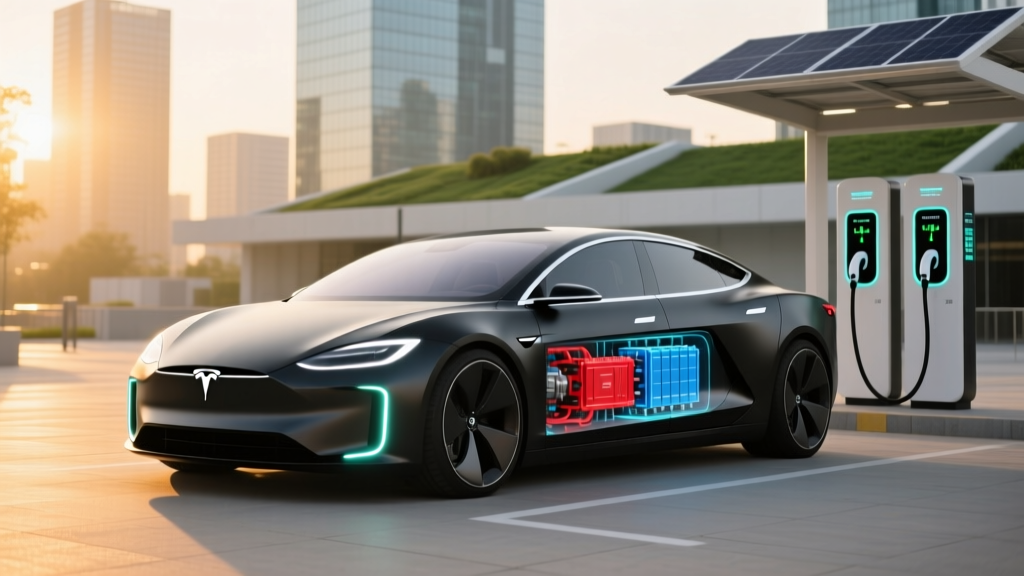
Charging logistics are the make-or-break operational challenge for any robotaxi fleet. A vehicle sitting at a charger is a vehicle not earning revenue. Tesla's approach leverages its existing Supercharger network but adds fleet-specific infrastructure:
| Charging Level | Power (kW) | Estimated Time / Rate |
|---|---|---|
| Level 1 (120V) | ~1.4 kW | N/A — not used in fleet ops |
| Level 2 (240V depot) | ~11.5–19.2 kW | ~3–5 hours (0–100%) |
| DC Fast Charge (V4 Supercharger) | ~150–250 kW (peak) | ~15–20 min (10–80%) |
| Inductive / wireless (announced) | ~11–22 kW (target) | Automated depot charging (no plug-in) |
Tesla has demonstrated wireless inductive charging pads at its "We, Robot" event, suggesting that production Cybercabs may charge at fleet depots without any physical connection — the vehicle simply parks over a pad. This eliminates the need for robotic plug-in arms (like those used by some competitors) and reduces mechanical wear. However, inductive charging is less efficient than wired (typically 85–90% vs. 95%+ efficiency) and adds cost to depot buildout.
The Cybercab will use the NACS connector exclusively (as all Tesla vehicles do), and its relatively small ~50 kWh battery means that even at moderate DC charge rates, a 10–80% session should complete in under 20 minutes. For fleet operations, Tesla is likely to deploy dedicated depot chargers — potentially combining Level 2 overnight top-ups with DC fast-charge stations for mid-shift turnaround.
The real charging question is not speed but logistics: how many chargers per vehicle, how much idle time is acceptable, and how depot locations align with demand zones. These operational details remain entirely undisclosed.
Autonomous Driving System: Hardware and SAE Level
The Cybercab represents Tesla's bet that a vision-only approach — cameras and neural networks, with no LiDAR or radar — can achieve Level 4 autonomy at scale. This stands in direct contrast to Waymo, which uses a sensor suite combining LiDAR, radar, and cameras on its Jaguar I-PACE robotaxis.
Expected sensor and compute hardware on the Cybercab:
- Cameras: 8+ exterior cameras providing 360° coverage (Tesla's standard vision architecture)
- Compute: Next-generation Tesla AI inference chip (HW5 or successor), significantly more powerful than current HW4
- No LiDAR, no radar: Pure vision approach, consistent with Tesla's production vehicles
- Cabin monitoring: Interior camera for passenger safety and behavior monitoring
- Redundant systems: Dual-compute paths, redundant braking and steering actuators (required for Level 4 without driver fallback)
Even at Level 4, the Cybercab will be geofenced to specific operational design domains — initially likely limited to certain neighborhoods in Austin with favorable weather, well-mapped roads, and lower speed limits. It will not handle all driving scenarios everywhere. Heavy rain, snow, construction zones, and unmapped areas may require the vehicle to pull over and wait or request remote assistance. Level 4 is not Level 5 (full autonomy everywhere in all conditions). No production vehicle at any price currently achieves Level 5.
Tesla's FSD (Supervised) system on consumer vehicles has accumulated billions of miles of real-world data, which Tesla argues gives its neural networks a training-data advantage over competitors. However, FSD remains a Level 2 system requiring driver supervision. The leap from Level 2 to Level 4 — removing the driver entirely and accepting full liability — is not incremental. It requires demonstrating to regulators (NHTSA, state DMVs, and potentially the NTSB) that the system is safe without a human fallback, a bar that Waymo has met in specific cities after years of testing and regulatory engagement.
Pricing, Cost Per Ride, and the Tax Credit Question
Because the Cybercab is not a consumer vehicle, traditional MSRP and tax credit analysis does not apply in the usual way. Here's what we know and what we can estimate:
| Cost Factor | Estimate / Detail |
|---|---|
| Vehicle production cost (Tesla's cost) | ~$25,000–$30,000 per unit (Tesla target) |
| Consumer purchase price | N/A — not available for consumer purchase |
| Estimated cost per ride (Tesla target) | ~$0.20/mile (Musk's stated goal) |
| Comparable Waymo ride cost | ~$1.00–$1.50/mile (current market) |
| IRS §30D tax credit (consumer) | Not applicable — fleet/manufacturer-owned vehicle |
| Commercial EV credit (§45W) | Potentially applicable to Tesla as fleet operator |
Tesla's stated goal of $0.20 per mile would undercut not only Waymo but also personal car ownership on a per-mile basis — if achieved. For comparison, the IRS §30D federal tax credit applies to consumer-purchased new clean vehicles meeting MSRP caps ($55,000 for sedans, $80,000 for SUVs/trucks), buyer income limits, and battery-sourcing requirements. Since Tesla plans to retain ownership of all Cybercabs, consumers cannot claim this credit. Tesla itself, however, may benefit from the §45W Commercial Clean Vehicle Credit or other fleet incentives, though the specifics depend on how the fleet is legally structured.
Musk has also floated the idea of individual Tesla owners adding their personal vehicles to the ride-hailing network — essentially an "Airbnb for cars" model. This concept, which Musk has discussed since 2019, would theoretically allow consumer Tesla owners to earn income from their vehicles when not in use. As of 2026, this remains a concept with no announced timeline or regulatory framework.
Interior, Passenger Experience, and Standout Tech
The Cybercab prototype shown in October 2024 featured a minimalist interior with two seats, a large central touchscreen, and no driver controls whatsoever. Based on the prototype and Tesla's disclosures:
- Seating: 2 passengers on a bench-style seat, facing forward
- Display: Large central touchscreen for ride information, entertainment, and climate control
- Climate: Individual HVAC controls via touchscreen (no physical buttons)
- Entry: Likely app-based unlock; no physical key or fob
- Accessibility: Unknown — the prototype's low-slung sports-car-like design raises questions about wheelchair access and ADA compliance, which will be a regulatory requirement for commercial ride services
- Cargo: Small rear trunk area, estimated under 10 cubic feet — sufficient for a couple of bags, not luggage for an airport run
Notable design choices include butterfly-style doors (for dramatic entry and potentially easier ingress in tight spaces) and a convertible roof option shown on one prototype. Whether these features survive to production is uncertain — concept-car flourishes often get cut for cost and durability reasons.
- Extremely low operating cost per mile if Tesla hits $0.20/mi target
- LFP battery offers long cycle life for high-utilization fleet duty
- Leverages existing Supercharger network for DC fast charging
- Vision-only system has massive training-data advantage from Tesla's consumer fleet
- No driver means lower per-ride cost vs. Uber/Lyft/Waymo (if scaled)
- Wireless depot charging reduces operational complexity
- Vision-only Level 4 autonomy is unproven at scale — no manufacturer has achieved it
- Regulatory approval timeline is entirely uncertain (state-by-state patchwork)
- Two-passenger capacity limits use cases (no families, groups, or large cargo)
- Accessibility (ADA compliance) is an unresolved design challenge
- Tesla's production timeline promises have historically been missed by 1–3 years
- No consumer ownership option — purely a ride-hailing service
- Cold-weather LFP range loss could limit viable deployment cities
Cybercab vs. Waymo: The Robotaxi Landscape in 2026
The Cybercab's most direct competitor is Waymo, which as of early 2026 operates commercial Level 4 robotaxi service in Phoenix, San Francisco, Los Angeles, and Austin — the same city where Tesla plans to launch. Waymo's fleet of Jaguar I-PACE vehicles (equipped with LiDAR, radar, and cameras) has completed tens of millions of paid rider trips, establishing a real-world safety and reliability track record that Tesla must match or exceed to compete.
Key differences in approach:
- Sensor philosophy: Waymo uses LiDAR + radar + cameras (redundant sensing). Tesla uses cameras only (vision-only). This is the most consequential technical disagreement in the autonomous vehicle industry.
- Scaling model: Waymo retrofits existing production vehicles (Jaguar, soon Zeekr). Tesla plans to manufacture a purpose-built vehicle at massive scale with its "unboxed" process.
- Cost structure: Waymo's sensor suite costs tens of thousands of dollars per vehicle. Tesla's vision-only approach is dramatically cheaper per unit — if it works at Level 4.
- Regulatory posture: Waymo has methodically pursued permits city-by-city over 5+ years. Tesla's regulatory strategy for driverless operations remains less defined.
Other players in the space include Zoox (Amazon-backed, purpose-built Level 4 vehicle, testing in Las Vegas and California), Cruise (GM-backed, currently restructuring after safety incidents), and several Chinese operators (Baidu Apollo, Pony.ai) running at scale in Beijing and other cities under different regulatory frameworks.
Who Should Pay Attention to the Cybercab — and Who Shouldn't
If you are a consumer looking to buy an EV in 2026, the Cybercab is not relevant to your purchase decision. It is not available for sale, and Tesla has given no indication it ever will be. Your options in the Tesla ecosystem remain the Model 3, Model Y, Cybertruck, and the refreshed Model S/X.
The Cybercab matters if you are:
- An investor evaluating Tesla's long-term revenue diversification beyond vehicle sales
- A ride-hailing driver (Uber/Lyft) assessing the timeline and threat of autonomous competition
- A city planner or regulator preparing for autonomous vehicle fleet operations
- A technologist tracking the vision-only vs. LiDAR debate in Level 4 autonomy
- A potential rider in Austin or other likely early-deployment cities who may eventually hail one
Watch the Cybercab if: You're interested in Tesla's long-term autonomous strategy, you live in a likely launch city (Austin, Phoenix, Miami), or you're evaluating robotaxi economics as an investor or urban planner.
Look elsewhere if: You need to buy a vehicle in 2026. The Cybercab cannot be purchased, has no certified specs, no firm launch date, and faces significant regulatory and technical hurdles before carrying paying passengers. For a Tesla EV you can actually buy and drive today, see our EPA data on the Model 3 and Model Y for current range, efficiency, and pricing.
Frequently Asked Questions
Can I buy a Tesla Cybercab?
No. The Cybercab is designed exclusively as a fleet vehicle for Tesla's planned autonomous ride-hailing network. Tesla has not announced any consumer purchase option, and the vehicle lacks a steering wheel and pedals, making it unsuitable (and likely illegal) for private ownership under current vehicle regulations.
When will the Cybercab be available for riders?
Tesla targets volume production beginning in the second half of 2026, with paid rider service potentially launching in late 2026 or 2027 in limited cities (Austin is the most likely first market). However, Tesla's production timelines have historically slipped by 1–3 years, and regulatory approval for driverless commercial service is a separate and uncertain process.
Is the Cybercab truly self-driving?
The Cybercab is designed as a Level 4 autonomous vehicle — meaning it operates without any human driver within its defined operational domain (specific geofenced areas, certain weather conditions, limited speeds). This is fundamentally different from Tesla's FSD (Supervised) on consumer vehicles, which is Level 2 and requires the driver to remain engaged at all times. Level 4 has been achieved commercially by Waymo in several US cities, but Tesla has not yet demonstrated Level 4 capability in production.
How much will a Cybercab ride cost?
Tesla CEO Elon Musk has stated a target of approximately $0.20 per mile, which would be dramatically cheaper than current ride-hailing services ($1.00–$2.50/mile for Uber/Lyft) and even Waymo ($1.00–$1.50/mile). Whether this cost is achievable at scale — factoring in vehicle depreciation, charging, insurance, maintenance, remote assistance, and fleet operations — remains unproven.
Does the Cybercab qualify for the federal EV tax credit?
Not for consumers. The IRS §30D clean vehicle credit applies to qualifying new EVs purchased by individual taxpayers, subject to MSRP caps ($55,000 sedans / $80,000 SUVs and trucks), buyer income limits, and battery-sourcing requirements. Since Tesla plans to own and operate all Cybercabs, consumers cannot purchase one or claim the credit. Tesla may qualify for commercial fleet credits (§45W) depending on how the operation is structured.
What battery does the Cybercab use?
Tesla has not officially confirmed the Cybercab's battery specifications. Based on the vehicle's compact size, two-passenger configuration, and ~200-mile range target, industry analysts estimate a ~50 kWh LFP (lithium iron phosphate) battery pack. LFP is the likely chemistry choice for fleet vehicles due to its superior cycle life (3,000+ cycles), lower cost, and thermal stability — critical for a vehicle expected to operate 16–20 hours daily.
How does Tesla's vision-only approach compare to Waymo's LiDAR?
This is the central technical debate in autonomous vehicles. Waymo uses LiDAR, radar, and cameras — providing redundant depth perception and all-weather sensing at high per-vehicle cost (estimated $50,000+ in sensors). Tesla uses only cameras and neural networks, arguing that human-level vision is achievable through software alone and at dramatically lower hardware cost. Waymo has demonstrated commercial Level 4 service with its approach; Tesla has not yet done so with vision-only. The Cybercab will be the definitive test of Tesla's thesis.
Sources: Tesla Q4 2025 earnings call transcripts, NHTSA Automated Vehicles Safety, IRS Clean Vehicle Credits, fueleconomy.gov. All Cybercab specifications cited are preliminary estimates based on Tesla disclosures and industry analysis; final production specs may differ. Tesla's production timeline targets are forward-looking statements subject to change.