The Tesla Cybercab — the dedicated robotaxi platform Elon Musk unveiled in October 2024 — remains one of the most scrutinized unreleased vehicles in the EV space. With production targeted for 2026, prospective riders, fleet operators, and spec-watchers are hunting for every detail. Among the highest-volume searches: the Cybercab interior, which Tesla has shown in limited renders and prototype sightings, promising a minimalist two-seat cabin optimized for autonomy rather than driver engagement.
This profile compiles every confirmed and credibly estimated specification available as of early 2026, clearly separating Tesla's official claims from preliminary figures. Because the Cybercab is designed primarily as a Level 4 autonomous fleet vehicle — not a consumer-owned car — many traditional review metrics (like trunk space for groceries or child-seat anchors) require a different lens. Let's break down what matters.
Cybercab Interior: Two Seats, Zero Driver Controls
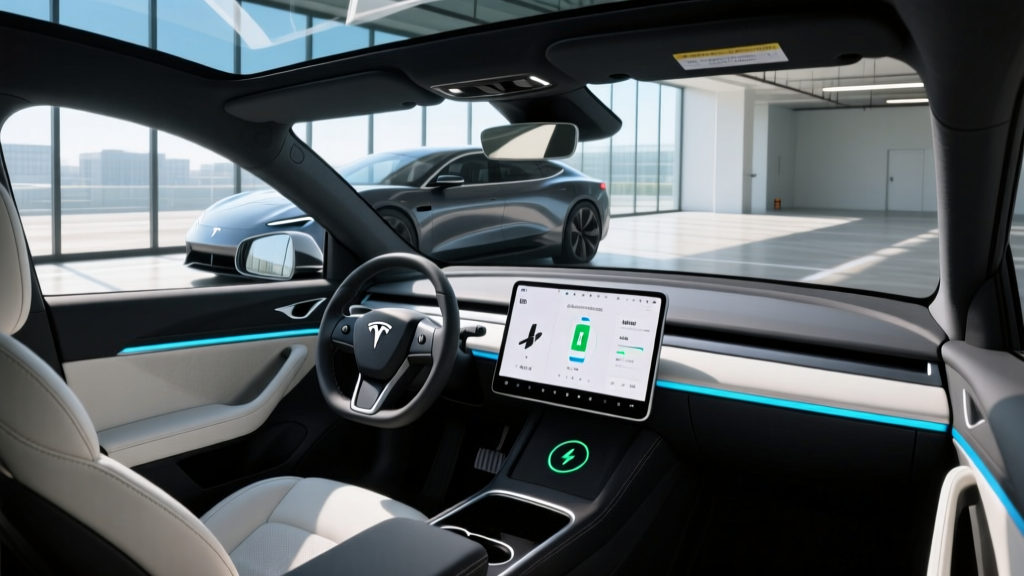
The Cybercab interior represents a fundamental departure from every production Tesla to date. There is no steering wheel, no pedal assembly, and no traditional instrument cluster. Instead, the cabin is configured around two forward-facing bucket seats separated by a slim center console, with a single large central touchscreen (estimated 15–17 inches, consistent with current Model 3/Y architecture) serving as the sole passenger interface.
From prototype images and Tesla's October 2024 "We, Robot" event footage, the interior materials appear to use Tesla's vegan leather upholstery in a light tan or cream colorway, with brushed aluminum or composite trim. The aesthetic is deliberately lounge-like: ambient lighting strips run along the lower door panels and footwells, and the absence of a steering column opens up significant knee and legroom for both occupants.
Passenger Space & Cargo Dimensions (Estimated)
| Dimension | Estimated Spec | Context |
|---|---|---|
| Seating capacity | 2 passengers | No rear seats; optimized for ride-hailing pairs |
| Front legroom | ~44–46 in | Generous; no steering column intrusion |
| Front headroom | ~39–40 in | Sloping roofline limits taller riders slightly |
| Cargo volume (behind seats) | ~12–16 cu ft | Sufficient for 2 carry-on bags + backpacks |
| Frunk | None confirmed | Front structure houses compute hardware |
The trade-off for the lounge-style cabin is utility. Two-seat capacity means the Cybercab cannot serve families or groups larger than a couple, and the modest cargo area behind the seats handles airport luggage for two but not a Costco run. Tesla has not published official SAE cargo measurements, and the final production interior may shift slightly as crash-test and accessibility compliance is finalized.
Range, Battery & Efficiency
Tesla stated at the Cybercab unveil that the vehicle would achieve "over 250 miles" of range on a single charge. Given the vehicle's compact footprint (shorter wheelbase than a Model 3), lightweight two-seat construction, and expected use of Tesla's latest structural battery pack, industry analysts estimate a usable battery capacity in the 45–55 kWh range, likely using LFP (lithium iron phosphate) chemistry.
LFP is the logical choice here: it's cheaper per kWh, tolerates frequent 100% charging (critical for fleet duty cycles), and offers a longer cycle life — all priorities for a robotaxi that may log 50,000+ miles annually. The trade-off is lower energy density than NMC, but the Cybercab's smaller mass and aero-efficient teardrop shape compensate.
Announced target: 250+ miles (Tesla estimate, not yet EPA-certified)
Expected real-world: ~200–220 miles in mixed city/highway fleet use; potentially ~170–190 miles in cold-weather markets (Chicago, Minneapolis) where LFP batteries see 15–25% range reduction at highway speeds in sub-30°F temperatures. For a robotaxi completing 15–20 short urban trips per day, this is operationally adequate with opportunity charging between shifts.
| Spec | Estimated / Announced | Notes |
|---|---|---|
| Battery capacity (usable) | ~50 kWh | Structural pack, LFP chemistry likely |
| Range (Tesla estimate) | 250+ mi | EPA certification pending |
| Efficiency | ~130–145 MPGe (est.) | ~23–26 kWh/100 mi; lightweight + aero |
| Battery chemistry | LFP (projected) | 100% SoC daily charging compatible |
| Thermal management | Active liquid + heat pump | Octovalve-based system expected |
Charging: DC Fast & Fleet Depot Speeds
For a robotaxi, charging speed is an operational KPI — every minute plugged in is revenue lost. Tesla has indicated the Cybercab will support DC fast charging, though it has not published a peak kW figure. Based on the estimated ~50 kWh battery and Tesla's current 400V architecture (the Cybercab is not expected to use an 800V system like the Ioniq 5 or Lucid), a reasonable projection is a peak charge rate of 150–175 kW.
| Charging Method | Estimated Rate | Speed / Notes |
|---|---|---|
| DC Fast Charge (peak) | ~150–175 kW | 10–80% in approximately 20–25 minutes |
| DC Fast Charge (sustained avg) | ~100–120 kW | Charge curve tapers above 60% SoC |
| Level 2 (fleet depot, 48A) | ~11.5 kW | ~40–45 miles of range per hour; full overnight charge in ~5 hrs |
| Level 1 (120V) | ~1.4 kW | ~5 mi/hr; not practical for fleet ops |
| Connector | NACS (Tesla native) | Direct Supercharger access |
A critical nuance for fleet operators: peak kW is not sustained kW. LFP batteries typically hold their charge curve more consistently than NMC up to ~80% SoC, then taper sharply. In practice, a Cybercab pulling into a V3 Supercharger at 10% SoC should reach 80% in roughly 20–25 minutes, adding about 175 miles of range — enough for another half-shift of urban trips. Tesla's fleet management software will likely automate charge scheduling to minimize downtime during off-peak electricity rate windows.
Performance & Drivetrain
The Cybercab is not engineered for performance driving. It's a purpose-built urban mobility pod, and the powertrain reflects that priority: adequate acceleration for merging and intersection clearance, not track times.
| Performance Metric | Estimated |
|---|---|
| Drivetrain | Rear-wheel drive (single motor) |
| Horsepower | ~200–250 HP |
| 0–60 mph | ~5.5–6.5 seconds (est.) |
| Top speed | ~100 mph (software-limited) |
| Towing capacity | None — not rated for towing |
A single rear motor keeps cost, weight, and complexity down — all essential for a fleet vehicle where total cost per mile is the dominant metric. The estimated 0–60 time is more than adequate for highway merging and is broadly consistent with other compact EVs in this power class. Don't expect a Plaid mode here.
Pricing, Availability & Tax Credit Eligibility
This is where the Cybercab diverges most sharply from a traditional car review. Tesla does not plan to sell the Cybercab to individual consumers. The vehicle is designed for Tesla's own autonomous ride-hailing network, competing directly with Waymo's fleet operations. Elon Musk has mentioned a projected "cost" of around $25,000 per unit for fleet economics, but this is a manufacturing cost estimate, not a consumer MSRP.
| Pricing Factor | Detail |
|---|---|
| Consumer MSRP | N/A — not sold to individuals (announced) |
| Fleet unit cost (Tesla estimate) | ~$25,000 |
| Estimated ride cost per mile | $0.20–$0.30/mi (Tesla projection) |
| Federal §30D tax credit | Not applicable — credit requires consumer purchase of a new qualified plug-in EV; fleet/robotaxi vehicles do not qualify |
| Commercial fleet incentives | §45W commercial clean vehicle credit may apply for fleet operators (up to $7,500 for vehicles under 14,000 lbs GVWR) — consult IRS §45W guidance |
For individuals hoping to buy a Cybercab as a personal vehicle: this is not on Tesla's announced roadmap. If Tesla ever offers a consumer variant (adding a steering wheel, pedals, and rear seats to meet FMVSS requirements), that would be an entirely different product with different pricing and credit eligibility. As of 2026, the Cybercab is a fleet-only platform.
The Cybercab is designed for SAE Level 4 autonomous operation — meaning no human driver is required within its operational design domain (specific geofenced urban areas, fair weather conditions initially). This is fundamentally different from Tesla's current consumer vehicles, which offer Level 2 driver-assistance (Autopilot / FSD Supervised) requiring constant human supervision. Level 4 robotaxis like the Cybercab and Waymo's Jaguar I-PACE fleet are subject to separate NHTSA regulatory frameworks and state-level permitting. See NHTSA AV safety guidance for current rules.
Tech, Sensors & Autonomous Hardware
The Cybercab's technology suite is its core product — the vehicle is essentially a sensor platform with seats. Based on Tesla's unveil and subsequent patent filings, the autonomous hardware stack is expected to include:
- Cameras: 8+ external cameras providing 360° coverage (Tesla's pure-vision approach, no LiDAR)
- Compute: Next-gen Tesla AI inference chip (HW5 or equivalent), estimated at 2–3× the throughput of current HW4
- Connectivity: Dual-band 5G + redundant LTE for real-time fleet routing and remote teleoperations
- Passenger interface: Single large touchscreen for ride status, route display, climate control, and entertainment
- Climate: Heat pump HVAC with HEPA filtration (consistent with current Tesla fleet)
- Entry: Phone-as-key via Tesla app; no physical key or fob
The biggest question mark is Tesla's vision-only approach to Level 4 autonomy. Waymo, Cruise (now defunct as of 2024), and Zoox all use LiDAR as a redundancy layer alongside cameras and radar. Tesla's bet that neural-network-driven vision can achieve Level 4 safety without LiDAR remains unproven at commercial fleet scale. Regulatory approval from NHTSA and state agencies (particularly California's DMV and CPUC, which oversee robotaxi permits) will be the gating factor — not the hardware spec sheet.
Cybercab vs. Waymo & Zoox: Robotaxi Competition
| Attribute | Tesla Cybercab | Waymo (6th Gen) | Amazon Zoox |
|---|---|---|---|
| Seating | 2 passengers | 4 passengers | 4 passengers (facing) |
| Steering wheel | None | None | None |
| Range (est.) | 250+ mi | ~300 mi | ~185 mi (75 kWh) |
| Sensors | Cameras only | LiDAR + cameras + radar | LiDAR + cameras + radar |
| SAE Level | Level 4 (target) | Level 4 (live) | Level 4 (live, limited) |
| Live markets (2026) | None yet (testing) | Phoenix, SF, LA, Austin | Las Vegas, SF (limited) |
| Consumer purchase | No | No | No |
The Cybercab's two-seat layout is a clear disadvantage versus Waymo's four-passenger vehicles for airport runs and group travel, but it reduces per-unit cost and energy consumption. Tesla's camera-only approach is the biggest technical risk — and the biggest potential cost advantage if it proves viable at scale.
Warranty & Fleet Durability
Tesla has not published Cybercab-specific warranty terms, but fleet vehicles require durability specifications that exceed consumer norms. For reference, Tesla's current consumer battery warranty covers 8 years / 100,000–120,000 miles (depending on model) with a minimum 70% capacity retention threshold. A fleet vehicle logging 50,000 miles per year would exhaust a 100,000-mile warranty in just two years — inadequate for fleet economics.
Industry expectations for the Cybercab's powertrain warranty target 8 years / 300,000+ miles, consistent with commercial fleet standards. LFP chemistry supports this: LFP cells typically sustain 3,000–5,000 full charge cycles before reaching 80% State of Health, which at 250 miles per cycle translates to 750,000–1,250,000 miles of theoretical battery life. The limiting factor will likely be suspension, interior wear, and sensor calibration rather than the battery itself.
Frequently Asked Questions
What is the real-world range of the Tesla Cybercab?
Tesla targets 250+ miles, but real-world fleet operation in mixed urban/highway conditions will likely yield 200–220 miles, dropping to 170–190 miles in cold climates. For short-trip urban ride-hailing, this is sufficient for a full shift with a mid-day opportunity charge.
How fast does the Cybercab charge?
Estimated peak DC fast charging at 150–175 kW via NACS connector, achieving a 10–80% charge in approximately 20–25 minutes. Fleet depot Level 2 charging at 11.5 kW provides a full overnight charge in about 5 hours.
Can I buy a Tesla Cybercab for personal use?
No. Tesla has announced the Cybercab exclusively for its autonomous ride-hailing fleet. There is no consumer purchase option, and the vehicle lacks a steering wheel and pedals, making it non-compliant with current FMVSS standards for consumer-owned vehicles.
Does the Cybercab qualify for the federal EV tax credit?
The §30D consumer credit does not apply because the Cybercab is not sold to individual buyers. Fleet operators may qualify for the §45W commercial clean vehicle credit (up to $7,500 per vehicle) — consult a tax professional and review IRS guidance on commercial credits.
When will the Cybercab be available to ride?
Tesla has targeted 2026 for production start, but regulatory approval for driverless Level 4 operation in specific markets is a separate process with no guaranteed timeline. Waymo took approximately 5 years from early testing to commercial launch in its first markets.
Is the Cybercab interior spacious enough for luggage?
The estimated 12–16 cu ft of cargo space behind the two seats handles two carry-on suitcases and a backpack or two. It is not designed for large grocery hauls, furniture, or family travel — those use cases remain better served by Waymo's four-seat vehicles or a personal EV.