Tesla unveiled the Cybercab in October 2024 as a dedicated, steering-wheel-free robotaxi — a vehicle designed from the ground up to operate without a human driver. As of early 2026, the Cybercab remains in pre-production, with Tesla CEO Elon Musk targeting a production start in 2026 at the Austin Gigafactory. This article consolidates every confirmed and estimated specification available, separates marketing projections from engineering reality, and explains what buyers, fleet operators, and investors should actually expect.
What the Tesla Cybercab Actually Is
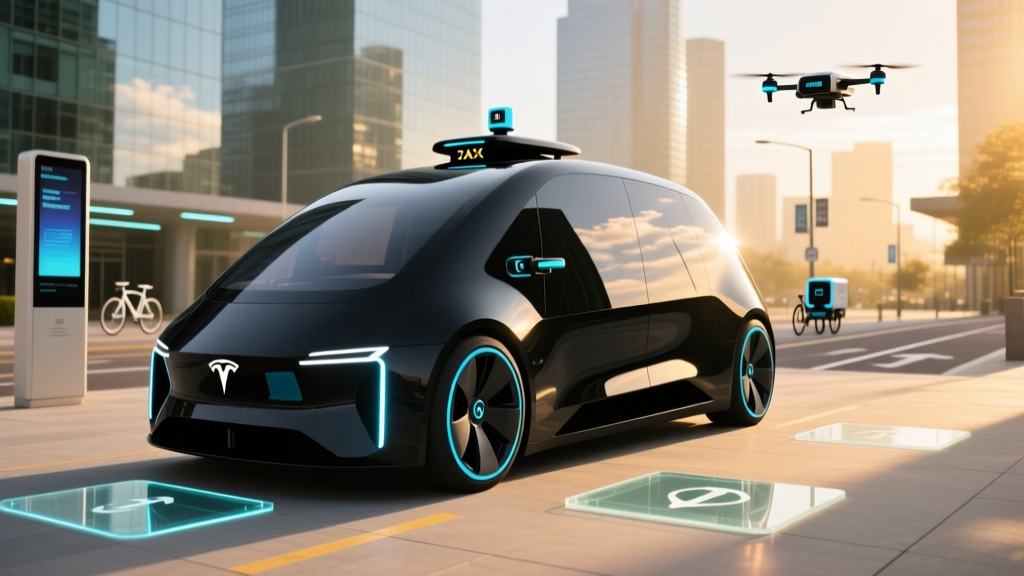
The Cybercab is not a consumer vehicle in the traditional sense. It is a purpose-built, two-seat electric pod designed exclusively for autonomous ride-hailing — Tesla's answer to Waymo's Jaguar I-PACE fleet and Zoox's purpose-built carriage. Key design decisions signal this intent:
- No steering wheel or pedals. The cabin contains only a bench seat and a central touchscreen. There is no manual override.
- Butterfly doors. Gull-wing-style doors open upward for curb-side passenger access in tight urban spaces.
- No side mirrors. Camera-only perception, consistent with Tesla's vision-based approach across its lineup.
- Inductive (wireless) charging. Tesla stated the Cybercab will charge wirelessly at dedicated depots, eliminating plug-in logistics for fleet operations.
This architecture means the Cybercab will not be sold to individual consumers in the way a Model Y or Model 3 is. Instead, Tesla envisions a fleet model: Tesla-owned vehicles operating on a Tesla-run ride-hailing network, with some units potentially available to investors who lease them back to the fleet. Pricing, discussed below, reflects this unconventional ownership structure.
Projected Specs: Battery, Range, and Efficiency
Tesla has not published a full EPA certification sheet for the Cybercab, but the company's unveil event and subsequent commentary provide enough data points for informed estimates. The vehicle's compact footprint and low projected curb weight (~3,000 lbs, significantly lighter than a Model Y) suggest a smaller battery pack than Tesla's consumer vehicles.
| Attribute | Projected / Estimated Value | Confidence Level |
|---|---|---|
| Battery Capacity (usable) | ~50–55 kWh | Estimated (based on weight/target range) |
| Battery Chemistry | LFP (lithium iron phosphate) likely | Probable — fleet use favors LFP cycle life |
| EPA Estimated Range | ~250 miles (projected) | Tesla target; not EPA-certified |
| Efficiency | ~22–25 kWh/100 mi (projected) | Estimated from weight/aero |
| Drivetrain | Rear-wheel drive (single motor) | Confirmed by Tesla unveil |
| 0–60 mph | ~6.5 seconds (estimated) | Not a priority for robotaxi use |
| Horsepower | ~200–250 hp (estimated) | Based on single-motor Tesla powertrains |
| Seating | 2 passengers | Confirmed |
| Cargo Volume | ~12–15 cu ft (trunk, estimated) | Based on vehicle footprint |
| Charging Port | None — inductive (wireless) only | Confirmed by Tesla |
| Projected Base Price | ~$30,000 (fleet unit cost target) | Tesla-stated target; unconfirmed |
| Battery/Powertrain Warranty | TBD (likely 8 yr / 100,000+ mi for fleet) | Not published |
Battery Chemistry: Why LFP Makes Sense for a Robotaxi
While Tesla has not confirmed the Cybercab's cell chemistry, lithium iron phosphate (LFP) is the most probable choice for a fleet vehicle. Here's why:
| Factor | LFP (Lithium Iron Phosphate) | NMC (Nickel Manganese Cobalt) |
|---|---|---|
| Cycle Life | 3,000–5,000+ cycles to 80% SoH | 1,000–2,000 cycles to 80% SoH |
| Cost per kWh | Lower — no cobalt or nickel | Higher — commodity-dependent |
| Energy Density | Lower (heavier pack for same kWh) | Higher (lighter, more compact) |
| Cold-Weather Performance | Greater range loss in freezing temps | Better low-temp efficiency |
| 100% SoC Charging | Can charge to 100% daily without accelerated degradation | Best kept at 80% daily; 100% stresses cells |
| Fleet Suitability | Ideal — high utilization, daily full charges, cost-sensitive | Better for long-range consumer vehicles |
For a vehicle expected to run 200+ miles daily, 365 days a year, LFP's superior cycle life and tolerance for daily 100% charges make it the economically rational choice — even at the cost of slightly lower energy density and worse cold-weather performance.
Charging: Wireless Induction and Fleet Logistics
The Cybercab's most distinctive technical decision is its lack of a physical charging port. Tesla confirmed at the unveil that the vehicle will charge exclusively via inductive (wireless) pads embedded in depot parking spaces. This eliminates the need for human plug-in, a critical requirement for fully driverless fleet operations.
| Charging Method | Power (kW) | Estimated Time (10–80%) | Notes |
|---|---|---|---|
| Inductive (Wireless) Depot Charging | ~50–75 kW (projected) | ~45–60 minutes | Primary charging method; slower than plug-in DCFC |
| Level 2 (Home/Public) | N/A — no port | N/A | Not applicable; fleet-only charging |
| DC Fast Charge (Plug-In) | N/A — no port | N/A | Not applicable |
The inductive charging decision carries a real trade-off: wireless charging is typically 5–10% less efficient than wired and operates at lower power levels. A 50–75 kW inductive pad will charge the Cybercab's ~50 kWh battery in roughly 45–60 minutes for a 10–80% cycle. For a fleet vehicle that returns to a depot between shifts or during low-demand hours, this is acceptable. For consumer expectations of 15-minute Supercharger stops, it would be unacceptable — which reinforces that the Cybercab is not a consumer car.
Tesla has not detailed whether future Supercharger stalls will include inductive pads for Cybercab use, or whether dedicated Cybercab-only depots will be built. This infrastructure question is one of the largest unknowns in the vehicle's deployment timeline.
Autonomous Driving: What Level 4 Actually Requires
The Cybercab's entire value proposition rests on achieving SAE Level 4 autonomous operation — driving without a human in the loop, within a defined geographic area. This is a fundamentally different engineering and regulatory challenge than Tesla's current FSD (Supervised) software, which is Level 2 and requires continuous driver attention.
- Operate outside its approved Operational Design Domain (ODD) — expect initial deployment in geofenced urban/suburban zones only.
- Drive in severe weather (heavy snow, fog, torrential rain) without pulling over — vision-only systems have known limitations here.
- Handle unmapped construction zones or novel road configurations without remote teleoperations support.
- Replace a personal vehicle — it is a ride-hailing pod, not a family car, commuter car, or road-trip vehicle.
Tesla's vision-only sensor suite (cameras, no LiDAR) is a point of industry debate. Waymo's Level 4 vehicles use a combination of LiDAR, radar, and cameras — a sensor-fusion approach that many autonomous-driving experts consider more robust for safety-critical redundancy. Tesla has staked its robotaxi strategy on neural-network-driven perception from cameras alone, arguing that solving vision solves the general driving problem. As of early 2026, no vision-only system has received regulatory approval for driverless Level 4 operation in the United States.
The regulatory pathway is equally uncertain. NHTSA has not yet established a comprehensive federal framework for Level 4 vehicle certification, and state-by-state approval (similar to how California, Arizona, and Texas have permitted Waymo) will likely be required. Tesla will need to demonstrate millions of miles of validated driverless operation before widespread deployment.
Pricing, Ownership Model, and Tax Credit Considerations
Tesla has stated a target unit cost of approximately $30,000 for the Cybercab. However, this figure requires substantial context:
- This is a fleet unit cost target, not a consumer MSRP in the traditional sense. Tesla has not confirmed that individual consumers will be able to purchase a Cybercab outright.
- The intended model appears to be a fleet ownership structure: Tesla owns and operates the vehicles, or investors purchase units and lease them back to the Tesla ride-hailing network, earning a share of ride revenue.
- At $30,000 per unit, the Cybercab would need to complete approximately 10,000–15,000 paid rides (depending on pricing per mile) to recoup the vehicle cost alone — before insurance, maintenance, charging, and platform overhead.
Federal EV Tax Credit (§30D) Eligibility
The IRS §30D clean vehicle credit applies to vehicles purchased for personal use. Because the Cybercab is designed as a fleet/ride-hailing vehicle and may not be sold to individual consumers in a traditional retail transaction, standard §30D eligibility is uncertain. Key considerations:
- MSRP Cap: §30D caps eligibility at $55,000 for sedans — the Cybercab's ~$30,000 target would clear this threshold.
- Income Cap: Buyer AGI must not exceed $150,000 (single) / $300,000 (joint) — relevant only if individual purchases are permitted.
- Battery Sourcing: Critical minerals and battery component requirements must be met. LFP cells sourced from CATL (China) would likely fail the critical-minerals requirement under current rules, potentially disqualifying the credit entirely unless Tesla sources from approved suppliers.
- Fleet/Commercial Use: Vehicles purchased exclusively for commercial fleet use may fall under the separate §45W commercial clean vehicle credit instead of §30D, with different qualification criteria.
Bottom line: do not assume a $7,500 tax credit will apply to a Cybercab purchase or fleet investment. Consult a tax professional and monitor IRS guidance as the vehicle approaches production.
Competitive Landscape: Cybercab vs. Waymo vs. Zoox
| Factor | Tesla Cybercab | Waymo (Jaguar I-PACE / Geely) | Amazon Zoox |
|---|---|---|---|
| SAE Level | Level 4 (targeted) | Level 4 (operational) | Level 4 (operational) |
| Status (Early 2026) | Pre-production | Active in Phoenix, SF, LA, Austin | Active in Las Vegas, SF Bay Area |
| Sensor Suite | Vision-only (cameras) | LiDAR + radar + cameras | LiDAR + radar + cameras |
| Vehicle Origin | Purpose-built Tesla | Modified Jaguar / Geely platform | Purpose-built Zoox carriage |
| Passenger Capacity | 2 | 3–4 | 4 |
| Paid Rides Completed | 0 (as of early 2026) | Millions | Tens of thousands |
| Unit Cost (Est.) | ~$30,000 target | $100,000+ per vehicle | Not disclosed (high) |
The Cybercab's primary advantage, if Tesla achieves its targets, is unit cost. At $30,000 per vehicle versus Waymo's estimated $100,000+ per modified Jaguar, Tesla could theoretically deploy a fleet at a fraction of the capital expenditure. The disadvantage is that Waymo and Zoox have years of real-world Level 4 operational data, regulatory approvals, and paid-ride track records that Tesla has yet to begin building.
Who the Cybercab Is For — And Who Should Look Elsewhere
- This is for you if: You are a fleet investor evaluating autonomous ride-hailing unit economics, an urban resident in a future deployment city who currently spends heavily on Uber/Lyft, or a Tesla shareholder assessing the company's robotaxi thesis.
- This is NOT for you if: You need a personal vehicle for commuting, family transport, road trips, cargo hauling, or any use case requiring a steering wheel, more than two seats, or the ability to drive outside a geofenced zone. For those needs, consider the Tesla Model Y, Hyundai Ioniq 5, or a plug-in hybrid like the Toyota RAV4 Prime.
Key Pros and Cons
- Targeted ~$30,000 unit cost could disrupt ride-hailing economics
- LFP battery cycle life suited to high-utilization fleet duty
- Wireless charging enables fully driverless depot turnaround
- Tesla's manufacturing scale (Austin Gigafactory) enables rapid fleet ramp if approved
- Purpose-built 2-seat design optimized for urban ride-hailing trips
- Not yet in production; no confirmed delivery date
- No regulatory approval for Level 4 driverless operation
- Vision-only sensor suite unproven at Level 4 (no LiDAR redundancy)
- No physical charging port — entirely dependent on proprietary inductive infrastructure
- 2-seat capacity limits group/family ride-hailing use cases
- Tax credit eligibility uncertain for fleet/commercial purchase
- Cold-weather range loss (LFP) could limit northern-city deployment
Frequently Asked Questions
What is the real-world range of the Tesla Cybercab?
Tesla targets approximately 250 miles of range, but this figure has not been EPA-certified. In real-world urban fleet service — with constant stop-and-go driving, HVAC use, and passenger weight — expect an effective operating range of 180–210 miles per charge cycle. In cold climates (below 32°F), LFP chemistry could reduce this further by 15–25%, yielding as little as 140–170 effective miles in winter conditions.
How fast does the Cybercab charge?
The Cybercab charges exclusively via wireless inductive pads at an estimated 50–75 kW. A 10–80% charge cycle should take approximately 45–60 minutes. There is no plug-in option — no CCS, no NACS, no Supercharger compatibility. This is by design for driverless fleet operations but means the vehicle cannot use any public charging infrastructure.
How much does the Tesla Cybercab cost?
Tesla has stated a target unit cost of approximately $30,000. However, it is unclear whether individual consumers will be able to purchase the vehicle. The expected model is fleet ownership by Tesla or by investors who lease units back to the Tesla ride-hailing network. Final pricing, ownership structures, and any per-ride costs to passengers have not been published.
Does the Cybercab qualify for the federal EV tax credit?
Uncertain. The IRS §30D credit applies to personal-use vehicle purchases. If the Cybercab is sold only for fleet/commercial use, it may fall under the §45W commercial credit instead. Additionally, if Tesla sources LFP cells from Chinese suppliers (e.g., CATL), the battery critical-minerals requirement under §30D would likely disqualify it. Consult a tax professional and check IRS guidance for updates as production approaches.
Is the Cybercab self-driving?
It is designed to be — but it is not yet. The Cybercab targets SAE Level 4 autonomy (no driver required within a defined zone). As of early 2026, Tesla has not received regulatory approval for driverless operation, and the vehicle has not completed validated driverless miles on public roads. This is fundamentally different from Tesla's current FSD (Supervised), which is Level 2 and requires an attentive driver.
When will the Tesla Cybercab be available?
Tesla has targeted a production start in 2026 at the Austin Gigafactory. However, Tesla's production timelines have historically shifted. Even after production begins, regulatory approval for driverless passenger service will be required on a state-by-state basis, potentially delaying commercial deployment into 2027 or beyond in most markets.
Can I buy a Tesla Cybercab for personal use?
Tesla has not confirmed a consumer purchase option. The vehicle's design (no steering wheel, no pedals, inductive-only charging) makes it impractical for personal ownership outside of a Tesla-operated fleet ecosystem. If Tesla does offer individual ownership, it would likely be restricted to investors participating in the fleet lease-back program, not traditional retail buyers.