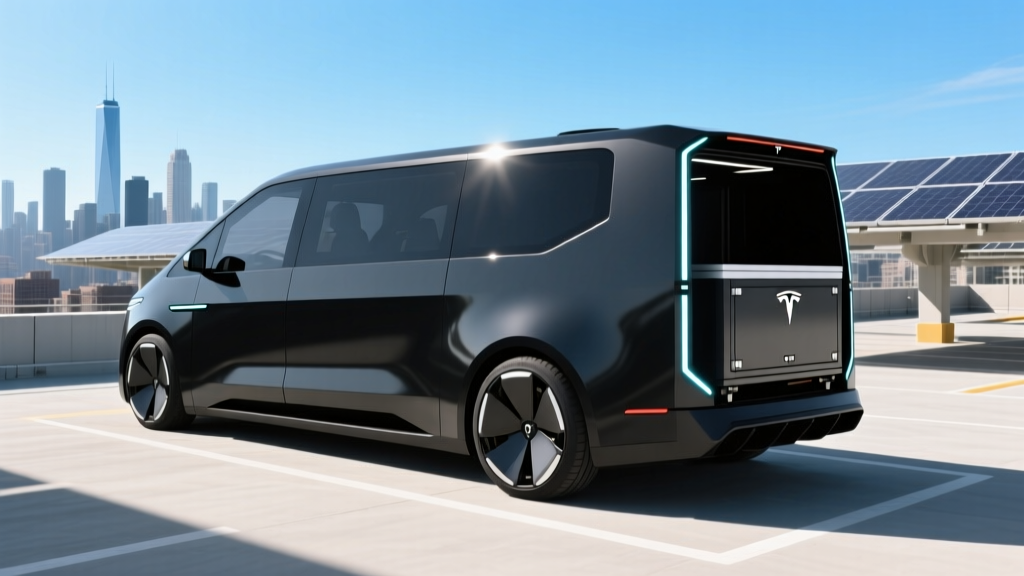
Tesla has never built a minivan, and as of early 2026, the so-called Cyber Van Tesla remains a speculative concept — not an announced, orderable vehicle. No official specs, no reservation page, no press release from Tesla exists for a van bearing the Cybertruck's angular design language. What does exist is a persistent wave of renders, patent filings, and Elon Musk comments that keep the idea alive in EV forums and YouTube thumbnails.
This article separates confirmed Tesla product reality from rumor, gives you our best analyst estimates based on Tesla's current platform architecture, and — critically — points you toward the electric vans and large-format EVs you can actually buy in 2026.
Is the Tesla Cyber Van Real or Just Rumor?
Let's be direct: Tesla has not announced a Cyber Van, Robovan, or any passenger van as of 2026. There is no listing on Tesla.com, no EPA certification filing on fueleconomy.gov, and no NHTSA VIN decoder entry for such a model.
The concept traces back to Tesla's 2020 "Master Plan Part 3" references to a future electric van, occasional Musk tweets about a "Cybertruck-based van," and a stream of fan renders that blend the Cybertruck's stainless-steel exoskeleton with a boxy people-mover silhouette. Tesla's actual product lineup in 2026 consists of the Model 3, Model Y, Model S, Model X, Cybertruck, and the Semi (fleet-only). A van is not among them.
Estimated Cyber Van Specs — Based on Tesla's Current Platform
While we have no official data, we can project what a Tesla van would likely look like if it were built on the Cybertruck's structural battery pack architecture or a stretched Model Y platform. The table below represents analyst estimates only — not manufacturer specifications.
| Attribute | Estimated Figure | Basis |
|---|---|---|
| EPA Range (est.) | 280–340 miles | Cybertruck AWD (340 mi) minus van drag/weight penalty |
| Battery Capacity | ~123 kWh usable (NMC) | Cybertruck structural pack |
| Chemistry | NMC (nickel manganese cobalt) | Large Tesla vehicles use NMC for energy density |
| Peak DC Fast Charge | ~250 kW (Supercharger V4) | Current Tesla maximum |
| 10–80% Charge Time | ~30–35 minutes (est.) | Large pack tapers earlier than sedan packs |
| Level 2 Home Charging | 11.5 kW / ~34 mi/hr | Tesla Wall Connector max |
| Drivetrain | Dual-motor AWD or tri-motor | Based on Cybertruck lineup |
| 0–60 mph (est.) | 4.5–5.5 seconds (AWD) | Heavier than Cybertruck due to van body |
| Horsepower | ~600 HP (dual-motor) | Cybertruck dual-motor output |
| Seating | 7–8 passengers (est.) | Minivan segment norm |
| Cargo (est.) | ~40 cu ft behind 3rd row; ~120 cu ft max | Comparable to Chrysler Pacifica |
| Estimated Base MSRP | $70,000–$85,000 | Above Cybertruck AWD ($81,895 in 2026) |
| Battery Warranty | 8 years / 120,000 miles (est.) | Tesla's current large-vehicle battery warranty |
Real-World Range Expectations for a Tesla Van
EPA Estimate: ~300–340 miles (if built on Cybertruck platform)
Real-World Highway (70–80 mph): Expect 240–280 miles — large, boxy vehicles suffer significant aero drag at speed
Cold Weather (below 32°F): Add a 20–30% reduction, yielding ~180–230 miles of usable range
Towing (if rated): Range could drop to 120–160 miles depending on trailer weight
For context, the Cybertruck AWD is EPA-rated at 340 miles, but independent highway tests have recorded 260–280 miles at sustained 75 mph speeds. A van body would carry a higher drag coefficient (Cd) than the Cybertruck's wedge shape, further reducing efficiency. Tesla's heat pump — standard across the lineup — would help mitigate cold-weather cabin heating losses, but the physics of a tall, flat-fronted vehicle fighting wind resistance are unavoidable.
Charging Speed Projections & Infrastructure Reality
| Level | Power (kW) | Miles Added/Hour | Notes |
|---|---|---|---|
| Level 1 (120V) | ~1.4 kW | ~3–4 mi/hr | Emergency/trickle only |
| Level 2 (240V, 48A) | 11.5 kW | ~34 mi/hr | Tesla Wall Connector; overnight full charge |
| DC Fast (Supercharger V4) | Peak ~250 kW | ~800+ mi/hr at peak | 10–80% in ~30–35 min; tapers above 80% |
A large 123 kWh pack means that even at 250 kW peak, a full 10–80% session takes longer than a Model 3's ~18-minute sprint. The charge curve on structural battery packs tends to taper more aggressively past 60% state of charge (SoC) to protect cell longevity. Expect the last 20% (60–80%) to take nearly as long as the first 40%. On a road trip, plan charging stops around the 50–60% mark for maximum time efficiency — don't wait until 10% and try to charge to 90%.
Tesla's Supercharger network now includes V4 cabinets capable of delivering up to 350 kW to compatible vehicles, but no current Tesla vehicle (including the Cybertruck) accepts more than 250 kW peak. A future van could adopt next-gen 4680 cells with improved C-rates, but that remains speculative.
Pricing, Tax Credit Eligibility & What a Cyber Van Would Cost
If Tesla were to produce a Cyber Van, pricing would likely land between the Cybertruck AWD ($81,895 in 2026) and the Model X ($84,630 base). That positions it firmly above the IRS §30D federal tax credit MSRP cap for vans.
| Trim (Est.) | Est. MSRP | §30D Credit Eligible? | Est. Net Price |
|---|---|---|---|
| Dual-Motor AWD Base | $72,000–$78,000 | ❌ Exceeds $80,000 van cap (if classified as van) | $72,000–$78,000 |
| Tri-Motor / Performance | $90,000–$100,000 | ❌ Exceeds cap | $90,000–$100,000 |
Key §30D rules to understand (per IRS.gov, current for 2026):
- MSRP Cap: Vans, SUVs, and pickups capped at $80,000; sedans at $55,000
- Income Cap: $300,000 joint / $225,000 head of household / $150,000 single filers (modified AGI)
- Battery Sourcing: Critical minerals and battery components must meet escalating North American / FTA-partner thresholds — Tesla's LFP cells from CATL (China) currently disqualify some trims
- Point-of-Sale Transfer: Eligible buyers can apply the credit at purchase, reducing out-of-pocket cost immediately
- FEOC Restriction: Vehicles with battery components from a "foreign entity of concern" (primarily Chinese manufacturers) are disqualified — this is a significant risk for any Tesla using CATL-sourced cells
Tax credit eligibility is complex and changes annually. Consult a tax professional and verify current-year rules at IRS.gov before making a purchase decision.
Electric Vans and Large EVs You Can Actually Buy in 2026
Since the Cyber Van doesn't exist, here are the electrified people-movers available right now that serve the same use case:
| Vehicle | Type | EPA EV Range | Seating | Base MSRP |
|---|---|---|---|---|
| Chrysler Pacifica PHEV | Plug-in Hybrid | 32 mi electric + 490 mi gas | 7 | ~$52,000 |
| Kia EV9 (3-row SUV) | BEV | 304 mi (LR RWD) | 6–7 | ~$60,000 |
| Rivian R1S (3-row SUV) | BEV | 352 mi (Max Pack) | 7 | ~$82,000 |
| Tesla Model X | BEV | 335 mi | 5–7 | ~$84,630 |
| Mercedes EQV / eSprinter | BEV (commercial) | ~200 mi (est.) | 7–8 (EQV) | Fleet pricing |
The Kia EV9 is the closest thing to an electric minivan in 2026: three rows, 304 miles of range, available NACS charging (via adapter or 2026 native port), and starting around $60,000 — potentially eligible for the §30D credit depending on trim and sourcing. The Tesla Model X offers falcon-wing doors and Supercharger access but at a steep premium and no federal credit eligibility due to MSRP and sourcing rules.
Tesla's Stated Van Ambitions — What Has Musk Actually Said?
Elon Musk has referenced a Tesla van or "Robovan" concept on multiple occasions:
- 2020 Battery Day: Musk mentioned Tesla would "make a van at some point" but provided no timeline
- 2023 Shareholder Meeting: Referenced a "Robovan" concept alongside the Cybertruck, again with no production date
- 2024–2025: Tesla's focus shifted heavily to the Cybertruck production ramp, next-gen platform ("Model 2" / compact), and Optimus robotics — a van was not in the disclosed product roadmap
Tesla's historical pattern shows long gaps between concept mention and production: the Roadster 2.0 was announced in 2017 and remains undelivered as of 2026. The Cybertruck was announced in 2019 and didn't reach meaningful production until 2024. A van announcement, even if made, would likely be 3–4 years from delivery.
Pros and Cons — If the Cyber Van Were Real
- Supercharger network access (17,000+ NA stalls)
- Tesla's OTA software updates and infotainment ecosystem
- Strong towing capacity (Cybertruck rated 11,000 lbs)
- Tri-motor performance variant possible
- Stainless-steel exoskeleton durability (if Cybertruck-derived)
- Standard Autopilot with optional FSD (Supervised)
- Likely $75,000+ MSRP — no federal tax credit
- Does not exist — pure speculation as of 2026
- Large battery = slow 10–80% charge times (~30+ min)
- Boxy shape = poor highway efficiency vs. sedans
- Tesla's panel-gap and build-quality reputation
- No physical controls — everything through touchscreen
- Cold-weather range loss significant on large, heavy vehicles
Who Should Wait — and Who Should Buy Now?
Wait for a Tesla Van if:
- You're not buying for 3–5+ years and want to see if Tesla announces anything
- You require Supercharger-exclusive access and Tesla's software ecosystem
- You're speculating on Tesla's autonomous robotaxi/van future (high risk)
- You need a 7-seat electric family hauler today — see the Kia EV9 or Tesla Model X
- You want federal tax credit eligibility — Pacifica PHEV or EV9 (select trims) may qualify
- You can't afford $75,000+ and need practical, proven range and charging
- You want a warranty-backed, NHTSA-rated vehicle with real-world reliability data
Frequently Asked Questions
What is the real-world range of the Tesla Cyber Van?
The Tesla Cyber Van does not exist as a production or announced vehicle in 2026. Projected range, if built on the Cybertruck platform, would be approximately 300–340 miles EPA, with real-world highway driving yielding 240–280 miles and cold-weather driving potentially dropping to 180–230 miles.
How fast would a Tesla Cyber Van charge?
Estimated peak DC fast charging at ~250 kW on Tesla Supercharger V4, with a 10–80% session taking approximately 30–35 minutes due to the large ~123 kWh battery pack. Home Level 2 charging at 11.5 kW would add roughly 34 miles per hour, achieving a full overnight charge in about 10–12 hours.
How much would the Tesla Cyber Van cost after tax credits?
Estimated base MSRP of $72,000–$85,000. At this price, the Cyber Van would likely exceed the IRS §30D federal tax credit MSRP cap of $80,000 for vans, meaning most buyers would pay full price. Additionally, battery-sourcing rules and income caps further restrict eligibility. Always verify current rules at IRS.gov.
Is the Tesla Cyber Van worth waiting for vs. buying a Kia EV9 or Model X?
No — because you cannot wait for something that hasn't been announced and has no production timeline. If you need a three-row electric vehicle in 2026, the Kia EV9 (from ~$60,000, up to 304 mi range) or Tesla Model X (from ~$84,630, 335 mi range) are proven, buyable options with published EPA ratings and safety data.
What are the biggest pros and cons of a potential Tesla van?
Projected pros include Supercharger access, Tesla's software ecosystem, strong towing, and potential tri-motor performance. Cons include likely ineligibility for the federal tax credit, long charge times due to a large battery, poor highway efficiency from a boxy shape, and the fundamental issue that the vehicle does not exist.
Does the Tesla Cyber Van qualify for the federal EV tax credit?
The vehicle doesn't exist, so it cannot qualify. If it were produced at an estimated $72,000–$85,000 MSRP, it would be at or above the $80,000 van cap under §30D rules. Battery-sourcing requirements (particularly regarding Chinese-made CATL cells in some Tesla packs) and buyer income limits would further complicate eligibility. Consult a tax professional for your specific situation.
Has Tesla filed any patents related to a van?
Tesla has filed various patents related to vehicle body structures and modular platforms that could theoretically support a van configuration, but patent filings are not production commitments. Many automotive patents never reach production.
What Tesla vehicles are actually available in 2026?
Tesla's 2026 lineup includes the Model 3 (from ~$39,990), Model Y (from ~$44,990), Model S (from ~$79,990), Model X (from ~$84,630), and Cybertruck (from ~$81,895 for AWD). The Semi is available to fleet customers only. No van or minivan is offered.