Quick Verdict: The Tesla 3-Row Model Y at a Glance
The Tesla Model Y has been America's best-selling EV for years, but the optional third-row seat has always been its most debated feature. For 2026, Tesla continues to offer the Long Range AWD with a factory-installed seven-seat configuration, adding two small rear-facing seats in the cargo area. It's a compelling package for families who need occasional extra seating without stepping up to the much larger and pricier Model X — but the third row comes with real compromises in cargo space, passenger comfort, and effective range.
After spending time with the 2026 Model Y Long Range AWD in the seven-seat configuration, here's what buyers need to know: the EPA-rated 320 miles of range drops noticeably when you're hauling a full load, the third row is strictly for small children, and the $2,000 seat option doesn't change the vehicle's fundamental strengths — class-leading efficiency, access to the Supercharger network, and strong over-the-air updates.
| Spec | Value |
|---|---|
| EPA Range | 320 miles (5-seat); ~310 miles (7-seat config) |
| Battery (usable) | ~75 kWh, NMC chemistry |
| Drivetrain | Dual-motor AWD |
| Horsepower | 384 hp (combined) |
| 0–60 mph | 4.8 seconds |
| Max DC Fast Charge | 250 kW peak |
| 10–80% DC Charge Time | ~27 minutes |
| Level 2 Home Charging | 11.5 kW (~44 mi/hr) |
| Efficiency | 122 MPGe combined / 28 kWh/100mi |
| Base MSRP (7-seat) | $49,990 (incl. destination) |
| Battery Warranty | 8 years / 120,000 miles |
Range and Efficiency: EPA vs. Real World
EPA estimate: 320 miles (5-seat Long Range AWD)
7-seat configuration: ~310 miles EPA (added weight of seats and passengers reduces range)
Real-world highway (70–75 mph, moderate temps): expect 260–280 miles
Cold weather (below 32°F, highway): expect 210–240 miles
Full passenger load (6–7 occupants + cargo): subtract another 10–15 miles
The Model Y Long Range AWD carries an EPA-estimated 320 miles in its standard five-seat form. Adding the third-row option introduces roughly 60 pounds of seat hardware, and Tesla rates the seven-seat variant slightly lower. But the EPA sticker is only part of the story.
In real-world highway driving at 70–75 mph, the Model Y's aerodynamic efficiency — a drag coefficient of 0.23 — helps it retain more range than boxier competitors. Still, sustained highway speeds above 70 mph consistently yield 260–280 miles on a full charge in moderate temperatures. The heat pump, standard on all 2026 Model Y trims, mitigates cold-weather losses compared to older EVs without one, but physics still wins: expect a 20–30% range reduction in sub-freezing conditions.
The efficiency figure of 122 MPGe combined (or roughly 28 kWh per 100 miles) remains among the best in the midsize electric SUV segment. For context, the Ford Mustang Mach-E Extended Range AWD returns about 101 MPGe combined, and the Hyundai Ioniq 5 AWD sits at 110 MPGe. That efficiency gap translates directly into lower charging costs over time.
Charging: Supercharger Access and Home Setup
| Charging Level | Power / Rate | Miles Added per Hour | Notes |
|---|---|---|---|
| Level 1 (120V outlet) | ~1.4 kW | ~5 mi/hr | Emergency/top-up only |
| Level 2 (240V, 48A) | 11.5 kW | ~44 mi/hr | Full charge overnight (~7 hrs) |
| DC Fast Charge (peak) | 250 kW | — | 10–80% in ~27 min |
| DC Fast Charge (sustained avg.) | ~150 kW avg. | — | Real-world average across curve |
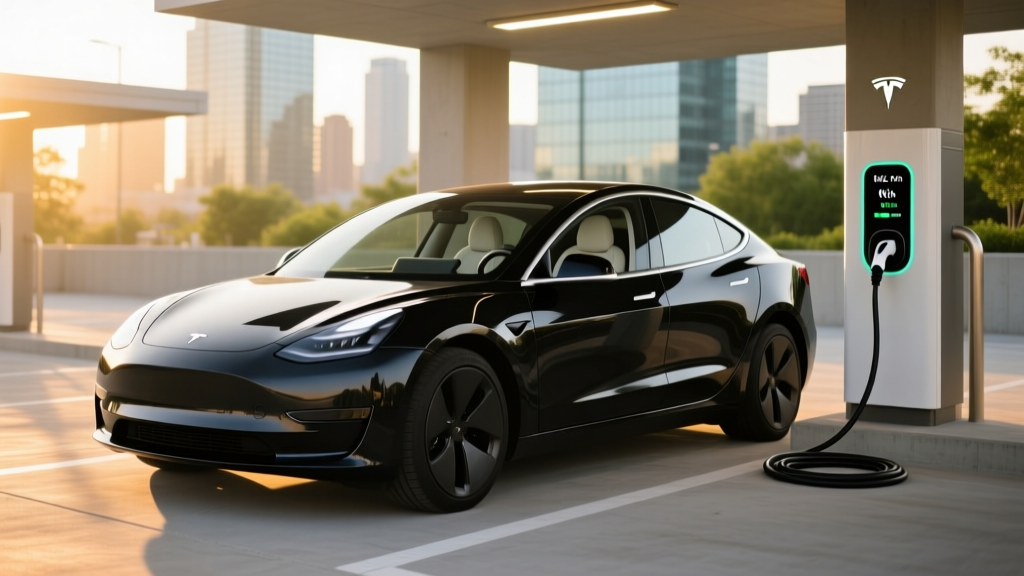
The Model Y charges at up to 250 kW on a V3 Supercharger or any compatible CCS/NACS DC fast charger. That peak rate holds roughly from 10% to about 35% state of charge, then tapers progressively. The full 10–80% session takes approximately 27 minutes under ideal thermal conditions — meaning the battery is preconditioned, either through the car's navigation-routed preconditioning or by driving for 20+ minutes before plugging in.
Here's a critical nuance many spec sheets omit: the sustained average charge rate across the full 10–80% session is closer to 150 kW. Peak kW numbers make headlines, but the charge curve taper above 50% SoC is where real charging time is determined. Tesla's battery thermal management is among the best in the industry, which is why the Model Y sustains higher rates longer than many competitors with similar peak ratings.
For home charging, the onboard charger accepts up to 11.5 kW (48 amps) on a 240V Level 2 circuit. A typical installation on a 60-amp breaker using a Tesla Wall Connector or equivalent J1772/NACS unit will deliver roughly 44 miles of range per hour of charging — enough to fully replenish the battery in about 7 hours. Installation costs for a Level 2 home setup typically run $500–$2,000 depending on panel proximity and whether your electrical panel needs an upgrade. Always consult a licensed electrician for final specs.
The 2026 Model Y ships with the NACS (North American Charging Standard) connector natively, giving it seamless access to Tesla's Supercharger network — now exceeding 25,000 stalls in North America — without adapters. Non-Tesla networks like Electrify America and EVgo also work natively as the industry converges on NACS.
Performance and Driving Dynamics
The Long Range AWD pairs dual permanent-magnet motors producing a combined 384 horsepower. The 0–60 mph sprint takes 4.8 seconds — genuinely quick for a family crossover, and more than adequate for highway merging and passing. The instant torque delivery that defines all EVs makes the Model Y feel even quicker than the stopwatch suggests around town.
The dual-motor AWD system provides confident traction in rain and light snow. Regenerative braking is strong enough for one-pedal driving in most conditions, though Tesla removed the user-adjustable regen setting several years ago — the car manages regen strength automatically based on battery temperature and state of charge.
Ride quality remains firm by crossover standards. The 2026 refresh improved suspension tuning slightly over earlier Juniper-generation models, but this is still a sport-oriented chassis. Families with small children may notice more head toss over broken pavement than in a Hyundai Ioniq 5 or Kia EV6, which prioritize comfort.
Interior, Cargo, and the Third-Row Reality
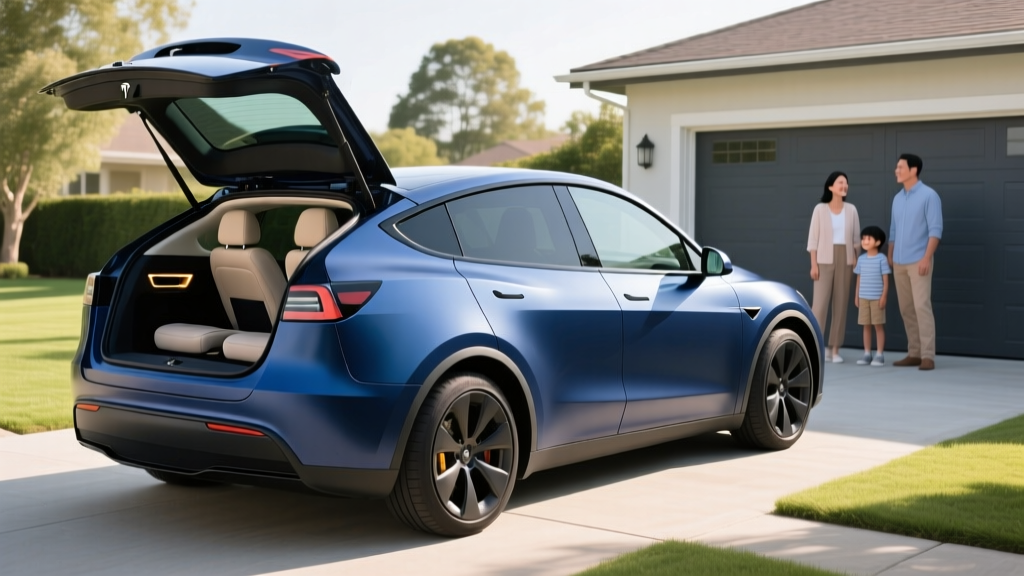
This is the section that matters most if you're considering the seven-seat option. Let's be direct: the Model Y's third row is a children-only space.
Third-row dimensions:
- Legroom: ~26 inches (suitable for children under approximately 4'10")
- Headroom: severely limited by the sloping roofline
- Access: requires folding and sliding the second row forward
- Seat orientation: rear-facing, mounted in the cargo floor area
Cargo volume:
- Behind third row (all seats up): ~12 cu ft — enough for a couple of grocery bags or a small stroller
- Third row folded, second row up: ~34 cu ft
- All rear seats folded: ~72 cu ft (including front trunk/frunk space)
- Frunk (front trunk): ~4.1 cu ft
The trade-off is mathematical: deploying the third row essentially eliminates usable cargo space. If you need seven seats and luggage room simultaneously, the Model Y cannot deliver both. The Kia EV9 (with its 300-mile range and genuine three-row SUV proportions) or the Rivian R1S are far more capable in that scenario — though both cost significantly more.
The 15.4-inch center touchscreen handles infotainment, climate, and vehicle settings. The 2026 Model Y retains Tesla's minimalist interior: no instrument cluster, no physical buttons for climate or mirrors. Everything routes through the screen. Rear passengers get a small 8-inch display for climate and entertainment controls — a meaningful improvement over earlier models that left second-row occupants reaching for the front screen.
Autopilot, FSD, and Driver Assistance
Tesla Autopilot and FSD (Supervised) are SAE Level 2 driver-assistance systems. The driver must remain fully engaged, hands on the wheel (or providing steering-torque input), and eyes on the road at all times. These systems are not self-driving. Only Level 4 services like Waymo operate without a human driver, and those are limited to geofenced urban areas.
Every 2026 Model Y includes Tesla's basic Autopilot: traffic-aware cruise control and lane-keeping assist on divided highways. The optional Full Self-Driving (Supervised) package — currently priced at $8,000 or $99/month — adds automated lane changes, navigate-on-autopilot for highway interchanges, traffic light and stop sign recognition, and the city-streets driving capability that Tesla continues to refine through over-the-air updates.
FSD (Supervised) has improved substantially in 2025–2026, with smoother interventions and fewer disengagements per mile. But it remains a supervised system: you are the driver, legally and practically. NHTSA continues to monitor Tesla's Autopilot and FSD crash data, and buyers should approach these features as convenience aids, not replacements for attention.
Standard safety equipment includes automatic emergency braking, blind-spot monitoring, rear cross-traffic alert, and 360-degree cameras. The Model Y earns top marks from both IIHS and NHTSA, consistently achieving 5-star overall ratings.
Pricing, Tax Credits, and Total Cost
| Trim / Configuration | MSRP (incl. destination) | Est. Price After §30D Credit |
|---|---|---|
| Long Range AWD (5-seat) | $47,990 | $40,490* |
| Long Range AWD (7-seat) | $49,990 | $42,490* |
| Performance AWD (5-seat only) | $52,490 | $44,990* |
*Federal tax credit eligibility requires meeting all IRS §30D criteria. See checklist below.
- MSRP cap: SUVs must be ≤ $80,000 (Model Y qualifies)
- Buyer income cap: Modified AGI ≤ $150,000 (single) / $300,000 (joint) / $225,000 (head of household)
- Battery sourcing: Critical minerals and battery components must meet phased-in percentage thresholds that increase annually — check current-year requirements on IRS.gov
- Point-of-sale transfer: As of 2024+, you can transfer the credit to the dealer at purchase, reducing your out-of-pocket cost immediately (rather than waiting for tax filing)
- Assembly: Vehicle must undergo final assembly in North America (Model Y: Fremont, CA and Austin, TX — qualifies)
Important: Battery-sourcing requirements tighten each year. Some Model Y configurations may qualify for the full $7,500, a partial $3,750, or no credit depending on the specific battery pack's mineral and component sourcing at time of delivery. Always verify eligibility on the IRS website or with a tax professional before purchasing.
Beyond the purchase price, the Model Y's total cost of ownership benefits from low fueling costs (electricity at $0.13/kWh national average works out to roughly $3.64 per 100 miles vs. $12–$14 for a comparable gas SUV), minimal maintenance (no oil changes, fewer brake replacements due to regen), and strong resale value. Insurance premiums, however, tend to run 15–25% higher than comparable non-electric crossovers — get quotes before committing.
How It Compares: Model Y 7-Seat vs. the Competition
If you need three rows in an electric vehicle, here's how the landscape looks in 2026:
| Vehicle | EPA Range | 3rd-Row Practicality | Base MSRP | Cargo (all seats up) |
|---|---|---|---|---|
| Tesla Model Y LR AWD (7-seat) | ~310 mi | Children only | $49,990 | ~12 cu ft |
| Kia EV9 GT-Line AWD | 270 mi | Adults (short trips) | $63,900 | ~20 cu ft |
| Rivian R1S Dual-Motor | 352 mi | Adults (comfortable) | $79,900 | ~18 cu ft |
| VW ID.4 (no 3rd row) | 291 mi | N/A — 2-row only | $44,995 | 30.3 cu ft |
The Model Y's seven-seat option occupies a narrow niche: it's the most affordable way to get seven seats in an EV, and the most efficient. But if you regularly carry more than five people or need real cargo space with all seats occupied, the Kia EV9 or Rivian R1S are substantially more capable — at a $14,000–$30,000 premium.
Pros and Cons
- Best-in-class efficiency (122 MPGe combined)
- Access to 25,000+ Supercharger stalls (NACS native)
- Strong 0–60 performance (4.8 sec) for a family hauler
- Over-the-air updates continuously improve the vehicle
- Lowest entry price for a 7-seat EV
- Top safety ratings (IIHS Top Safety Pick+, NHTSA 5-star)
- Heat pump standard for better cold-weather efficiency
- Third row fits only small children; no adult usability
- Cargo space nearly eliminated when third row is deployed
- Minimalist interior isn't for everyone (no physical buttons, no instrument cluster)
- FSD (Supervised) remains Level 2 — not autonomous driving
- Firm ride quality compared to comfort-oriented rivals
- Insurance premiums run higher than segment average
- Tax credit eligibility depends on battery sourcing — not guaranteed
Who Should Buy the Tesla 3-Row Model Y?
Choose the 7-seat Model Y if:
- You have 2–3 small children and occasionally need to carpool one or two more
- The third row would be used 10–20% of the time, not daily
- You prioritize efficiency and charging speed over interior volume
- You want the lowest entry price for any 7-seat EV
- You value Supercharger network access for road trips
- You regularly transport more than five people
- You need cargo space and full seating simultaneously
- Your passengers include teenagers or adults in the third row
- You prefer physical climate controls and a traditional instrument cluster
- You need more than ~310 miles of real-world range for your commute
The seven-seat Model Y is best understood as a five-seat SUV with an occasional emergency expansion option. It's the right call for families with young kids who carpool to school or activities a few times a week — and who can fold the third row flat the other 85% of the time to reclaim cargo space. If your needs are more demanding, the extra investment in a Kia EV9 or Rivian R1S pays dividends in daily usability.
Frequently Asked Questions
What is the real-world range of the Tesla 3-row Model Y?
The EPA rates the 7-seat Model Y Long Range AWD at approximately 310 miles. In real-world highway driving at 70–75 mph in moderate temperatures, expect 260–280 miles. In cold weather below freezing, plan for 210–240 miles. A full passenger load further reduces range by roughly 10–15 miles.
How fast does the Model Y charge at home and on the road?
On a DC fast charger, the Model Y peaks at 250 kW and charges from 10–80% in approximately 27 minutes (sustained average ~150 kW across the curve). At home on a 240V Level 2 charger (48A/11.5 kW), it adds about 44 miles of range per hour, fully charging in roughly 7 hours.
How much does the 7-seat Model Y cost after federal tax credits?
The 7-seat Long Range AWD starts at $49,990. If you qualify for the full $7,500 federal tax credit under IRS §30D — meeting income caps, MSRP limits, and battery-sourcing requirements — the effective price drops to approximately $42,490. However, credit eligibility depends on the specific battery pack sourcing at time of delivery. Always verify on IRS.gov before purchase.
Is the Tesla 3-row Model Y worth it vs. competitors?
It's the most affordable and efficient 7-seat EV available. If your third-row needs are occasional and your passengers are small children, it's an excellent value. If you need regular full-size seating and cargo, the Kia EV9 ($63,900) or Rivian R1S ($79,900) are far more practical despite the higher price.
Does the Model Y's third row have LATCH anchors for car seats?
The third-row seats in the Model Y are rear-facing and designed for smaller children. They do include restraint systems, but the space is tight. Check Tesla's owner manual for specific child-seat compatibility and weight limits before installing car seats in the third row.
What is the battery warranty on the Model Y?
Tesla covers the Model Y's battery and drive unit for 8 years or 120,000 miles (whichever comes first), with a minimum 70% capacity retention guarantee over that period. Based on industry data, NMC batteries in Tesla vehicles typically degrade 8–12% over the first 100,000 miles, well within the warranty threshold.