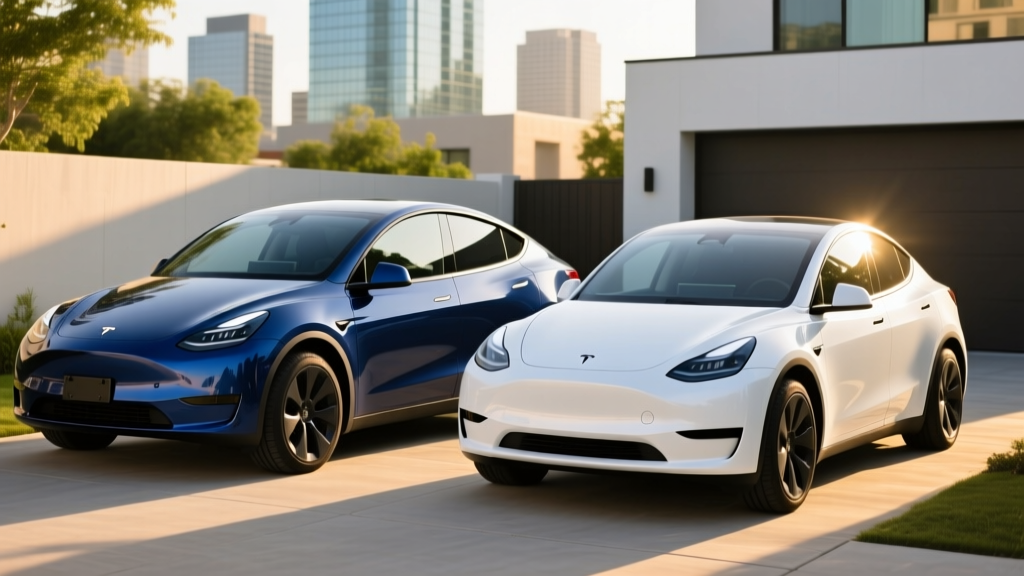
Tesla rarely advertises traditional dealer discounts, but the automaker frequently adjusts pricing, referral incentives, and financing rates to move metal. If you're researching Tesla current promotions in early 2026, you're likely weighing a Model Y or Model 3 purchase against a shifting landscape of federal tax credits, inventory availability, and aggressive competition from Hyundai, Ford, and Chevrolet. This guide decodes what Tesla is actually offering right now — not marketing spin, but the real numbers on range, charging, pricing after incentives, and whether these deals hold up against key rivals.
Tesla's 2026 Lineup at a Glance: Model 3 and Model Y
Tesla's volume sellers remain the Model 3 sedan and Model Y crossover. Both received significant refreshes in recent years — the Model 3 "Highland" update and the Model Y "Juniper" redesign — bringing improved interiors, better ride quality, and updated powertrains. Here's how the core trims stack up on paper for the 2026 model year.
| Spec | Model 3 RWD | Model 3 Long Range AWD | Model Y Long Range AWD | Model Y Performance |
|---|---|---|---|---|
| EPA Range | 272 mi | 363 mi | 320 mi | 295 mi |
| Battery (usable) | ~57.5 kWh (LFP) | ~75 kWh (NMC) | ~75 kWh (NMC) | ~75 kWh (NMC) |
| 0-60 mph | 5.8 sec | 4.2 sec | 4.8 sec | 3.5 sec |
| Horsepower | 271 hp | 346 hp | 384 hp | 456 hp |
| Drivetrain | RWD | Dual-Motor AWD | Dual-Motor AWD | Dual-Motor AWD |
| Efficiency (MPGe) | 132 MPGe | 132 MPGe | 117 MPGe | 111 MPGe |
| Base MSRP | $38,990 | $45,990 | $46,990 | $51,490 |
Sources: fueleconomy.gov, Tesla.com. Prices exclude destination fee and are subject to change. Verify current pricing at Tesla.com.
What Tesla Current Promotions Actually Include in 2026
Tesla doesn't run "sales" in the traditional sense — no dealer haggling, no cash-back envelopes. Instead, the company adjusts pricing dynamically and periodically offers:
- Reduced APR financing — Tesla has periodically offered rates as low as 0.99%–2.99% on select inventory, typically on in-stock vehicles rather than custom orders. As of early 2026, promotional financing is available on select Model Y configurations.
- Referral benefits — Tesla's referral program periodically grants credits toward accessories, Supercharging, or FSD trials when you use an existing owner's referral link. The exact value fluctuates.
- Free Supercharging credits — Occasionally bundled with end-of-quarter delivery pushes, typically 5,000–10,000 free Supercharger miles.
- Inventory price adjustments — Tesla routinely adjusts MSRP across trims. In late 2025 and early 2026, the Model 3 RWD and Model Y Long Range saw multiple price revisions.
The most impactful "promotion" for most buyers remains the federal §30D tax credit, which can reduce your effective cost by up to $7,500 — but eligibility has strict requirements detailed below.
Real-World Range vs. EPA Estimates: What Owners Actually See
EPA Sticker: Model 3 Long Range AWD — 363 miles
Real-World Expectation: ~290–320 miles highway (70-75 mph); ~240–270 miles in freezing temperatures with cabin heat.
Tesla's EPA range figures are among the most accurate in the industry, but physics still applies. Highway driving at sustained speeds above 70 mph increases aerodynamic drag, typically reducing range by 10–15% versus the EPA combined cycle. Cold weather (below 32°F) hits harder — expect 20–30% range loss due to battery resistance and cabin heating demands, though Tesla's heat pump mitigates this better than most competitors.
The Model 3 RWD with its LFP battery offers a unique advantage: Tesla recommends charging LFP packs to 100% regularly, meaning you get the full 272 miles of usable capacity daily. NMC packs (Long Range, Performance) are best kept at 80% for daily use, reserving 100% for road trips — effectively giving you ~290 daily usable miles on the 363-mile Long Range.
Charging Speed: DC Fast Charging and Home Level 2
Charging speed is where Tesla's Supercharger network advantage meets hard physics. Here's what to expect across charging levels:
| Charging Level | Power | Speed (approx.) | Notes |
|---|---|---|---|
| Level 1 (120V) | ~1.4 kW | ~3–5 mi/hr | Emergency/trickle only |
| Level 2 (240V, 48A) | ~11.5 kW | ~37–44 mi/hr | Home Wall Connector; full charge in ~7–9 hrs |
| DC Fast (V3 Supercharger) | Peak 250 kW | 10–80% in ~25–30 min | Peak rate sustained only up to ~50% SoC |
| DC Fast (V4 Supercharger) | Peak 250+ kW | 10–80% in ~22–27 min | Newer stalls; availability varies by location |
Charging curve reality check: The advertised 250 kW peak applies only at low states of charge (roughly 10–30% SoC) and with a preconditioned battery. Above 50%, the rate tapers significantly — expect ~100–120 kW at 60% and ~50 kW near 80%. This is why the 10–80% time (~25–30 minutes) is a more useful metric than peak kW alone. On a road trip, plan for 20–25 minute stops every 2–3 hours.
At home, the Tesla Wall Connector ($475) on a 60-amp circuit delivers up to 11.5 kW, adding roughly 40 miles of range per hour. Most owners charge overnight and start every morning with a full battery — effectively eliminating daily range concerns.
Pricing After Tax Credits: What You'll Actually Pay
Understanding Tesla's pricing requires layering the federal tax credit on top of MSRP. Here's how the math works for 2026:
| Model/Trim | Base MSRP | Est. Max Credit | Effective Price |
|---|---|---|---|
| Model 3 RWD | $38,990 | $7,500 | ~$31,490* |
| Model 3 Long Range AWD | $45,990 | $7,500 | ~$38,490* |
| Model Y Long Range AWD | $46,990 | $7,500 | ~$39,490* |
| Model Y Performance | $51,490 | $7,500 | ~$43,990* |
*Effective price assumes full §30D credit eligibility. Actual credit may be $0–$7,500 depending on battery sourcing, buyer income, and MSRP caps. Verify at IRS.gov or with a tax professional.
§30D Federal Tax Credit Requirements (2026):
- MSRP Cap: SUVs/vans/pickups ≤ $80,000; sedans ≤ $55,000. All current Model 3 and Model Y trims qualify on price.
- Income Cap: AGI ≤ $150,000 (single), $225,000 (head of household), $300,000 (joint). Exceed this and you're ineligible.
- Battery Sourcing: Up to $3,750 requires critical minerals from FTA countries; up to $3,750 requires battery components manufactured in North America. Sourcing rules tighten annually — some Tesla configurations may qualify for only $3,750 or $0 depending on the battery's supply chain.
- Point-of-Sale Transfer: You can transfer the credit to Tesla at purchase, reducing your out-of-pocket cost immediately rather than waiting for tax filing.
Tech, Interior, and Driver Assistance
The refreshed Model 3 and Model Y interiors are minimalist by design — a 15.4-inch center touchscreen handles virtually everything, including climate controls, navigation, and media. The Juniper Model Y adds ventilated front seats, a rear touchscreen, power-folding mirrors, and improved sound insulation.
Autopilot comes standard and includes adaptive cruise control, lane-keeping, and automatic emergency braking. Full Self-Driving (Supervised) is an $8,000 add-on (or $99/month subscription) that adds city-street navigation, traffic light recognition, and automated lane changes.
SAE Automation Level: Level 2. Both Autopilot and FSD (Supervised) require continuous driver attention and hands-on-wheel monitoring. These are not self-driving systems. You are legally and operationally responsible for the vehicle at all times. True driverless operation (Level 4) is currently limited to geofenced robotaxi services like Waymo.
Cargo and passenger space:
- Model 3: 23 cu ft trunk + rear seats fold; 42.3" front / 35.3" rear legroom
- Model Y: 30 cu ft behind rear seats (76 cu ft folded); 41.8" front / 41.6" rear legroom
Pros, Cons, and Who Should Buy
Pros
- Access to the Supercharger network — the most reliable DC fast-charging network in North America
- Class-leading efficiency (kWh/100mi) across trims
- Strong software/OTA update cadence
- LFP battery option (Model 3 RWD) allows daily 100% charging with minimal degradation concern
- Competitive pricing after §30D credit
Cons
- No Apple CarPlay or Android Auto
- FSD (Supervised) remains a Level 2 system despite the name and price
- Minimalist interior not for everyone — no physical buttons for climate or mirrors
- Service center availability varies; body repair can take weeks in some markets
- Ride quality improved but still firm compared to Hyundai Ioniq 5 or Chevrolet Equinox EV
Choose the Model 3 RWD if: You commute under 60 miles daily, can charge at home, and want the lowest entry price with LFP battery longevity.
Choose the Model 3 Long Range if: You take regular road trips and need 300+ miles of real-world range without frequent charging stops.
Choose the Model Y Long Range if: You need crossover cargo space, rear-seat room for car seats, or AWD for snow-belt winters.
Look elsewhere if: You want physical controls, CarPlay, a softer ride, or a traditional dealership service experience.
How Tesla Stacks Up Against Key Competitors
The Model Y and Model 3 face serious competition in 2026. Here's how they compare on the metrics that matter:
- vs. Hyundai Ioniq 5: The Ioniq 5 charges faster (800V architecture, 10–80% in ~18 min at 350 kW) and offers a more comfortable ride. But Tesla wins on Supercharger network access and software integration. The Ioniq 5's EPA range tops out at ~318 miles (Long Range RWD).
- vs. Ford Mustang Mach-E: The Mach-E offers a more conventional interior and BlueCruise hands-free highway driving. Range is competitive (~320 mi Extended Range), but charging is slower and Ford's DC charging reliability has trailed Tesla's.
- vs. Chevrolet Equinox EV: Significantly cheaper (starting ~$33,000 before credit) with 319 miles of range. Slower charging and less performance, but an excellent value play for budget-conscious buyers.
Warranty and Long-Term Ownership
Tesla's warranty coverage is competitive but not class-leading:
- Vehicle: 4 years / 50,000 miles (bumper-to-bumper)
- Battery & Drive Unit: 8 years / 100,000 miles (Model 3 RWD); 8 years / 120,000 miles (Long Range & Performance trims)
- Capacity retention threshold: Tesla warrants that the battery will retain at least 70% of original capacity during the warranty period
Real-world degradation data from fleet analyses shows Tesla NMC packs typically lose 5–8% capacity over the first 100,000 miles, with LFP packs showing comparable or slightly better retention. Battery replacement outside warranty currently runs $12,000–$16,000 depending on the pack — a cost to factor if you plan to keep the vehicle past 150,000 miles.
Frequently Asked Questions
What is the real-world range of a Tesla Model Y in 2026?
The Model Y Long Range AWD carries a 363-mile EPA rating, but expect ~270–300 miles on highway road trips at 70-75 mph, and ~220–250 miles in sub-freezing winter conditions. The Model Y Performance drops to roughly 250–270 real-world highway miles due to larger wheels and sport tuning.
How fast does a Tesla charge on a road trip?
On a V3 or V4 Supercharger, the Model 3 Long Range and Model Y peak at ~250 kW and charge from 10–80% in approximately 25–30 minutes with a preconditioned battery. The Model 3 RWD with its smaller LFP pack charges at a lower peak (~170 kW) and takes ~30–35 minutes for the same 10–80% session.
Does the Tesla Model Y qualify for the $7,500 federal tax credit?
The Model Y qualifies on MSRP (under the $80,000 SUV cap), but full $7,500 credit eligibility depends on battery component and critical mineral sourcing, which changes periodically. Your personal AGI must also fall under IRS income caps ($300,000 joint / $150,000 single). Check the IRS clean vehicle credit page and verify with Tesla at point of sale, as you can transfer the credit to reduce your purchase price immediately.
Is it worth buying a Tesla vs. a Hyundai Ioniq 5 or Chevy Equinox EV?
If Supercharger network access and software are your top priorities, Tesla remains the default. If you value faster DC charging (Ioniq 5's 800V system), physical controls, or a lower price (Equinox EV), competitors make a compelling case. Test-drive both before deciding.
What are the biggest drawbacks of owning a Tesla?
The lack of Apple CarPlay/Android Auto frustrates many buyers. Service center wait times can stretch weeks in less-populated areas. FSD (Supervised) costs $8,000 but remains a Level 2 driver-assist system — not autonomous driving. And the minimalist interior, while clean, requires touchscreen interaction for basic adjustments like mirror positioning and wiper speed.
Are there any Tesla promotions or discounts right now?
Tesla's "promotions" typically take the form of reduced APR financing on select inventory, referral credits, or occasional free Supercharging bundles — especially near quarter-end delivery pushes. The most impactful discount remains the federal §30D tax credit (up to $7,500 via point-of-sale transfer). Check Tesla.com's inventory page for current financing offers in your region.