NYC Congestion Pricing Meets the Electric Vehicle: What Tesla Owners Need to Know
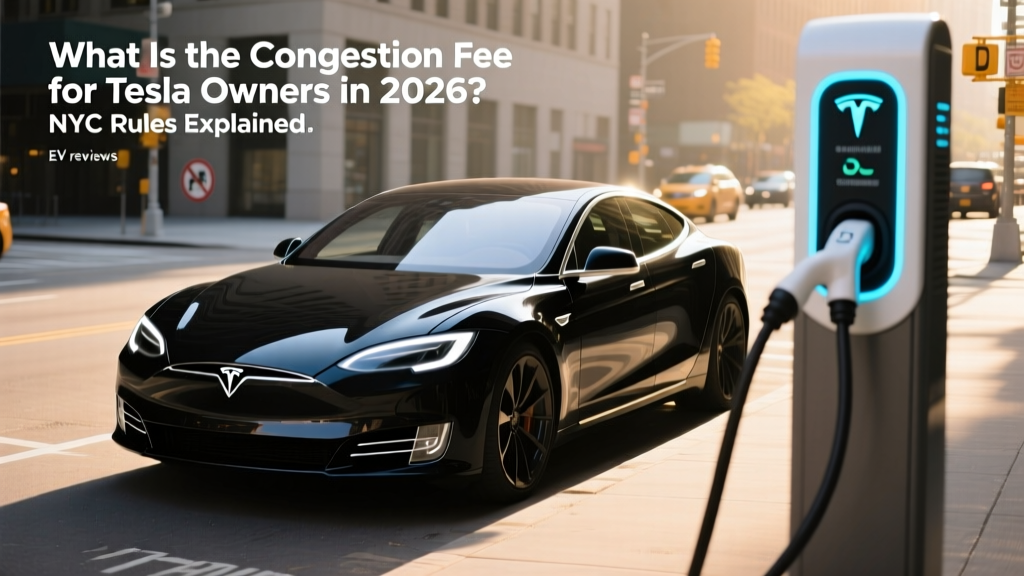
If you've searched "what is congestion fee Tesla" you're likely a New York City commuter—or someone planning to drive into Manhattan below 60th Street—wondering whether your Tesla gets a break. The short answer: as of 2026, New York's congestion pricing program charges most passenger vehicles a base toll during peak hours, and battery-electric vehicles including Teslas do not receive a blanket exemption. However, specific discount programs, toll caps, and the sheer efficiency advantage of an EV can make the financial picture more nuanced than a simple toll sticker.
Below, we break down exactly how congestion pricing works for Tesla drivers, which models are affected, and whether the math still favors going electric in the five boroughs and beyond.
How NYC Congestion Pricing Works in 2026
New York City's congestion pricing zone covers all streets in Manhattan south of and including 60th Street. Cameras at every entry point—bridges, tunnels, and surface avenues—read your license plate and charge the registered vehicle automatically via E-ZPass or Tolls-by-Mail.
| Time Window | E-ZPass Rate | Tolls-by-Mail Rate |
|---|---|---|
| Peak (5 AM – 9 PM weekdays) | $9.00 | $13.50 |
| Overnight (9 PM – 5 AM weekdays) | $2.25 | $3.40 |
| Weekends (all day Sat–Sun) | $2.25 | $3.40 |
Source: MTA Congestion Pricing. Rates shown are for standard passenger vehicles; commercial trucks and for-hire vehicles face different schedules.
Does Tesla Get a Congestion Fee Discount or Exemption?
This is the core of the "what is congestion fee Tesla" question. As of 2026, New York does not offer a dedicated EV discount on the congestion toll. Unlike London's ULEZ (Ultra Low Emission Zone), which exempts zero-emission vehicles, NYC's program was designed primarily to reduce traffic volume and fund the MTA—not to incentivize EV adoption directly.
Here's what is available that can affect your Tesla's toll bill:
- Low-Income Discount Plan (LIDP): Drivers with household incomes below $50,000 can apply for a 50% discount on daytime tolls after their first 10 trips in a month. This applies to any vehicle, including Teslas.
- Disability Exemption: Vehicles registered to individuals with qualifying disabilities can apply for full exemption.
- Crossing Credit: If you already paid a toll on the Lincoln, Holland, Hugh L. Carey, or Queens-Midtown tunnels within the same entry period, you receive a credit (up to $3.00 off the peak congestion toll).
- E-ZPass Advantage: Simply having an E-ZPass linked to your Tesla saves you $4.50 per peak trip versus Tolls-by-Mail.
Bottom line: A Tesla Model 3 or Model Y entering Manhattan during weekday peak hours pays the same $9.00 congestion toll as a gas-powered Honda Civic—unless the driver qualifies for the LIDP or disability exemption.
The Real EV Advantage: Running Cost vs. Gas Cars in the Congestion Zone
While the congestion toll itself doesn't discriminate, the total cost of driving into Manhattan heavily favors a Tesla. Consider the full picture for a commuter driving 15 miles each way from, say, Jersey City into Midtown:
| Cost Factor | Tesla Model 3 RWD | Toyota Camry LE (Gas) |
|---|---|---|
| Congestion Toll (E-ZPass, peak) | $9.00 | $9.00 |
| Energy/Fuel (30 mi round trip) | ~$2.70 (home charging at $0.18/kWh) | ~$4.80 (30 MPG at $3.60/gal) |
| Daily Total | $11.70 | $13.80 |
| Monthly (22 workdays) | $257.40 | $303.60 |
The Tesla saves roughly $46/month on energy alone. Add in zero oil changes, fewer brake pad replacements (thanks to regenerative braking), and potential insurance discounts for EV safety ratings, and the ownership gap widens further—even with an identical congestion toll.
Which Tesla Models Are Affected (and How They Compare)
All Tesla models currently sold in the US are classified as passenger vehicles and face the same congestion toll. Here's how the 2026 lineup stacks up on the specs that matter for urban commuters:
| Model | EPA Range | Battery (kWh) | Efficiency | 0–60 mph | Base MSRP |
|---|---|---|---|---|---|
| Model 3 RWD | 272 mi | 60 kWh (LFP) | 132 MPGe / 25 kWh/100mi | 5.8s | $38,990 |
| Model 3 Long Range AWD | 341 mi | 79 kWh (NMC) | 134 MPGe / 25 kWh/100mi | 4.2s | $45,240 |
| Model Y LR AWD | 320 mi | 79 kWh (NMC) | 122 MPGe / 28 kWh/100mi | 4.8s | $46,630 |
| Model S LR | 402 mi | 100 kWh (NMC) | 124 MPGe / 27 kWh/100mi | 3.1s | $74,990 |
Data sourced from fueleconomy.gov and Tesla.com.
Charging in the Congestion Zone: Where Tesla Owners Plug In
One practical advantage Tesla owners retain in Manhattan is access to the Supercharger network. As of 2026, Tesla operates several urban Supercharger stations in and around the congestion zone:
- Tesla Supercharger – Hudson Yards (V3, 250 kW peak) — western edge of the zone
- Tesla Supercharger – Lower East Side (V3, 250 kW peak)
- Destination Chargers at dozens of Manhattan garages and hotels (Level 2, typically 11.5 kW / ~44 mi/hr)
| Charging Level | Power | Speed | 10–80% Time |
|---|---|---|---|
| Level 1 (120V household) | 1.4 kW | ~5 mi/hr | N/A (overnight only) |
| Level 2 (240V home/Wall Connector) | 11.5 kW | ~44 mi/hr | ~6.5 hours |
| DC Fast (V3 Supercharger) | 250 kW peak | ~170 mi in 15 min | ~25 minutes |
Real-world charging note: The 250 kW peak rate on a V3 Supercharger applies primarily between 10–40% State of Charge. Above 60%, the charge curve tapers significantly—you'll see roughly 80–100 kW from 60–80%, which is why the 10–80% time is ~25 minutes rather than the ~15 minutes marketing sometimes implies. Battery preconditioning (navigating to a Supercharger in the Tesla nav) is essential to hit peak rates, especially in cold weather.
Federal Tax Credit and Total Cost: Does It Offset the Congestion Fee?
While the congestion fee itself has no EV discount, the federal §30D tax credit can significantly reduce your Tesla's purchase price—making the toll a smaller fraction of your total ownership cost.
| Model | Base MSRP | §30D Credit | Effective Price | MSRP Cap? | Income Cap |
|---|---|---|---|---|---|
| Model 3 RWD | $38,990 | Up to $7,500 | ~$31,490 | Under $55K ✓ | $150K single / $300K joint |
| Model 3 LR AWD | $45,240 | Up to $7,500 | ~$37,740 | Under $55K ✓ | $150K single / $300K joint |
| Model Y LR AWD | $46,630 | Up to $7,500 | ~$39,130 | Under $80K ✓ | $150K single / $300K joint |
| Model S LR | $74,990 | $0 (over cap) | $74,990 | Over $55K ✗ | Does not apply |
Critical caveats per IRS §30D rules:
- MSRP caps: Sedans (Model 3) must be under $55,000; SUVs/pickups/vans (Model Y) under $80,000. Fully loaded trims that exceed these caps lose eligibility.
- Income caps: Modified AGI must not exceed $150,000 (single) or $300,000 (married filing jointly).
- Battery sourcing: The full $7,500 requires meeting both critical-minerals and battery-component requirements. Partial credit ($3,750) is available if only one requirement is met. Check the latest IRS eligible-vehicle list before purchasing.
- Point-of-sale transfer: As of 2024, you can transfer the credit to the dealer at purchase for an immediate price reduction rather than waiting for tax-time.
Is a Tesla Worth It for NYC Congestion-Zone Commuters?
Pros
- Lowest per-mile energy cost in the zone: ~$0.09/mile on home charging vs. ~$0.16/mile for a 30 MPG gas car
- Supercharger network is the most reliable public charging infrastructure in the NYC metro
- Regenerative braking reduces brake wear significantly in stop-and-go Manhattan traffic
- §30D credit (up to $7,500) on Model 3 and Model Y dramatically lowers effective purchase price
- OTA updates continuously improve efficiency, navigation, and driver-assist features
- Heat pump on all current models minimizes cold-weather range loss vs. older EVs
Cons
- No congestion-fee discount for EVs in NYC (unlike London ULEZ)
- Street parking charging in Manhattan remains scarce—home garage or workplace charging is nearly essential
- Insurance premiums for Teslas in NYC average 15–25% higher than comparable gas sedans
- Model S/X exceed MSRP caps and receive no federal tax credit
- FSD (Supervised) remains SAE Level 2—driver must stay engaged at all times, despite the "Full Self-Driving" name
Who Should Buy a Tesla for Manhattan Commuting?
Best fit: Commuters who have access to home or workplace Level 2 charging, drive into the congestion zone regularly (where the per-mile energy savings compound), and qualify for the §30D tax credit. The Model 3 RWD at ~$31,500 after credit is arguably the best value-per-mile vehicle available for this use case.
Consider alternatives if: You rely exclusively on street parking with no charging access, your income exceeds §30D caps, or you need a vehicle under $30,000. In those cases, a plug-in hybrid like the Toyota RAV4 Prime (42 mi electric range, no charging-dependency) may offer a more practical bridge.
Frequently Asked Questions
Does a Tesla pay the NYC congestion fee?
Yes. As of 2026, all passenger vehicles—including battery-electric Teslas—pay the same congestion toll entering Manhattan below 60th Street. The base peak-hour rate is $9.00 with E-ZPass. There is no EV-specific exemption in New York's program.
How much is the congestion fee for a Tesla Model 3?
The toll is identical to any passenger car: $9.00 during weekday peak hours (5 AM–9 PM), $2.25 overnight and weekends, with E-ZPass. Tolls-by-Mail rates are 50% higher. The vehicle's powertrain (electric or gas) does not affect the rate.
Do any electric vehicles get a discount on NYC congestion pricing?
Not currently. Unlike London's Congestion Charge and ULEZ, which exempt zero-emission vehicles, NYC's program charges all passenger vehicles equally. Discounts exist only for low-income drivers (50% off after 10 trips/month) and qualifying disabled individuals.
What is the real-world range of a Tesla Model 3 in NYC commuting?
The Model 3 RWD carries an EPA rating of 272 miles. In real-world NYC commuting—stop-and-go traffic, climate control use, and cold winters—expect roughly 220–240 miles. Highway driving at 70+ mph reduces range to approximately 230–250 miles. The Model 3 Long Range AWD (EPA 341 mi) provides a more comfortable buffer, delivering ~280–300 real-world miles in mixed conditions.
Can I charge my Tesla at home in Manhattan?
It depends on your building. Most Manhattan apartment buildings lack private garages with 240V outlets. If you have a deeded garage spot, a Tesla Wall Connector (11.5 kW, ~44 mi/hr) requires a dedicated 60A circuit—budget $1,500–$4,000 for electrician installation depending on panel capacity. Without home charging, rely on workplace Level 2 chargers or the Supercharger network (V3 stations at Hudson Yards and the Lower East Side offer 250 kW DC fast charging).
Does the Tesla Model Y qualify for the federal tax credit?
Yes, the Model Y Long Range AWD (MSRP $46,630) qualifies for up to $7,500 under IRS §30D, as it falls under the $80,000 SUV MSRP cap. Eligibility requires meeting income thresholds ($150K single / $300K joint) and battery-sourcing requirements. The credit can be transferred at point of sale for an immediate price reduction. Always verify current eligibility on IRS.gov before purchasing.
How does the congestion fee affect total Tesla ownership cost in NYC?
For a daily commuter entering the zone 22 days/month, the congestion toll adds approximately $198/month ($9 × 22 trips). However, the Tesla's energy savings (~$46/month vs. a 30 MPG gas car), reduced maintenance, and federal tax credit (up to $7,500) substantially offset this over a 5-year ownership period. The net result: a Tesla commuter still pays less per mile overall than a gas-car commuter paying the same toll.