If you're searching for a Tesla near Columbus Easton, you're likely weighing whether the 2026 Model Y fits Ohio driving realities — from I-71 commutes to winter road trips along US-33. The Model Y remains Tesla's highest-volume vehicle for good reason: crossover utility, access to the Supercharger network, and competitive efficiency. But EPA stickers and marketing copy don't tell you what it's like to live with one in central Ohio's climate.
This review breaks down the 2026 Tesla Model Y with the exact numbers that matter — real-world range in cold weather, actual charging speeds (not just peak kW), out-the-door pricing after federal tax credits, and how it stacks up against the Hyundai Ioniq 5 and Ford Mustang Mach-E. Whether you're charging at home in Westerville or relying on the Easton Supercharger station, here's everything you need before you order.
2026 Model Y at a Glance: Key Specifications
| Spec | Value |
|---|---|
| EPA Range | 320 miles |
| Battery Capacity | ~75 kWh usable (NMC) |
| Drivetrain | Dual-Motor AWD |
| Horsepower | ~384 hp (combined) |
| 0–60 mph | 4.8 seconds |
| Max DC Fast Charge | 250 kW (peak) |
| 10–80% DC Charge Time | ~27 minutes |
| Level 2 Home Charge Rate | 11.5 kW (~44 mi/hr) |
| Efficiency | 122 MPGe / 28 kWh/100 mi |
| Cargo Volume | 76.2 cu ft (rear seats folded) |
| Rear Legroom | 41.6 inches |
| Base MSRP (Long Range AWD) | $44,990 |
| Battery Warranty | 8 years / 120,000 miles |
Note: Tesla adjusts pricing periodically. Verify current MSRP on Tesla's configurator before ordering. The base RWD model starts lower but uses an LFP battery with reduced range (~260 mi EPA).
Real-World Range: What to Expect Beyond the EPA Sticker
EPA Estimate: 320 miles (Long Range AWD)
Real-World Highway (70–80 mph): ~260–280 miles
Real-World Winter (30°F, mixed driving): ~220–250 miles
Cold-Weather Highway (20°F, 75 mph): ~200–220 miles
The EPA's 320-mile figure assumes a mix of city and highway driving at moderate temperatures. In practice, the Model Y Long Range AWD delivers closer to 260–280 miles on a flat highway at 70 mph in 65°F weather. Efficiency drops to roughly 3.5–3.8 miles per kWh at sustained highway speeds versus the EPA-rated 3.6–4.0 mi/kWh combined.
For Columbus drivers, winter is the bigger variable. Lithium-ion batteries lose efficiency in cold temperatures, and cabin heating draws significant energy even with the Model Y's heat pump (standard on all 2026 trims). Expect a 20–30% range reduction in sustained sub-40°F weather. A January commute from Dublin to Easton and back — roughly 30 miles round trip — won't tax the battery, but a winter drive to Cincinnati (roughly 110 miles each way) will require a charge stop if you're starting below 90% State of Charge.
According to fueleconomy.gov, the Model Y Long Range AWD achieves 122 MPGe combined. That translates to roughly 28 kWh per 100 miles — among the most efficient in the compact electric crossover segment.
Charging Speeds: DC Fast, Home, and the Easton Supercharger
| Charging Level | Power / Rate | Miles Added per Hour | Notes |
|---|---|---|---|
| Level 1 (120V) | ~1.4 kW | ~4–5 mi/hr | Emergency/trickle only |
| Level 2 (240V, 48A) | 11.5 kW | ~44 mi/hr | Full charge in ~7 hours |
| DC Fast (V3 Supercharger) | 250 kW peak | ~1,000 mi/hr (at peak) | 10–80% in ~27 min |
| DC Fast (V4 Supercharger) | 250 kW peak | Same as V3 for Model Y | CCS-adapter compatible |
The Model Y's 250 kW peak DC fast-charging rate is competitive but not class-leading — the Hyundai Ioniq 5 can peak at 350 kW on an 800V architecture. However, peak kW is misleading without understanding the charge curve. The Model Y sustains roughly 150–200 kW between 10–50% SoC, then tapers progressively. From 50–80%, expect an average of ~80–100 kW. This is why the 10–80% time lands around 27 minutes rather than the theoretical minimum.
Preconditioning matters. If you navigate to a Supercharger using the car's built-in navigation, the battery thermal management system begins warming the pack 10–15 minutes before arrival. Skip this step (for example, by driving to a charger without setting it as a destination), and your initial charge rate may be significantly lower — especially in Ohio winters when ambient temps hover around freezing.
Charging at Home Near Easton
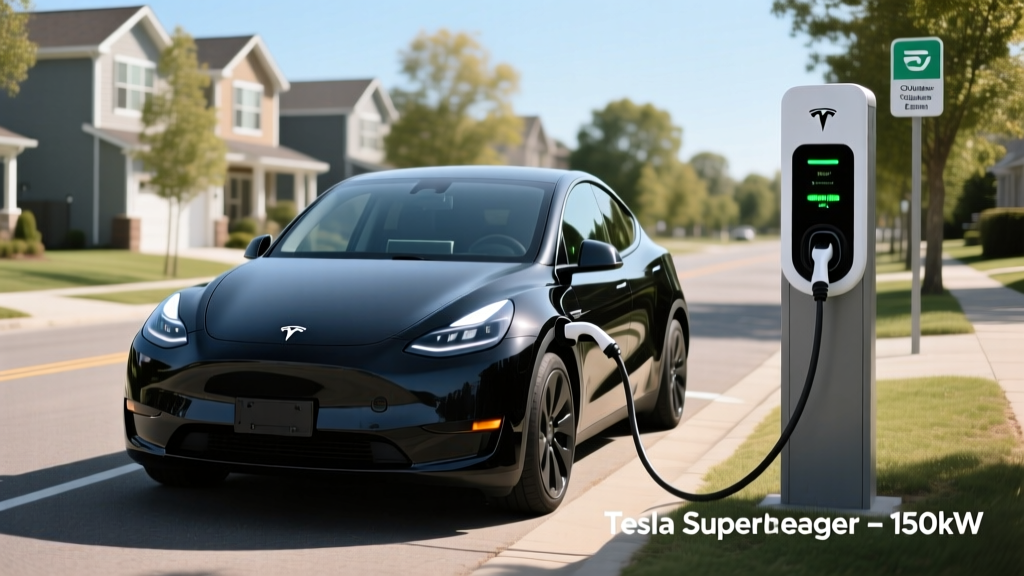
Most Columbus-area owners charge at home. A Level 2 Wall Connector (Tesla's $475 home unit) on a 60-amp circuit delivers 11.5 kW — enough to add roughly 44 miles of range per hour, or a full charge overnight. Installation in the Easton/Westerville/New Albany area typically runs $800–$2,500 depending on panel capacity and run length. Homes with a 200-amp electrical panel usually accommodate a 60-amp circuit without a panel upgrade.
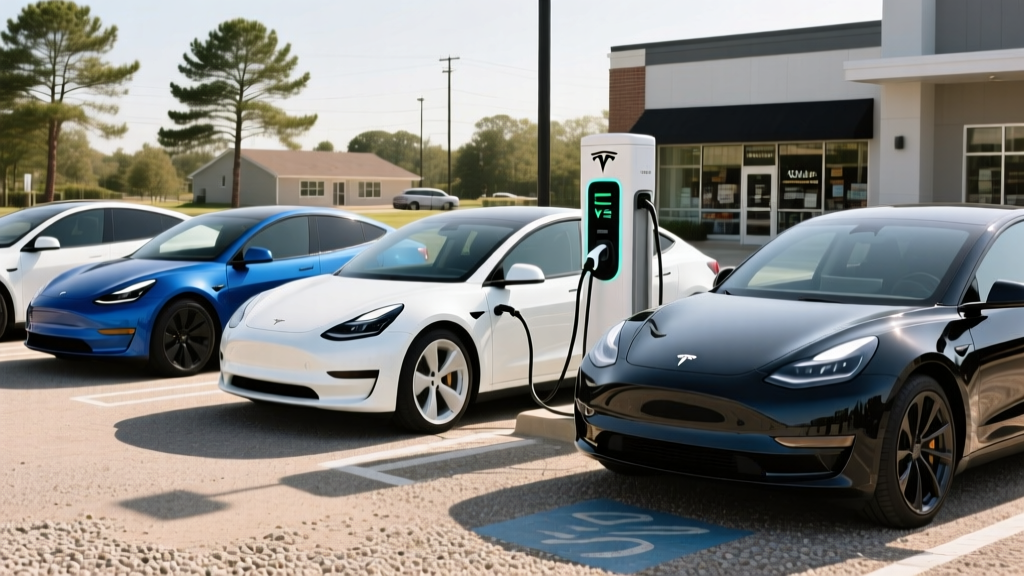
The Easton Town Center area also hosts a Tesla Supercharger station (V3, 250 kW stalls). This is convenient for apartment dwellers or those without home-charging access, though regular Supercharger use costs roughly 2–3× more per mile than home charging. At current Ohio Supercharger rates (~$0.28–$0.33/kWh), expect to pay about $20–$25 for a 10–80% charge.
Pricing, Tax Credits, and Out-the-Door Cost
| Trim | Base MSRP | Est. §30D Credit | Effective Price |
|---|---|---|---|
| Long Range AWD | $44,990 | Up to $7,500* | ~$37,490* |
| Performance AWD | $49,990 | Up to $7,500* | ~$42,490* |
*Federal §30D tax credit eligibility depends on buyer income, battery component sourcing, and critical mineral requirements. The Model Y qualifies for up to $7,500 for eligible buyers as of early 2026, with point-of-sale transfer available. Verify current eligibility on irs.gov.
Federal Tax Credit Rules (§30D) — What You Must Know
- Income caps: Modified AGI must not exceed $150,000 (single), $225,000 (head of household), or $300,000 (joint filers).
- MSRP cap: SUVs/crossovers must be under $80,000 — the Model Y clears this easily.
- Battery sourcing: The $7,500 credit splits into two halves — $3,750 for critical mineral sourcing and $3,750 for battery component manufacturing. Tesla's Fremont/Austin-built Model Y has historically qualified for the full $7,500, but sourcing requirements tighten annually. Confirm before ordering.
- Point-of-sale transfer: Since 2024, buyers can transfer the credit to the dealer (Tesla) at purchase, reducing the purchase price directly rather than waiting for a tax refund.
Ohio does not currently offer a state EV purchase incentive, though some municipal utilities (such as AEP Ohio) have offered time-of-use rate programs that reduce home charging costs. Check with your utility for current EV rate plans.
Performance, Ride, and Daily Driving
The Long Range AWD Model Y delivers 384 combined horsepower and hits 0–60 mph in 4.8 seconds — brisk for a family crossover and more than adequate for merging onto I-270 from Easton. The Performance trim drops that to 3.5 seconds with 510 hp, though the stiffer suspension tuning trades some ride comfort for cornering composure.
Ride quality on the 2026 Model Y has improved over earlier model years, with updated damper tuning that better absorbs the expansion joints and potholes common on central Ohio roads. The cabin is quieter than pre-2025 versions thanks to additional sound deadening, though it still falls short of the Hyundai Ioniq 5's isolation at highway speeds.
One-pedal driving via regenerative braking is strong but not as aggressive as some competitors. The Model Y doesn't come to a complete stop in "Hold" mode without light brake application at very low speeds — a minor quirk if you're transitioning from a Chevrolet Bolt or Nissan Leaf.
Tech, Driver Assistance, and Interior
The 15.4-inch center touchscreen handles all vehicle controls — there are no physical buttons for climate, mirrors, or glovebox. This minimalist approach divides opinion, but the interface is responsive and the navigation system is among the best in any EV, with real-time Supercharger availability and automatic battery preconditioning.
Autopilot and FSD (Supervised)
Tesla Autopilot and Full Self-Driving (Supervised) are Level 2 driver-assistance systems. The driver must remain fully engaged — hands on the wheel, eyes on the road — at all times. These are NOT autonomous or self-driving systems. SAE Level 4 (no driver required) is currently only available through commercial robotaxi services like Waymo in select cities.
Standard Autopilot includes adaptive cruise control and lane-centering on highways. The optional FSD (Supervised) package ($8,000 one-time or $99/month subscription as of 2026) adds automated lane changes, traffic light and stop sign recognition, and city-street navigation. It works well in many scenarios but requires constant supervision — particularly in construction zones and on poorly marked rural Ohio roads.
Cargo and Passenger Space
With 76.2 cubic feet of cargo volume (rear seats folded), the Model Y offers more utility than most electric crossovers. The rear trunk is deep and wide, and the front trunk (frunk) adds useful space for charging cables or a small bag. Rear legroom at 41.6 inches is adequate for adults on longer trips, though the rear seat cushion is relatively flat and less supportive than the Mach-E's.
How the Model Y Compares: Ioniq 5 and Mach-E
| Spec | Tesla Model Y LR AWD | Hyundai Ioniq 5 LR AWD | Ford Mach-E ER AWD |
|---|---|---|---|
| EPA Range | 320 mi | 290 mi | 300 mi |
| Battery (usable) | ~75 kWh (NMC) | 84 kWh (NMC) | 91 kWh (NMC) |
| Max DC Charge | 250 kW | 350 kW | 150 kW |
| 10–80% DC Time | ~27 min | ~18 min | ~45 min |
| 0–60 mph | 4.8 sec | 5.1 sec | 5.6 sec |
| Efficiency | 122 MPGe | 110 MPGe | 101 MPGe |
| Cargo Volume | 76.2 cu ft | 59.3 cu ft | 59.7 cu ft |
| Base MSRP | $44,990 | $48,600 | $45,995 |
| Charging Network | Tesla Supercharger (native) | NACS (adapter req.) | NACS (adapter req.) |
The Model Y's advantages are efficiency (best-in-class MPGe), cargo volume (significantly more than competitors), and native Supercharger access — still the most reliable DC fast-charging network in the US. The Ioniq 5 counters with faster peak charging (350 kW on 800V architecture), a more comfortable ride, and physical buttons for climate controls. The Mach-E offers a more traditional crossover feel and strong dealer support but trails on charging speed and efficiency.
Who the 2026 Model Y Is For — And Who Should Look Elsewhere
- Want maximum cargo space in an electric crossover
- Prioritize Supercharger network reliability for road trips
- Value best-in-class efficiency (lowest cost per mile to charge)
- Prefer a minimalist, screen-centric interior
- Commute in the Columbus area and can charge at home
- Want the fastest possible DC charging (Ioniq 5 at 350 kW)
- Prefer physical buttons and a more traditional cockpit layout
- Need a softer, quieter highway ride (Ioniq 5 or EV6)
- Want a dealership experience for service and test drives (Mach-E)
Ownership and Warranty
Tesla covers the Model Y's battery and drive unit for 8 years or 120,000 miles (whichever comes first), with a guarantee that the battery will retain at least 70% of its original capacity during that period. The basic vehicle warranty is 4 years / 50,000 miles. These terms are competitive with the industry standard, though some competitors (Hyundai/Kia) offer 10-year battery warranties.
Service in the Columbus area is handled through the Tesla Service Center on Bethel Road and mobile service for many software-related or minor hardware issues. Wait times for service appointments have improved but can still stretch to 2–3 weeks for non-urgent items during peak demand.
Insurance costs for the Model Y tend to run 15–30% higher than comparable gas crossovers in Ohio, according to industry averages. Get quotes from your provider before ordering — Tesla also offers its own insurance product in Ohio that uses real-time driving data to set premiums, which can be competitive for low-mileage or safe-driving profiles.
Frequently Asked Questions
What is the real-world range of the 2026 Model Y in Ohio winters?
Expect 220–250 miles in typical Ohio winter conditions (30°F, mixed driving). On cold highway trips at 75 mph with temperatures below 20°F, plan for 200–220 miles. The heat pump helps, but cabin heating and battery chemistry both reduce efficiency in the cold.
How fast does the Model Y charge at the Easton Supercharger?
The Easton Supercharger station uses V3 stalls capable of 250 kW. With a preconditioned battery, you'll see peak rates around 240–250 kW in the first few minutes, tapering to ~80–100 kW as you approach 80%. A 10–80% session takes roughly 25–30 minutes.
Does the 2026 Model Y qualify for the $7,500 federal EV tax credit?
The Model Y has historically qualified for the full $7,500 under §30D for eligible buyers. However, eligibility depends on your income (AGI caps apply), battery sourcing compliance (requirements tighten annually), and MSRP limits ($80,000 cap for SUVs — the Model Y is well under). The credit can be transferred at point of sale. Always verify current eligibility on irs.gov or consult a tax professional before relying on the credit.
Is the Model Y worth buying over the Ioniq 5 or Mach-E?
If Supercharger access, maximum cargo space, and lowest per-mile charging cost are your priorities, the Model Y is the strongest pick. If you value faster DC charging, a quieter ride, or physical controls, the Ioniq 5 is a compelling alternative. The Mach-E suits buyers who want a traditional dealer service experience.
What are the biggest drawbacks of the Model Y?
The all-screen interface (no physical buttons), firm ride quality compared to rivals, rear-seat comfort on long trips, and the $8,000 FSD upsell that still requires full driver attention. Service center wait times can also be longer than traditional dealerships.
Can I charge a non-Tesla EV at the Easton Supercharger?
As of 2026, Tesla has opened select Supercharger stations to non-Tesla EVs via the "Charge Other Vehicles" program, but availability varies by location. Check the Tesla app for real-time access status at the Easton station. Non-Tesla vehicles require a NACS adapter or built-in NACS port.