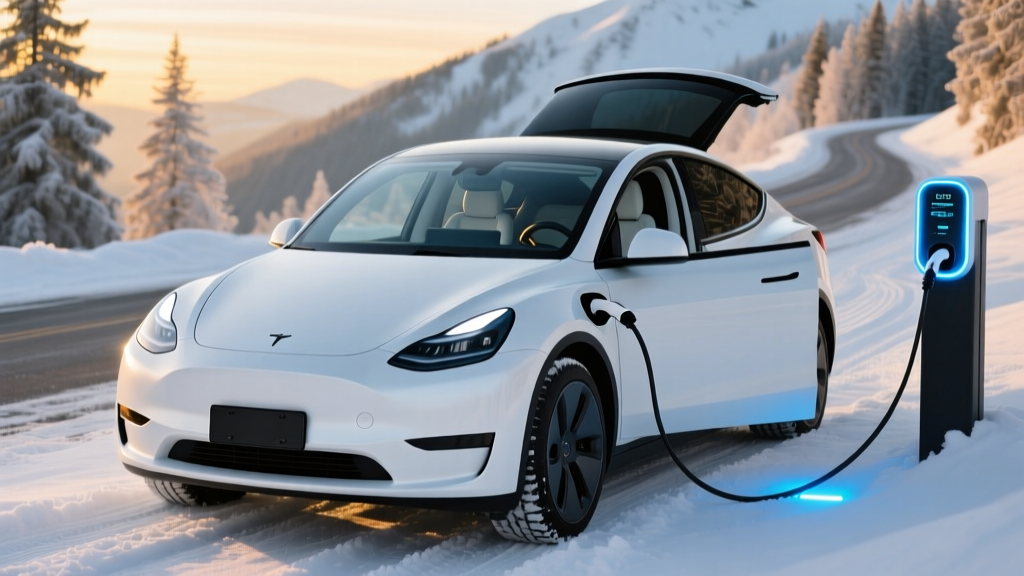
If you live north of the Mason-Dixon line, the phrase "Tesla cold weather package" likely sits at the top of your research list. Tesla doesn't sell a standalone option by that name on the 2026 Model Y — instead, every Long Range and Performance trim ships with a heat pump, heated seats (front and rear), a heated steering wheel, and battery preconditioning software. Together, these features function as Tesla's de facto cold-weather suite, and they materially change how the Model Y behaves when temperatures drop below freezing.
This review evaluates the 2026 Tesla Model Y Long Range AWD through a winter-ownership lens: how much range you actually lose, whether the heat pump earns its keep, and how DC fast charging holds up on a cold January morning.
2026 Tesla Model Y: Core Specifications
| Spec | Value |
|---|---|
| EPA Range | 320 miles |
| Battery (usable) | ~75 kWh, NMC chemistry |
| Drivetrain | Dual-Motor AWD |
| Horsepower | 384 hp (combined) |
| 0-60 mph | 4.8 seconds |
| Peak DC Fast Charge | 250 kW |
| 10-80% DC Time | ~25 minutes (warm battery) |
| Level 2 Home Charge | 11.5 kW (~44 mi/hr) |
| MPGe (combined) | 111 MPGe |
| Efficiency | 30 kWh/100 mi |
| Cargo (rear seats up) | 30.2 cu ft |
| Cargo (rear seats folded) | 72.1 cu ft |
| Base MSRP | $48,990 |
| Battery Warranty | 8 years / 120,000 miles |
What the Tesla Cold Weather Package Actually Includes
Tesla bundles its winter hardware and software into the standard equipment list on the Long Range AWD and Performance trims for 2026. Here is what you get:
- Heat pump (octovalve system): Replaces the older resistive PTC heater. The heat pump scavenges waste heat from the drive motors and battery to warm the cabin, drawing roughly 1-2 kW instead of the 4-6 kW a resistive heater demands.
- Heated front and rear seats: Five heated seats are standard on the Long Range. They warm occupants directly, letting you lower cabin air temperature and save energy.
- Heated steering wheel: A small but meaningful comfort feature that reduces the need for high blower settings.
- Battery preconditioning: When you navigate to a Supercharger (or manually enable it), the car warms the NMC pack to an optimal temperature before you arrive, enabling peak charge rates even in sub-freezing conditions.
- Heated side mirrors and wiper de-icer: Small details that matter during ice storms.
The base Rear-Wheel-Drive Model Y also includes a heat pump for 2026, but its LFP battery chemistry and single-motor layout mean different cold-weather behavior, which we address below.
Real-World Range: EPA Sticker vs. Winter Reality
EPA Estimated: 320 miles
Real-World Highway (65-75 mph, mild weather): ~270-290 miles
Real-World Winter (30°F, highway, heat pump active): ~220-250 miles
Deep Cold (below 10°F, short trips): ~190-220 miles
The EPA rates the 2026 Model Y Long Range AWD at 320 miles. That number assumes a mix of city and highway driving at moderate temperatures. In practice, highway driving at 70+ mph cuts range to roughly 270-290 miles in mild conditions because EVs are less efficient at sustained high speeds — unlike gas cars, they have no multi-gear transmission to lower engine RPM.
Cold weather compounds the loss. At 30°F with the heat pump running, expect a 20-30% reduction from the EPA figure, landing you around 220-250 miles of usable range. In deep cold (below 10°F), particularly on short trips where the cabin and battery must heat from cold-soak repeatedly, range can dip to 190-220 miles. This is physics, not a Tesla flaw — all EVs lose range in cold weather due to increased battery internal resistance and cabin heating demand. The heat pump mitigates the loss significantly compared to resistive heating, which can slash range by 40% or more.
For context, a 220-mile winter range still covers most commutes and regional trips. A 300-mile winter road trip from Chicago to Indianapolis remains feasible with one 15-20 minute Supercharger stop.
Charging Speeds: DC Fast Charging and Home Level 2
| Charging Level | Power | Speed / Time |
|---|---|---|
| Level 1 (120V household) | ~1.4 kW | ~4-5 miles per hour |
| Level 2 (240V, 48A Wall Connector) | 11.5 kW | ~44 miles per hour |
| DC Fast Charge (peak) | 250 kW | 10-80% in ~25 min (warm) |
| DC Fast Charge (cold, no preconditioning) | ~50-100 kW | 10-80% in 45-60+ min |
The 2026 Model Y Long Range accepts up to 250 kW at a V3 or V4 Supercharger. On a warm battery (above ~70°F / 21°C), the charge curve peaks near 250 kW at low states of charge, then tapers progressively above 50% SoC. A 10-80% session takes approximately 25 minutes. Above 80%, charging slows dramatically to protect the NMC cells — an 80-100% top-off can add another 25-30 minutes.
This is where battery preconditioning becomes critical. If you arrive at a Supercharger with a cold-soaked battery (say, 20°F) and preconditioning was not activated, the car may limit charge rates to 50-100 kW to protect the cells, stretching a 10-80% session to 45-60 minutes or more. Always navigate to a Supercharger using the car's built-in navigation — this triggers automatic preconditioning roughly 10-20 miles before arrival, depending on ambient temperature and battery state.
At home, Tesla's Wall Connector on a 60-amp circuit delivers 11.5 kW (48 amps), adding roughly 44 miles of range per hour. An overnight charge from 20% to 80% takes about 4-5 hours, which is more than adequate for daily use. Installation costs vary; expect $500-$2,000 for the electrician work depending on panel capacity and conduit run length.
Winter Efficiency: How the Heat Pump Changes the Math
The heat pump is the single most important component in Tesla's cold-weather package. Here is why:
A traditional resistive heater converts electricity to heat at a 1:1 ratio — 1 kW of electrical draw produces 1 kW of thermal output. Tesla's octovalve heat pump operates at a coefficient of performance (COP) of roughly 2-4x, meaning it produces 2-4 kW of heat for every 1 kW of electricity consumed. In mild cold (30-40°F), the COP approaches 3-4x. In extreme cold (below 0°F), the COP drops toward 2x, and a supplemental resistive element kicks in.
Translated to real driving: in 25°F weather, the heat pump might draw 1.5-2 kW to maintain a 70°F cabin. A resistive system would draw 4-5 kW for the same result. Over a 2-hour highway drive, that difference saves roughly 5-6 kWh — worth about 17-20 miles of range. Across a full winter of commuting, the heat pump saves thousands of watts and meaningfully reduces your charging frequency.
Pair the heat pump with seat heaters (which draw only ~50-100 watts per seat) and a heated steering wheel, and you can set the cabin air temperature to 65°F instead of 72°F while staying perfectly comfortable. This strategy alone can recover another 5-10% of winter range.
Pricing, Tax Credits, and Total Cost
| Trim | MSRP | Est. After §30D Credit |
|---|---|---|
| Long Range AWD | $48,990 | ~$41,490* |
| Performance AWD | $53,990 | ~$46,490* |
*Federal tax credit estimates assume buyer eligibility. Verify current rules at IRS.gov §30D.
The 2026 Model Y Long Range AWD carries a base MSRP of $48,990, which falls under the IRS §30D MSRP cap of $80,000 for SUVs. As of 2026, the Model Y qualifies for the full $7,500 federal tax credit for eligible buyers, and this credit can be transferred to the dealer at point of sale — effectively reducing your purchase price at the dealership rather than waiting for a tax refund.
Eligibility requirements for the §30D credit include:
- Income caps: Modified AGI of $150,000 (single), $225,000 (head of household), or $300,000 (joint filers).
- Battery sourcing: The vehicle must meet critical mineral and battery component requirements that phase in progressively through 2026. Tesla's US-built Model Y with its domestic battery supply chain currently qualifies.
- MSRP cap: $80,000 for SUVs, vans, and pickups; $55,000 for sedans.
Always verify eligibility with a tax professional and check the latest IRS guidance before purchasing, as sourcing rules tighten annually.
How It Compares: Model Y vs. Key Cold-Weather Competitors
- You prioritize Supercharger network access for winter road trips
- You want the most mature battery preconditioning software
- You value over-the-air updates that continuously improve efficiency
- Hyundai Ioniq 5: You want 800V architecture for faster peak charging (~18 min 10-80%) and a more conventional interior layout
- Ford Mustang Mach-E: You prefer a traditional dealership experience and BlueCruise hands-free driving on approved highways
- Rivian R1S: You need three rows, serious off-road capability, or 9,000+ lb towing
The Model Y's primary winter advantage is the Supercharger network. When temperatures drop and range shrinks, knowing you can reliably pull into a well-maintained, high-power charging station every 150-180 miles along major corridors removes the anxiety that plagues owners of CCS-only vehicles in regions with sparse Electrify America or EVgo coverage.
Competitors like the Hyundai Ioniq 5 charge faster at peak (350 kW capable on 800V architecture, 10-80% in ~18 minutes), but real-world winter charging on non-Tesla networks can be less predictable due to station uptime and connector compatibility issues. The Model Y's NACS connector is now the North American standard, and by 2026, most major networks have added NACS cables, though Tesla's own Superchargers remain the most reliable option.
Pros, Cons, and Who Should Buy
- Heat pump delivers best-in-class winter efficiency
- Supercharger network reliability in cold-weather corridors
- Battery preconditioning enables consistent DC fast charging
- 320-mile EPA range provides winter buffer
- OTA updates continuously refine thermal management
- Strong cargo capacity (72.1 cu ft folded)
- 250 kW peak charge rate trails 800V competitors
- Minimalist interior lacks physical buttons for glove operation
- No spare tire — uses tire sealant kit
- FSD (Supervised) requires constant driver attention (SAE Level 2)
- Rear visibility is limited; relies heavily on cameras
Best for: Daily commuters in cold climates who can charge at home, families needing versatile cargo space, and road-trippers who travel corridors served by Superchargers. The Model Y's cold weather package makes it one of the most winter-capable EVs on the market, provided you understand the real-world range trade-offs.
Not ideal for: Buyers without home charging access in extreme-cold regions (northern Minnesota, Alaska) where public charging infrastructure remains sparse, or those who need three-row seating for larger families.
Frequently Asked Questions
Does the Tesla Model Y have a dedicated cold weather package option?
No. Tesla includes heat pump, heated seats, heated steering wheel, and battery preconditioning as standard equipment on the 2026 Model Y Long Range and Performance trims. There is no separate package to add or pay extra for.
How much range does the Model Y lose in winter?
Expect a 20-30% reduction from the 320-mile EPA rating at 30°F, yielding roughly 220-250 miles of real-world range. In deep cold below 10°F with short trips, range can drop to 190-220 miles. The heat pump limits losses compared to vehicles using resistive heating.
Does the Model Y qualify for the $7,500 federal tax credit in 2026?
Yes, the US-built Model Y qualifies for the full $7,500 credit for eligible buyers who meet IRS §30D income caps ($150K single / $300K joint) and purchase a vehicle under the $80K SUV MSRP cap. The credit can be applied at point of sale. Verify current eligibility at IRS.gov before purchasing.
How fast does the Model Y charge in cold weather?
With battery preconditioning active, the Model Y charges at up to 250 kW even in freezing weather, achieving a 10-80% session in roughly 25-30 minutes. Without preconditioning, a cold-soaked battery may be limited to 50-100 kW, doubling charge time. Always navigate to a Supercharger using the car's built-in navigation to trigger preconditioning.
Is the Tesla Model Y good in snow?
Yes. The dual-motor AWD system provides excellent traction, and the low center of gravity (battery pack under the floor) enhances stability. Pair it with dedicated winter tires (recommended below 45°F) and the Model Y performs confidently in snow. Regenerative braking also provides smooth, controlled deceleration on slippery surfaces.
What is the battery warranty on the 2026 Model Y?
Tesla covers the battery and drive unit for 8 years or 120,000 miles (whichever comes first) on the Long Range AWD, with a minimum 70% capacity retention guarantee over that period. NMC chemistry in Tesla's packs has demonstrated strong long-term durability, with fleet data showing roughly 10-12% degradation after 100,000 miles.