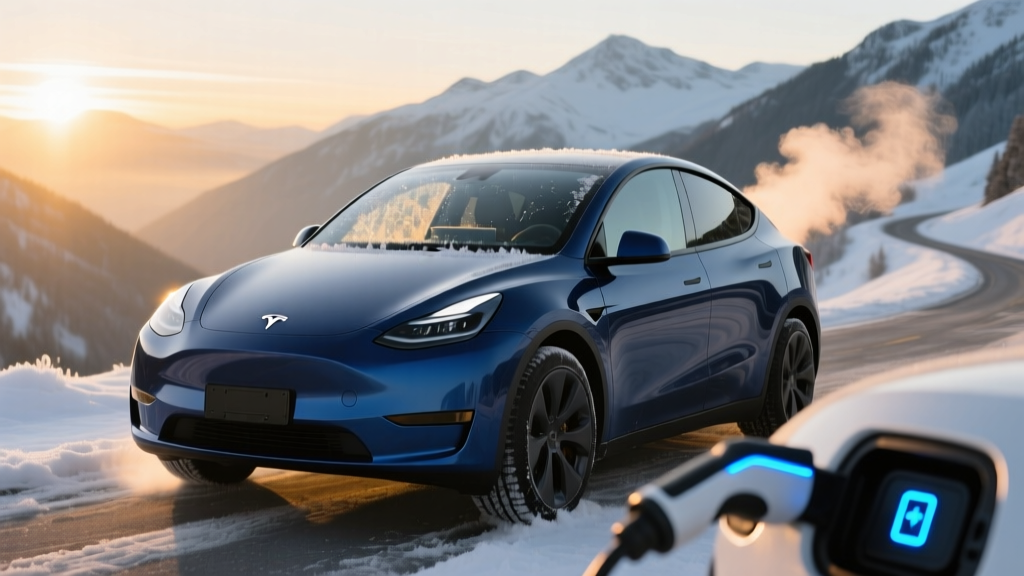
Every Tesla buyer in a northern climate eventually asks the same question: what is Tesla's cold weather feature, and does it actually protect range in freezing temperatures? The answer isn't a single button — it's a layered thermal management system that spans a heat pump, battery preconditioning logic, heated surfaces, and software-driven cabin overheat/underheat protections. For 2026, Tesla's cold-weather stack is standard across the Model 3, Model Y, Model S, and Model X, but how it affects your real-world range and charging speed varies by model and battery chemistry.
This guide dissects the engineering behind Tesla's winter performance, then grounds it in exact EPA figures, kWh capacities, charging speeds, and 2026 pricing for every model in the lineup.
The Core System: Octovalve, Heat Pump, and Preconditioning
Tesla's cold-weather capability rests on three integrated subsystems:
- Octovalve thermal manifold — Introduced on Model Y and retrofitted to refreshed Model 3, this eight-port valve routes heat between the battery pack, drive motors, power electronics, and cabin HVAC. Instead of wasting motor heat, the system scavenges it to warm the battery or cabin.
- Electric heat pump — Standard on all 2026 Teslas. Unlike resistive PTC heaters that draw 3–5 kW directly from the battery, the heat pump moves ambient heat at a coefficient of performance (COP) of roughly 2.0–3.5, meaning it delivers 2–3.5 kW of heat per 1 kW of electricity consumed. This is the single biggest efficiency gain Tesla made for winter driving.
- Battery preconditioning — When you navigate to a Supercharger in cold weather, the car automatically warms the battery pack to approximately 40–50°C (104–122°F) before arrival. This prevents the sluggish charge curves that plague cold lithium-ion cells and enables the advertised peak kW rates.
All EVs lose range in freezing temperatures — typically 20–30% at 20°F compared to 70°F baseline, per fueleconomy.gov testing. Tesla's heat pump reduces this penalty to roughly 15–22% in mixed driving, but highway driving at 75+ mph in sub-freezing air still hits harder. Plan accordingly: a Model 3 Long Range with a 341-mile EPA sticker will realistically deliver 265–290 miles in 30°F highway conditions.
2026 Tesla Lineup: Cold-Weather Specs at a Glance
| Spec | Model 3 LR AWD | Model Y LR AWD | Model S LR | Model X LR |
|---|---|---|---|---|
| EPA Range | 341 mi | 320 mi | 402 mi | 335 mi |
| Battery (usable) | ~79 kWh (NMC) | ~78 kWh (NMC) | ~95 kWh (NMC) | ~95 kWh (NMC) |
| Heat Pump | Standard | Standard | Standard | Standard |
| Max DC Charge | 250 kW | 250 kW | 250 kW | 250 kW |
| 10–80% DC Time | ~27 min | ~27 min | ~32 min | ~34 min |
| L2 Home Rate | 11.5 kW (~44 mi/hr) | 11.5 kW (~44 mi/hr) | 11.5 kW (~37 mi/hr) | 11.5 kW (~32 mi/hr) |
| 0–60 mph | 4.2 sec | 4.8 sec | 3.1 sec | 3.8 sec |
| Horsepower | 346 hp | 384 hp | 670 hp | 670 hp |
| Drivetrain | Dual-motor AWD | Dual-motor AWD | Dual-motor AWD | Dual-motor AWD |
| MPGe (combined) | 131 MPGe | 122 MPGe | 120 MPGe | 102 MPGe |
| Base MSRP | $47,740 | $48,240 | $79,990 | $84,990 |
Real-World Winter Range: What the EPA Sticker Doesn't Tell You
The EPA range figure on the window sticker assumes moderate temperatures and mixed driving. In practice, cold weather introduces three range-draining factors:
- Cabin heating load — Even with a heat pump, maintaining 70°F inside when it's 10°F outside draws 1.5–3 kW continuously.
- Battery internal resistance — Cold electrolyte slows lithium-ion movement, increasing resistance and reducing usable capacity by 5–10% until the pack warms.
- Aerodynamic density — Cold air is denser, increasing drag at highway speeds by roughly 3–5%.
Based on owner-reported data and independent testing, here's what 2026 Tesla owners should expect in 20–30°F conditions:
- Model 3 LR AWD: EPA 341 mi → expect 265–290 mi (highway), 290–310 mi (city with regen)
- Model Y LR AWD: EPA 320 mi → expect 250–275 mi (highway), 275–295 mi (city)
- Model S LR: EPA 402 mi → expect 320–350 mi (highway), 350–375 mi (city)
- Model X LR: EPA 335 mi → expect 260–285 mi (highway), 285–310 mi (city)
City driving recovers more energy through regenerative braking, and Tesla's heated seats and steering wheel (standard on all 2026 models) let you lower cabin air temperature by 5–10°F, saving 0.5–1 kW of continuous draw.
Charging in Cold Weather: Why Preconditioning Is Non-Negotiable
Tesla's battery preconditioning activates automatically when you set a Supercharger as your navigation destination. The car begins warming the pack 10–20 miles out, depending on ambient temperature. Skip this step — say, by driving to a charger without navigating — and you'll see charge rates capped at 30–60 kW until the pack self-heats, turning a 27-minute stop into a 60-minute ordeal.
| Scenario | Peak kW | 10–80% Time | Notes |
|---|---|---|---|
| Preconditioned, 70°F | 250 kW | ~27 min (M3/Y) | Advertised peak, taper above 55% |
| Preconditioned, 20°F | 230–250 kW | ~30 min (M3/Y) | Slight taper, still fast |
| NOT preconditioned, 20°F | 30–60 kW | 60–90 min | Battery too cold for fast charge |
| Level 2 home, 48A/11.5 kW | 11.5 kW | ~8 hr (0–100%) | Overnight; garage mitigates cold |
At a V3 Supercharger (250 kW peak), the Model 3 and Model Y sustain roughly 150–170 kW on average from 10–80%, which is why the total time lands around 27 minutes. The larger Model S and X packs take proportionally longer despite the same peak rate.
Cabin Comfort Features: Beyond the Heat Pump
Tesla's cold-weather comfort extends to surfaces and scheduling:
- Heated front and rear seats — Standard on all 2026 models, with three intensity levels. Draws roughly 100–150W per seat, far less than forced-air heating.
- Heated steering wheel — Standard. Resistive element, minimal energy draw.
- Scheduled departure / preconditioning — Set a departure time via the app, and the car warms the battery and cabin while still plugged in, drawing from grid power instead of the battery.
- Defrost mode — Activates heat pump and compressor to clear windows rapidly without the energy penalty of resistive defrosters.
- Camp Mode / Dog Mode — Maintains cabin temperature while parked, useful for winter tailgating or waiting in the car.
Pricing, Trims, and Federal Tax Credit Eligibility
For 2026, the IRS §30D federal tax credit offers up to $7,500, split into two halves: $3,750 for battery-component sourcing and $3,750 for critical-minerals sourcing. Eligibility depends on MSRP caps, buyer income, and where battery materials are sourced.
| Model / Trim | Base MSRP | Under MSRP Cap? | Est. Credit | Effective Price |
|---|---|---|---|---|
| Model 3 RWD | $38,990 | Yes (sedan ≤$55K) | Up to $7,500* | ~$31,490 |
| Model 3 LR AWD | $47,740 | Yes | Up to $7,500* | ~$40,240 |
| Model Y LR AWD | $48,240 | Yes (SUV ≤$80K) | Up to $7,500* | ~$40,740 |
| Model S LR | $79,990 | Yes (sedan ≤$55K) — NO | $0 (over cap) | $79,990 |
| Model X LR | $84,990 | Yes (SUV ≤$80K) — NO | $0 (over cap) | $84,990 |
*Credit eligibility also requires buyer AGI ≤ $150K (single) / $300K (joint), and compliance with battery-sourcing rules that tighten annually. The point-of-sale transfer option lets you apply the credit at purchase rather than waiting for tax filing. Always verify current rules at irs.gov and consult a tax professional.
The Model S and X exceed the §30D MSRP caps ($55,000 for sedans, $80,000 for SUVs/vans/pickups), making them ineligible for the federal credit regardless of buyer income. Some states offer separate rebates — check your local DMV or energy office.
Who Should Buy a Tesla for Cold Climates?
Pros
- Heat pump standard on every model — class-leading winter efficiency
- Preconditioning enables full DC fast-charge speeds even at 0°F
- Supercharger network reliability (15,000+ U.S. stalls) reduces winter stranding risk
- Heated seats/steering wheel reduce cabin-heating energy draw
- OTA updates continuously refine thermal algorithms
- Dual-motor AWD provides strong traction on snow and ice
Cons
- Real-world winter range drops 15–25% — plan trips around 70% of EPA
- Model S/X excluded from federal tax credit due to MSRP caps
- No physical buttons — glove controls and climate via touchscreen can frustrate with gloves on
- LFP battery option (Model 3 RWD) loses more range in cold than NMC — roughly 25–30%
- Supercharger stalls in remote cold-weather corridors (Montana, northern Maine) remain sparse
Best for: Commuters in the Northeast, Midwest, and Mountain West who have home Level 2 charging and drive primarily in suburban/highway mixed conditions. The Model 3 LR AWD and Model Y LR AWD offer the strongest value proposition with full tax credit eligibility.
Less ideal for: Owners in extreme cold (below –10°F regularly) who lack garage parking or home charging. Unplanned outdoor cold-soaks reduce usable range and require longer preconditioning before fast charging.
Warranty and Long-Term Battery Confidence
Tesla's battery and drive unit warranty covers 8 years or 100,000 miles (whichever comes first) for the Model 3 and Model Y, and 8 years or 150,000 miles for the Model S and Model X. The warranty guarantees a minimum of 70% capacity retention over that period. Independent fleet data from sources like Recurrent Auto shows most Tesla NMC packs retaining 88–92% capacity at 100,000 miles, well above the warranty floor.
Cold weather itself does not accelerate long-term degradation — it's sustained high SoC combined with heat that degrades lithium-ion cells. Tesla's thermal management protects against both extremes, which is why Teslas in Minnesota and Norway show degradation curves similar to those in California.
Frequently Asked Questions
What exactly is Tesla's cold weather feature?
It's not a single feature but a system: the Octovalve thermal manifold, electric heat pump, automatic battery preconditioning, heated seats and steering wheel, and scheduled departure preconditioning. Together, they minimize range loss and maintain fast-charging capability in freezing temperatures.
How much range do I actually lose in winter?
Expect 15–25% range reduction at 20–30°F compared to the EPA sticker, depending on driving style, speed, and whether you precondition. A Model 3 LR rated at 341 miles will realistically deliver 265–290 miles on a cold highway trip.
Do I need to precondition every time I charge?
Only for DC fast charging. If you navigate to a Supercharger, preconditioning starts automatically. For home Level 2 charging, preconditioning isn't necessary — the slower charge rate is safe for cold batteries.
Does the Model 3 RWD (LFP battery) handle cold worse?
Yes, modestly. LFP (lithium iron phosphate) chemistry has higher internal resistance in cold weather, leading to 25–30% range loss versus 15–22% for NMC packs. The heat pump and preconditioning still work, but expect a bigger winter penalty. If you live where temperatures regularly drop below 20°F, the NMC-equipped Long Range models are the stronger choice.
Can I use Tesla's cold weather features while parked?
Yes. Camp Mode maintains a set cabin temperature indefinitely (drawing from the battery), and Dog Mode keeps climate running while you step away. Both work in cold weather, though energy consumption will reduce your remaining range.
Is Tesla's Autopilot affected by cold weather?
Snow, ice, and road salt can obscure cameras and reduce Autopilot functionality. Tesla's system is SAE Level 2 — you must remain fully engaged regardless of weather. Keep cameras clean and expect more frequent disengagements in heavy snow or fog.
Tesla's cold-weather engineering in 2026 is among the most comprehensive in the EV industry. The heat pump, Octovalve, and automatic preconditioning collectively turn what was once a liability — lithium-ion's sensitivity to cold — into a manageable ownership experience. The key is understanding the real numbers: plan for 70–80% of EPA range in freezing highway conditions, always navigate to Superchargers to trigger preconditioning, and lean on heated surfaces rather than cabin air heating to maximize every kilowatt-hour.