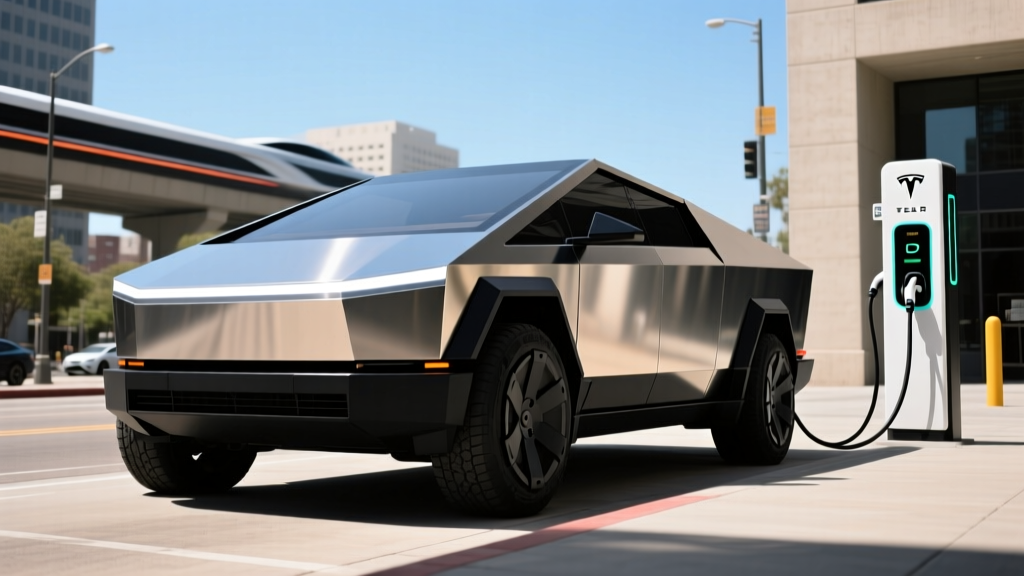
If any production vehicle deserves the nickname Blade Runner Cybertruck, it's Tesla's stainless-steel, angular electric pickup. The Cybertruck looks like it rolled off the set of a dystopian sci-fi film, but beneath the polarizing exoskeleton lies a serious full-size truck with legitimate towing capability, rapid DC charging, and the kind of performance numbers that embarrass sports cars. Now well into its second full model year, the Cybertruck lineup has stabilized into three distinct trims, and real-world ownership data has replaced early-production speculation.
This review breaks down every spec that matters to a truck buyer — from EPA range and real-world highway efficiency to DC fast-charging curves, federal tax credit eligibility under IRS §30D, and how the Cybertruck stacks up against the Ford F-150 Lightning and Rivian R1T in 2026.
Quick Verdict: Who Is the Cybertruck For?
The Cybertruck is best suited for buyers who want a full-size electric pickup with standout design, class-leading acceleration, and access to Tesla's Supercharger network — and who can accommodate its polarizing looks and panel-gap inconsistencies. It's a strong fit for tech-forward commuters, light-to-moderate towers, and anyone who values charging infrastructure reliability. It's a weaker match for traditional truck buyers who need a conventional bed layout, proven long-term durability data, or a more refined interior.
Cybertruck Specs at a Glance
| Spec | Long Range (AWD) | All-Wheel Drive | Cyberbeast |
|---|---|---|---|
| Base MSRP | $79,990 | $99,990 | $119,990 |
| EPA Range | 340 mi | 340 mi (est. w/ range extender) | 320 mi |
| Battery (usable, est.) | ~123 kWh, NMC | ~123 kWh, NMC | ~123 kWh, NMC |
| 0–60 mph | 5.8 sec | 4.1 sec | 2.6 sec |
| Horsepower | 600 hp | 600 hp | 845 hp |
| Drivetrain | Dual-Motor AWD | Dual-Motor AWD | Tri-Motor AWD |
| Max DC Fast Charge | 250 kW (V3 Supercharger) / 350+ kW (V4) | 250 kW / 350+ kW | 250 kW / 350+ kW |
| 10–80% DC Time | ~28 min (V3) / ~20 min (V4) | ~28 min / ~20 min | ~28 min / ~20 min |
| Level 2 Home Charge | 11.5 kW (~44 mi/hr) | 11.5 kW (~44 mi/hr) | 11.5 kW (~44 mi/hr) |
| Towing Capacity | 11,000 lb | 11,000 lb | 11,000 lb |
| MPGe (combined) | 67 MPGe | 65 MPGe | 63 MPGe |
| Battery/Drive Warranty | 8 yr / 120,000 mi | 8 yr / 120,000 mi | 8 yr / 120,000 mi |
Sources: Tesla Cybertruck Design Page, fueleconomy.gov
Real-World Range: Beyond the EPA Sticker
EPA Combined: 320–340 miles (depending on trim)
Real-World Highway (70 mph, 75°F): ~260–290 miles
Real-World Cold Weather (30°F, highway): ~210–240 miles
Towing (5,000 lb trailer, flat terrain): ~150–180 miles
The Cybertruck's 4,600–4,700 lb curb weight and flat-panel aerodynamics work against highway efficiency. While the EPA combined figures look competitive, expect roughly a 15–20% reduction at sustained 70–75 mph speeds. Cold weather compounds this — Tesla's heat pump helps, but the large battery mass takes longer to precondition, and cabin heating draws significant energy before the pack reaches optimal temperature.
If you're planning road trips in winter conditions across the Mountain West or Northeast, budget for stops every 200–220 miles. The good news: Tesla's Supercharger network means those stops are predictable and fast. The Cybertruck supports V4 Supercharger stalls (now rolling out at high-traffic corridors), which can push peak rates above 350 kW on compatible hardware, dramatically cutting charge times versus older V3 stations.
Charging Speed: DC Fast and Home Level 2
| Charge Level | Power | Miles Added per Hour | Notes |
|---|---|---|---|
| Level 1 (120V outlet) | ~1.4 kW | ~5 mi/hr | Emergency/trickle only |
| Level 2 (240V, 48A) | 11.5 kW | ~44 mi/hr | Full charge overnight (~8 hrs) |
| DC Fast (V3 Supercharger) | Up to 250 kW | ~180 mi in 15 min | Peak rate, tapers above 60% SoC |
| DC Fast (V4 Supercharger) | Up to 350+ kW | ~220 mi in 15 min | Requires V4-compatible stall; availability growing |
The Cybertruck's 800-volt-class architecture (nominally ~816V) enables impressive DC fast-charging throughput. On a V4 Supercharger, the charge curve holds near peak kW from roughly 10–50% State of Charge before tapering. The 10–80% sprint takes approximately 20 minutes at a V4 stall, or about 28 minutes at a standard V3 (250 kW) station. Above 80% SoC, charge speed drops sharply — a common trait of NMC chemistry — so plan to unplug at 80% on road trips unless you need the final miles.
At home, the Cybertruck accepts up to 11.5 kW on a 48-amp Level 2 circuit (requiring a 60-amp breaker). This adds roughly 44 miles of range per hour, meaning a depleted pack reaches full in about 8 hours. Most owners who charge nightly from 20–80% will see a full replenishment in under 4 hours. Tesla's Wall Connector ($420) is the recommended home unit, though any J3472/NACS-compatible Level 2 unit will work.
Performance and Driving Dynamics
The Cyberbeast's 2.6-second 0–60 mph time remains one of the quickest production vehicles of any kind, let alone a 6,800-lb pickup. Even the base Long Range model hits 60 mph in 5.8 seconds — quicker than most gas-powered V8 trucks. The tri-motor Cyberbeast uses torque vectoring across the rear axle pair for cornering agility that defies the vehicle's mass, though the steer-by-wire system (Tesla calls it a "yoke" setup with adaptive ratio) requires an adjustment period.
Ride quality benefits from the adaptive air suspension, which offers up to 16 inches of ground clearance in Extract mode. The stainless-steel exoskeleton panels are dent-resistant but show fingerprints aggressively — expect to own microfiber cloths. Panel gaps remain inconsistent across production units, a point of contention among owners accustomed to legacy-brand fit and finish.
The 11,000-lb max towing rating is competitive with the F-150 Lightning (10,000 lb) and Rivian R1T (11,000 lb). However, towing at max capacity cuts range nearly in half. Tesla's integrated trailer brake controller and tow-assist cameras are well-executed, but the 6.5-foot bed (shorter than a standard F-150 bed) limits utility for contractors and tradespeople.
Pricing, Trims, and Federal Tax Credit Eligibility
| Trim | Base MSRP | Federal §30D Credit Eligible? | Effective Price (if eligible) |
|---|---|---|---|
| Long Range (AWD) | $79,990 | No — exceeds $80,000 truck MSRP cap | $79,990 |
| All-Wheel Drive | $99,990 | No — exceeds $80,000 truck MSRP cap | $99,990 |
| Cyberbeast | $119,990 | No — exceeds $80,000 truck MSRP cap | $119,990 |
Under IRS §30D rules, the new clean vehicle credit offers up to $7,500 — but pickups and SUVs face an $80,000 MSRP cap. Since every Cybertruck trim starts at or above $79,990 (and destination fees push the Long Range above the cap), no Cybertruck trim currently qualifies for the federal purchase credit. Additionally, buyer income caps apply ($150,000 single / $300,000 joint AGI), and battery critical-mineral and component sourcing requirements must be met independently.
The Cybertruck may qualify for certain state-level incentives (e.g., California's CVRP rebate, Colorado's state tax credit, or utility-company rebates for home charger installation), but these vary by jurisdiction. Always verify with your state energy office or tax professional before assuming eligibility.
As-tested pricing on a well-equipped All-Wheel Drive model with Full Self-Driving (Supervised) capability ($8,000 add-on) and premium interior upgrades can push past $110,000 before delivery fees. Tesla also offers the Cybertruck through its business lease program, which may allow the leasing company to capture the commercial clean vehicle credit (§45W) and pass savings through reduced monthly payments — consult a tax advisor for structuring options.
Interior, Cargo, and Technology
The Cybertruck's interior follows Tesla's minimalist playbook: an 18.5-inch front touchscreen handles nearly all vehicle functions, with a smaller 9.4-inch rear touchscreen for passengers. There are no physical buttons for climate, mirrors, or glovebox — everything routes through the display. This keeps the cabin visually clean but frustrates users who prefer tactile controls while driving.
Cargo dimensions:
- Bed length: 6.5 ft (74.4 in) with tailgate closed; extends with tailgate down
- Bed volume: ~67 cu ft (bed), ~54 cu ft (frunk under front trunk)
- Front legroom: 41.5 in | Rear legroom: 38.2 in
- Seating: 5 passengers (3-across rear bench)
- Frunk: Lockable, drainable, ~54 cu ft — usable for gear or as a cooler
The motorized tonneau cover is a standout feature, providing lockable security for the bed and improving aerodynamics when closed. The 120V and 240V bed outlets (up to 9.6 kW output via Powershare) enable job-site tool use or camping setups — a genuine advantage over trucks without bi-directional power.
Driver assistance: The Cybertruck ships with Tesla's Enhanced Autopilot (adaptive cruise, lane centering, auto lane change). Full Self-Driving (Supervised) remains an optional upgrade and is SAE Level 2 — it requires continuous driver attention and is not autonomous. Tesla's camera-only vision system handles parking assist and Smart Summon but still struggles in heavy rain and construction zones.
Pros, Cons, and the Competition
- Class-leading acceleration (Cyberbeast: 2.6s 0–60)
- Access to Tesla Supercharger network (17,000+ NA stalls)
- Stainless-steel exoskeleton: dent- and corrosion-resistant
- 9.6 kW bi-directional power (Powershare) for tools/camping
- Adaptive air suspension with up to 16" ground clearance
- Over-the-air updates continually add features
- No federal §30D tax credit (MSRP exceeds cap)
- Real-world highway range ~15–20% below EPA
- Steep learning curve with steer-by-wire/yoke
- Short 6.5-ft bed limits traditional truck utility
- Panel gaps and build consistency still uneven
- Stainless panels show smudges; require frequent cleaning
Key competitors in 2026:
- Ford F-150 Lightning: More conventional truck layout, lower starting price (~$55,000), qualifies for §30D credit on select trims. Less performance, slower DC charging.
- Rivian R1T: Premium adventure truck, quad-motor option, ~$70,000–$99,000. Better interior refinement, smaller service network.
- Chevrolet Silverado EV: GM's Ultium-based truck, up to 400 mi EPA range, 4WT steering. Larger bed options, newer platform with less proven reliability.
Ownership Costs and Battery Longevity
Tesla covers the Cybertruck's battery and drive units for 8 years or 120,000 miles (whichever comes first), with a minimum 70% capacity retention threshold. The NMC chemistry pack is expected to retain ~85–90% capacity at 100,000 miles based on Model S/X fleet data, though the Cybertruck's higher weight and power output may accelerate wear slightly.
Insurance premiums run 20–35% higher than comparable gas trucks, driven by repair costs for the stainless-steel body and proprietary components. Expect annual premiums of $2,800–$4,200 depending on state and driving record.
Maintenance is minimal — no oil changes, no transmission fluid, regenerative braking extends pad life to 100,000+ miles. Budget for cabin air filter replacement (~$60/yr), tire rotation, and wiper fluid. Tesla's mobile service handles most routine work; body repair requires approved collision centers familiar with the exoskeleton.
Frequently Asked Questions
What is the real-world range of the Tesla Cybertruck?
The EPA rates the Cybertruck at 320–340 miles depending on trim. In real-world highway driving at 70–75 mph in moderate temperatures, expect 260–290 miles. Cold weather (below 35°F) reduces this further to approximately 210–240 miles. Towing at or near max capacity cuts range to roughly 150–180 miles.
How fast does the Cybertruck charge?
On a Tesla V4 Supercharger (350+ kW), the Cybertruck charges from 10–80% in approximately 20 minutes. On a V3 Supercharger (250 kW), expect about 28 minutes. At home on a 48-amp Level 2 charger (11.5 kW), the Cybertruck adds roughly 44 miles of range per hour, reaching a full charge from empty in about 8 hours.
Does the Cybertruck qualify for the $7,500 federal EV tax credit?
No. Under IRS §30D rules, trucks and SUVs are subject to an $80,000 MSRP cap. All 2026 Cybertruck trims start at $79,990 or above, and destination charges push the base Long Range model over the threshold. State incentives and utility rebates may still apply — check your state's energy office for details.
Is the Cybertruck worth buying over the F-150 Lightning or Rivian R1T?
Choose the Cybertruck if you prioritize acceleration, Tesla's Supercharger network, and the stainless-steel aesthetic — and don't need the §30D credit. Choose the F-150 Lightning if you want a lower price, tax credit eligibility, and a conventional truck layout. Choose the Rivian R1T for premium interior quality and adventure-focused features. Each serves a different buyer profile.
How long will the Cybertruck battery last?
Tesla warranties the battery for 8 years / 120,000 miles with a minimum 70% capacity retention guarantee. Based on historical NMC pack data from Tesla's fleet, owners can reasonably expect 85–90% capacity at 100,000 miles with normal charging habits (avoiding frequent 100% charges and deep discharges). A full battery replacement out of warranty is estimated at $15,000–$22,000 based on current Model S/X replacement pricing.
Can the Cybertruck power my home or tools?
Yes. Tesla's Powershare feature provides up to 9.6 kW of output through 120V and 240V outlets in the bed, sufficient for running power tools, camping equipment, or providing emergency home backup power (with appropriate transfer switch installation by a licensed electrician). This is competitive with Ford's Pro Power Onboard.