If you have spent any time scrolling Tesla owner forums or watching EV YouTube, you have likely encountered the term Chill Mode. It is one of Tesla's most discussed — and occasionally misunderstood — software features. Unlike a performance trim upgrade or a bigger battery pack, Chill Mode is purely a software setting that fundamentally changes how your Tesla accelerates, manages regenerative braking, and delivers power to the wheels.
But what does Chill Mode actually do to your driving experience? Does it meaningfully extend your range? And how does it interact with the real-world efficiency figures of Tesla's current 2026 lineup? This guide breaks down everything you need to know about Tesla Chill Mode across the Model 3, Model Y, and Cybertruck — with exact specs, real-world range data, and ownership economics to help you decide how (and when) to use it.
What Is Chill Mode on a Tesla?
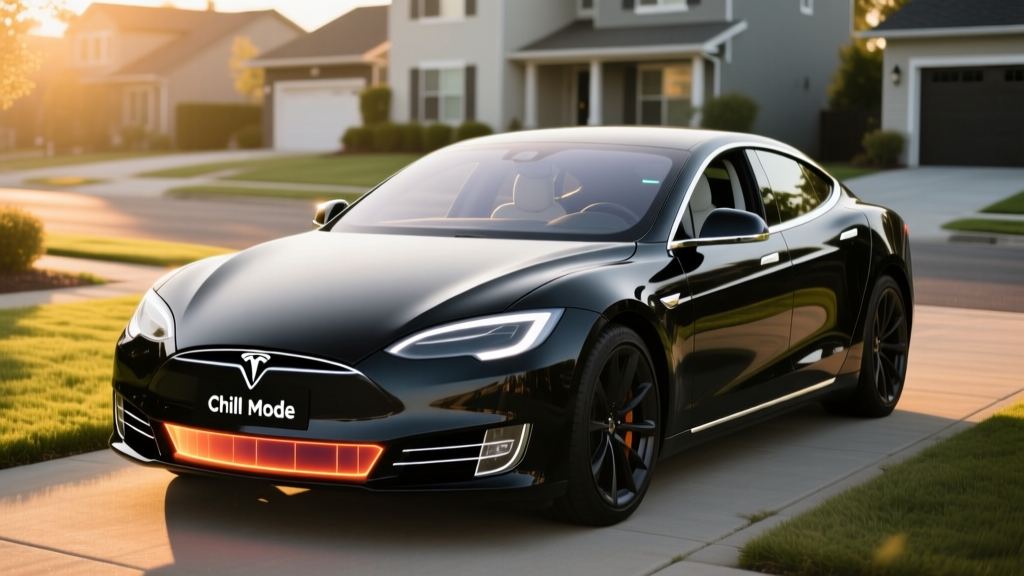
Chill Mode is a driver-selectable acceleration profile available on most Tesla vehicles, including dual-motor and Performance variants of the Model 3, Model Y, and Cybertruck. When activated, it reduces the rate of acceleration by limiting the power delivered to the electric motors. The result is a smoother, more gradual launch from a stop and gentler throttle response at all speeds.
Think of it as the EV equivalent of switching a performance sedan from "Sport" to "Comfort" mode — except in a Tesla, the difference is entirely software-defined. There is no mechanical change. The same motors, the same battery, the same inverter. Only the torque-delivery curve changes.
How Chill Mode Affects Performance: 0-60 and Drivetrain Behavior
The most measurable impact of Chill Mode is on acceleration. Here is how it changes the 0-60 mph times across Tesla's current 2026 lineup:
| Model / Trim | Drivetrain | 0-60 (Standard) | 0-60 (Chill Mode) | Horsepower |
|---|---|---|---|---|
| Model 3 Long Range AWD | Dual-Motor AWD | 4.2 sec | ~6.5–7.0 sec | 346 hp |
| Model 3 Performance | Dual-Motor AWD | 2.9 sec | ~5.5–6.0 sec | 510 hp |
| Model Y Long Range AWD | Dual-Motor AWD | 4.8 sec | ~7.0–7.5 sec | 384 hp |
| Model Y Performance | Dual-Motor AWD | 3.5 sec | ~5.8–6.3 sec | 456 hp |
| Cybertruck AWD | Dual-Motor AWD | 3.9 sec | ~6.0–6.5 sec | 600 hp |
The pattern is clear: Chill Mode roughly doubles your 0-60 time on Performance trims and adds 2–3 seconds on Long Range variants. For context, a 6.5-second 0-60 is comparable to a well-equipped Toyota Camry V6 — perfectly adequate for merging and passing, just not thrilling.
On single-motor RWD variants of the Model 3 and Model Y, Chill Mode is less commonly available or has a less dramatic effect because the base acceleration is already more moderate (5.8–6.9 seconds to 60 mph). Tesla has historically made Chill Mode most prominent on dual-motor and Performance configurations where the standard acceleration could surprise an unprepared driver.
Does Chill Mode Actually Improve Range?
This is the question every efficiency-minded EV owner asks. The short answer: yes, but modestly.
Chill Mode does not change your battery capacity, aerodynamics, or rolling resistance. What it does change is how aggressively you draw energy from the pack during acceleration. Hard acceleration dumps large current from the battery, generating heat losses in the cells and inverter. Smoother, lower-power acceleration reduces these losses and keeps you at more efficient speeds for longer.
Here are the EPA-estimated range figures for Tesla's current 2026 models, along with what you might realistically expect in Chill Mode during mixed driving:
| Model | Battery (kWh, usable) | Chemistry | EPA Range | Real-World (Mixed) | MPGe (Combined) |
|---|---|---|---|---|---|
| Model 3 RWD | 57.5 kWh | LFP | 272 mi | 240–260 mi | 132 MPGe |
| Model 3 LR AWD | 75 kWh | NMC | 341 mi | 295–320 mi | 132 MPGe |
| Model Y LR AWD | 75 kWh | NMC | 320 mi | 275–300 mi | 122 MPGe |
| Model Y Performance | 75 kWh | NMC | 298 mi | 255–280 mi | 117 MPGe |
| Cybertruck AWD | 123 kWh | NMC | 340 mi | 280–310 mi | 79 MPGe |
Source: fueleconomy.gov — EPA estimates. Real-world ranges reflect owner-reported data and independent testing in moderate temperatures with mixed city/highway driving.
If you consistently drive in Chill Mode and avoid hard acceleration, expect to see the higher end of the "Real-World" column. The gain is most noticeable in stop-and-go city traffic where you would otherwise be repeatedly drawing high current. On the highway, where steady-state cruising dominates, Chill Mode's effect on efficiency is negligible.
Charging Speed: DC Fast Charging and Home Level 2
Chill Mode has no impact on charging speed. Whether you charge at 50 kW or 250 kW, the vehicle's battery management system (BMS) handles the session identically regardless of your acceleration profile. What matters for charging is the vehicle's peak DC charge rate, battery chemistry, and whether you precondition the pack.
| Model | Max DC Fast Charge | 10–80% Time | Level 2 (Home) | Miles per Hour (L2) |
|---|---|---|---|---|
| Model 3 RWD (LFP) | 170 kW | ~30 min | 11.5 kW | ~37 mi/hr |
| Model 3 LR / Performance | 250 kW | ~22 min | 11.5 kW | ~44 mi/hr |
| Model Y LR / Performance | 250 kW | ~25 min | 11.5 kW | ~40 mi/hr |
| Cybertruck AWD | 250 kW (800V arch.) | ~20 min | 11.5 kW | ~30 mi/hr |
Charging curve reality check: The peak kW figure is just that — a peak. Teslas with NMC packs typically sustain near-peak rates from roughly 10–40% State of Charge (SoC), then taper progressively. Above 80%, charging slows dramatically to protect cell longevity. LFP packs in the Model 3 RWD have a flatter charge curve but a lower peak, and Tesla recommends charging LFP batteries to 100% regularly to maintain accurate SoC calibration — a notable difference from NMC, where daily charging to 80% is recommended.
All 2026 Teslas use the NACS (North American Charging Standard) connector natively, which is now the dominant standard in North America. This gives Tesla owners access to the Supercharger network — consistently the most reliable DC fast-charging network in the U.S. — without adapters. Non-Tesla EVs with CCS connectors can now access many Superchargers via a Magic Dock adapter, but Tesla owners have native plug-and-charge simplicity.
Pricing, Trims, and Federal Tax Credit Eligibility
Here is where the math of buying a Tesla gets nuanced for 2026. Federal tax credit rules under IRS §30D impose income caps, MSRP caps, and battery-sourcing requirements that change periodically.
| Model / Trim | Base MSRP | Under MSRP Cap? | Potential §30D Credit | Est. Net Price |
|---|---|---|---|---|
| Model 3 RWD | $38,990 | Yes ($55K cap) | Up to $7,500* | ~$31,490 |
| Model 3 LR AWD | $44,990 | Yes ($55K cap) | Up to $7,500* | ~$37,490 |
| Model 3 Performance | $52,990 | Yes ($55K cap) | Up to $7,500* | ~$45,490 |
| Model Y LR AWD | $44,990 | Yes ($80K cap) | Up to $7,500* | ~$37,490 |
| Model Y Performance | $48,990 | Yes ($80K cap) | Up to $7,500* | ~$41,490 |
| Cybertruck AWD | $79,990 | Yes ($80K cap) | Varies** | ~$72,490+ |
* Full $7,500 credit eligibility requires meeting buyer income caps ($150K single / $300K joint MAGI), critical-mineral and battery-component sourcing requirements per IRS rules, and taking delivery via point-of-sale transfer or tax filing. Credit amounts may be $3,750 if only one of the two sourcing requirements is met. Always verify current eligibility at irs.gov and with a tax professional.
** Cybertruck eligibility fluctuates based on battery-sourcing compliance. Consult the IRS qualified vehicles list at time of purchase.
Tech, Interior, and the Full Tesla Software Experience
Chill Mode is one thread in a much larger Tesla software tapestry. Every 2026 Tesla comes with the brand's signature 15.4-inch central touchscreen (Model 3/Y) or 18.5-inch screen (Cybertruck), over-the-air updates, and access to Tesla's Supercharger network. Here are the standout tech features — and the notable drawbacks:
Standout features:
- Autopilot (standard): Includes Traffic-Aware Cruise Control and Autosteer. This is an SAE Level 2 driver-assistance system — you must keep your hands on the wheel and eyes on the road at all times. It is not self-driving.
- Full Self-Driving (Supervised): Optional $8,000 upgrade (or $99/month subscription). Adds Navigate on Autopilot, Auto Lane Change, Autopark, and Smart Summon. Despite the name, FSD remains SAE Level 2 — full driver supervision is required. It does not make the vehicle autonomous.
- Sentry Mode / Dashcam: Records surroundings when parked, a genuine deterrent against break-ins and hit-and-runs.
- Over-the-air updates: Tesla regularly pushes feature additions and performance tweaks remotely. Chill Mode itself was originally added via OTA update.
- Heat pump (standard on all 2026 models): Significantly improves cold-weather efficiency compared to resistive heating, reducing winter range loss.
Notable drawbacks:
- No traditional instrument cluster: All information is on the central screen. Speed is displayed in the corner. Some drivers find this distracting or prefer a head-up display, which Tesla does not offer.
- Turn signal stalks removed (2025+ Model 3/Y refresh): Steering-wheel-mounted buttons replace traditional stalks — a polarizing design choice that takes weeks to adapt to.
- Panel gaps and build consistency: While improved significantly since the Fremont early days, build quality still varies more than legacy automakers like BMW or Hyundai.
- Insurance costs: Tesla insurance premiums are typically 20–40% higher than comparable non-Tesla EVs due to repair costs and claims data. Factor this into your total cost of ownership.
Battery Warranty and Long-Term Degradation
Tesla's battery and drive unit warranty is competitive but not class-leading:
- Model 3 RWD (LFP): 8 years / 100,000 miles, whichever comes first, with retention of at least 70% battery capacity.
- Model 3 LR / Performance, Model Y (NMC): 8 years / 120,000 miles, with at least 70% capacity retention.
- Cybertruck: 8 years / 150,000 miles, with at least 70% capacity retention.
The 70% retention threshold is standard across the industry, though some competitors like Hyundai offer 10-year/100,000-mile coverage. In practice, Tesla's NMC packs have demonstrated approximately 10–12% degradation at 100,000 miles based on fleet data, while LFP packs tend to degrade more slowly but have lower initial energy density. Chill Mode itself has no measurable impact on battery degradation — charging habits (avoiding sustained 100% SoC on NMC, using preconditioning for DC fast charging) matter far more.
Pros and Cons: Tesla with Chill Mode
✓ Pros
- Chill Mode smooths acceleration for passengers, new drivers, and valet situations
- Access to the Supercharger network — the most reliable DC fast-charging system in the U.S.
- Class-leading efficiency (kWh/100mi) in Model 3 and Model Y
- Continuous OTA improvements add features post-purchase
- Strong resale value relative to most EVs
- Heat pump standard across the lineup
- LFP option on Model 3 RWD allows regular 100% charging without degradation concern
✗ Cons
- Chill Mode's range benefit is modest (2–5%), not a substitute for efficient driving habits
- No instrument cluster or HUD — all info on central screen
- Steering-wheel turn-signal buttons are divisive and slow to use initially
- Insurance premiums run 20–40% above comparable EVs
- FSD remains Level 2 despite the "Full Self-Driving" name — $8,000 for a supervised assist
- Cybertruck pricing pushes past the value proposition of Model Y
- Service center wait times can be lengthy in high-demand metro areas
Who Should Use Chill Mode — and Who Should Buy a Tesla?
Chill Mode is ideal for specific driving scenarios rather than as a permanent setting:
- Daily commuters in stop-and-go traffic: The gentler throttle reduces lurching and makes one-pedal-style driving smoother.
- Parents with young passengers: Kids in car seats appreciate the absence of aggressive torque launches.
- Valet or car-wash situations: Limiting acceleration reduces risk when someone else is behind the wheel.
- Rain and snow driving: Reduced torque delivery helps prevent wheelspin on low-traction surfaces (though Tesla's traction control is already excellent).
As for who should buy a Tesla in 2026: the Model 3 LR AWD remains the best all-around sedan value in the EV market at roughly $37,490 after the federal credit. The Model Y LR AWD is the default family EV crossover for buyers who need cargo space and Supercharger access. The Cybertruck suits buyers who want a distinctive truck with strong towing capacity (11,000 lbs) and are willing to pay a premium. For buyers who prioritize traditional build quality, physical controls, or lower insurance costs, the Hyundai Ioniq 5, BMW i4, or Chevrolet Equinox EV are worth cross-shopping.
Frequently Asked Questions
Can I set Chill Mode as the default every time I start the car?
Yes. Through Tesla's driver profile settings, you can link Chill Mode to your key fob or phone key so it activates automatically when you enter the vehicle. You can also create separate profiles — for example, Chill Mode for commuting and Standard for weekend drives.
Does Chill Mode affect regenerative braking?
On 2026 Tesla models, regenerative braking is standardized (Tesla removed the adjustable regen setting in 2020–2021 for most models). Chill Mode does not change regen strength — it only affects the acceleration/throttle map. However, the gentler acceleration in Chill Mode means you are less likely to overshoot your target speed and then need to brake hard, which can make the overall driving feel smoother.
Does Chill Mode void my warranty or affect insurance?
No. Chill Mode is a factory software feature, not a modification. It has no impact on your battery/powertrain warranty. Insurance companies do not differentiate between Chill Mode and Standard mode when calculating premiums.
Is Chill Mode available on the base Model 3 RWD?
Availability varies by model year and software version. On the 2026 Model 3 RWD, which uses a single rear motor with 271 hp and a 5.8-second 0-60, the acceleration is already moderate enough that Tesla has not always included Chill Mode as a toggle. Check your software settings under Pedals & Steering — if it is available on your build, it will appear there.
How does Chill Mode compare to Eco modes in other EVs?
Most EVs offer some form of efficiency-oriented driving mode. Hyundai's Eco mode in the Ioniq 5, for example, also softens throttle response and can adjust climate-control power draw. Tesla's Chill Mode is more narrowly focused on acceleration limiting — it does not reduce HVAC output or alter suspension settings. For maximum efficiency in a Tesla, combine Chill Mode with moderate speeds, proper tire inflation, and battery preconditioning before DC fast charging.